How To File For Mutual Divorce In Delhi
How To File For Mutual Divorce In Delhi
Mutual Consent Divorce is the Simplest Way to Obtain a Divorce decree in India. Mutual Consent Divorce is Granted by The family Court when Both parties to marriage i.e. Husband and Wife Mutually agree to Divorce.Advantages of Mutual Divorce:
- No need to give reasoning for Divorce , No washing dirty linen in Public, Your privacy is well Guarded.
- This form of Divorce is Quick and Cost effective and
- If all papers submitted are satisfactory the hon'ble court Grants it Without Delay.
- Peaceful way of Obtaining Divorce.
Laws Governing Mutual Divorce:
In India we have separate personal laws depending upon which Religion One
belongs, therefore your religion determines which law shall govern your marriage
and Divorce Procedure.
Therefore:
- The Hindu Marriage Act, 1955 applies to Those belonging to Hindu, Sikh, Buddhists, and Jains Religion.
- Special Marriage Act: applies to Those Couples who have opted for Court marriage or Couple belonging from Different Religion.
- Divorce Act, 1869: Applies for those belonging from the Christian Religion
- The Muslim Marriage Act, 1939 Governs the laws Related to Marriage and Divorce for Muslim Couples.
Section of each Act Dealing in Mutual Divorce:
Hindu Marriage Act, 1955:
Section 13B of The Act has given both husband and wife a right to get their marriage dissolved by Mutual Consent Divorce.
13-B. Divorce by mutual consent.-(1) Subject to the provisions of this Act a petition for dissolution of marriage by a decree of divorce may be presented to the District Court by both the parties to a marriage together, whether such marriage was solemnised before or after the commencement of the Marriage Laws (Amendment) Act, 1976, on the ground that they have been living separately for a period of one year or more, that they have not been able to live together and that they have mutually agreed that the marriage should be dissolved. (2) On the motion of both the parties made earlier than six months after the date of the presentation of the petition referred to in sub-section (1) and not later than eighteen months after the said date, if the petition is not withdrawn in the mean time, the Court shall, on being satisfied, after hearing the parties and after making such inquiry as it thinks fit, that a marriage has been solemnised and that the averments in the petition are true, pass a decree of divorce declaring the marriage to be dissolved with effect from the date of the decree.
Special Marriage Act:
Section 28 of the Special Marriage Act, 1954 provides for Divorce by mutual consent for those who have registered their Marriage under Special Marriage Act. Special Marriage Act applies to Inter-Religion Marriages and Court Marriage.
Divorce Act, 1869:
Those married Under Christian Laws can Obtain a mutual consent divorce under Section 10A of the Divorce Act, 1869
What are the Advantages of Filing Mutual Divorce
- Since Divorce By Mutual consent is the fastest and simpliest wasy to obtaion Dovorce therefore it saves time, money and energy.
- Unnecessary quarrel amongst Couple is avoided
- Privacy is safeguarded of the Couple.
Essential Requirements For Mutual Divorce are as follows:
- Husband and Wife has to be living Separately For One year.
In case of Christians Two Years separation is Prescribed.
- This separation means no Congenial Relationship for the prescribed
period; and
- Husband and wife mutually agreed to the desire to dissolve their marriage.
To File for mutual Divorce The Couple have to Mutually agree upon certain facts Before Filing the petition they are:
- Custody of child;
- Alimony (lump sum maintenance to be decided between parties;
- Return of items i.e. dowry, streedhan, etc;
- Litigation expenses
Where Can You File For A Mutual Divorce Petition?
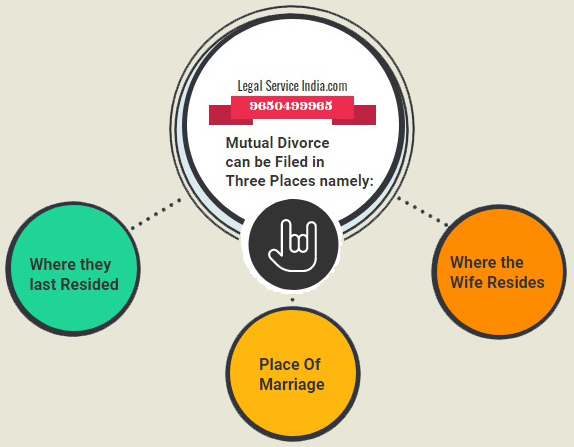
The Jurisdiction of Filing Mutual Divorce Petition are:
Facts To Know before filing Mutual Consent Divorce:
- One year separation period Must before Filing The petition and two years in case of Christians.
-
The couple can Submit a Joint petition For mutual Divorce in
the family Court or District Court where:
i. Where they Last Resided
ii. Where the marriage took Place
iii. Where the Wife Resides
iv. The entire Process takes 6 Months.
v. Couple can extend the period of second motion till upto 18 months
vi. This period can be Shortened to within 3 months by Filing a separate application to waive off Cooling period of Six months. (This entire Depends on the Discretionary powers of the Judge)
Documents Required to File a Mutual Consent Divorce:
- Proof of Address of Both parties i.e. Aadhaar Card/Passport/Electricity Bill/Ration Card (either one of them)
- Marriage Certificate
- Wedding Card
- Marriage Photograph
- Passport 4 Passport size Photographs
This is an exhaustive list and depends on the grounds of filing
the divorce petition.
Procedure to File Mutual Consent Divorce Petition:
Petition to file for Mutual divorce:
The First step is to File a Joint petition in the family Court/District Court in
the Correct Jurisdiction mentioned in the Graph given above. the petition should
contain that both are unable to live together and have mutually agreed to
dissolve the marriage and that they have been living seperately for a period of
one year or more. the petition is to be duly signed by Both parties.
First Motion:
After the petition is filed and accepted by the Court a date for First motion is
give (in some places same day of Filing)
Respective lawyer will present the Mutual petition before the Hon'ble judge.
After Critically examining the documents and the petition presented in the
court. The Hon'ble judge may upon being satisfied direct the court to record the
statements of parties, then the parties have to both sign and give thumb
impression in the petition (party's statements to be recorded on oath) and
submit it before the Judge. The Court will than grant the first motion.
Cooling-Off Period
After the Completion of First motion a Cooling period of six months is given,
before the Second motion can be filed.
This period is given to the couple to reconsider their descision. If they aggree
upon to co-habit, give each other a chance, the couple may appeal before the
court to cancel the mutual Divorce petition, which the court will happily do so.
Second Motion:
After six months of the first motion or at the end of the reconcile period/colling
off period If both parties still don't agree to live together and desires to go
for second motion. they may file for second motion between a time frame of six
to eighteen Months.
The second Motion also known as Final hearing of a Mutual Consent Divorce
includes parties having to appear and record their statements before the Family
Court.
Judge Grants Decree of Divorce:
Finally before Granting Divorce Decree the hon'ble court will satisfy itself
that both parties have settled matters related to alimony, custody of a child,
maintenance, property, and such other things amicably and that there remains no
disagreements between the parties. the court will finally grant a Divorce
Decree.
Mutual Divorce is Non-Appeal able:
Once the Court Grants a Divorce Decree in Mutual Consent it cannot be Challenged
nor can you file for appeal in Higher Court Challenging the Decree at a later
date, It is the Final Order and nothing can change it. This is Because Mutual
Divorce is a Consenting Decree of Divorce.
Family Courts in Delhi have significantly streamlined the process of Mutual Consent Divorce,
making it faster, more practical, and less stressful for couples seeking an amicable separation.
The following updates reflect current judicial practice.
Courts are now routinely waiving the mandatory six-month cooling-off period where the parties
have lived separately for over one year, all disputes relating to alimony, child custody, and
property are fully settled, and there is no possibility of reconciliation. In such cases,
divorce decrees are often granted within 30 to 90 days.
Delhi Family Courts increasingly permit the first motion and second motion to be taken up
together. Where consent is clear and settlement terms are complete, divorce decrees may be
granted on the same day or within a few weeks.
Parties residing outside Delhi, including NRIs, are frequently allowed to appear through
video conferencing. Physical presence of one spouse may be waived upon court approval,
reducing travel, cost, and inconvenience.
Courts have clarified that "living separately" does not necessarily mean living in different
houses. Even if spouses reside under the same roof but have no marital relationship, the
requirement of separation is considered fulfilled.
Where settlement terms are recorded during the first motion and obligations such as alimony
or return of streedhan are completed or secured, courts are fast-tracking final divorce decrees
without insisting on mechanical timelines.
Courts actively encourage mutual consent divorce over prolonged contested litigation,
recognising mental peace, dignity, and individual autonomy as important considerations in
matrimonial disputes.
Mutual Consent Divorce has emerged as the most efficient, peaceful, and legally preferred
method of dissolving a marriage in Delhi and NCR.
Latest Legal Updates on Mutual Consent Divorce in Delhi (2024-2025)
Waiver of Six-Month Cooling-Off Period
Same-Day or Expedited Divorce Orders
Video Conferencing and Virtual Appearances
Practical Interpretation of One-Year Separation
No Rigid Waiting for Second Motion Where Settlement Is Final
Judicial Preference for Mutual Divorce
Practical Impact for Couples in Delhi & NCR
Mutual Consent Divorce
- To File Mutual Consent Divorce in Delhi and NCR
Contact Adv.Tapan Choudhury at Ph no: 9650499965 (Available in Whatsapp)
- To File Mutual Consent Divorce in Pune
Contact NirDita Law Firm at Ph no: 8851978611 (Available in Whatsapp)
Law Article in India
Lawyers in India - Search By City

Popular Articles
How To File For Mutual Divorce In Delhi
How To File For Mutual Divorce In Delhi Mutual Consent Divorce is the Simplest Way to Obtain a D...
Increased Age For Girls Marriage
It is hoped that the Prohibition of Child Marriage (Amendment) Bill, 2021, which intends to inc...
Facade of Social Media
One may very easily get absorbed in the lives of others as one scrolls through a Facebook news ...
Section 482 CrPc - Quashing Of FIR: Guid...
The Inherent power under Section 482 in The Code Of Criminal Procedure, 1973 (37th Chapter of t...


Home | Lawyers | Events | Editorial Team | Privacy Policy | Terms of Use | Law Books | RSS Feeds | Contact Us
Legal Service India.com is Copyrighted under the Registrar of Copyright Act (Govt of India) © 2000-2026
ISBN No: 978-81-928510-0-6
Please Drop Your Comments