|
Grounds of Divorce in IndiaThere are in all 11 grounds for divorce apart for an additional 5 more grounds exclusively for wife. |
Divorce Lawyers in DelhiPh no: +9650499965 |
|
|
Grounds of Divorce in IndiaThere are in all 11 grounds for divorce apart for an additional 5 more grounds exclusively for wife. |
Divorce Lawyers in DelhiPh no: +9650499965 |
We Help You File Transfer of Petition in Supreme Court.
Call Ph no 9873628941 or Email: [email protected]
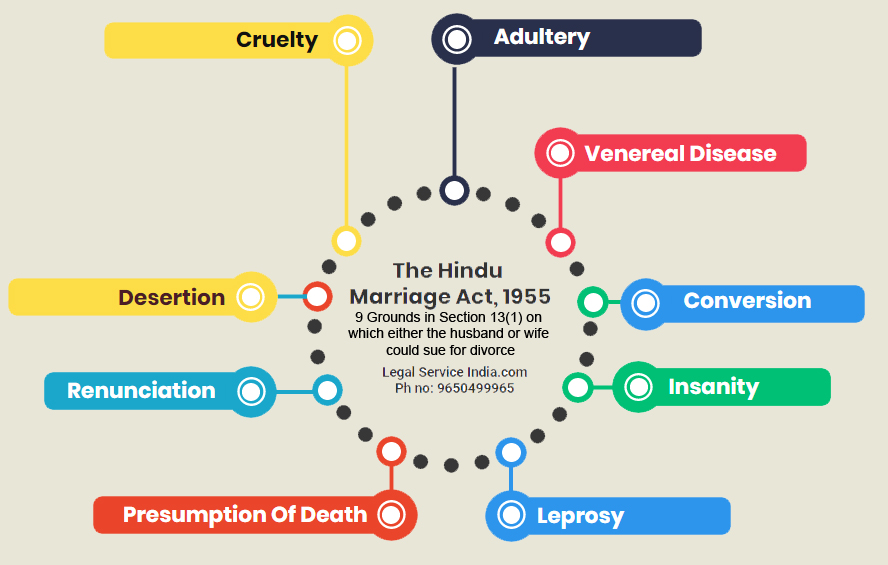
Listed Below are the Nine Grounds of Divorce |
|
AdulteryEither party to the marriage may present a petition for divorce under cl. (i) of sub-sec. (1) of s. 13, on the ground of adultery of the respondent. The expression living in adultery used in old s. 13(I)(i) meant a continuous course of adulterous life as distinguished from one or two lapses from virtue. It would not be in consonance with the intention of the Legislature to put too narrow and too circumscribed a construction upon the words 'is living' in (old) cl. (i) of sub-sec. (1) of s. 13 of the Act. On the other hand, it was clear that too loose a construction must also not be put on these words.For attracting the operation of these words, it would not be enough if the spouse was living in adultery sometime in the past, but had seceded from such life for an appreciable duration extending to the filing of the petition. It is not possible to lay down a hard and fast rule about it since the decision of each case must depend upon its own merits and turn upon its own circumstances. But it is clear that for invoking the application of (old) cl. (i) of sub-sec. (1) of s. 13, it must be shown that the period during, which the spouse was living an adulterous life was so related from the point of proximity of time, to the filing of the petition that it could be reasonably inferred that the petitioner had a fair ground to believe that, when the petition was filed, the respondent was living in adultery. By using the words 'is living in adultery' the Legislature did not intend to make such living co-extensive with the filing of the petition. The identical expression of 'living in adultery' is to be found in s. 488(4) the Code of Criminal Procedure (old) and in s. 125(4) of the Code of Criminal Procedure (new). This expression implies that a single lapse from virtue even if true will not suffice, and it must be shown that the respondent was actually living in adultery with someone else at the time of the application. Living in adultery is different from failing to lead a chaste life.
CrueltyAfter the Marriage Laws (Amendment) Act 1976, cruelty has been made a ground for divorce as well as judicial separation. Prior to that amendment it was only a ground for judicial separation and not for divorce.Mental cruelty in s.13(l)(ia) can be broadly defined as the conduct which inflicts upon the other party such mental pain and suffering as would make it not possible for that party to live with the other. In other words, mental cruelty must be of such a nature that the parties cannot reasonably be expected to live together. The situation must be such that the wronged party cannot reasonably be asked to put up with the other party. It is not necessary to prove that the mental cruelty is such as to cause injury to the health of the petitioner. While arriving at such conclusion, regard must be had to the social status, educational level of the parties, the society they move in, the possibility or otherwise of the parties ever living together in case they are already living apart and all other relevant facts and circumstances. What is cruelty in one case may not amount to cruelty in another case.14 In that case allegations were made by the wife in her written statement and question put by her counsel to her husband that he and all the members of his family were lunatic etc. All these constitute mental cruelty. In the absence of a positive act of cruelty a party is not entitled to obtain a decree of divorce. DesertionDesertion as a ground for divorce has been added to s.13 by the Marriage Laws (Amendment) Act 1976. Previously, it was only a ground for judicial separation. Now desertion is a ground for both judicial separation and divorce.New Phenomenon of NRI Related DesertionMany non-resident Indians (NRI) come to India to marry girls who are also aspirants to migrate from India by this marriage relation. It is often seen that some NRIs marry local girls, enjoy them and return to the foreign countries with vague hopes behind that their wives would be taken after completion of official formalities. But all those hopes are never materialized. Sometimes they receive papers in India in the form of foreign divorce decree. In the Punjab it is said that the NRI matrimonial frauds account for at least one-fifth of women related complaints to the Punjab State Women's Commission.To check this menace the Centre should make laws that any marriage between an Indian bride and an NRI solemnized in India cannot be dissolved by any foreign court without application of the law under which they are married. There should also be law for cancellation of their passports where NRIs are found to be perpetrators of such frauds. ConversionA Hindu marriage may be dissolved by a decree of divorce on the ground that the respondent has ceased to be a Hindu by conversion to another religion. According to ancient Hindu Law a marriage was not ipso facto dissolved by conversion of one of the parties to the marriage. Thus the statement of objects and reasons of the Bill laid down that a change in religion was not inconsistent with the continuance of conjugal love and it should therefore not be permissible for a party to the marriage to get a divorce by changing his or her religion. The right to get a divorce under this law is therefore given to the party who continued to be Hindu.A somewhat similar right is given to a person changing his religion for Christianity under the Native Convert's Marriage Dissolution Act 1866.Though s. 13(1)(ii) confers expressly right on a spouse to present a petition for divorce against the other spouse who has changed his or her religion after the solemnization of marriage, but the apostate can also file a petition for dissolution of marriage after he or she has ceased to be a Hindu under the Hindu Marriage Act provided he or she is able to establish the ground for it. Mere professing or theoretical allegiance to a religion other than a Hindu religion does not mean conversion for the purpose of this provision. There must be voluntary relinquishment of Hindu religion by the respondent and formal ceremonial conversion to another religion so as to attract this provision for the purpose of divorce. Unsoundness of mindPrior to the Marriage Laws (Amendment) Act 1976, a petition for divorce might be presented by a spouse on the ground (a) that the respondent had been incurably of unsound mind, and (b) that the respondent had been so for a continuous period of not less than three years immediately before the filing of the petition. By the Marriage Laws (Amendment) Act 1976, the period of duration of unsoundness of mind has been omitted and elaborative clarifications have been made.The expression 'incurably of unsound mind' cannot be so widely interpreted as to cover feeble-minded person or persons of dull intellect who understand the nature and consequences of their acts and are able, therefore, to control themselves and their affairs and their reactions in the normal way. Where this ground is taken for dissolution of marriage, the said ground must be proved by cogent and clear evidence beyond reasonable doubt so as to satisfy the court. Eccentricities do not constitute psychopathic disorder or any other kind of mental disorder. It is not yet settled by medical science whether schizophrenia is curable disease or not. But paranoid schizophrenia has been held to be indicative of unsoundness of mind. After the amendment of s.13 by the Marriage Laws (Amendment) Act 1976, the expression 'mental disorder' includes schizophrenia. Unsoundness of mind is now a ground for both divorce and judicial separation without any distinction. For attracting s. l3(1)(iii) either of the two conditions is to be fulfilled. First, the respondent has been incurably of unsound mind. Secondly, the respondent has been suffering continuously or intermittently from mental disorder of such a kind and to such an extent that the petitioner cannot reasonably by expected to live with the respondent. So far as the second condition is concerned, the petitioner will have to prove two elements, namely, mental disorder and at the same time that the disease must be of such a kind and to such an extent that the petitioner cannot reasonably be expected to live with the respondent. So, proof of one element is insufficient to grant a decree.2 In case of schizophrenia as a mental disorder it is not necessary to show that it existed at or before the marriage for divorce. The context in which the ideas of unsoundness of "mind" and "mental disorder" occur in the section as grounds for divorce require the assessment of the degree of the "mental disorder". Its degree must be such as that the aggrieved Spouse cannot be reasonably expected to live with the other. All mental abnormalities are not recognized as grounds for grant of decree. "Schizophrenia" is said to be difficult mental affliction. It is said to be insidious in its onset and has hereditary predisposing factor. It is characterized by the shallowness of emotions and is marked by a detachment from reality. It is a varying degrees and manifestations. Not all schizophrenics are characterized by the same intensity of the disease. The mere branding of a person as schizophrenic will not suffice. For purposes of s. 13(l)(iii) "schizophrenia" is what schizophrenia does. Thus, the appeal by the husband for divorce on the ground of schizophrenia of the wife could not succeed. Over sensitiveness of the mind or character cannot be equated with insanity or automatism. Epileptic insanity is a sign of unsoundness of mind. When the wife intelligibly answers the query of the court, it cannot be said that she suffers from any mental disorder. SchizophreniaThe word "schizophrenia" is derived from Greek word which means "split mind". The sufferers do not in fact have any "split personality". Generally they undergo a gradual or sudden breaking down of the barriers between fantasy and reality. The thoughts of such sufferer are muddled and distorted. In some cases he suffers hallucination. A schizophrenic's delusions often lead him to believe that he is being persecuted. Many sufferers sleep a great deal and neglect their appearance in public.They develop odd and obsessive habits. No one knows the real cause of schizophrenia. Many researchers believe that there is a genetic component. A person with a family history of schizophrenia is susceptible to it. It is common in the age group of 15-30 years. Thereafter women sufferers are a little higher than the male sufferers. In India it is estimated that there are nine million sufferers of this disease. But it is found that about one-third of such sufferers recover fully; another one-third are able to lead near normal lives with the help of anti-psychotic drugs in tablets or injection form. Most of the remainder can lead ordinary lives only with medication and occasional hospitalization. The symptoms of this illness were recognized by Indian doctors about 2,000 years ago. Virulent and incurable leprosyA petition for divorce may be presented by either party to the marriage on the ground that the respondent has been suffering from a virulent and incurable leprosy. Old cl. (iv) of s. 13(1) did not require that before such a petition was presented the marriage existed for more than three years and that it was only then it was possible for anyone of the spouses to file an application for dissolution of marriage on that ground.? Virulent means malignant or venomous.8The onus to prove the ingredients of cl. (iv) of s. 13(1) is on the petitioner. When it is not disputed that the respondent has been suffering from leprosy, the onus is on the petitioner to establish that the leprosy is virulent and incurable. 'Virulent' in the context of s. 13(I)(iv) is not a medical term The decisions of the different High Courts and the Privy Council where the word 'virulent' has been used for interpreting the Hindu Law on the subject have used it to describe the leprosy of the most serious and aggravated type. This does not therefore give sure and reliable guide in interpreting the word 'virulent'. The dictionary meaning of the word 'virulent' is malignant and infectious. Lepromatus leprosy is a malignant, contagious and incurable form of disease. If it be true that suI phone drugs have m"ade leprosy of all types curable, there would be no point in the Legislature making a provision in this Act which will entitle a spouse to a decree of divorce. A spouse cannot be compelled to live with the other spouse who is suffering from an aggravated form of leprosy and who can give the petitioner and children leprosy almost any moment in their daily life. Thus the Legislature by a statute has given an aggrieved spouse a way of relief. Venereal disease in communicable formVenereal disease in a communicable form is a ground for obtaining a decree for dissolution of marriage. This ground affords also a ground for obtaining a decree for judicial separation. Syphilis, gonorrhea or soft chancre are recognized as venereal diseases under the (English) Venereal Diseases Act 1917.Entering new religious orderA decree for divorce may be obtained on a petition presented by a spouse on the ground that the respondent has renounced the world by entering any religious order. This clause consists of two components. First, the respondent must have renounced the worldly affairs, and secondly, the respondent has thereafter entered into a religious order recognized by Hindu religion. Such entry requires some ceremonial performance or observance of certain formalities.Renouncement of the world by entering any religious order must be absolute. It amounts to civil death and has the effect of excluding a person from inheritance and right to partition. But persons merely wearing saffron-coloured clothes know as sadhus or bairagis and who enjoy a married life cannot be said to have renounced the world and entered a religious order. Similarly, the mere holding by a man of certain religious opinions or professions does not amount to civil death. Presumption of deathA divorce may be granted on the ground that the respondent has not been heard of as being alive for a period of seven years or more by those persons who would naturally have heard of it, had that party been alive. This is a legal presumption of death which is based on English law of evidence.The presumption is drawn by reason of the fact that if the person were living, the person would probably have communicated with some of his or her friends and relatives. The legal presumption is different from presumption under ancient Hindu law, according to which twelve years must have elapsed before a person was presumed to be dead. This presumption under the provision of law is not rigid and death may even be presumed before lapse of seven years from proof of special circumstances. This presumption may also be rebutted where a person is not heard of for a period of seven years by reason of special circumstances, such as absconding on a charge of murder. A decree nisi will be resounded where the respondent is proved to be alive before the decree made absolute. The onus of proving the absence of the respondent for the statutory period without being heard of as alive lies on the petitioner. The standard of proof for this purpose is laid down in s. 23 of the Act. The petitioner is required to give particulars relating to the last date of cohabitation, the date and place last seen the respondent and steps taken to trace the respondent. Evidence as to reasonable inquiry or search about the respondent is necessary to be adduced by the petitioner. But the onus of proving that the respondent is alive lies on the person who pleads so. Non-compliance with a decree of judicial separationBy sub-sec. (IA) of s.13 either spouse may present a petition for divorce on the ground that there has not been any resumption of cohabitation of the parties to the marriage for a period not less than one year after the passing of a decree for judicial separation. Resumption of cohabitation means living together in conjugal relationship. But this means is narrow and as such it should not be applied to all cases irrespective of their special and surrounding circumstances.The meaning of this expression therefore depends upon the intention of the parties, and there may be resumption of cohabitation even where the parties do not live under the same roof of matrimonial home. f there is sexual intercourse of the parties to the marriage, it is no doubt a good ground to presume the resumption of cohabitation, but that is not the conclusive evidence for this purpose. The birth of a child from an isolated act of sexual intercourse does not mean resumption of cohabitation. There may be resumption of cohabitation without having sexual intercourse. The court will grant a decree for divorce on the ground provided in sub� sec. (1A) of s.13 in the absence of any bar laid down in s. 23 of the Act. In a proceeding for divorce, a decree of judicial separation cannot be challenged on the ground of lack of jurisdiction of the court in the previous proceedings. The statutory period of one year (previously two years) laid down in this provision will be operative from the date of the judgment of the District Court and with the lapse of this period the High Court in Letters Patent appeal may pass a decree for divorce under s. 13( 1 A) of the Act. But where a decree for judicial separation is passed by the High Court in appeal, period of one year (previously two years) will commence from the date of the decree in appeal But where an appeal is preferred against the decree and the decree confirmed by dismissing the appeal, the period of one year (previously two years) will run from the date of the original decree. Non-compliance with a decree of restitution of conjugal rightsUnder cl (ii) of sub-sec. (1A) of s. 13 either party to the marriage may present a petition for divorce on the ground that there has been no resumption of conjugal rights for a period of not less than one year after the passing of a decree to that effect. The court before granting a decree for divorce on this ground may be satisfied that the petitioner is not disentitled to this right by reason of any bar laid down in s. 23 of the Act.After a decree for restitution of conjugal rights obtained by the wife under s.9 of the Act the husband is not entitled to the relief under s. 13( lA) of the Act if he fails to comply with the decree and also acts positively by ill-treating her and driving her away from the house.19 There are, however, conflicting decisions on the question of application of s. 23(1 )(a) of the Act. The Punjab High Court, the Mysore High Court and the Bombay High Court' were of the opinion that the petitioner in divorce proceedings cannot take the advantage of his or her own wrong for the purpose of this relief by non-compliance with the decree of restitution of conjugal rights. But the FuIl Bench of the Delhi High Court is of the opinion that non-compliance with the decree for restitution of conjugal rights by the husband would not constitute wrong within the meaning of s. 23(1)(a) of the Act. A reconciliation between these two sets of conflicting decisions has been suggested in an article3 that the equation of the judgment-debtor and the decree-holder for making a petition under this provision has no bearing on the conduct of either party after the decree is passed. But the court in divorce proceedings may consider the condiJct of the parties not considered in the proceedings leading to the decree. It is submitted that the plain wordings of s. 13(1A) have made no distinction between the parties to the marriage and hence any contrary holding would impute super added idea in the intention of the Legislature making the amendment for insertion of sub-sec. (1A) of s. 13 of the Act. Further, where the language is plain and simple without any ambiguity, s. 13(1)(a) should not restrict and control the application of s. 13(1A) of the Act. In a case where a consent decree for restitution of conjugal rights was passed, it would form the basis for divorce for non-compliance. It is to be noted that if a decree for restitution of conjugal rights is complied with, there is no scope for a petition of divorce. AIl the controversies on this issue have come to rest on the decision of Saroj Rani v Sudarshan Kumar, where it has been held that after a decree for restitution of conjugal rights the husband is entitled for a decree of divorce under s. 13 of the Act and his failure to resume cohabitation would not amount to wrong within the meaning of s. 23(1 )(a) of the Act. But where the husband has obtained a decree for restitution of conjugal rights, only for the purpose of seeking a divorce under s. 13(1 A)(ii) of the Act and preventing the wife from performing her conjugal duties by driving her away from the house, this constituted misconduct under s. 23(1)(a) of the Act as the husband was taking advantage of his own wrong and hence he was not entitled to any relief under s. 13(1A) of the Act.6a The expression the passing of a decree would mean the passing of a judgment.
|
 |
File Your Mutual Divorce - |
|
Related Articles
|
|
 |
100% MONEY-BACK GUARANTEE!! We GUARANTEE that Mutual Divorce petition will be accepted & a Decree passed by the competent court or we refund 100% of your money.
File Your Mutual Divorce - |
|
|
About Us |
Irretrievable Breakdown of Marriage |
Annulment of Marriage |
Family Laws |
Lawyers |
Legal Article |
Sitemap |
Contact Us
Legal Service India.com is Copyrighted under the Registrar of Copyright Act ( Govt
of India) � 2000-2025
ISBN No: 978-81-928510-0-6