
Considering the importance of user interface in a software program, the issue of providing legal protection for user interfaces through the law of intellectual property rights has become critical in the greater discourse on the protection of software programs. This project examines in the detail the protection extended to user interfaces through the means of copyright laws.
1. Graphical user interface (GUI) and Menu Command Hierarchy: A Primer:
The term graphical user interface (GUI) is used to describe the user interface of most modern operating systems. A GUI is a method of interacting with a computer through a metaphor of direct manipulation of graphical images and widgets such as windows, menus, radio buttons, check boxes, and icons in addition to text and employs a pointing device (such as a mouse, trackball, or touch screen) in addition to a keyboard. The GUI is based on the famous What you see is what you get (WYSIWYG) principle of modern computing Examples of systems that support GUIs are Mac OS and Microsoft Windows. The following screenshots show the graphical user interfaces of these popular operating systems:
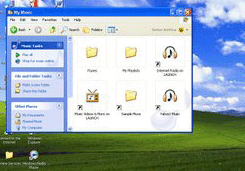
An example of graphical user interface in Windows XP
1.1 The Components of GUI
Several industry experts refer to GUIs as WIMPs which stands for Windows, Icons, Menus, Pointer. Graphical user interfaces feature the following basic components:# Pointer: A symbol that appears on the display screen and that you move to select objects and commands. Usually, the pointer appears as a small angled arrow. Text -processing applications, however, use an I-beam pointer that is shaped like a capital I.
# Pointing device: A device, such as a mouse or trackball that enables you to select objects on the display screen.
# Icons: Small pictures that represent commands, files, or windows. By moving the pointer to the icon and pressing a mouse button, you can execute a command or convert the icon into a window. You can also move the icons around the display screen as if they were real objects on your desk.
# Desktop: The area on the display screen where icons are grouped is often referred to as the desktop because the icons are intended to represent real objects on a real desktop.
# Windows: You can divide the screen into different areas. In each window, you can run a different program or display a different file. You can move windows around the display screen, and change their shape and size at will.
# Menus: Most graphical user interfaces let you execute commands by selecting a choice from a menu.
1.2 The Evolution of GUI
The precursor to GUIs was invented by researchers at the Stanford Research Institute (led by Doug Engelbart) with the development and use of text-based hyperlinks manipulated with a mouse for the On-Line System.Researchers at Xerox Corporation's Palo Alto Research Center in the 1970s further refined the concept of hyperlinks and extended it to graphics and used GUIs as the primary interface for the Xerox Alto computer. Most modern general-purpose GUIs are derived from this system. For this reason some people call this class of interface a PARC User Interface (PUI) (note that PUI is also an acronym for perceptual user interface).
The emergence of the Apple Macintosh with its easy to use graphical user interfaces made GUI’s popular and soon the GUI evolved into a standard component in software products in the information technology industry as all industry leaders like Microsoft Atari, Three Rivers Computer Corporation, Digital Research and Lotus introduced GUI based products (the major exception being IBM which was slow in adapting GUI as part of its software products).
The ease of use provided by GUIs and the rapid advancements in computing technology and a rapid decline in the cost of hardware that supports GUIs has meant that that GUIs base products dominate the software markets across the globe. Today well over 90% of the world’s users employ one GUI-faced OS or another and all leading platforms like the Mac OS X, the Windows XP and Linux OS use graphics bases user interfaces as the primary mean of access.
In the early 90’s Microsoft took the next big leap in GUI revolution by adding multimedia components like sound , animation and video to the GUI environments. In the years to come GUI will evolve further to include virtial reality components (3D technology) and other features that would make GUI’s even more user-friendly like voice recognition, touch screens, retinal and fingerprint scans for security and holographic representations. GUI is no longer confined to just computers but is being adapted to a variety of new age gadgets like mobile phones, hand-held personal digital assistants (PDA’s), MP3 players, gaming machines and digital cameras. It is almost axiomatic to state that in the years to come the role of the GUI environment would be central to computing technology efforts in improving user experience and increase the spread of the digital revolution across the globe.
1.3 Menu Command Hierarchy
Menu Command hierarchy is a fundamental component of the user interface. It is the structure and placement of commands on menus within a program. Essentially it is the selection or arrangement of commands within a particular software program.Copyright Protection for Graphical User Interface and Menu Command Hierarchy:
Copyright Protection for Graphical User Interface and Menu Command Hierarchy has one of the central issues in the discourse on copyright protection for software programs. Since the time, software programs have been brought within the ambit of copyright protection; literal infringement of copyrighted programs has been a relatively straightforward issue that has been easy to deal with. However, protection of ‘non-literal elements’ of a program like user interfaces has been much more complicated and controversial. Courts have held that the literal elements of a computer program may be copyrighted, as can the no literal elements, but that a copyright in the no literal elements may only be obtained if they contain original expression.The application of ‘non-literal' copyright protection has been the focus of a heated debate within the software industry and the academia. Several commentators have argued that reluctance by courts to grant any kind of intellectual property protection for graphical user interfaces has been counterproductive to consumers and to the software industry. Consequently, there have been no real developments since 1984, when the first graphical software program was introduced and until a consistent and reliable method of protecting graphical user interfaces is applied by courts (to spark competition and in turn, to promote technological progress,) computer users, for the most part, would relegated to the uniformity of GUI designs without major innovations. Professor Arthur R. Miller who supports protection for the user has argued that "a computer program's user interface design is extremely resource-intensive, and a well-composed user interface is frequently the precise feature that renders a computer program successful. Promoting the unauthorized copying of interfaces penalizes the creative effort of the original designer, something that runs directly counter to the core purposes of copyright law because it may freeze or substantially impede human innovation and technological growth".
Further, from a legal perspective, a user interface is an is an audiovisual work that may contain a screen display which often contains sufficient expression in its selection and arrangement, as well as in the individual elements, to warrant copyright protection. Also, an audiovisual work may be protected as a compilation if there is a sufficient amount of originality in the selection and arrangement of the individual elements contained in the work.
On the other hand, several commentators like Gerard J. Lewis, Jr have argued that at the user interface level, standardization is critical for the widespread adoption of new computer programs and the operating systems that run them. Standardization permits the transfer of computer files among users and across different programs and reduces training costs. Standardization also meets the needs of users who want to rely on a common user interface without having to learn and unlearn incompatible programs.
Also, they argue that there is no need to provide further incentives to the software industry as the rapid developments in the past indicate the lack of copyright protection does not hinder the progress of the industry and more importantly interface copyright will actually retard progress, as interface development is evolutionary in nature. For example the Macintosh interface was based on ideas tried previously by Xerox and SRI, and before that by the Stanford Artificial Intelligence Laboratory.
Proof of Infringement of User Interfaces
In Computer Associates International, Inc. v. Altai , Inc, the court developed the test for infringment of non-literal elements of a program by another known abstraction-filtration-comparison test. In this test. two programs are separated by their levels of abstraction, any expression which was not protectable by copyright is fitlered or excluded and then the similarities in the remaining elements of the two programs are compared for coyright infringement.The courts have applied the abstraction-filtration-comparison test in several leading cases like Engineering Dynamics v. Structural Software to determine the infringement of user interfaces. However in Lotus v. Borland International, while deciding on the question of copyright infringement of Menu Command hierarchy, the court refused to apply the abstraction-filtration-comparison test on the grounds that the question before the court was whether the Menu Command hierarchy as whole was copyrightable or not (and not dealing with specific elements).
Land Mark Judicial Decisions Regarding the Copyright Protection of User Interfaces and Menu Command Hierarchy:
Apple Computer v. Microsoft Corp.
In Apple Computer v. Microsoft , the court found that Microsoft's Windows 2.03 and 3.0 did not infringe Apple's graphical user interface, because a license given to Microsoft by Apple made it unnecessary for the court to determine whether Apple's user interface should receive copyright protection.The Apple case involved a graphical user interface that allowed a user to easily communicate with Apple's Lisa and Macintosh computers. This graphical user interface was based on a desktop metaphor including icons, pull-down menus, and windows for viewing various items at the same time. The user could interact with these elements using a device called a mouse. Apple filed a claim for copyright infringement of its graphical user interface when Microsoft released Windows 1.0; an operating system which Apple alleged was substantially similar to Apple's graphical user interface.
In 1985, shortly after Apple complained, the parties agreed to a license giving Microsoft the right to use and sublicense derivative works based on Windows 1.0. The dispute seemed to be settled, as an infringement claim cannot be based on licensed similarities.
However, when Microsoft released Windows 2.03 and 3.0, Apple filed a claim alleging the new versions exceeded the scope of the license and infringed its copyright on the graphical user interface of its Lisa and Macintosh computers.
The court found Microsoft's visual displays were an authorized use, rather than an infringement. The court interpreted the term "derivative works" in the license agreement to mean that Windows 1.0 was a derivative work of Apple's Lisa and Macintosh graphical user interfaces. Consequently, the derivative works in the license agreement were the visual displays and not the graphical user interface itself. Therefore, the license permitted Microsoft to create derivative works based on the visual displays rather than the Windows 1.0 interface. This allowed Microsoft to create a graphical user interface with greater similarity to the user interface of the Lisa and Macintosh.
The court further held that since the vast portion of the user interface i.e. the visual display, was not capable of constituting copied material, therefore there was no copyright infringement.
Although the court did not find that Microsoft's graphical user interface infringed Apple's interface, it is submitted that the decision does not stand for the proposition that graphical user interfaces cannot receive copyright protection.
3.2 Engineering Dynamics v. Structural Software
The court in Engineering Dynamics v. Structural Software held that a computer program user interface, in the form of input and output formats, was copyrightable. Engineering Dynamics developed a computer program called SACS IV, which was designed to solve structural engineering problems. The input formats, which contained this information, were entered into the computer through the use of decks of eighty column keypunch cards Structural Software developed its own structural analysis program called StruCAD. Structural Software borrowed heavily from SACS's user interface, basing it on an eighty column format. Engineering Dynamics brought a claim against Structural Software alleging that the sequence and organization of its input and output formats were copyrightable and that Structural Software copied fifty-six of its input formats.The Fifth Circuit determined that the non-literal elements of a computer program, such as structure, sequence, and organization, might receive copyright protection. The next question the court addressed was whether Structural Software copied Engineering Dynamics' input and output formats.
To answer this question the court adopted the abstraction-filtration-comparison test. In the abstraction portion of the analysis, the court dissected the user interface into varying levels of generality to aid in distilling the protectable elements from those, which were merely ideas, methods of operation, and other unprotect able elements.
The court " stated that abstraction of ideas from expression [did] not pose a particular conceptual hurdle in this case for three reasons." First, the input and output formats were analytically distinct from the remaining components of the SACS program. Second, [Engineering Dynamics] claimed protection of input and output formats not individually but en masse." The court found that since Engineering Dynamics sought protection for the formats as a whole, there was no need to determine whether each individual component was an expression or an un-protectable idea. In the filtration portion of the analysis, the court sought to isolate non-copyrightable elements from each level of the user interface. After applying the various copyright limitation doctrines to the remaining elements at each level of generality, the court determined that the only potential area of un-protectability was the impact of the scenes a faire doctrine.
The court then remanded the case to the district court to complete the filtration analysis and compare the remaining elements of Engineering Dynamics' user interface to decide if the interfaces were substantially similar. Thus, the court found that user interfaces, even input and output formats such as SACS that bear only the slightest bit of expression, are copyrightable.
Lotus Development Corp. v. Paperback Software International
The scope of user interface copyright reached its maximum breadth in Lotus Development Corp. v. Paperback Software International . The plaintiff's spreadsheet i.e. Lotus 1-2-3 was written in 1982. At roughly the same time that the developers of Lotus 1-2-3 were creating the initial version of that spreadsheet, an independent software developer began to develop his own electronic spreadsheet. This spreadsheet eventually became the defendant's VP-Planner program. As the developer of VP-Planner continued to improve his program before its release, Paperback decided that the only way to compete effectively against the growing commercial success of Lotus 1-2-3 was to make VP-Planner "compatible" with 1-2-3 by ensuring that the arrangement and names of commands and menus in VP-Planner were identical to those in 1-2- 3. VP-Planner was introduced in 1985.Lotus filed suit against Paperback Software for infringement of its user interface by VP-Planner of its copyrighted 1-2-3 program at the beginning of 1987.The court rejected Paperback's standardization arguments on two grounds. First, the court viewed its own role as one limited to enforcing the mandates of legislation and resolving unanswered questions in a manner consistent with legislative policy. On a fundamental level, the court refused to engage in "lawmaking" by adopting Paperback's policy arguments as the basis for its decision. The court simply read Paperback's standardization arguments as inconsistent with Congress' intent in passing the Copyright Act. Second, and most importantly, the court specifically rejected Paperback's incremental innovations and de facto industry standard arguments.
The court held that held that the Menu Command hierarchy of Lotus 1-2-3 constituted copyrightable subject matter and that Paperback's VP-Planner program infringed the Lotus 1-2-3 user interface. The court relied primarily on the idea-expression distinction in copyright law to reach this conclusion. According to the court the mere idea of an electronic spreadsheet was not copyrightable. However, the court noted that the general idea of an electronic spreadsheet could manifest itself through a variety of expressions. If those expressions are found not to be essential to an electronic spreadsheet, the court then concluded, the expression would be copyrightable. The court examined the menu command system and determined that the particular system designed by Lotus was not essential to the electronic spreadsheet and was thus copyrightable.
Having found the menu command system to be a mode of expression, the court then determined the command structure of Lotus 1-2-3 constituted original expression because other electronic spreadsheet programs incorporate different command structures. Finally, the court determined that the Lotus 1- 2-3 user interface was a substantial portion of the program, accounting for the program's overall popularity. Because Paperback's program copied a substantial portion of Lotus 1-2-3, the district court concluded that Paperback Software was liable to Lotus for copyright infringement the user interface was an expression of an idea (the idea could be expressed in several different ways) and therefore, was entitled to copyright protection.
Lotus v. Borland International
The Lotus Development Corp. v. Borland International decision provides greater restrictions to copyright protection for user interfaces than any other case to date. It is also the only case involving copyright protection for user interfaces that the Supreme Court affirmed, although it was a four-to-four vote and no opinion was delivered.Lotus filed a claim for copyright infringement after Borland made "a virtually identical copy of the entire Lotus 1-2-3 menu" command hierarchy. The district court ruled that the Lotus menu command hierarchy was a copyrightable expression because "[a] very satisfactory spreadsheet menu tree [could] be constructed using different commands and a different command structure from those of Lotus 1-2-3."
On appeal, however, the First Circuit overruled the district court decision. The court applied a test that eliminated copyright protection for user interfaces. This test was inconsistent with established copyright principles. The Lotus court found that the menu hierarchy of a computer spreadsheet program was a method of operation and, therefore, could not receive copyright protection.
While deciding on the issue of copyright infringement, the court drew an analogy with VCRs. The court stated that regardless of the arrangement of the VCR buttons, they, like the commands in the menu command hierarchy, remained a way of operating the VCR. Similarly, the court reasoned that even if Lotus arranged the menu commands differently or chose different labels, the menu commands still represented a means to use the program. Determining that giving expressive names to menu commands did not turn an uncopyrightable method of operation into copyrightable subject matter, the court held that Borland did not infringe Lotus' copyright by incorporating an identical copy of Lotus' menu commands into its Quattro programs.
In its analysis, the court found that applying the abstraction-filtration-comparison test would be misleading because the initial question should be whether the menu command hierarchy could be copyrighted at all, and not whether individual elements may be copyrighted.
Next, the court went on to determine whether the Lotus menu command hierarchy was a method of operation. The Lotus court defined a "method of operation" as "the means by which a person operates something." In applying this definition the court found that the menu hierarchy was a method of operation, and thus, could not be protected. The court also found that the selection and arrangement could not be protected because it was also part of the method of operation.
However, the court acknowledged it was only deciding whether a particular aspect of the user interface, the menu hierarchy, could receive protection and not the user interface as a whole. It is submitted that this decision did not automatically bar protection for user interfaces, because the court was not deciding whether the interface, as a whole, was copyrightable.
The Lotus court also cited the need for computer compatibility as a reason for not protecting the menu hierarchy. The idea of a menu structure or a desktop interface, however, does not preclude others from developing another desktop interface or menu. In addition, a user could easily learn new commands or arrangements in very little time.
The court also stated that it is irrelevant whether the menu command hierarchy could be expressed in a number of different ways. However, the court then distinguished the menu command hierarchy from a computer program. The court reasoned that Borland could achieve the same capabilities as the Lotus 1-2-3 spreadsheet program without copying the program code, but the capabilities of the Lotus 1-2-3 menu command hierarchy could not be achieved without copying the entire hierarchy.
Conclusion:
There is great divide within the software industry, judiciary and academia on the issue of copyright protection for user interfaces and menu command hierarchy. While some have argued that copyright protection for user interfaces provides vital incentives for development of better products Other have highlighted the importance of standardization of software user interfaces which serves the interests of both software users and developers.
In this context it is pertinent to note that history of software development has indicated that with or without the copyright protection being extended to user interfaces, the growth in the software industry had been rapid and unhindered. Further, copyright protection can actually impede growth, as development of user interfaces has been evolutionary in nature with one developer borrowing from the earlier ideas of another and then improving user interfaces further.
The court rejected the standardization arguments in in Lotus Development Corp. v. Paperback Software International while granting copyright protection to the plaintiff. However considering the importance of standardization in any industry especially in a technologically related, the court rejection of standardization norms seems flawed. Therefore it is submitted that the court in Lotus Development Corp. v. Borland International was correct in recognizing the importance of inter-operability and standardization while denying the plaintiff copyright protection. Further, the court's reasoning that menu command hierarchy as 'method of operation' and thus not eligible for copyright protection is substantiated by industry practice.
To conclude, we can state that while user interfaces do deserve individual elements copyright protection when there is sufficient originality, the protection should not be extended to cases where it hinders standardization and inter-operability.
The author can be reached at: [email protected] / Print This Article
Related Articles
#
Copyright Protection on Reports of
Judicial Proceedings such as Head Notes and Commentaries of an Act
# Copyright Protection on historical book,
facts - Lecture - Letters
# To learn more about copyright laws here are a list of articles:
# Copyright Amendment Bill 2012:
Copyright Act 2012
1) Provisions for Persons with Disabilities 2) Extension of Fair Dealing
to All Works 3) Term of Copyright for Photographs has increased 4) Cover
Versions songs
#
The Copyright Act (Amendment) Bill, 2012 - artistes entitled to lifelong royalty
#
Intellectual Property and Traditional knowledge
#
Registration and filing of Copyrights in India:
Copyright, is a bundle of rights, which grants protection to the unique
expression of ideas. Ideas per se cannot be protected; it is the
expression of ideas in a material medium that is the subject matter of
copyright protection. Copyright is a negative right and the owner of a
copyright gets the right to prevent others from copying his work without
his consent towards a commercial end. However, at the same time it gives
to the author an exclusive right for the commercial exploitation of his
work.
#
The Rights protected by Copyright Law: Copyright law seeks to promote
human creativity and confers several rights on the copyright owner.
International agreements, among which the most important is the Berne
Convention, 1886
# Copyright Law in India:
Copyright is a form of intellectual property protection granted under Indian law
to the creators of original works of authorship such as literary works
(including computer programs, tables and compilations including computer
databases which may be expressed in words, codes, schemes or in any other form,
including a machine readable medium), dramatic, musical and artistic works,
cinematographic films and sound recordings, fees for copyright registration in
India.
# Copyright Infringement
through internet
Internet has become a breeding ground for violation of copyright. This mass
misuse require more stringent laws
# Here is a list of Important Copyright Judgments in India
# Copyrighting Photograph has become very complicated now NOC from the
photographed person is also required.
#
Challenges of Copyright And Cyber Space:
The main focus of this paper is to enlighten not only the academicians but also
the non tech savvy laymen to have first-hand information about the internet,
cyberspace and their linkage with Intellectual Property Rights especially
copyright.
How To Submit Your Article:
Follow the Procedure Below To Submit Your Articles

Submit your Article by using our online form
Click here
Note* we only accept Original Articles, we will not accept
Articles Already Published in other websites.
For Further Details Contact:
[email protected]
 Right Away Call us at Ph no: 9650499965
File Your Copyright - Right Now!
 Online Copyright Registration in India Call us at: 9891244487 / or email at: [email protected] |
Lawyers in India - Search By City |
|||
|
Delhi Chandigarh Allahabad Lucknow Noida Gurgaon Faridabad Jalandhar Vapi |
Mumbai Pune Nagpur Nashik Ahmedabad Surat Indore Agra Jalgaon |
Kolkata Siliguri Durgapur Janjgir Jaipur Ludhiana Dimapur Guwahati Amritsar |
Chennai Jamshedpur Hyderabad Coimbatore Eluru Belgaum Cochin Rajkot Jodhpur |