





Abstract
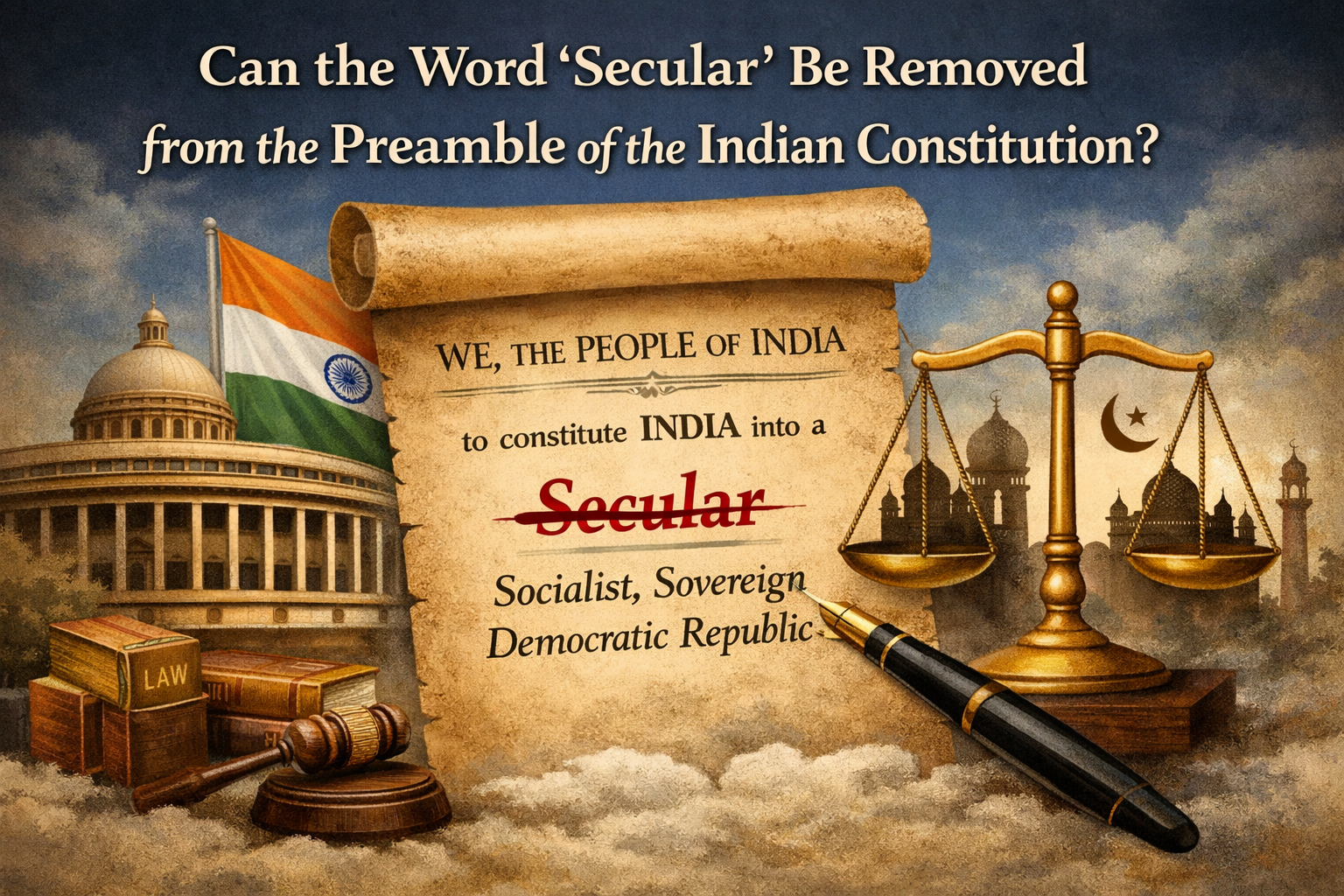
The insertion of the word “Secular” into the Preamble of the Indian Constitution by the Forty-Second Constitutional Amendment Act, 1976 continues to generate constitutional debate.
While some argue that what was added by amendment can also be removed by amendment, Indian constitutional jurisprudence suggests otherwise.
Scope of the Analysis
This article examines whether the word “Secular” can legally be removed from the Preamble by analysing:
- The constitutional status of the Preamble
- The scope and limits of Parliament’s amending power under Article 368
- The evolution of the basic structure doctrine
Judicial Reasoning and Constitutional Practice
Relying on landmark judicial judgments and constitutional practices, the article argues that secularism forms an integral part of the basic structure of the Constitution.
Consequently, its removal, whether direct or indirect, would be constitutionally impermissible.
Conclusion
The article concludes that secularism in India is not merely a textual expression, but a foundational constitutional principle that defines the identity of the Indian State.
Introduction: A Question Rooted in Constitutional Memory
Every few years, Indian constitutional discourse returns to a familiar but unsettled question: Can the word “Secular” be removed from the Preamble of the Indian Constitution, just as it was added by a constitutional amendment? At the front face, the question appears simple but it is not so. Parliament had the power to insert the word through the Forty-Second Constitutional Amendment, could it not exercise the same power to delete it? However, constitutional law rarely works on if’s and but’s. The permissibility of an amendment is determined not by political logic, but by constitutional limitations.
Unlike many constitutional provisions that were debated on in the Constituent Assembly, the word “Secular” was not part of the original Preamble adopted in 1950. Its insertion during the Emergency period has led to arguments which are both legal and political that what was added once can be removed again. However, constitutional law is not governed by symmetry alone. The permission of an amendment depends not only on how something was added, but on what it represents within the constitutional structure.
The core intention behind this article is to examine whether there is a possibility of another amendment to the Indian Constitution for the removal of the word “Secular” is constitutionally possible, not as a matter of political will, but as a matter of constitutional legality.
The Preamble’s Unique Position in Constitutional Law
The Preamble occupies a unique position in Indian constitutional law. Initially regarded as non-justiciable, its status evolved through judicial interpretation. In Kesavananda Bharati v. State of Kerala, the Supreme Court decisively held that the Preamble forms part of the Constitution and reflects its fundamental philosophy.[1] The Court recognised that the values enshrined in the Preamble are not decorative expressions but foundational principles that guide constitutional interpretation and governance. As a result, any attempt to amend the Preamble necessarily attracts a higher degree of constitutional scrutiny.
Amending Power and the Basic Structure Limitation
The debate over removal of the word “Secular” therefore raises a deeper constitutional issue: the scope and limits of Parliament’s amending power under Article 368. While Parliament possesses wide authority to amend the Constitution, that power is not unlimited. The basic structure doctrine, evolved in Kesavananda Bharati, acts as a substantive restriction on constitutional amendments.[2] Parliament may amend the Constitution, but it cannot alter its fundamental identity.
This distinction between amending power and constituent power is crucial. Parliament derives its authority from the Constitution and cannot exercise a power that destroys the very framework that legitimises it. As the Supreme Court observed in Minerva Mills Ltd. v. Union of India, limited amending power itself forms part of the basic structure.[3] Any amendment that seeks to remove or dilute a foundational constitutional value would therefore be subject to invalidation.
The Preamble and Its Constitutional Status
The Preamble to the Indian Constitution serves as an introduction to the Constitution and reflects its underlying philosophy. Though short in length, it expresses the core values on which the constitutional framework rests. It declares India to be a sovereign, socialist, secular, democratic republic and sets out the objectives of justice, liberty, equality, and fraternity. The constitutional status of the Preamble, however, was not always clearly settled and has evolved through judicial interpretation.
Early Understanding: The Preamble as an Interpretative Aid
In the early years after the Constitution came into force, the Supreme Court adopted a limited view of the Preamble’s legal status. In In re Berubari Union (1960), the Court held that the Preamble was not a part of the Constitution and therefore could not be a source of power or a limitation on governmental authority.[4] The Court treated the Preamble as a guiding key to understand the intent of the framers, but not as an enforceable part of the Constitution.
At this stage, the Preamble was seen primarily as an interpretative aid. This approach followed the idea that where the text of the Constitution is clear, the Preamble cannot override it. The underlying reasoning was that lex non cogit ad impossibilia – the law does not compel what it does not itself authorise.
Shift in Jurisprudence: Kesavananda Bharati and Beyond
The constitutional position of the Preamble changed fundamentally with the landmark decision in Kesavananda Bharati v State of Kerala (1973).[5] In this case, the Supreme Court overruled the earlier view in Berubari Union and held that the Preamble is indeed a part of the Constitution. The Court clarified that while the Preamble does not grant powers or impose direct restrictions, it plays a crucial role in understanding the nature and limits of constitutional provisions.
Most importantly, the Court relied on the Preamble to identify the basic structure of the Constitution. Values such as sovereignty, democracy, secularism, and republicanism were traced directly to the Preamble. This marked a significant development, as it elevated the Preamble from a symbolic introduction to a constitutionally meaningful text.
This reasoning reflects the maxim ut res magis valeat quam pereat – the Constitution must be interpreted in a manner that gives effect to its purpose rather than rendering its guiding principles meaningless.
The Preamble and the Basic Structure Doctrine
The basic structure doctrine, evolved in Kesavananda Bharati, places substantive limits on Parliament’s amending power under Article 368. Parliament may amend the Constitution, but it cannot alter or destroy its basic structure.[6]
The Preamble plays a central role in identifying what constitutes this basic structure. In Minerva Mills Ltd v Union of India, the Supreme Court reaffirmed that the harmony between Fundamental Rights and Directive Principles – an idea reflected in the Preamble – is itself part of the basic structure.[7] The Court emphasised that limited amending power is a constitutional safeguard, not a restriction on democracy.
This approach is grounded in the doctrine that Parliament is not sovereign in the same sense as the British Parliament. India follows constitutional supremacy, not parliamentary supremacy. The maxim delegatus non potest delegare becomes relevant here in principle – Parliament cannot exercise a power that the Constitution itself has not delegated.
Is the Preamble Amendable?
An important question that arose after Kesavananda Bharati was whether the Preamble itself could be amended. The Supreme Court answered this in the affirmative but with an important qualification. Since the Preamble is part of the Constitution, it can be amended under Article 368. However, such an amendment must not violate the basic structure.[8]
This means that while words may be added or clarified, the essential values reflected in the Preamble cannot be removed or diluted. In Waman Rao v Union of India, the Court reaffirmed that all constitutional amendments, including those affecting the Preamble, are subject to basic structure review.[9]
The principle here aligns with the maxim sublato fundamento cadit opus – if the foundation is removed, the entire structure collapses. The Preamble forms the foundational philosophy of the Constitution, and any amendment undermining it would be constitutionally invalid.
The Preamble as an Interpretative Guide
Even after settling its constitutional status, courts have continued to rely on the Preamble as an interpretative guide. In S R Bommai v Union of India, the Supreme Court used the Preamble to reinforce the principle of secularism and held that the State must maintain neutrality towards all religions.[10] This demonstrates that the Preamble is not a static declaration but a living guide that informs constitutional governance.
The Preamble thus acts as a bridge between constitutional text and constitutional values. It ensures that interpretation remains faithful to the spirit of the Constitution and prevents mechanical or purely literal readings.
The Introduction of “Secular” through the 42nd Amendment
The word “Secular” was introduced into the Preamble by the Constitution (Forty-Second Amendment) Act, 1976, along with the word “Socialist”. This amendment was enacted during the period of Internal Emergency (1975–77), a time marked by suspended civil liberties and weakened democratic institutions.
Was Secularism a New Concept in 1976?
A common misunderstanding is that secularism was introduced into Indian constitutional law for the first time in 1976. In reality, the Forty-Second Amendment did not create the principle of secularism; it merely made explicit what was already implicit in the constitutional scheme.
Pre-1976 Constitutional Guarantees of Secularism
Even before 1976, the Constitution guaranteed religious freedom and equality through several provisions:
- Articles 14 and 15 ensured equality before law and prohibited discrimination on religious grounds.
- Articles 25 to 28 guaranteed freedom of conscience and religion.
- Articles 29 and 30 protected the rights of religious and linguistic minorities.
These provisions collectively reflected a constitutional commitment to religious neutrality.
Judicial Recognition of Secularism as a Basic Feature
In :contentReference[oaicite:0]{index=0}, the Supreme Court confirmed that secularism was always a part of the basic structure of the Constitution, even before the insertion of the word in the Preamble.[11] The Court observed that the State has no religion of its own and must treat all religions with equal respect.
This judgment clearly establishes that secularism was a constitutional doctrine long before it was expressly stated.
Constitutional Validity of the 42nd Amendment
The validity of the Forty-Second Amendment was examined in several cases after the Emergency. In :contentReference[oaicite:1]{index=1}, the Supreme Court struck down certain parts of the amendment for violating the basic structure but did not invalidate the insertion of the words “Socialist” and “Secular” in the Preamble.[12]
This judicial acceptance is significant. It demonstrates that the Court did not view the addition of “Secular” as inconsistent with the Constitution’s basic framework.
The maxim expressio unius est exclusio alterius is relevant here in a broader sense. The explicit mention of “Secular” did not exclude or alter existing constitutional provisions; rather, it reinforced their meaning.
The Preamble as Declaratory, Not Creative
The insertion of “Secular” through the Forty-Second Amendment should be understood as declaratory rather than creative. It declared an existing constitutional value instead of introducing a new one.
This understanding aligns with the principle quod ab initio non valet, in tractu temporis non convalescit — what was constitutionally valid from the beginning cannot be treated as invalid later simply due to formal expression.
Judicial interpretation has consistently treated the amendment as clarificatory. Courts have relied on the Preamble to reinforce secular interpretation but have never suggested that secularism depends solely on the word’s presence.
Can What Was Added Be Removed?
The argument that what was added by amendment can be removed by amendment appears simple but is constitutionally flawed. The Supreme Court has repeatedly held that even amendments are subject to the basic structure doctrine.
In :contentReference[oaicite:2]{index=2}, the Court made it clear that Parliament’s power to amend does not include the power to destroy the Constitution’s basic features.[13]
Once “Secular” was inserted and judicially recognised as reflecting a basic feature, its removal would not be a neutral textual change. It would amount to altering the Constitution’s identity.
The maxim sublato fundamento cadit opus becomes relevant here — if the foundation is removed, the entire structure collapses.
Article 368 and the Limits of the Amending Power
Article 368 empowers Parliament to amend the Constitution. However, this power is not absolute. The landmark ruling in Kesavananda Bharati introduced the basic structure doctrine, which restricts Parliament from altering the fundamental framework of the Constitution.
However, the power under Article 368 is an amending power, not a constituent power. Parliament does not act as a sovereign body while amending the Constitution; it functions within the limits prescribed by the Constitution itself. This distinction is crucial.
The Constitution is supreme, and all organs of the State – including Parliament – derive their authority from it. This idea flows from the doctrine of constitutional supremacy, which India follows in contrast to parliamentary supremacy as seen in the United Kingdom.
The legal maxim delegatus non potest delegare is relevant in principle. Parliament cannot exercise a power that the Constitution has not delegated to it. It may amend the Constitution, but it cannot rewrite or destroy it.
The Basic Structure Doctrine
The basic structure doctrine acts as a substantive limitation on the amending power under Article 368. According to this doctrine, certain features of the Constitution are so fundamental that they cannot be amended, even by following the procedure laid down in Article 368.
Although the Court did not provide an exhaustive list of basic features, subsequent judgments have identified several such elements, including:
- Supremacy of the Constitution
- Rule of law
- Separation of powers
- Judicial review
- Democracy and secularism
The doctrine is rooted in the principle salus populi suprema lex – the welfare of the people is the supreme law. By protecting core constitutional values, the basic structure doctrine ensures that temporary political majorities cannot permanently alter the constitutional framework.
Article 368 and the Preamble
Since the Preamble has been held to be part of the Constitution, it is subject to amendment under Article 368. However, as clarified in Kesavananda Bharati, such amendment must not violate the basic structure.[14]
This means that while Parliament may clarify or reinforce constitutional values through amendments to the Preamble, it cannot remove or dilute them.
In Waman Rao v Union of India, the Supreme Court reaffirmed that all amendments, whether made before or after Kesavananda Bharati, are subject to basic structure review.[15] This judgment reinforces the idea that Article 368 is not a blank cheque.
The maxim sublato fundamento cadit opus applies squarely here. If the foundational principles reflected in the Preamble are removed, the constitutional structure itself would collapse.
Limited Amending Power as a Basic Feature
An important development in this area came in Minerva Mills Ltd v Union of India. The Supreme Court held that limited amending power is itself part of the basic structure.[16]
This means that any amendment seeking to expand Parliament’s amending power beyond constitutional limits would be invalid.
The Court observed that granting Parliament unlimited power would destroy the balance between constitutional rigidity and flexibility. This reasoning reflects the doctrine that power must be exercised within bounds – cessante ratione legis cessat ipsa lex – when the reason for a law ceases, the law itself ceases to operate.
Implications for Removing “Secular” from the Preamble
Applying these principles, any attempt to remove the word “Secular” from the Preamble would face serious constitutional obstacles. Secularism has been recognised as part of the basic structure in multiple judgments, most notably in S R Bommai v Union of India.[17]
Since Parliament cannot alter the basic structure, an amendment seeking to remove secularism – whether by deleting the word or by indirect dilution – would likely be struck down by the courts. The form of the amendment is irrelevant; its effect is decisive.
This reflects the maxim quando aliquid prohibetur ex directo, prohibetur et per obliquum – what cannot be done directly cannot be done indirectly.
Can “Secular” Be Removed Because It Was Added Later?
One of the most frequently raised arguments in debates surrounding secularism in the Indian Constitution is based on timing. It is often argued that since the word “Secular” was not part of the original Preamble and was inserted later through the Forty-Second Constitutional Amendment, it can similarly be removed by another constitutional amendment. At first glance, this argument appears logical and straightforward. However, constitutional law does not function on such mechanical reasoning. The permissibility of an amendment is determined not by when a word was added, but by what constitutional value it represents.
The Fallacy of the “Added Later, Removed Later” Argument
The Indian Constitution does not recognise a principle of reversible symmetry in constitutional amendments. The Supreme Court has never held that a constitutional provision becomes less permanent merely because it was introduced at a later stage. On the contrary, judicial interpretation makes it clear that even amendments can acquire constitutional permanence if they reflect or reinforce the basic structure.
In Kesavananda Bharati v State of Kerala, the Supreme Court clearly held that Parliament’s power under Article 368 does not extend to altering the basic structure of the Constitution.[18] The Court did not draw any distinction between original provisions and amended provisions while applying this doctrine. What matters is not the origin of the provision, but its impact on the constitutional framework.
This approach reflects the maxim sublato fundamento cadit opus – if the foundation is removed, the entire structure collapses. Once a value becomes foundational, its later insertion does not make it dispensable.
Secularism as a Basic Structure, Not a Mere Word
Judicial decisions have repeatedly affirmed that secularism is part of the basic structure of the Constitution. In S R Bommai v Union of India, the Supreme Court held that secularism was always embedded in the constitutional scheme, even before the Forty-Second Amendment.[19] The Court made it clear that the State has no religion of its own and must treat all religions equally.
This finding is crucial. It means that secularism does not derive its constitutional status from the presence of the word “Secular” in the Preamble. Instead, the word merely declares an already existing constitutional doctrine. Therefore, removing the word would not change the constitutional reality – but it would amount to an attempt to symbolically weaken a basic feature.
The maxim quod ab initio non valet, in tractu temporis non convalescit can be understood here in reverse – what was valid from the beginning does not lose its validity merely because it was expressed later.
Judicial Treatment of Amendments Introduced Later
The Supreme Court has also clarified that amendments introduced after the Constitution came into force are subject to the same constitutional standards as original provisions. In Waman Rao v Union of India, the Court held that all constitutional amendments – whether enacted before or after Kesavananda Bharati – are subject to basic structure review.[20]
This means that the timing of insertion is constitutionally irrelevant. What matters is whether the amendment affects the basic structure. Once a principle has been judicially recognised as part of the basic structure, it cannot be removed, diluted, or destroyed, regardless of how or when it was introduced.
The legal maxim quando aliquid prohibetur ex directo, prohibetur et per obliquum applies squarely here – what cannot be done directly (removing secularism) cannot be done indirectly (by deleting the word from the Preamble).
Nature of the Forty-Second Amendment
Another important aspect is the nature of the Forty-Second Amendment itself. Courts have generally treated the insertion of “Secular” as clarificatory rather than transformative. In Minerva Mills Ltd v Union of India, while striking down several provisions of the Forty-Second Amendment, the Supreme Court did not invalidate the addition of “Socialist” and “Secular” to the Preamble.[21] This judicial acceptance reinforces the view that the amendment was consistent with the Constitution’s basic framework.
Thus, the argument that secularism was “introduced” only in 1976 is constitutionally inaccurate. The amendment merely made explicit what was already implicit in the constitutional text and structure.
The Constitutional Test
Indian constitutional law consistently emphasises effect over form. An amendment cannot escape judicial scrutiny merely because it is framed as a textual deletion rather than a substantive change. In determining constitutionality, courts examine whether the amendment alters the identity of the Constitution.
Removing the word “Secular” from the Preamble would have a profound symbolic and normative effect. Even if the substantive provisions on religious freedom remain untouched, such a deletion would signal a shift in constitutional philosophy. This would violate the basic structure doctrine, as recognised in Kesavananda Bharati and reaffirmed in later cases.
The maxim ratio legis est anima legis – the reason of the law is the soul of the law – is instructive here. Secularism is part of the constitutional soul; altering its expression would amount to altering its essence.
Conclusion
The question of whether the word “Secular” can be removed from the Preamble of the Indian Constitution is often framed as a matter of political preference or historical correction. However, when examined through the lens of constitutional law, the issue admits of a far clearer answer. The Constitution of India does not permit such a removal – not because the word holds symbolic value alone, but because the principle it represents forms part of the Constitution’s basic structure.
This article has tried to study that secularism was never a late or artificial addition to the Indian constitutional framework. Even before the Forty-Second Amendment, the Constitution embodied a clear commitment to religious neutrality through its guarantees of equality, freedom of conscience, and protection of minority rights. The insertion of the word “Secular” in 1976 did not create a new constitutional value; it merely made explicit what was already implicit in the constitutional scheme.
Judicial interpretation has played a decisive role in settling this issue. Through landmark judgments such as Kesavananda Bharati v. State of Kerala, Minerva Mills Ltd. v. Union of India, and S.R. Bommai v. Union of India, the Supreme Court has consistently affirmed that the basic structure doctrine limits Parliament’s power to amend the Constitution under Article 368. Once a principle is recognised as part of the basic structure, its origin – whether original or amended – becomes constitutionally irrelevant. What matters is its role in preserving the identity of the Constitution.
The argument that “what was added later can be removed later” fails to appreciate this constitutional logic. Indian constitutional jurisprudence does not recognise reversibility of amendments where such reversals would destroy foundational values. As the courts have repeatedly emphasised, Parliament may amend the Constitution, but it cannot alter its soul. The maxim sublato fundamento cadit opus aptly captures this position: remove the foundation, and the entire constitutional structure collapses.
Comparative constitutional experience further reinforces this conclusion. Across democratic jurisdictions, secularism has been protected either through express constitutional text or sustained judicial interpretation. In India’s deeply plural society, secularism serves not merely as a governance principle, but as a constitutional safeguard against religious majoritarianism and State bias.
In conclusion, while political debates around secularism may continue, constitutional law provides a settled answer. The word “Secular” cannot be removed from the Preamble without violating the basic structure of the Constitution. More importantly, even if such a removal were attempted, the constitutional commitment to secularism would remain intact through the Constitution’s text, structure, and judicial interpretation. Secularism is not simply a word in the Preamble; it is a defining feature of India’s constitutional identity – one that cannot be erased by amendment.
References
- Kesavananda Bharati v. State of Kerala, (1973) 4 SCC 225
- Constitution of India, Article 368
- Indira Nehru Gandhi v. Raj Narain, 1975 Supp SCC 1
- In re Berubari Union, AIR 1960 SC 845
- Kesavananda Bharati v. State of Kerala, (1973) 4 SCC 225
- Constitution of India, Article 368
- Minerva Mills Ltd. v. Union of India, (1980) 3 SCC 625
- Kesavananda Bharati v. State of Kerala, (1973) 4 SCC 225
- Waman Rao v. Union of India, (1981) 2 SCC 362
- S.R. Bommai v. Union of India, (1994) 3 SCC 1
- S.R. Bommai v. Union of India, (1994) 3 SCC 1
- Minerva Mills Ltd. v. Union of India, (1980) 3 SCC 625
- Kesavananda Bharati v. State of Kerala, (1973) 4 SCC 225
- Kesavananda Bharati v. State of Kerala, (1973) 4 SCC 225
- Waman Rao v. Union of India, (1981) 2 SCC 362
- Minerva Mills Ltd. v. Union of India, (1980) 3 SCC 625
- S.R. Bommai v. Union of India, (1994) 3 SCC 1
- Kesavananda Bharati v. State of Kerala, (1973) 4 SCC 225
- S.R. Bommai v. Union of India, (1994) 3 SCC 1
- Waman Rao v. Union of India, (1981) 2 SCC 362
- Minerva Mills Ltd. v. Union of India, (1980) 3 SCC 625
