
The Eichmann Trial - Proceedings: The 15 Charges
Charges from the court transcript:
Clerk of the Court: Criminal Case No. 40/61. The Attorney General versus Adolf Eichmann, the son of Adolf Karl Eichmann. On behalf of the prosecution, Mr. Gideon Hausner, Attorney General, Dr. Ya'akov Robinson, Assistant to the Attorney General, Mr. Gabriel Bach, Mr. Ya'akov Baror, Mr. Zvi Terlo --Assistant State Attorneys; the Accused in person and his Counsel, Dr. Robert Servatius.
Presiding Judge: Adolf Eichmann, are you Adolf Eichmann, the son of Adolf Karl Eichmann?
Accused: [standing] Yes.
Presiding Judge: Are you represented in this trial by Dr. Robert Servatius and by Mr. Dieter Wechtenbruch?
Accused: Yes.
Presiding Judge: You are accused before this Court in terms of an indictment containing 15 Counts. I shall read the indictment to you and this indictment will be translated for you into German. This is the indictment against you on behalf of the Attorney General.
First Count
Nature of the Offence
Crime against the Jewish People, an offence against Section 1(a)(1) of the Nazis and Nazi Collaborators (Punishment) Law, 5710-1950 and Section 23 of the Criminal Law Ordinance, 1936.
Particulars of the Offence
(a) The Accused, during the period from 1939 to 1945, together with others, caused the deaths of millions of Jews as the persons who were responsible for the implementation of the plan of the Nazis for the physical extermination of the Jews, a plan known by its title "The Final Solution of the Jewish Question.
(b) Immediately after the outbreak of the Second World War the Accused was appointed to be the head of a Section of the Gestapo in Berlin the functions of which were to locate, deport and exterminate the Jews of Germany and of the other Countries of the Axis as well as in the areas which the Axis States had occupied. The Section bore, in succession, these identification numbers:
IVD4; IVB4; IVA4.
(c) Instructions for carrying out the plan of extermination in Germany were given directly by the Accused to local headquarters of the Gestapo, whilst in Berlin, Vienna and Prague the Accused's instructions were given to the central offices (Zentralstelle für Jüdische Auswanderung) for the administration of which he was personally responsible until their dissolution, shortly before the end of the Second World War.
(d) In the areas of German occupation the Accused operated through the offices of the commanding officers of the Security Police and the SD and the persons specifically responsible for Jewish affairs who were appointed from amongst the personnel of the Accused's Section in the Gestapo, and who were subject to his directives.
(e) In the Countries of the Axis and the occupied areas, the Accused made use of the offices of Germany's foreign representatives in each individual place, and he did so in constant liaison with the special departments of the German Foreign Ministry in Berlin which dealt with matters concerning Jews. In these representative offices advisers were appointed subject to his directives.
(f) The Accused together with others perpetrated the extermination of Jews, inter alia, by means of putting them to death in concentration camps, the purpose of which was mass murder, of which the more important ones were:
Auschwitz: Millions of Jews were exterminated here, commencing from the year 1941 and until the end of January 1945, in gas chambers, in incinerators, by shooting and by hanging. The Accused directed the commanders of this camp to use the gas Zyklon B and during the years 1942 and 1944 actually took steps to ensure the supply of a quantity of gas for the purpose of exterminating Jews.
Chelmno: This extermination camp was operated from the beginning of November 1941 until the beginning of 1945, and in it, inter alia, poisonous gases were used.
Belzec: This extermination camp was operated from the month of March 1942 until October 1943, and in it poisonous gases were used, among other means of extermination.
Sobibor: This extermination camp was operated from the month of March 1942 until October 1943, and in it were installed, inter alia, five rooms built of stone into which poisonous gases were introduced.
Treblinka: This extermination camp was operated on 23 July 1942 and until the month of November 1943. Here too, inter alia, poisonous gases were used.
Majdanek: This extermination camp was operated from the year 1941 until the month of July 1944, and in it, inter alia, poisonous gases were used.
(g) Immediately following the invasion of the German Army into Poland, in September 1939, the Accused carried out acts of expulsion, the uprooting of populations, and extermination which were coordinated with massacre units mobilized from the ranks of the German Security Police and the SS and called by the name Einsatzgruppen ("Operation Units"). Such units operated also after the invasion of the Soviet Union in the year 1941, and advanced in the wake of the German Army. They received their orders directly from the "Head Office for Reich Security" (RSHA) and operated in collaboration with the Accused in the extermination of Jews, each within the area of its authority. The Units were made to act especially on the Jewish Sabbath and Festival Days -- dates which were selected for the massacre of Jews. These Units exterminated hundreds of thousands of Jews in the German area of occupation in Poland.
(h) Before the invasion of the German Army into the regions of the Soviet Union and the Baltic Countries, Lithuania, Latvia and Estonia, which were annexed to her, four Operation Units were organized by the Head Office for Reich Security (RSHA) working in collaboration with the Accused in the extermination of the Jews in the aforementioned regions in that part of Poland which had been annexed to the Soviet Union after September 1939. The acts of these Units included, inter alia, the following operations:
Operation Unit "A" put to death in the course of the first four months of the German Army's invasion into the aforementioned regions:
Lithuania: over 80,000 Jews;
Latvia: over 30,000 Jews;
Estonia: about 470 Jews;
Belorussia: over 7,600 Jews;
Russia: about 2,000 Jews;
The province of Tilsit: about 5,500 Jews.
A total of over 135,000 Jews.
Operation Unit "B" up to 14 November 1941 exterminated upwards of 45,000 Jews in Belorussia and other zones.
Operation Unit "C" up to 3 November 1941 exterminated in the Ukraine more than 75,000 Jews -- and amongst them about 33,000 Jews of Kiev.
Operation Unit "D" exterminated about 54,000 Jews up to 12 December 1941.
During the period August to November 1942, these Operation Units exterminated approximately 363,000 Jews. These Operation Units dealt on this scale and with this objective in the aforementioned areas in the extermination of the Jews, beginning from June 1941, and until the year 1944, and exterminated hundreds of thousands of Jews in addition to those previously specified.
(i) At the end of the year 1941, the Accused gave orders to deport thousands of Jews from Germany, Austria and Czechoslovakia (the Protectorate) to ghettos in Riga, Kovno and Minsk. These Jews were exterminated -- and amongst others --
(1) A transport of these Jews from the Reich (Germany) was murdered on 30 November 1941 together with about 4,000 Jews of Riga.
(2) About 3,500 Jews from Germany who were sent to Minsk as mentioned, upon the orders of the Accused, were liquidated by an Operation Unit in Belorussia, together with 55,000 Jews from amongst the residents of the area.
(j) The Accused, together with others, caused the deaths of thousands of Jews between the years 1940-1945 in forced labour camps which were administered under a concentration camp regime and where Jews were enslaved, tortured and starved to death in Germany and the Countries it conquered.
(k) The Accused, together with others, caused the deaths of additional hundreds of thousands of Jews between the years 1939-1945 by means of mass deportations and the assembly of the Jews in ghettos and other places of concentration, which were implemented under cruel and inhuman conditions in Germany and the other Countries of the Axis, and also in the occupied regions, namely in the following Countries:
Germany, Austria, Italy, Bulgaria, Belgium
The Soviet Union and the Baltic Countries Lithuania, Latvia and Estonia which were annexed by her, and that part of Poland which had been annexed to the Soviet Union after September 1939.
Denmark, Holland, Hungary, Yugoslavia, Greece, Luxembourg, Monaco, Norway, Poland, Czechoslovakia, France, and Romania.
(l) The Accused caused the deaths of approximately half a million of the Jews of Hungary by means of their mass deportation to the extermination camp at Auschwitz and other places during the period between 19 March 1944 and 24 December 1944 when he was serving as Head of the "Eichmann Special Commando Unit" (Sondereinsatz-kommando Eichmann) in Budapest. (m) The Accused carried out all the acts detailed in this Count with the intention of destroying the Jewish People.
Second Count
Nature of the Offence
Crime against the Jewish People, an offence against Section 1(a)(1) of the Nazis and Nazi Collaborators (Punishment) Law, 5710-1950 and Section 23 of the Criminal Law Ordinance, 1936.
Particulars of the Offence
(a) The Accused, together with others, subjected many millions of Jews to living conditions which were likely to bring about their physical destruction, during the period 1939 to 1945 and to this end operated in Germany and the other Countries of the Axis, in the areas of their occupation and also in areas which were in practice subject to their authority. In the said period and by virtue of his functions mentioned in the First Count, and in order to implement "The Final Solution of the Jewish Question" he acted in the following ways:
Enslaving them in forced labour camps
Placing and keeping them in ghettos
Driving them into transit camps and other places of concentration
Their deportation and their mass transportation under inhuman conditions
And all of this was done by the Accused for those same objectives, by the same methods of operation and in the same places as described in the First Count.
(b) The Accused carried out these acts with the intention of destroying the Jewish People.
Third Count
Nature of the Offence
Crime against the Jewish People, an offence against section 1
(a)(1) of the Nazis and Nazi Collaborators (Punishment) Law 5710- 1950, and section 23 of the Criminal Law Ordinance, 1936.
Particulars of the Offence
(a) During the period of Nazi rule, the Accused fulfilled functions in the Security Service of the SS (SD) for dealing with Jews, according to the plan of the Nazi Party (NSDAP). These functions were amalgamated after the outbreak of the Second World War with the functions of the Department in the Gestapo described in the First Count and which was headed by the Accused.
(b) Throughout that entire period the Accused, together with others, caused grave harm to millions of Jews, physically and mentally, in Germany and in the other Countries of the Axis, in the occupied areas and also in the areas which in practice were subject to their authority in those Countries specified in the First Count.
(c) The Accused, together with others, caused this grave harm by means of enslavement, starvation, expulsion and persecution, confinement to ghettos, to transit camps and to concentration camps -- all this under conditions intended to humiliate the Jews, to deny their rights as human beings, to oppress and torment them by inhuman suffering and torture.
(d) The Accused, together with others, carried out these acts by adopting methods, of which the most important were:
Sudden mass arrests of innocent Jews, without judicial process, and only because of their being Jews, and their torture in concentration camps, such as those at Dachau and Buchenwald;
The organization of mass persecution by means of arrests, cruel beatings, the infliction of serious injury, and torture in concentration camps, of approximately 2,000 Jews of Germany and Austria on the night between the 9th and 10th November 1938;
Organizing operations of social and economic boycott of the Jews and stigmatizing them as a subhuman racial group;
Putting into practice the laws known as "The Nuremberg Laws" for the purpose of depriving millions of Jews in all those Countries specified in the First Count of their human rights.
(e) The Accused carried out these acts with the intention of destroying the Jewish People.
Fourth Count
Nature of the Offence
Crime against the Jewish People, an offence against Section 1(a)(1) of the Nazis and Nazi Collaborators (Punishment) Law 5710-1950 and Section 23 of the Criminal Law Ordinance, 1936.
Particulars of the Offence
(a) Commencing in the year 1942, the Accused, together with others, adopted measures calculated to prevent births amongst the Jews of Germany, and the occupied Countries.
(b) The adoption of these measures by the Accused in his official capacity as Head of the Department for Jewish Affairs in the Gestapo in Berlin was also intended to advance the "Final Solution of the Jewish Question."
(c) Amongst these measures were;
Instructions by the Accused to Dr. Eppstein, head of the Council of Elders in the Concentration Camp at Terezin (Theresienstadt) in the years 1943-44, concerning the ban on births in the camp, and concerning the termination of pregnancies by means of artificial abortion in every case and in all stages of pregnancy;
An order of the German police in the Baltic Countries in the year 1942 against Jewish women in the Kovno Ghetto forbidding them to give birth and compelling them to undergo operations for abortion in every case of pregnancy;
On 27 October 1942 in the offices of the Accused (RSHA) IVB4 in Berlin, the Accused, together with others, prescribed measures for the sterilization of persons of mixed descent of the first degree of Jews in Germany and in the occupied territories according to the following principles:
(aa) The sterilization would be carried out on the person of the individual of mixed descent, Jew or Jewess, upon their agreeing to this in return for the favour of receiving permission to remain within the borders under the rule of the German Reich;
(bb) The individual of mixed descent would be entitled to choose between sterilization and deportation to the extermination areas in the East;
(cc) The authorities were to suggest to individuals of mixed descent to choose deportation;
(dd) Those choosing deportation would be separated according to their sex in order to prevent any further births;
(ee) The sterilization would be performed privately and secretly;
(d) In laying down these measures the Accused intended to destroy the Jewish People.
Fifth Count
Nature of the Offence
Crime against humanity, an offence against Section 1(a)(2) of the Nazis and Nazi Collaborators (Punishment) Law 5710-1950, and Section 23 of the Criminal Law Ordinance, 1936.
Particulars of the Offence
The Accused committed acts, during the period between 1939 and 1945, in Germany and the other Countries of the Axis, in the occupied territories and also in the areas which were in practice subject to their authority, which are to be defined as crimes against humanity, when, together with others, he caused the murder, extermination, enslavement, starvation and expulsion of the Jewish civilian population in those Countries and areas. The Accused committed these acts in the course of fulfilling his functions as specified in the first Count.
Sixth Count
Nature of the Offence
Crime against humanity, an offence against section 1(a)(2) of the Nazis and Nazi Collaborators (Punishment) Law 5710-1950, and Section 23 of the Criminal Law Ordinance, 1936.
Particulars of the Offence
The Accused in committing the acts described in Counts 1 to 5 persecuted Jews on national, racial, religious and political grounds.
Seventh Count
Nature of the Offence
Crime against humanity, an offence against Section l(a)(2) of the Nazis and Nazi Collaborators (Punishment) Law 5710-1950, and Section 23 of the Criminal Law Ordinance, 1936.
Particulars of the Offence
(a) During the period of Nazi rule in Germany and the other Countries of the Axis, in the occupied Countries, and also in the areas which were, in practice, subject to their authority, the Accused, together with others, caused the plunder of the property of millions of Jews who were residents of these Countries, by means of inhuman coercion, robbery, terror and torture.
(b) Amongst the Accused's deeds were:
The establishment, organization, and management of the "Central Office for Jewish Emigration" (Zentralstelle fur Jüdische Auswanderung) in Vienna, immediately following the entry of the Nazis into Austria in the month of March 1938 and until the end of the Second World War, by means of which the Accused transferred the property of the Jews of Austria and of the Jewish communities of that state to German control. This property was in part plundered in order to finance the expulsion of the Jews of Austria beyond the Country's borders and in part transferred through coercion to the possession of the authorities by means of terror against the owners thereof.
The establishment of the "Central Office for the Emigration of Jews" in Prague following the Nazi invasion of Czechoslovakia in the month of March 1939, and its organization and management by the Accused, until the end of the Second World War, according to the model of the Central Office in Vienna. Through this office a "Special AcCount" was administered as a channel for the transfer of the property of the Jews whom the Accused, together with others, robbed -- within Czechoslovakia and in other Countries.
The establishment of the Central Office for the Emigration of Jews and for Jewish Affairs in Germany (Reichszentrale) in Berlin in the year 1939 and its management by the Accused until the end of the Second World War. By means of this Central Office, following the example of the Central Office in Vienna, the Accused, together with others, plundered the property of the Jews of Germany and the property of their communities by the same means and under the same conditions as he laid down in respect of the offices in Vienna and Prague.
By means of collecting forced payments from persons deported from Germany and the occupied territories, the Accused compelled hundreds of thousands of Jews to finance their deportation to the extermination camps and the sites of other concentrations for mass slaughter. To this end the Accused set up the Special AcCount "W" which was at the exclusive disposal of his Section.
The property of the Jews slain in the Countries of German conquest in Eastern Europe was also plundered by their murderers -- the men of the SS. For purposes of centralizing the act of robbery, special operations were organized in the years 1942 - 1943 within the framework of a special campaign for the slaughter of the Jews of Poland, which was known by the description "Reinhardt Action" (Aktion Reinhardt). The person in charge of this special operation was the Senior Commander of the Security Police and the SD for the district of Lublin. During these two years property estimated at a nominal value of 200 million marks, but the actual value of which amounted to several times this sum, was stolen.
During the Second World War and until shortly before its conclusion, freight trains were dispatched to Germany every month from the areas of occupation in the East, containing the movable property of those murdered in the extermination camps, in the concentration sites and in the ghettos. This property also included enormous quantities of parts of the bodies of those done to death such as hair, gold teeth, false teeth, artificial limbs; furthermore, every other personal item was plundered from the bodies of the Jews before and after their extermination.
The Accused, together with others, planned all the operations of comprehensive robbery so that the property of millions of those brought for extermination might be taken from them and brought to Germany. The extent of his success emerges from the fact that, when at the time of their retreat in January 1945, the Germans burned 29 stores of personal effects and articles of value out of 35 such stores established in the extermination camp at Auschwitz, there were found in the stores that were saved from the fire, inter alia:
348,820 men's suits, 836,255 women's costumes, 38,000 men's shoes.
(c) The Accused carried out the said operations until the end of the year 1939 by virtue of his special duties in the Security Service of the SS (SD); and since the end of that year the Accused merged these duties with his functions in Department IV of the RSHA.
(d) The Accused carried out the robbery of the property of the Jews in Germany and in the other territories of occupation, over and above those already mentioned in this Count as aforesaid, by means of issuing instructions to the local commanders of the Security Police and to those in the Countries of the Axis and the occupied areas, through the foreign representatives of Germany as described in the First Count.
Eight Count
Nature of the Offence
War crime, an offence against Section l(a)(3) of the Nazis and Nazi Collaborators (Punishment) Law 5710-1950 and Section 23 of the Criminal Law Ordinance, 1936.
Particulars of the Offence
The Accused performed acts, during the period of the Second World War, in Germany and in the other Countries of the Axis and also in the occupied territories, which are to be defined as war crimes, when, together with others, he caused the persecution, expulsion and murder of the Jewish population of the Countries occupied by the Germans and the other Countries of the Axis. The Accused committed these acts in the course of fulfilling his functions as specified in the First Count.
Ninth Count
Nature of the Offence
Crime against humanity, an offence against Section 1(a)(2) of the Nazis and Nazi Collaborators (Punishment) Law 5710-1950 and Section 23 of the Criminal Law Ordinance, 1936.
Particulars of the Offence
The Accused, between the years 1940 and 1942 committed acts in Poland, which at that time was occupied by Germany, which are to be defined as crimes against humanity when, together with others, he caused the deportation of more than half a million Polish civilians from their places of residence, with the intention of settling German families in those places. The displaced Poles were transferred, some to Germany and the territories occupied by her for the purpose of employing them and holding them under conditions of servitude, coercion and terror; some were abandoned in other regions of Poland and the German areas of occupation in the East; some were concentrated in labour camps organized by the SS under inhumane conditions; and some were transferred to Germany and were destined for the purpose of Rückverdeutschung ("Germanization"). The Accused committed these acts of his by virtue of a special appointment in the month of December 1939, according to which he was empowered by the Chief of the Security Police in Berlin to act as the person responsible for the "evacuation" of the civilian Population.
Tenth Count
Nature of the Offence
Crime against humanity, an offence against Section 1(a)(2) of the Nazis and Nazi Collaborators (Punishment) Law 5710-1950, and Section 23 of the Criminal Law Ordinance, 1936.
Particulars of the Offence
(a) The Accused committed acts in the year 1941 in Yugoslavia in parts then occupied by Germany, which are to be defined as crimes against humanity when, together with others, he caused the deportation of more than fourteen thousand Slovene civilians from their places of residence, with the intention of settling German families in their stead;
(b) The deported Slovenes were transferred to the Serbian province of Yugoslavia by methods of coercion and terror, and under inhumane conditions.
(c) The planning of these expulsions was effected by the Accused at a meeting on 6 May 1941 which took place in Marburg (Untersteiermark) and to which the Accused invited representatives of the other authorities dealing with the matter. The expulsion headquarters continued to be located in that city, and acted in accordance with the directives of the Accused. The Accused committed these acts by virtue of his special appointment as mentioned in the Ninth Count.
Eleventh Count
Nature of the Offence
Crime against humanity, an offence against Section 1(a)(2) of the Nazis and Nazi Collaborators (Punishment) Law 5710-1950, and Section 23 of the Criminal Law Ordinance, 1936.
Particulars of the Offence
The Accused committed acts during the period of the Second World War which are to be defined as crimes against humanity in Germany and the occupied territories when, together with others, he caused the deportation from their places of residence of tens of thousands of Gypsies, their assembly in places of concentration, and their dispatch to extermination camps in the areas of the German occupation in the East, for the purpose of murdering them. The Accused committed these acts by virtue of his special appointment as mentioned in the Ninth Count.
Twelfth Count
Nature of the Offence
Crime against humanity, an offence against Section l(a)(2) of the Nazis and Nazi Collaborators (Punishment) Law, 5710-l950, and Section 23 of the Criminal Law Ordinance, 1936.
Particulars of the Offence
In the year 1942 the Accused committed acts which are to be defined as crimes against humanity when, together with others, he caused the deportation of approximately 100 children, residents of the village of Lidice in Czechoslovakia, their transfer to Poland and their murder there. The Accused committed these acts in the course of fulfilling his functions in the Gestapo in Berlin.
Thirteenth Count
Nature of the Offence
Membership of a hostile organization, an offence against Section 3(a) of the Nazis and Nazi Collaborators (Punishment) Law 5710-1950.
Particulars of the Offence
The Accused, during the period of the Nazi rule in Germany, was a member of the organization known by the name of Schutzstaffeln der NSDAP (SS) and during the course of his service in this organization attained the rank of SS Obersturmbannführer. This body was declared a criminal organization in the Judgment of the International Military Tribunal on 1 October 1946 in accordance with Section 9 of the Charter of the Tribunal which was attached to the Agreement of the Four Powers dated 8 August 1945, in regard to the trial of the major war criminals.
Fourteenth Count
Nature of the Offence
Membership of a hostile organization, an offence against Section 3(a) of the Nazis and Nazi Collaborators (Punishment) Law, 5710-1950.
Particulars of the Offence
During the period of Nazi rule in Germany, the Accused was a member of an organization known by the name Sicherheitsdienst des Reichsführers SS (SD). This body was declared a criminal organization in the Judgment of the International Military Tribunal on 1 October 1946 in accordance with Section 9 of the Charter of the Tribunal which was attached to the Agreement of the Four Powers dated 8 August 1945 in regard to the trial of the major war criminals.
Fifteenth Count
Nature of the Offence
Membership of a hostile organization, an offence against Section 3(a) of the Nazis and Nazi Collaborators (Punishment) Law 5710-1950.
Particulars of the Offence
During the period of Nazi rule in Germany, the Accused was a member of the Secret State Police (Geheirne Staatspolizei) known as the "Gestapo" and served therein as Head of the Department for Jewish Affairs. This body was declared a criminal organization in the Judgment of the International Military Tribunal on 1 October 1946 in accordance with Section 9 of the Charter of the Tribunal which was attached to the Agreement of the Four Powers dated 8 August 1945 in regard to the trial of the major war criminals.
Presiding Judge: Did you understand the indictment?
Accused: Yes, certainly
Sentencing
Presiding Judge:
After considering the appropriate sentence for the Accused with a deep feeling of the burden of responsibility borne by us, we reached the conclusion that in
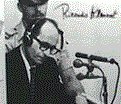 order to punish the Accused and deter others, the
maximum penalty laid down in the law must be imposed on him. In the
Judgment we described the crimes in which the Accused took part. They are
of unparalleled horror in their nature and their scope. The objective of
the crimes against the Jewish People of which the Accused was found guilty
was to obliterate an entire people from the face of the earth. In this
respect they differ from criminal acts perpetrated against persons as
individuals. It may be said that such comprehensive crimes, as well as
crimes against humanity which are directed against a group of persons as
such, are even more heinous than the sum total of the criminal acts
against individuals of which they consist.
order to punish the Accused and deter others, the
maximum penalty laid down in the law must be imposed on him. In the
Judgment we described the crimes in which the Accused took part. They are
of unparalleled horror in their nature and their scope. The objective of
the crimes against the Jewish People of which the Accused was found guilty
was to obliterate an entire people from the face of the earth. In this
respect they differ from criminal acts perpetrated against persons as
individuals. It may be said that such comprehensive crimes, as well as
crimes against humanity which are directed against a group of persons as
such, are even more heinous than the sum total of the criminal acts
against individuals of which they consist.But at the stage of passing sentence consideration must also, and perhaps primarily, be given to the injury inflicted on the victims as individuals, which was implicit in these crimes, and the immeasurable anguish which they and their families suffered and still suffer to this very day because of these crimes. For the despatch of each train by the Accused to Auschwitz, or to any other extermination site, carrying one thousand human beings, meant that the Accused was a direct accomplice in a thousand premeditated acts of murder, and the degree of his legal and moral responsibility for these acts of murder is not one iota less than the responsibility of the person who with his own hands pushed these human beings into the gas chambers.
Even if we had found that the Accused acted out of blind obedience, as he argued, we would still have said that a man who took part in crimes of such magnitude as these over years must pay the maximum penalty known to the law, and he cannot rely on any order even in mitigation of his punishment. But we have found that the Accused acted out of an inner identification with the orders that he was given and out of a fierce will to achieve the criminal objective, and in our opinion, it is irrelevant even for the purpose of imposing a punishment for such terrible crimes, how this identification and this will came about, and whether they were the outcome of the training which the Accused received under the regime which raised him, as his Counsel argues.
This Court sentences Adolf Eichmann to death, for the crimes against the Jewish People, the crimes against humanity and the war crimes of which he has been found guilty. We shall not impose a penalty on him for membership of a hostile organization, of which he was found guilty (see the Criminal Procedure (Trial Upon Information) Ordinance Section 30(2), last part, and Crim. App. 132/57, 11 Piskei Din , 1544, 1552).
This is the Sentence. You are entitled to appeal against the Judgment and the Sentence, and if you wish to do so, you must submit the Statement of Appeal to the office of this Court within ten days from today and the grounds of appeal within fifteen days from today.
Scottsboro Trial
Tom Robinson's trial bears striking parallels to the "Scottsboro Trial," one of the most famous-or infamous-court cases in American history. Both the fictional and the historical cases take place in the 1930s, a time of turmoil and change in America, and both occur in Alabama. In both, too, the defendants were African-American men, the accusers white women. In both instances the charge was rape. In addition, other substantial similarities between the fictional and historical trials become apparent.A study of the Scottsboro trials will sharpen the reader's understanding of To Kill a Mockingbird. Both the historical trial(s) and the fictional one reflect the prevailing attitudes of the time, and the novel explores the social and legal problems that arise because of those attitudes.
First, it is essential to understand the social and economic climate of the 1930s. The country was in what has been called the Great Depression. Millions of people had lost their jobs, their homes, their businesses, or their land, and everything that made up their way of life. In every American city of any size, long "bread lines" of the unemployed formed to receive basic foodstuffs for themselves and their families, their only means of subsistence.
Many people lived in shanty towns, their shelters made of sheet metal and scrap lumber lean-tos. All over America it was common to see unemployed men and women riding the rails, looking for work, shelter, and food-for anything that offered some means of subsistence, some sense of dignity. It was a time when even a full-time employee, such as a mill worker, earned barely enough to live on. In fact, in 1931 a person working 55 or 60 hours a week in Alabama and other places would earn only about $156 annually.
The economic collapse of the 1930s resulted in ferocious rivalry for the very few jobs that became available. Consequently, the ill will between black and white people (which had existed ever since the Civil War) intensified, as each group competed with the other for the few available jobs. One result was that incidents of lynchings--primarily of African-Americans--continued. Here, lynching should be defined as the murder of a person by a group of people who set themselves up as judge, jury, and executioner outside the legal system.
It was in such a distressing social and economic climate that the Scottsboro case (and Tom Robinson's case) unfolded.
On March 25, 1931, several groups of white and black men and two white women were riding the rails from Tennessee to Alabama in various open and closed railroad cars designed to carry freight and gravel. At one point on the trip, the black and white men began fighting. One white man would later testify that the African-Americans started the fight, and another white man would later claim that the white men had started the fight. In any case, most of the white men were thrown off the train. When the train arrived at Paint Rock, Alabama, all those riding the rails-including nine black men, at least one white man, and the two white women--were arrested, probably on charges of vagrancy. The white women remained under arrest in jail for several days, pending charges of vagrancy and possible violation of the Mann Act. The Mann Act prohibited the taking of a minor across state lines for immoral purposes, like prostitution. Because Victoria Price was a known prostitute, the police were tipped off (very likely by the mother of the underaged Ruby Bates) that the two women were involved in a criminal act when they left Tennessee for Alabama. Upon leaving the train, the two women immediately accused the African-American men of raping them in an open railroad car (referred to as a "gondola") that was carrying gravel (or, as it was called, "chert").
The trial of the nine men began on April 6, 1931, only twelve days after the arrest, and continued through April 9, 1931. The chief witnesses included the two women accusers, one white man who had remained on the train and corroborated their accusations, another acquaintance of the women who refused to corroborate their accusations, the physician who examined the women, and the accused nine black men. The accused claimed that they had not even been in the same car with the women, and the defense attorneys also argued that one of the accused was blind and another too sickly to walk unassisted and thus could not have committed such a violent crime. On April 9, 1931, eight of the nine were sentenced to death; a mistrial was declared for the ninth because of his youth. The executions were suspended pending court appeals, which eventually reached the Supreme Court of the United States.
On November 7, 1932, the United States Supreme Court ordered new trials for the Scottsboro defendants because they had not had adequate legal representation.
On March 27, 1933, the new trials ordered by the Court began in Decatur, Alabama, with the involvement of two distinguished trial participants: a famous New York City defense lawyer named Samuel S. Leibowitz, who would continue to be a major figure in the various Scottsboro negotiations for more than a decade; and judge James E. Horton, who would fly in the face of community sentiment by the unusual actions he took in the summer of 1933.
In this second attempt to resolve the case, the trial for the first defendant lasted almost two weeks instead of only a few hours, as it had in 1931. And this time the chief testimony included the carefully examined report of two physicians, whose examination of the women within two hours of the alleged crime refuted the likelihood that multiple rapes had occurred. Testimony was also given by one of the women, Ruby Bates, who now openly denied that she or her friend, Victoria Price, had ever been raped. As a result of this, as well as of material brought out by investigations and by cross-examinations of the witnesses of Samuel Leibowitz, the character and honesty of accuser Victoria Price came under more careful scrutiny.
On April 9, 1933, the first of the defendants, Haywood Patterson, was again found guilty of rape and sentenced to execution. The execution was delayed, however; and six days after the original date set for Patterson's execution, one of the most startling events of the trial took place: local judge James Horton effectively overturned the conviction of the jury and, in a meticulous analysis of the evidence that had been presented, ordered a new trial on the grounds that the evidence presented did not warrant conviction. (It is probably not a coincidence that Judge Horton lost an election in the fall following his reversal of the jury's verdict.)
Despite judge Horton's unprecedented action, the second defendant, Clarence Norris, was tried in late 1933 and was found guilty as charged; but his execution was delayed pending appeal.
During this time all the defendants remained in prison, and not for two more years was any further significant action taken as Attorney Leibowitz filed appeals to higher courts. Finally, on April 1, 1935, the United States Supreme Court reversed the convictions of Patterson and Norris on the grounds that qualified African-Americans had been systematically excluded from all juries in Alabama, and that they had been specifically excluded in this case.
However, even this decision by the Supreme Court was not the end of the trials, for on May 1, 1935, Victoria Price swore out new warrants against the nine men.
Primary documents related to the case afford several avenues of comparison between the Scottsboro trials and Tom Robinson's trial in To Kill a Mockingbird. This is in addition to the more obvious parallels of time (1930s), place (Alabama), and charges (rape of white women by African-American men). First, the threat of lynching is common to both cases. Second, there is a similarity between the novel's Atticus Finch and the real-life judge James E. Horton, both of whom acted in behalf of black men on trial in defiance of their communities' wishes at a time of high feeling. In several instances, the words of the Alabama judge remind the reader of Atticus Finch's address to the jury and his advice to his children. Third, the accusers in both instances were very poor, working-class women who had secrets that the charges of rape were intended to cover up. Therefore, the veracity or believability of the accusers in both cases became an issue.
In order to keep straight the people and events in this complicated case, a brief list of the main characters and a brief chronology of main events follow.
The Trial of Charles I, 1649
Excerpts from the Original Electronic Text at the web site of the Hanover Historical Texts Project.On Saturday, being the 20th day of January 1648, The Lord President of the High Court of Justice with near fourscore of the Members of the said Court, having sixteen Gentlemen with Partisans, and a Sword and a Mace, with their, and other Officers of the said Court marching before them, came to the place ordered to be prepared for their sitting, at the West end of the great Hall at Westminster, where the Lord President in a Crimson Velvet Chair, fixed in the midst of the Court, placed himself, having a Desk with a Crimson Velvet Cushion before him; the rest of the Members placing themselves on each side of him upon the several Seats, or Benches, prepared and hung with Scarlet for that purpose, and the Partisans dividing themselves on each side of the Court before them.
The Court being thus sat, and silence made, the great Gate of the said Hall was let open, to the end, That all persons without exception, desirous to see, or hear, might come into it, upon which the Hall was presently filled, and silence again ordered.
This done, Colonel Thomlinson, who had the charge of the Prisoner, was commanded to bring him to the Court, who within a quarter of an hour's space brought him attended with about twenty Officers, with Partisans marching before him, there being other Gentlemen, to whose care and custody he was likewise committed, marching in his Rear. Being thus brought up within the face of the Court, The Sergeant at Arms, with his Mace, receives and conducts him straight to the Bar, having a Crimson Velvet Chair set before him. After a stern looking upon the Court, and the people in the Galleries on each side of him, he places himself, not at all moving his Hat, or otherwise showing the least respect to the Court; but presently rises up again, and turns about, looking downwards upon the Guards placed on the left side, and on the multitude of Spectators on the right side of the said great Hall. After Silence made among the people, the Act of Parliament for the Trying of Charles Stuart, King of England, was read over by the Clerk of the Court; who sat on one side of a Table covered with a rich Turkey Carpet, and placed at the feet of the said Lord President, upon which table was also laid the Sword and Mace.
After reading the said Act, the several names of the Commissioners were called over, every one who was present, being eighty, as aforesaid, rising up and answering to his Call.
Having again placed himself in his Chair, with his face towards the Court, Silence being again ordered, the Lord President stood up and said:
Lord President: Charles Stuart, King of England; The Commons of England Assembled in Parliament, being deeply sensible of the Calamities that have been brought upon this Nation (which is fixed upon you as the principal Author of it) have resolved to make inquisition for Blood, and according to that Debt and Duty they owe to Justice, to God, the Kingdom, and themselves, and according to the Fundamental Power that rests in themselves, They have resolved to bring you to Trial and Judgment; and for that purpose have constituted this High Court of Justice, before which you are brought.
This said, M. Cook Attorney for the Commonwealth (standing within a Bar on the right hand of the Prisoner) offered to speak, but the King having a staff in his Hand, held it up, and laid it upon the said M. Cook's shoulder two or three times, bidding him hold; Nevertheless, the Lord President ordering him to go on, he said:
M. Cook. My Lord, I am commanded to charge Charles Stuart, King of England, in the name of the Commons of England, with Treason and high Misdemeanors; I desire the said Charge may be read.
The said Charge being delivered to the Clerk of the Court, the Lord President ordered it should be read, but the King bid him hold; Nevertheless, being commanded by the Lord President to read it, the Clerk began. The Charge of the Commons of England, against Charles Stuart, King of England, Of High Treason, and other High Crimes, exhibited to the High Court of Justice. . . .
The Charge being read the Lord President replied:
Lord President. Sir, you have now heard your Charge read, containing such matter as appears in it; you find, that in the close of it, it is prayed to the Court, in the behalf of the Commons of England, that you answer to your Charge. The Court expects your Answer.
The King. I would know by what power I am called hither. . . . by what Authority, I mean, lawful; there are many unlawful Authorities in the world, Thieves and Robbers by the highways: but I would know by what Authority I was brought from thence, and carried from place to place, (and I know not what), and when I know what lawful Authority, I shall answer: Remember, I am your King, your lawful King, and what sins you bring upon your heads, and the Judgment of God upon this Land, think well upon it, I say, think well upon it, before you go further from one sin to a greater; therefore let me know by what lawful Authority I am seated here, and I shall not be unwilling to answer, in the meantime I shall not betray my Trust: I have a Trust committed to me by God, by old and lawful descent, I will not betray it to answer a new unlawful Authority, therefore resolve me that, and you shall hear more of me. . . . I will stand as much for the privilege of the house of Commons, rightly understood, as any man here whatsoever. I see no House of Lords, here that may constitute a Parliament, and (the King too) should have been. Is this the bringing of the King to his Parliament? Is this the bringing an end to the Treaty in the public Faith of the world? Let me see a legal Authority warranted by the Word of God, the Scriptures, or warranted by the Constitutions of the Kingdom, and I will answer.
Lord President. Sir, you have held yourself, and let fall such Language, as if you had been no ways Subject to the Law, or that the Law had not been your Superior. Sir, The Court is very well sensible of it, and I hope so are all the understanding People of England, That the Law is your Superior, that you ought to have ruled according to the Law, you ought to have done so. Sir, I know very well your pretence hath been that you have done so, but Sir, the difference hath been who shall be the Expositors of this Law, Sir, whether you and your Party out of Courts of Justice shall take upon them to expound Law, or the Courts of Justice, who are the Expounders; nay, the Sovereign and the High Court of Justice, the PARLIAMENT of England, that are not only the highest expounders, but the sole makers of the Law. Sir, for you to set yourself with your single judgment, and those that adhere unto you, to set yourself against the highest Court of Justice, that is not Law.
Sir, as the Law is your Superior; so truly Sir, there is something that is Superior to the Law, and that is indeed the Parent or Author of the Law, and that is the People of England, For Sir, as they are those that at the first (as other Countries have one) did choose to themselves the Form of Government, even for justice sake, that Justice might be administered, that Peace might be preserved, so Sir, they gave Laws to their Governors, according to which they should Govern, and if those Laws should have proved inconvenient, or prejudicial to the Public, they had a power in them and reserved to themselves to alter as they shall see cause. . . .This we learn, the end of having Kings, or any other Governors, it's for the enjoying of Justice, that's the end. Now Sir, if so be the King will go contrary to that End, or any other Governor will go contrary to the end of his Government; Sir, he must understand that he is but an Officer in trust, and he ought to discharge that Trust, and they are to take order for the animadversion and punishment of such an offending Governor.
This is not Law of yesterday Sir, (since the time of the division betwixt you and your People) but it is Law of old; and we know very well the Authors and the Authorities that do tell us what the Law was in that point upon the Election of Kings, upon the Oath that they took unto their People; and if they did not observe it, there were those things called Parliaments; the Parliaments were they that were to adjudge (the very words of the Author) the plaints and wrongs done of the King and the Queen, or their Children, such wrongs especially when the People could have no where else any remedy. Sir, that hath been the People of England's case, they could not have their remedy elsewhere but in Parliament. . . .
Sir, that road we are now upon by the command of the highest Courts hath been and is to try and judge you for these great offenses of yours. Sir, the Charge hath called you Tyrant, a Traitor, a Murderer, and a public Enemy to the Commonwealth of England. Sir, it had been well, if that any or all these terms might rightly and justly have been spared, if any one of them at all.
King: Ha!
The Lord President commands the sentence to be read. Make an O yes, and command silence while the sentence is read. O yes made. Silence commanded. The Clerk read the sentence, which was drawn up in parchment.
Whereas the Commons of England in Parliament had appointed them an High Court of Justice for the trying of Charles Stuart, King of England, before whom he had been three times convented, and at the first time a Charge of High Treason, and other Crimes and Misdemeanors, was read in the behalf of the Kingdom of England, etc.
Here the Clerk read the Charge.
Which Charge being read unto him as aforesaid, he the said Charles Stuart was required to give his Answer, but he refused so to do, and so expressed the several passages at his Trial in refusing to answer.
For all which Treasons and Crimes this Court doth adjudge, That he said Charles Stuart, as a Tyrant, Traitor, Murderer, and a public Enemy, shall be put to Death, by the severing his Head from his Body.
After the sentence read, the Lord President said; This sentence now read and published, it is the act, sentence, judgement, and resolution of the whole Court.
The Trial of Louis XVI
Barere: On January 29, 1792, the Legislative Assembly issued a decree
against factious priests, which you suspended.
Louis: The constitution left me the right of sanctioning decrees.
Barere: You used money from the civil lists to encourage
counterrevolutionary activity.
Louis: I had no knowledge of the projects they were engaged in. Never did
the idea of counterrevolution enter my head.
Barere: Who are those to whom you promised or gave money in the National
and Legislative Assemblies?
Louis: None.
Barere: You reviewed the troops on the morning of August 10 and extracted
from them a personal oath of obedience. This was a prelude to your
proposed attack on Paris.
Louis: I reviewed all the troops who were assembled at the Tuileries that
day. Then the constituted authorities accompanied me, the department and
the mayor. I even asked for a delegation from the National Assembly, and I
finally went, with my family, to the Assembly.
Barer: Why did you gather troops at the Tuileries?
Louis: All the constituted authorities saw them, the chateau was menaced,
and since I was constituted authority, I had to defend myself.
Barer: Why was the mayor called to the Tuileries on the night of August 9,
1792.
Louis: Because of the trouble that was brewing.
Barer: You are responsible for shedding French blood.
Louis: No, Monsieur, it was not I..
When the interrogation was over, after three hours, Barer asked Louis if
he had anything to add.
Louis: I ask to see the accusations and the pieces of evidence that
accompany them, and the right to choose a counsel to defend me.
After this, Valeza, who refused to stand in the king's presence and
refused to look at him, passed some documents to the King.
Vales: Do you recognize any of these documents as your own handwriting.
Louis: No .
Barer: Did you build a secret safe in Tuileries?
Louis: I have no knowledge of it.
Barere: I invite you to retire to the conference room, the Assembly is
going to deliberate.
Louis begged for a lawyer to help him, but at this time was ignored. In a
few days he was allowed to look for a lawyer. Louis was concerned because
old friends who had said they wanted to retire only to be some of the most
prominent lawyers just a few years after his death. Finally Seze was found
to represent him.
Barrere: Louis, the French Nation accuses you of having committed various
crimes to re-establish tyranny on the ruins of liberty; the National
Convention has decreed that you shall be tried and the members who compose
it are to be your judges.
President: You distributed money among the populace for the treacherous
purpose of acquiring popularity and enslaving the Nation.
Louis: I always took pleasure in relieving the needy, but never had any
treacherous purpose.
Seze: I don't want to play on their feelings. Louis came to the throne at
the age of twenty... he was thrifty, just severe: he proved himself the
constant friend of the people. When the people desired the destruction of
a crippling tax, he destroyed the tax. When asked for reform in criminal
law, to ease the lot of accused persons, he made these reforms. When the
people wished thousands of Frenchmen to enjoy the civil rights of which
they had long been deprived, he made the appropriate laws. When the people
wished for liberty, he gave it them. He took the lead in making
sacrifices, and yet in the name of this same people you are today
demanding...Citizens, I leave the phrase unfinished; I stop before
History; remember that it will pass judgment on your verdict and that its
judgment will endure.
Louis: I confess that the repeated signs I have given that I love the
people, and my behavior throughout my reign seems to me abundant proof
that I was not afraid to spare any trouble in order to prevent bloodshed,
and forever to banish such an imputation.
Assembly's Sentence Question: Is Louis guilty of plotting against
the Nation's freedom and of a criminal attempt on the general security of
the State?
Verdict: On this question, 749 members were present, 28 were
absent, thirteen abstained, all the others found Louis guilty.
Question: Shall the sentence, whatever it is, be sent to the people for
ratification?
Verdict: On this question a majority of 141 decided against
ratification.
Question: What is the penalty to be?
Verdict: This question was close. 387 voted for death
unconditionally, 334 for detention or for a suspended death sentence; a
majority of 53 for death.
How To Submit Your Article:
Follow the Procedure Below To Submit Your Articles

Submit your Article by using our online form
Click here
Note* we only accept Original Articles, we will not accept
Articles Already Published in other websites.
For Further Details Contact:
[email protected]
 Right Away Call us at Ph no: 9650499965
Articles of Yesteryears
Click on the link Below to check articles submitted in previous years:Latest Articles - Law Articles 2017 - Law Articles 2016 - Law Articles 2015 - Law Articles 2014 - Law Articles 2013 - Law Articles 2012 - Law Articles 2011 - Law Articles 2010 - Law Articles 2009 - Law Articles 2008 - Articles 2007 - Law Articles 2006 - Law Articles 2000-05 - Archive
File Your Copyright - Right Now!
 Online Copyright Registration in India Call us at: 9891244487 / or email at: [email protected] |
Lawyers in India - Search By City |
|||
|
Delhi Chandigarh Allahabad Lucknow Noida Gurgaon Faridabad Jalandhar Vapi |
Mumbai Pune Nagpur Nashik Ahmedabad Surat Indore Agra Jalgaon |
Kolkata Siliguri Durgapur Janjgir Jaipur Ludhiana Dimapur Guwahati Amritsar |
Chennai Jamshedpur Hyderabad Coimbatore Eluru Belgaum Cochin Rajkot Jodhpur |