





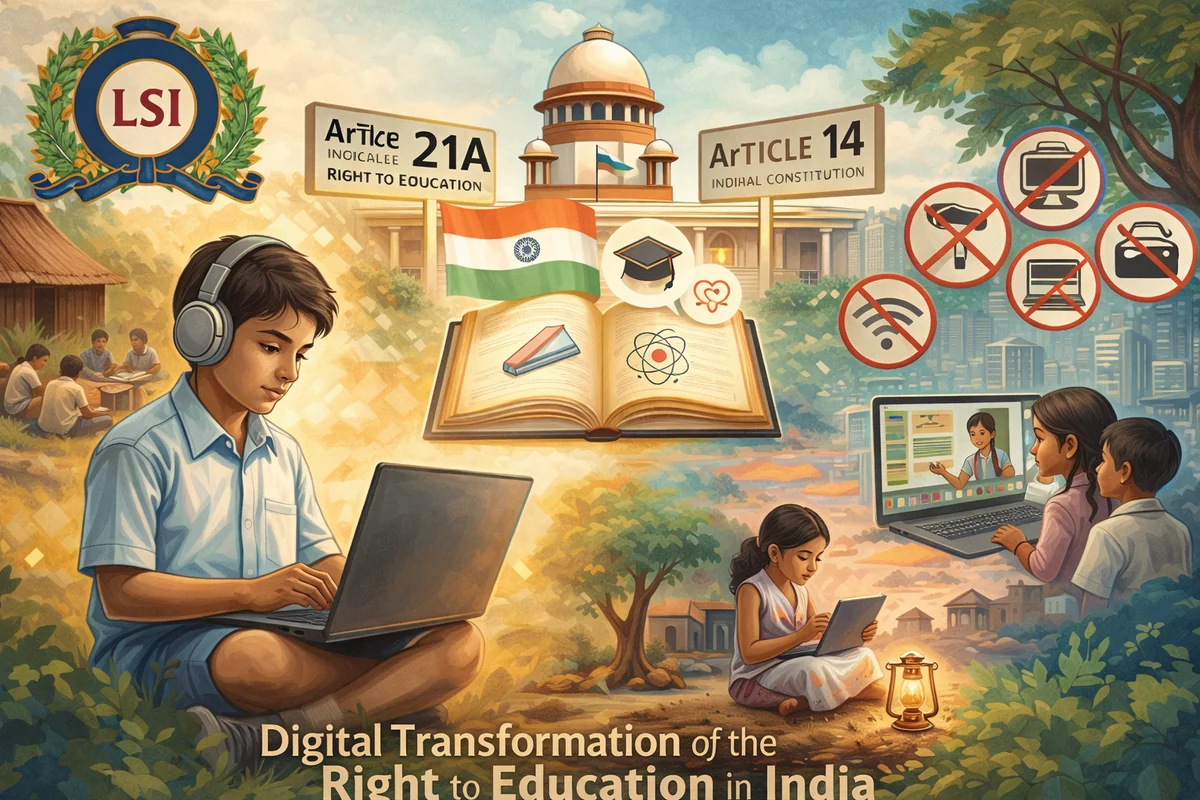
Introduction – The Digital Transformation of Right to Education
Right to education is a one of the fundamental rights to provide free and compulsory elementary education.
In India, the right of education is a very important legal right made for the children age between 6 to 14 under Right of Children to Free and Compulsory Education Act, 2009[1] and Article 21A of the Indian Constitution[2].
International Perspective on Right to Education
Similarly, many countries like Spain, France, Norway etc. provides 10 yrs of free education and countries like Japan, Finland, Russia etc. provides 9 yrs if free education.
Globally, United Nation adopted Sustainable Development Goal – 4 which aims to provide access high quality education by 2030[3].
Role of Digitalization in Education
To provide the right to education, many steps are to be taken by the state and one of that is digitalization of the education. Digitalization of education may be a way to achieve the determined goal but it also creates a big challenge in the name of digital divide.
Understanding the Digital Divide
The digital divide basically means the gap between the those who have access to technology and one who have not and this gap emerges as a big challenge by creating the unequal access to data, network, study tools, internet etc.
- Unequal access to data
- Lack of network connectivity
- Non-availability of study tools
- Limited or no internet access
Challenges and Socioeconomic Factors
Fiscal constraints and socioeconomic problems create the digital divide as everyone does not have the resources to get the benefit of the digitalization of education.
Need for Equal Access Before Digitalization
Before bringing the digitalization of education into the effect, it’s necessary to handle with this obstacle so that everyone can equally get the right to education.
Constitutional Framework for Education
There are several provisions regarding education which are being made all over the world. In India particularly, Mohini Jain vs State of Karnataka[4] which recognized the right to education as a fundamental right and Unni Krishnan[5], J.P. v. State of Andhra Pradesh which defined the scope of 14 age and extension of education support beyond that age depending on the economic capacity are landmark cases in education.
These case laws are followed by the 86th Amendment of 2002 which inserted Article 21A that made free and compulsory education for the age of 6 to 14, also inserted a fundamental duty under Article 51A(k) and modified Article 45 to emphasize on providing the care and assistance to children below the age of 6.
Global Legal Provisions on Education
Globally there are many legislations which are made to focus on education which include:
- Article 26 of the Universal Declaration of Human Rights which states that everyone has the right to education for overall personality development[6].
- Article 13 of the International Covenant on Economic, Social and Cultural Rights which emphasizes to make primary education free and compulsory.
- Convention on the Rights of the Child, the treaty which states the responsibility of government to make education free and compulsory.
As per the primary data, approximately 135 countries in the world made the right to education a fundamental right[7].
Digitalization of Education Post Covid
Post pandemic of Covid, the digitalization of education came into the limelight and the idea to enhance the quality of education by providing education through secured digital systems and the internet gained importance. However, this idea also brings a big challenge, that is not having equal access to tools, internet, computers, and network connectivity to everyone which is called the Digital Divide.
Digital Divide comprises unequal access to both physical technological devices and the required technological skills to operate the devices.
Dimensions of Digital Divide
Dimensions of Digital Divide include having or not having access to technology, having or not having the required skills to use the technology, and knowledge of using the technology effectively. These dimensions are created by many factors which are sex, age, literacy rate, geography, race and origin, income levels etc.
The dimensions are described in brief as follows:
Ownership and Access
Some people have access to technology but do not equip with the appropriate skills to use the same. Similarly, the one who owns a personal computer but does not have proper network connectivity or internet connections. These limited ownership and access lead to the digital divide.
Geographical Gaps
Rural and urban people have different lifestyles particularly in India. People living in urban areas do have access to modern devices, network connectivity and proper internet connection while still people in some rural areas do not have access to the same.
According to the data of the World Bank, almost 33% of the population still live in rural areas. Hence this gap of technology between rural and urban areas creates the digital divide[8].
Literacy and Digital Literacy
Basic literacy means the ability of writing and reading, while digital literacy goes far beyond this which means having proficiency and proper knowledge to use computer devices and technological devices[9].
In India, approximately more than 75% of the population are not digitally literate. This gap of literacy between the people leads to the digital divide[10].
Gender Discrimination
The next dimension of the digital divide is gender discrimination. In India, Indian society is considered to be a men dominated society, where women do not have equal access to technology and devices as men do.
According to a 2004 survey by India’s National Association for Software Companies, 74% professionals are men and women constitute only 26%[11].
Other Dimensions
Therefore, these are the main dimensions of digital divide. Other dimensions are also important to consider such as:
- Age factor
- Income levels
- Race and Origin
- Language
Challenges to the Constitutional Right to Life and Dignity
In Indian Constitution, Article 21 provides the Right to Dignified Life and Supreme Court in precedents state that the right to dignified life also includes the right to education. Dignified life means the equal access to resources, and providing the equitable opportunities to the everyone. Hence, having unequal access to the digital access led to harm to dignity of life, and the digital divide affect the right to dignified life in these ways:
- Inequality in the Education – All the child does not have the equal access to education digitally which led to students fall back in the academics, which also affects the future opportunities for those who have not the equal access to the same, this violates the right to life and dignity.
- Non-Accessibility to the Online Education – During the pandemic of Covid-19, many students did not have the access to the digital resources, because of that they could not attend the lectures during the same. Some child led to drop out during the pandemic. This violated the Article 21 Right to education.
- Gender Based Digital Divide – In many areas or families, female does not have the same access to mobile or laptop as the male have. This broadens the digital divide and affects the dignified development of them.
- Economic Burden on the Middle Class or Low-Class Families – Most middle class and low-class families does not have access to the technology and the devices like mobile, laptop, because of the same they forced to take loan, sell belongings and even compromise with necessities. This also affects the right to life and dignity.
These are the main factors which affects the Article 21 of Indian Constitution, other than those some factors also affect like Rural-Urban divide, Physiological and social harm etc.
Summary of Key Impacts on Article 21
| Factor | Impact on Dignified Life |
|---|---|
| Inequality in Education | Academic decline and reduced future opportunities |
| Non-Accessibility | Dropouts and denial of education |
| Gender Divide | Unequal development of female students |
| Economic Burden | Financial distress and compromise with basic needs |
Substantive Inequality and Breaches of Article 14
Article 14 of the Indian Constitution mandates equality before law and the equal protection to everyone no matter he is citizen or not within the territory of India. It means everyone should be treated equally and should be given protection equally. However, it permits reasonable qualification to give preferential treatment to backward groups or different treatment to different people.
Article 14 in relation to the Right to Education ensures that everyone should have equal access to education which is a fundamental right, irrespective of their caste, race, religion or gender.
This fundamental right is violated by the digital divide creating an unequal access of digital resources to students which leads to the discrimination. The failure to provide equal access snatches the student’s right to get the equal and fair future opportunities.
In the landmark case of E.P. Royappa v. State of Tamil Nadu[12] stated the article 14 is violated by the state by exercising the action which is arbitrary. Since digital divide leads to unequal access to education which is a fundamental right, it is considered as an arbitrary action hence the violation of Article 14 of the Indian Constitution[13].
Core Legal Issue under Article 14
- Equality before law is denied due to unequal digital access.
- Arbitrary state action occurs when digital infrastructure is not equitably provided.
- Discrimination arises between digitally privileged and underprivileged students.
- Denial of equal educational opportunity results in long-term social inequality.
Judicial Interventions: Landmark Rulings on Digital Access
In India courts have increasingly recognized that access to the internet and digital platforms is integral to the enjoyment of the Right to Education under Article 21A and the Right to Life and Equality under Articles 21 and 14.
Faheema Shirin v. State of Kerala (2019)
In Faheema Shirin v. State of Kerala (2019)[14], the Kerala High Court became the first to explicitly declare internet access as a part of the Right to Education and the Right to Privacy noting that in a modern learning environment denial of internet connectivity undermines a student’s dignity.
Anuradha Bhasin v. Union of India (2020)
This judicial trend was strengthened by the Supreme Court in Anuradha Bhasin v. Union of India (2020)[15], where the Court held that internet access is essential for the exercise of various fundamental rights and emphasized that any restriction on it must be necessary and proportionate especially since education, healthcare and livelihood increasingly depend on digital platforms.
Jammu & Kashmir High Court Bar Association v. Union of India (2020)
A related shift occurred in Jammu & Kashmir High Court Bar Association v. Union of India (2020)[16], where the Court acknowledged that slow internet speeds during the pandemic severely affected students online learning opportunities thereby impacting the Right to Education.
Justice for All v. Govt. of NCT of Delhi (2021)
Further, in Justice for All v. Govt. of NCT of Delhi (2021)[17], the Delhi High Court held that the State must provide digital devices and internet access to EWS/DG students in private schools observing that the digital divide cannot be allowed to deprive children of their fundamental right to education.
Sabu Mathew George v. Union of India (2017)
Earlier, in Sabu Mathew George v. Union of India (2017)[18], the Supreme Court highlighted the importance of digital platforms as centers of public information reinforcing the idea that internet access is crucial for rights related to knowledge and learning.
Avinash Mehrotra v. Union of India (2020)
The Supreme Court also expressed concern in pandemic-era hearings in Avinash Mehrotra v. Union of India (2020)[19] that economically weaker students were being excluded from education due to lack of devices thereby imposing a constitutional obligation on the State to ensure that no child is left behind.
Environment & Consumer Protection Foundation v. Delhi Administration (2012)
Moreover, in Environment & Consumer Protection Foundation v. Delhi Administration (2012)[20], the Court held that quality education includes adequate infrastructure in today’s context this principle clearly extends to digital infrastructure as a necessary educational facility.
Judicial Trajectory and Key Takeaways
These cases show a clear judicial trajectory towards recognizing that digital access is no longer optional but an essential component of the Right to Education and that the State has a duty to prevent digital exclusion that violates equality and dignity.
Summary of Landmark Cases
| Case | Year | Court | Key Judicial Finding |
|---|---|---|---|
| Faheema Shirin v. State of Kerala | 2019 | Kerala High Court | Internet access is part of the Right to Education and Right to Privacy. |
| Anuradha Bhasin v. Union of India | 2020 | Supreme Court | Internet is essential for fundamental rights and restrictions must be proportionate. |
| Jammu & Kashmir High Court Bar Association v. Union of India | 2020 | Supreme Court | Slow internet harmed students’ online learning during the pandemic. |
| Justice for All v. Govt. of NCT of Delhi | 2021 | Delhi High Court | State must provide devices and internet to EWS/DG students. |
| Sabu Mathew George v. Union of India | 2017 | Supreme Court | Digital platforms are centers of public information and learning. |
| Avinash Mehrotra v. Union of India | 2020 | Supreme Court | State must ensure economically weaker students are not excluded. |
| Environment & Consumer Protection Foundation v. Delhi Administration | 2012 | Supreme Court | Quality education includes adequate infrastructure, including digital facilities. |
Socio-Educational and Economic Consequences
The Digital Divide has great socio-educational and economic consequences owing to the constitutionally guaranteed equality and quality education that is indirectly jeopardized because of it. A key consequence is the increase in the number of students drooping out of school because they do not have smartphones, laptops or an available connection to the internet to sign into classes.
Many students, especially those in rural and economically poor families lost the ability to continue their education as they were digitally excluded during the pandemic, causing irreversible damage to their education. This exclusion is slightly more damaging because it puts the students at a systemic disadvantage counter to their peers who have an uninterrupted access to the Internet.
This is a big problem because the gap between the ones affecting from it, also majorly impacts the skills which are non-basic that are also fundamental to education rendering the low digitally experienced students further being suffered in key areas such as:
- Computer effective usage
- Online educational materials
- The ability to do proper research using the internet
These skills are important to major success. Financially, the digital divide would lead to increase in poverty by preventing backward students from getting the skills which are necessary for employment in the emerging digital economy.
At the current and upcoming time all jobs, even the basic ones, requires the digital skills. Students without experience of the same would have to face the barriers to employment and income.
The divide also affects the availability of scholarships by being unable to fill the form, e-governance services, and online applications, thereby limiting students to the many opportunities of others which are crucial in getting success.
The social consequences are also considerable. Students who have not the proper knowledge to use the online devices experience stress, anxiety, and depressed which can result in being perceived as less able than others simply because of a lack of devices or internet access. This also impacts their motivation and self-worth.
Overall Impact of the Digital Divide
Overall, the digital divide worsens socio-economic inequities, fuels poverty across generations, and contradicts the social justice principles enshrined in Articles 14, 21 and 21A. Instead of education being a means of empowerment, the lack of digital access converts it into a new form of exclusion, deeply impacting the constitutional aspiration of an equitable and just society.
State Obligation and Directive Principles of State Policy (DPSP)
In Indian constitution Art.21 in the light of Directive Principles of State Policy contained in Arts. 38, 39A, 41 and 45, the Court opined that it becomes clear that the framers of the Constitution made it obligatory for the State to provide education for its citizens.
According to the mandate of Constitution (86th Amendment) Act 2002, ‘Serva Shiksha Abhiyan’ (SSA) is launched by Government of India as a flagship program for achievement of ‘Universalization’ of elementary education in a time bound manner. SSA seeks to provide quality elementary education including life skills.
SSA has a special focus on girl’s education and children with special needs. SSA also seeks to provide computer education to bridge the digital divide. However, legislation was not enacted to make the right a reality.
Judicial Intervention in Education Rights
In 2008, Bhandari, J. in Ashokkumar Thakur directed, the Union of India to set a time-limit within which this Article is going to be completely implemented. This time limit must be set within six months. In case the Union of India fails to fix the time-limit then perhaps this work will also have to be done by the court.
Right to Education Act, 2009
The long-awaited dream came true in the year of 2009, when the Right of Children to Free and Compulsory Education Act, 2009 was enacted by the Parliament and came into force on 1st April, 2010.
Free and compulsory education to all children in the age group of 6 to 14 years is now a legal as well as constitutional duty of the Government.
| Provision | Objective |
|---|---|
| Article 21A | Right to free and compulsory education |
| SSA Scheme | Universal elementary education |
| RTE Act, 2009 | Legal enforcement of education rights |
Policy Recommendations and Legal Remedies to Bridge the Divide
Eliminating the digital divide requires a detailed and multi-layered policy framework that ensures every student should have access of digital learning as part of their fundamental right to education. The first and most important step is to provide the digital connectivity all over the territory of the state. The government shall provide the cheap, high-speed network to rural, tribal, and backward areas through initiatives like BharatNet and by forcing telecom service providers to make strong networks under the Universal Service Obligation Fund.
Connectivity and Infrastructure
However, connectivity alone would not be viable without providing access to the devices which are important to participate in digital learning like laptop, computer etc. Therefore, the State should make proper and effective schemes for device distribution and providing free interest loan to household families, ensuring that students from lower middle- and low-class families receive smartphones, tablets, or laptops either free of cost or at heavily discounted rates.
- Expansion of high-speed internet across rural, tribal, and backward regions.
- Strengthening telecom networks through Universal Service Obligation Fund.
- Ensuring last-mile connectivity for schools and households.
Device Access and Equity
Public-private partnerships, CSR initiatives, and NGO collaborations shall take steps which would be helpful in eliminating the device or technology gap.
| Stakeholder | Role in Device Access |
|---|---|
| Government | Free or subsidized device distribution schemes |
| Private Sector | CSR funding and affordable device manufacturing |
| NGOs | Community outreach and digital inclusion programs |
Digital Literacy and Training
Alongside connectivity and devices, the teaching of the effective usage of the devices would also be crucial. Students, teachers, and even parents require the learning to effectively use digital devices and applications. To train the teachers, proper webinars, programs must be organized to incorporate digital transformation, and localized, multilingual digital content should be developed to ensure inclusivity.
- Teacher training through webinars and digital programs.
- Multilingual and localized digital content.
- Awareness programs for parents and students.
Legal Reforms and Statutory Backing
A significant legal reform that can build these efforts is the amendment of the RTE Act, 2009, to include digital infrastructure, internet access, and digital learning resources as part of the “minimum standards” for schools. This would make digital access a statutory requirement enforceable by courts.
Furthermore, the judiciary can support digital inclusion by recognizing the Right to Digital Access as an amendment of Articles 21 and 21A, forcing the governments to take into the force the time-bound policies for equitable digital education.
Collaborative Approach
Through a coordinated efforts of everyone involving the government, private sector, civil society, and courts, India can move toward an inclusive digital education system that ensures no child would suffer in getting the equal learning opportunities due to lack of access.
Conclusion: Upholding the Constitutional Imperative
The Digital divide presents a critical constitutional issue by using undermining the Right to Education, which is guaranteed underneath Article 21A. It also challenges the broader principles of equality and dignity mentioned in Articles 14 and 21. In nowadays virtual want and access of generation and net could be very critical and useful in schooling.
Whenever college students lack digital resources, they simply not best omit out on sure equipment but additionally they are excluded from the gaining knowledge of process. This exclusion leads to structural inequality, increasing socio-economic gaps and restraining children from susceptible groups from having equal opportunities to advancement.
The choice for an inclusive, honest, and just society can’t be done unless virtual gaining knowledge of is available to all and sundry. Recent court rulings have stated this fact, highlighting that virtual access is important for exercise diverse fundamental rights.
Courts have said that dignity, equality and schooling are critical parts of constitutional values that cannot be accomplished without making sure virtual inclusion. The pandemic generation similarly highlighted that education systems now depend heavily on generation, making digital infrastructure critical.
Therefore, it’s miles critical for the legislative and govt branches to paintings together to make virtual get admission to a reality. This must contain building stable infrastructure, making sure affordability, promoting digital literacy, and addressing the desires of economically deprived corporations.
The judiciary need to keep to oversee and guide country efforts, ensuring digital get right of entry to is visible as a constitutional duty rather than only a coverage option.
In end last the virtual divide is not only a technological challenge, however a constitutional requirement. Providing digital accessibility to eliminate the inequalities, protecting the fundamental rights guaranteed in the Constitution of India and fulfilling the promises to provide Right to education to child in India.
We can achieve if we make a united effort, where eventually education is fair, inclusive and available to all. End Notes:
- The Right of Children to Free and Compulsory Education Act, No. 35 of 2009, INDIA CODE.
- Constitution of India, Article 21A (inserted by the Constitution (Eighty-Sixth Amendment) Act, 2002)
- United Nations, Sustainable Development Goal 4: Quality Education, UN SDGs (2015). URL: https://sdgs.un.org/goals/goal4
- Mohini Jain v. State of Karnataka, (1992) 3 S.C.C. 666 (India).
- Unni Krishnan, J.P. v. State of Andhra Pradesh, (1993) 1 S.C.C. 645 (India).
- Universal Declaration of Human Rights, G.A. Res. 217 A (III), U.N. Doc. A/810, art. 26 (1948). URL: https://www.un.org/en/about-us/universal-declaration-of-human-rights
- UNICEF, “Convention on the Rights of the Child,” Nov. 20, 1989, 1577 U.N.T.S. 3. URL: https://www.unicef.org/child-rights-convention
- World Bank Data, World Development Indicators, 2023. URL: https://databank.worldbank.org/source/world-development-indicators
- National Sample Survey Office, Household Social Consumption on Education in India, NSS 75th Round (2018).
- National Sample Survey Office (NSSO), “Household Social Consumption on Education in India,” NSS 75th Round, 2018.
- NASSCOM, Women in the Indian IT Workforce (2004). URL: https://www.nasscom.in
- E.P. Royappa v. State of Tamil Nadu, (1974) 4 S.C.C. 3 (India).
- Constitution of India, Article 14.
- Faheema Shirin R.K. v. State of Kerala, 2019 SCC Online Ker 1733 (India).
- Anuradha Bhasin v. Union of India, (2020) 3 S.C.C. 637 (India).
- Jammu & Kashmir High Court Bar Association v. Union of India, 2020 SCC Online SC 688 (India).
- Justice for All v. Government of NCT of Delhi, 2021 SCC Online Del 2306 (India).
- Sabu Mathew George v. Union of India, (2018) 3 S.C.C. 229 (India).
- Avinash Mehrotra v. Union of India, W.P. (C) No. 473/2005, Supreme Court of India (Order dated Apr. 2020).
- Environment & Consumer Protection Foundation v. Delhi Administration, (2012) 10 S.C.C. 197 (India).

