





Abstract
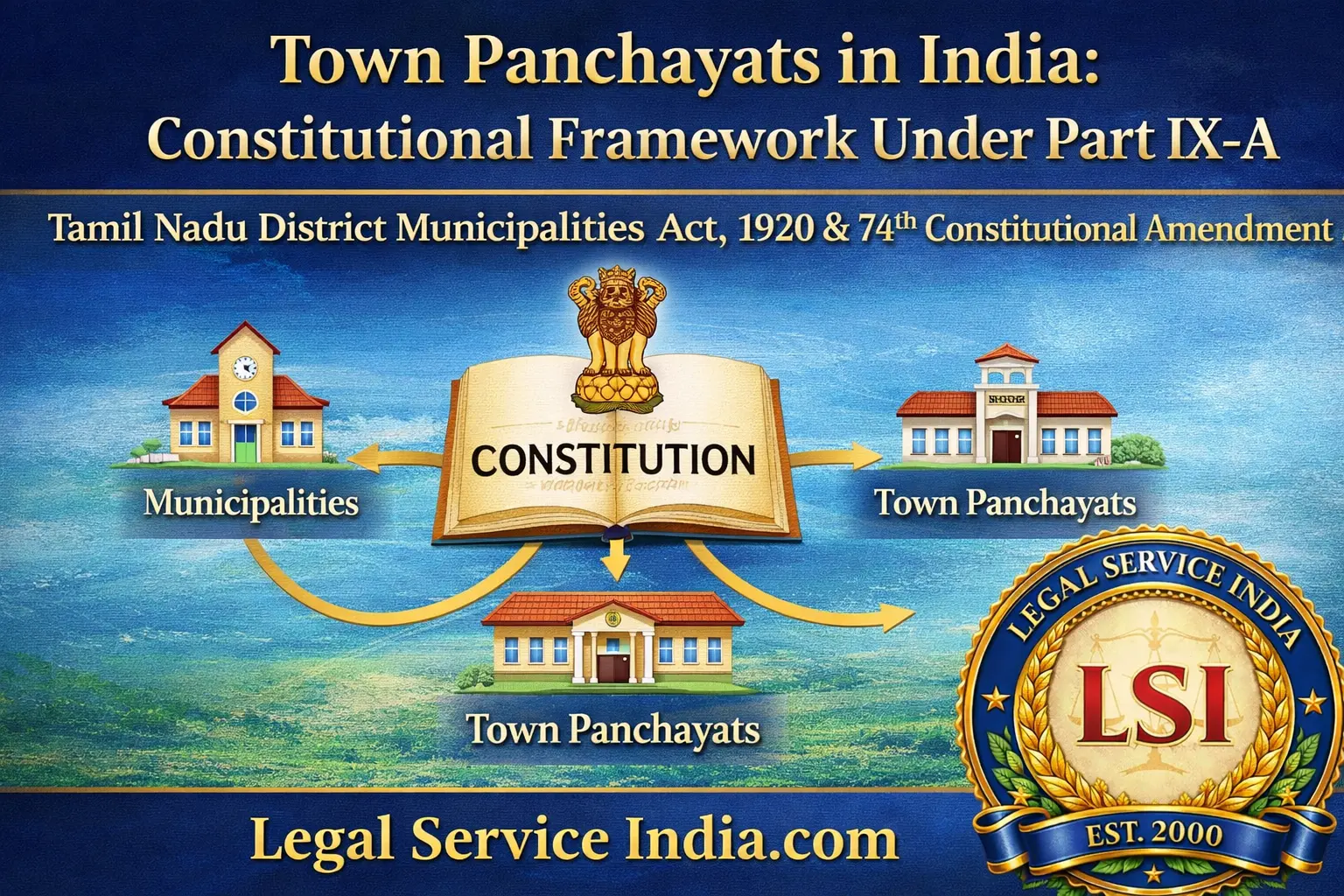
Town Panchayats occupy a distinctive position within India’s framework of urban local self-government, particularly in transitional areas experiencing gradual urbanisation. In Tamil Nadu, their legal and administrative foundation is primarily governed by the Tamil Nadu District Municipalities Act, 1920, which predates the constitutionalisation of urban local bodies under the 74th Constitutional Amendment Act, 1992.
Analytical Examination Of Town Panchayats
This study undertakes an analytical examination of the establishment and constitutional status of Town Panchayats, focusing on their statutory origins, constitutional legitimacy, functional responsibilities, and contemporary governance challenges.
- Statutory origins of Town Panchayats
- Constitutional legitimacy and recognition
- Functional responsibilities in governance
- Contemporary governance challenges
Constitutional Framework And Decentralisation
The research situates Town Panchayats within the broader constitutional framework of decentralisation under Part IX-A of the Constitution and evaluates the extent to which statutory provisions align with constitutional mandates of autonomy, democratic representation, and devolution of powers.
| Aspect | Description |
|---|---|
| Constitutional Basis | Part IX-A of the Constitution |
| Key Principles | Autonomy, Democratic Representation, Devolution of Powers |
| Relevant Amendment | 74th Constitutional Amendment Act, 1992 |
Judicial Interpretations And Practical Concerns
It further examines judicial interpretations concerning the constitutional nature of municipal bodies and highlights practical concerns such as financial dependence, administrative control, and the transitional identity of Town Panchayats.
- Financial dependence on higher authorities
- Administrative control and limitations
- Transitional identity challenges
Conclusion And Objective Of The Study
By critically analysing statutory provisions and constitutional principles, this study aims to assess whether Town Panchayats function as effective institutions of grassroots urban governance or remain constrained by structural and administrative limitations.
Introduction
Local self-government forms the cornerstone of democratic decentralisation in India. While rural governance is constitutionally secured under Part IX through Panchayati Raj Institutions, urban governance is addressed under Part IX-A, introduced by the 74th Constitutional Amendment Act, 1992. Within this framework, Town Panchayats function as urban local bodies for transitional areas regions that are neither fully rural nor completely urban in character. Their governance becomes crucial in managing urban expansion, infrastructure development, and civic administration.
In Tamil Nadu, the institutional governance of Town Panchayats traces its origin to the Tamil Nadu District Municipalities Act, 1920, one of the earliest municipal statutes in colonial India. Despite its pre-constitutional origin, the Act continues to regulate the structure, powers, and functions of municipal bodies, including Town Panchayats, with necessary amendments to align with constitutional mandates. The coexistence of a colonial-era statute with a post-constitutional decentralisation framework presents an interesting legal and administrative dynamic.
Town Panchayats serve as a bridge between Village Panchayats and Municipalities, tasked with delivering essential civic services while adapting to increasing urban pressures. However, their role often remains under-examined in constitutional and municipal law scholarship, despite their growing importance in urban governance. The ambiguity surrounding their autonomy, financial independence, and degree of state control raises important constitutional questions. This study seeks to examine the legal foundation, constitutional recognition, and functional effectiveness of Town Panchayats, particularly under the Tamil Nadu District Municipalities Act, 1920. It explores whether the statutory framework adequately fulfils constitutional objectives such as democratic governance, decentralisation, and accountability. The research also critically evaluates the challenges faced by Town Panchayats in transitioning into robust urban local bodies.
1.1. Objectives Of The Study
- To Examine the Statutory Basis for the Establishment of Town Panchayats
- To Analyse the Constitutional Recognition of Town Panchayats under Part IX-A
- To Study the Relationship between Constitutional Mandates and Statutory Control
- To Evaluate the Powers, Functions, and Financial Autonomy of Town Panchayats
- To Examine Judicial Interpretation Relating to Local Self-Government
- To Identify Practical and Structural Challenges Faced by Town Panchayats
- To Suggest Reforms for Strengthening Town Panchayats
2. Constitutional Framework Of Local Self-Government
The constitutional framework governing urban local self-government in India is primarily laid down under Part IX-A of the Constitution, inserted by the 74th Constitutional Amendment Act, 1992. This amendment marked a paradigm shift by granting constitutional status to municipalities and mandating democratic governance at the urban level. Article 243Q provides for the constitution of three categories of municipalities: Municipal Corporations, Municipal Councils, and Nagar Panchayats (Town Panchayats) for transitional areas.
Democratic Representation Under Article 243R
Article 243R mandates that all municipal bodies must consist of directly elected representatives, ensuring democratic legitimacy.
Devolution Of Powers Under Article 243S
Article 243S further requires the State Legislature to devolve powers and responsibilities relating to urban planning, public health, sanitation, roads, and other civic functions enumerated under the Twelfth Schedule. The constitutional vision thus emphasises decentralisation, local accountability, and participatory governance.
Financial Devolution Under Article 243Y
Another significant feature is the State Finance Commission under Article 243Y, which is responsible for recommending the devolution of financial resources to municipalities. This provision seeks to ensure fiscal autonomy, a crucial component of effective local governance.
Tenure Of Municipalities Under Article 243U
Similarly, Article 243U guarantees a fixed five-year tenure for municipalities, protecting them from arbitrary dissolution.
Constitutional Vs Statutory Framework
Despite these provisions, the Constitution leaves the detailed implementation of municipal governance to state legislatures. Consequently, municipal bodies like Town Panchayats derive their operational authority from state laws such as the Tamil Nadu District Municipalities Act, 1920. This dual structure often leads to tensions between constitutional ideals and statutory practice. Thus, while Town Panchayats enjoy constitutional recognition, the extent of their autonomy and effectiveness depends largely on the statutory framework and administrative approach adopted by the State Government.
Key Constitutional Provisions Summary
| Article | Provision | Significance |
|---|---|---|
| Article 243Q | Constitution of Municipalities | Defines types including Nagar Panchayats (Town Panchayats) |
| Article 243R | Composition of Municipalities | Ensures direct election and democratic representation |
| Article 243S | Devolution of Powers | Empowers municipalities to handle civic functions |
| Article 243U | Duration of Municipalities | Provides fixed tenure of five years |
| Article 243Y | State Finance Commission | Ensures financial resource allocation and fiscal autonomy |
3. Town Panchayats Under The Tamil Nadu District Municipalities Act, 1920
The Tamil Nadu District Municipalities Act, 1920 constitutes the primary statutory framework governing urban local bodies in the State, including Town Panchayats, which function as local authorities for transitional areas. Although enacted during the colonial period, the Act continues to regulate the institutional structure, powers, and administrative functioning of Town Panchayats, subject to constitutional mandates introduced by the 74th Constitutional Amendment Act, 1992. The continued relevance of this Act highlights the adaptability of statutory municipal law within India’s evolving constitutional scheme. :contentReference[oaicite:0]{index=0}
3.1. Establishment And Legal Character
Under the Act, the State Government is vested with the authority to declare any local area as a municipality or Town Panchayat by issuing a Government notification. This decision is based on factors such as population size, density, economic activity, and the level of urbanisation. Town Panchayats are generally constituted in areas that have outgrown rural governance structures but have not yet attained the demographic or infrastructural characteristics required for full municipal status. This transitional categorisation reflects the pragmatic approach adopted by the legislature to address uneven urban growth.
- Declared by State Government notification
- Based on population, density, and economic activity
- Represents transitional urban governance
Once constituted, a Town Panchayat acquires the status of a body corporate, with perpetual succession and a common seal. It is legally empowered to acquire, hold, and dispose of property and to sue or be sued in its own name. This corporate status signifies that Town Panchayats are not merely administrative extensions of the State Government but are independent legal entities capable of exercising statutory powers.
3.2. Institutional Structure And Governance
The Act provides for a representative governance structure comprising elected councillors and a chairperson. Following the 74th Constitutional Amendment, the composition of Town Panchayats has been aligned with Article 243R, ensuring that members are elected through direct elections. Statutory provisions also incorporate reservations for Scheduled Castes, Scheduled Tribes, and women, thereby promoting social justice and inclusive representation.
- Elected councillors and chairperson
- Direct elections under Article 243R
- Reservations for SC, ST, and women
Administrative functions, however, are carried out by an Executive Officer appointed by the State Government. This dual structure elected representatives responsible for policy decisions and an appointed official managing administration illustrates the balance sought between democratic governance and bureaucratic oversight. While such an arrangement aims to ensure efficiency and uniformity, it also raises concerns regarding excessive administrative dominance over elected bodies.
3.3. Powers And Functions
Town Panchayats are entrusted with a wide range of civic and regulatory functions under the Act. These include maintenance of public roads, water supply, street lighting, sanitation, waste management, and regulation of buildings and public spaces. The Act also empowers Town Panchayats to enforce public health measures and regulate markets, slaughterhouses, and other public utilities.
- Public roads and infrastructure maintenance
- Water supply and sanitation
- Waste management and street lighting
- Regulation of buildings and public spaces
- Public health and market regulation
In addition to obligatory functions, Town Panchayats may perform discretionary functions relating to urban development, welfare activities, and infrastructure expansion, subject to financial and administrative capacity. The functional responsibilities broadly correspond with subjects enumerated under the Twelfth Schedule of the Constitution, reflecting an attempt to harmonise statutory provisions with constitutional objectives.
3.4. Financial Powers And Constraints
Financial autonomy is a crucial aspect of local self-government. The Act authorises Town Panchayats to levy taxes such as property tax, profession tax, and licence fees. They may also collect user charges and receive grants from the State Government. Despite these statutory powers, Town Panchayats often face significant financial constraints due to limited tax bases and low revenue generation.
| Revenue Sources | Limitations |
|---|---|
| Property Tax, Profession Tax, Licence Fees | Limited tax base |
| User Charges | Low collection efficiency |
| State Government Grants | Dependency reduces autonomy |
Dependence on state grants and externally sponsored schemes restricts their capacity for independent planning and execution of development projects. This financial dependence underscores the gap between statutory authority and practical autonomy, limiting the effectiveness of Town Panchayats as self-governing institutions.
3.5. State Control And Supervisory Mechanisms
The Act grants the State Government extensive supervisory powers, including approval of budgets, suspension of resolutions, inspection of records, and dissolution of councils in exceptional circumstances. While such powers are intended to ensure accountability and legality, their frequent use may undermine the principle of decentralisation.
- Approval of budgets
- Suspension of resolutions
- Inspection of records
- Dissolution of councils
Post-constitutional amendments have introduced safeguards relating to tenure and elections; however, administrative oversight continues to shape the operational autonomy of Town Panchayats. This reveals a structural tension between constitutional decentralisation and statutory centralisation.
Constitutional Status And Interpretation Of Town Panchayats
The constitutional status of Town Panchayats must be understood in the context of India’s evolving philosophy of decentralised governance. Prior to the 74th Constitutional Amendment Act, 1992, urban local bodies, including Town Panchayats, were treated purely as statutory creations of State legislatures. Their existence, composition, and powers were entirely dependent on municipal statutes, rendering them vulnerable to arbitrary dissolution, prolonged supersession, and excessive administrative control by the State Government. The 74th Amendment fundamentally altered this position by embedding municipalities within the constitutional framework under Part IX-A.
Constitutional Recognition Under Article 243Q
Article 243Q explicitly mandates the constitution of three categories of urban local bodies, including Town Panchayats for transitional areas. This constitutional recognition elevates Town Panchayats from mere statutory entities to constitutionally envisaged institutions of self-government. As a result, their existence is no longer a matter of legislative grace but a constitutional obligation imposed on the State. This shift signifies a move from administrative decentralisation to constitutional decentralisation, thereby strengthening democratic legitimacy at the local level.
Judicial Interpretation And Key Cases
Judicial interpretation has played a critical role in clarifying the constitutional status of municipal bodies. In Kishansingh Tomar v. Municipal Corporation of Ahmedabad, the Supreme Court emphasised that municipalities are constitutional institutions whose democratic functioning cannot be undermined by executive inaction or delay in elections. Although the case did not specifically concern Town Panchayats, the principles laid down apply uniformly to all urban local bodies under Part IX-A. The Court underscored that regular elections and continuity of elected bodies are constitutional imperatives, not discretionary administrative choices.
Further, in State of U.P. v. Pradhan Sangh Kshettra Samiti, the Supreme Court held that local bodies enjoy constitutional protection against arbitrary interference, particularly in matters of tenure and dissolution. This jurisprudence reinforces the position that Town Panchayats, once constituted, cannot be dissolved or superseded except in accordance with constitutional and statutory safeguards.
Constitutional Framework Vs State Control
However, constitutional recognition does not imply absolute autonomy. The Constitution deliberately adopts a balanced federal approach, allowing State legislatures to determine the powers, functions, and finances of municipalities under Articles 243S and 243X. Consequently, Town Panchayats in Tamil Nadu continue to operate under the Tamil Nadu District Municipalities Act, 1920, which defines their administrative structure and functional scope. Courts have consistently recognised this legislative competence of States, provided that statutory provisions do not defeat the objectives of Part IX-A.
This creates a hybrid legal character for Town Panchayats: constitutionally mandated in existence but statutorily regulated in operation. While they enjoy protection regarding elections, tenure, and democratic composition, their actual autonomy is shaped by state legislation and administrative practice. Excessive state control, particularly through financial approvals, appointment of executive officers, and supervisory powers, raises concerns about dilution of constitutional intent.
Key Features Summary
| Aspect | Description |
|---|---|
| Constitutional Status | Recognised under Part IX-A |
| Legal Nature | Hybrid: Constitutional + Statutory |
| Autonomy | Limited due to State control |
| Judicial Protection | Protection against arbitrary dissolution |
| Governance Scope | Defined by State legislation |
Analytical Perspectives And Challenges
Despite their constitutional recognition, Town Panchayats in Tamil Nadu face significant structural, administrative, and functional challenges that impede their effectiveness as urban local self-governments. These challenges must be analysed against the normative expectations of Part IX-A, which envisions municipalities as autonomous, accountable, and participatory institutions.
Transitional Character Challenge
One of the most fundamental challenges is the transitional character of Town Panchayats. Designed for areas shifting from rural to urban status, Town Panchayats often suffer from ambiguity in governance priorities. Their infrastructure needs resemble those of municipalities, while their administrative capacities and revenue sources remain closer to rural panchayats. This mismatch leads to inadequate service delivery, particularly in areas such as sanitation, water supply, solid waste management, and urban planning. The absence of a clearly differentiated functional framework for transitional areas exacerbates this problem.
Financial Autonomy Issues
Financial autonomy remains another critical concern. Although Articles 243X and 243Y provide for taxation powers and State Finance Commissions, Town Panchayats continue to rely heavily on state grants. Their limited tax base, coupled with low collection efficiency, restricts their capacity to undertake development projects independently. In practice, delayed grants and conditional funding further undermine local planning and accountability. This financial dependence contradicts the constitutional objective of empowering municipalities as self-sustaining units of governance.
Administrative Control By State
Administrative control exercised by the State Government poses a serious challenge to the principle of self-government. Executive officers appointed by the State wield significant authority over daily administration, financial decisions, and implementation of schemes. While administrative oversight is necessary for uniformity and accountability, excessive interference dilutes the authority of elected representatives. This often results in a bureaucratic dominance model, where elected councils play a secondary role in governance.
Capacity Deficits
Another challenge lies in capacity deficits. Town Panchayats frequently lack trained personnel, technical expertise, and institutional mechanisms required for effective urban governance. Planning functions under the Twelfth Schedule, such as land-use regulation and urban development, are often inadequately implemented due to insufficient professional support. This undermines long-term development and increases dependence on higher levels of government. From a constitutional perspective, these challenges raise concerns about substantive decentralisation. While decentralisation exists formally through constitutional provisions, its functional realisation remains weak. Scholars argue that decentralisation without adequate power, finance, and capacity leads to “decentralisation in form but centralisation in substance.
Key Challenges Overview
- Ambiguity due to transitional nature
- Weak financial independence
- Excessive state administrative control
- Lack of technical and institutional capacity
- Ineffective implementation of urban planning functions
Conclusion
Town Panchayats occupy a strategically important position within the framework of local self-government in India, particularly in the context of rapidly urbanising regions. This study has examined the establishment and constitutional status of Town Panchayats under the Tamil Nadu District Municipalities Act, 1920, situating them within the broader constitutional vision introduced by the 74th Constitutional Amendment Act, 1992.
The analysis reveals that Town Panchayats represent a critical institutional bridge between rural and urban governance, designed to manage transitional areas experiencing socio-economic transformation.
- Institutional bridge between rural and urban governance
- Designed for transitional and rapidly urbanising areas
- Key role in managing socio-economic transformation
The constitutionalisation of urban local bodies under Part IX-A marked a decisive shift from administrative decentralisation to democratic decentralisation. Town Panchayats, though governed by a pre-constitutional statute, now derive legitimacy from constitutional mandates guaranteeing democratic composition, fixed tenure, and regular elections.
Judicial interpretation has further strengthened this position by recognising local self-government institutions as constitutional entities whose democratic functioning cannot be undermined by arbitrary state action.
State Control And Administrative Dominance
However, the study also highlights the continuing dominance of statutory and administrative control exercised by the State Government. Despite constitutional recognition, Town Panchayats in Tamil Nadu remain significantly dependent on state authorities for finances, approvals, and executive administration.
- Dependence on state authorities for financial resources
- Requirement of approvals for key decisions
- Executive administration controlled through appointed officers
The appointment of executive officers, extensive supervisory powers, and conditional fiscal transfers often dilute the autonomy of elected bodies. This creates a structural tension between constitutional ideals of self-governance and the practical realities of centralised administration.
Financial Constraints And Capacity Limitations
Financial constraints emerge as one of the most pressing challenges. Limited taxation powers and a narrow revenue base compel Town Panchayats to rely heavily on state grants, thereby restricting independent planning and long-term development initiatives.
| Challenge | Impact |
|---|---|
| Limited Taxation Powers | Reduced revenue generation capacity |
| Narrow Revenue Base | High dependency on state grants |
| Administrative Dependence | Restricted autonomy in decision-making |
| Capacity Limitations | Weak implementation of urban governance functions |
Additionally, capacity limitations in terms of trained personnel, technical expertise, and planning mechanisms further weaken their effectiveness as urban local bodies.
Suggestions
Statutory Reforms
Firstly, statutory reforms to the Tamil Nadu District Municipalities Act, 1920 are essential. The Act should be comprehensively updated to reflect the post-74th Amendment constitutional framework, particularly by explicitly recognising Town Panchayats as institutions of self-government rather than merely administrative units.
Clearer provisions on devolution of functions listed in the Twelfth Schedule would enhance functional clarity and reduce administrative ambiguity.
Enhancing Financial Autonomy
Secondly, enhancing financial autonomy must be prioritised. Town Panchayats should be empowered to expand their local revenue base through improved tax collection mechanisms, rationalisation of property taxes, and introduction of user charges where appropriate.
- Improve tax collection mechanisms
- Rationalise property tax systems
- Introduce user charges where appropriate
Recommendations of the State Finance Commission should be implemented more effectively to ensure predictable and adequate fiscal transfers. Greater financial independence would enable Town Panchayats to plan and execute development projects tailored to local needs.
Administrative Balance And Democratic Autonomy
Thirdly, the balance between administrative supervision and democratic autonomy needs recalibration. While state oversight is necessary to ensure accountability, excessive control through executive officers undermines elected councils.
Administrative reforms should focus on strengthening the role of elected representatives while redefining the functions of executive officers as facilitators rather than decision-makers.
Capacity Building
Fourthly, capacity building is crucial for improving governance outcomes. Regular training programmes for elected members and officials in urban planning, financial management, and service delivery would enhance institutional competence.
- Training in urban planning
- Financial management capacity development
- Improved service delivery mechanisms
Adoption of digital governance tools can further improve transparency, efficiency, and citizen engagement.
Public Participation And Accountability
Finally, there is a need to promote public participation and accountability mechanisms at the local level. Ward committees, grievance redressal systems, and participatory budgeting processes can strengthen democratic engagement and ensure that Town Panchayats remain responsive to community needs.
- Ward committees for grassroots participation
- Grievance redressal systems for accountability
- Participatory budgeting for inclusive governance
References
- Prof. Nishith Rai and Dr. Awadhesh Kumar Singh, “Urban Decentralisation and Governance in India.”
- Planning Commission of India, Report on Urban Local Bodies (2011).
- M.P. Jain, Indian Constitutional Law (LexisNexis, 2021).
- The Constitution of India, Bare Act, 2025.
- The Constitution (Seventy-Fourth Amendment) Act, 1992, https://mohua.gov.in/upload/uploadfiles/files/ConsAct74.pdf
- “Overview of Tamil Nadu District Municipalities Act, 1920”, https://blog.ipleaders.in/tamil-nadu-district-municipalities-act-1920/
Written By:
- Rohit K – II LLM, Department of Property Law, School of Excellence in Law, TNDALU &
- Dr P.Brinda – Associate Professor, The TN Dr Ambedkar Law University

