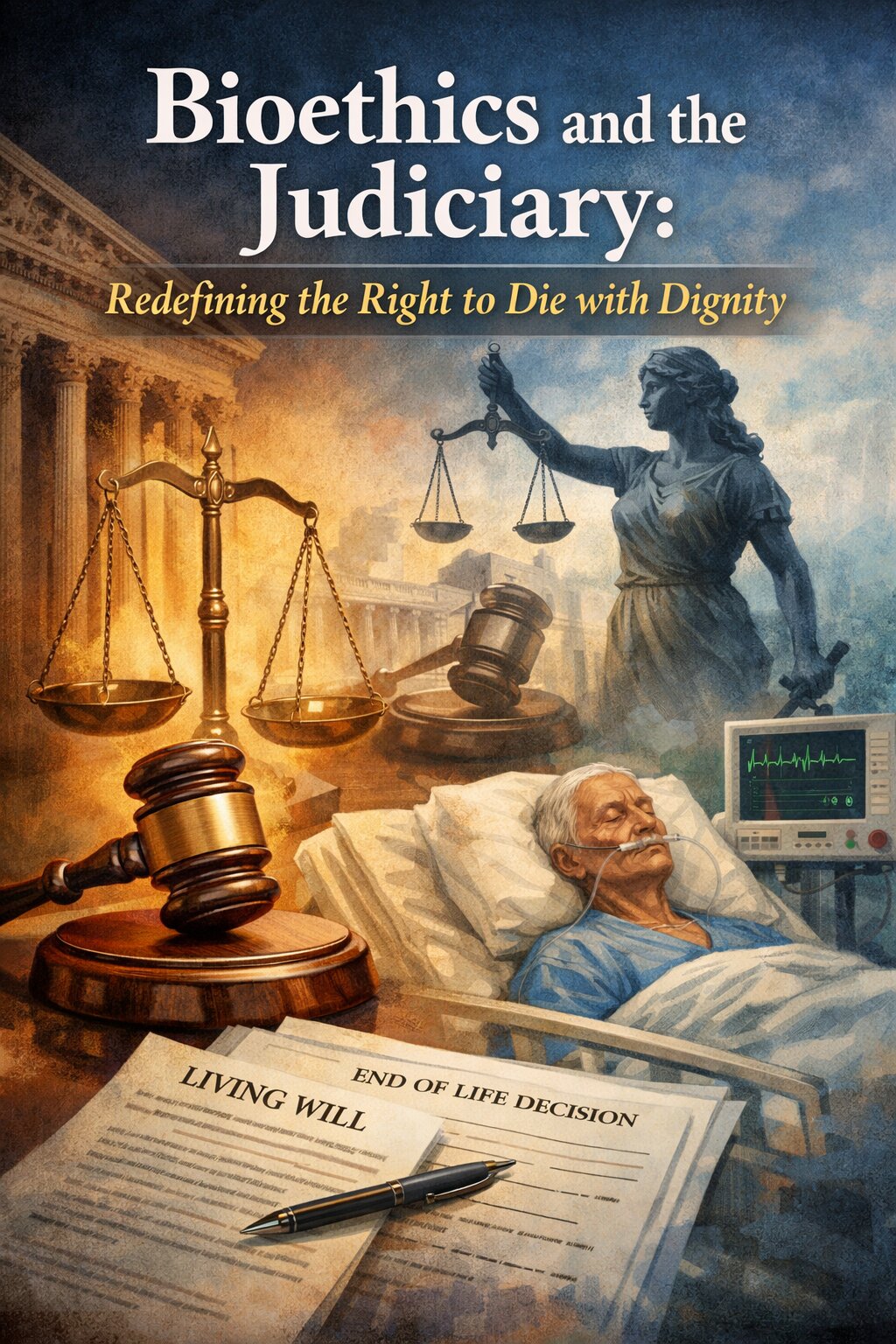
The Passive Euthanasia Precedent: Harish Rana v. Union of India (2026)
In a watershed moment for Indian jurisprudence and global bioethics, the Supreme Court of India, in its March 2026 ruling in Harish Rana v. Union of India, applied and clarified the framework for the withholding or withdrawal of life-sustaining medical treatment (often referred to as passive euthanasia). By permitting the withdrawal of clinically assisted nutrition and hydration (CANH) for a patient in a persistent vegetative state (PVS) for thirteen years, the Court transitioned from theoretical recognition in Common Cause (2018) to the first practical implementation of the “Right to Die with Dignity” under Article 21 of the Constitution.
I. The Legal Framework: From Common Cause to Harish Rana
While the 2018 Common Cause judgment established the legal validity of advance directives and passive euthanasia, the Harish Rana precedent serves as the operational refinement of these guidelines. The Court addressed the procedural bottlenecks that previously rendered the “Living Will” difficult to execute, streamlining the judicial and medical oversight required for the withdrawal of life support.
II. The Judicial Ratio Decidendi
The Court’s decision rested on three primary legal pillars:
- The Principle of Autonomy: Reinforcing that the right to privacy and bodily integrity under Article 21 includes the right of a patient (or their next friend/family in cases of incapacity) to refuse medical intervention that merely prolongs the process of dying without offering any meaningful benefit.
- Best Interest Test: In the absence of a clear Advance Medical Directive, the Court applied the “best interests” standard after a detailed assessment involving medical futility, irreversible loss of dignity, prolonged suffering, family views, and the absence of any prospect of recovery. The Court held that continued maintenance of a patient in a permanent vegetative state through life-sustaining treatment violates the inherent dignity protected under Article 21.
- Substantive Due Process: The ruling applied the Common Cause guidelines “in their full measure” while streamlining certain procedural aspects. It established a rigorous, multi-tier verification process involving primary and secondary Medical Boards along with limited judicial oversight to prevent any arbitrary termination of life-sustaining treatment.
III. Global Human Rights Implications
The Harish Rana decision is currently being scrutinized by international legal bodies and bioethicists as a model for balancing sanctity of life with quality of life.
Legal Observation: The judgment effectively harmonizes Indian domestic law with international human rights standards, specifically echoing the spirit of the European Convention on Human Rights (ECHR) regarding the prevention of “inhuman or degrading treatment.”
IV. Persistent Vegetative State (PVS)
In the context of the recent Harish Rana v. Union of India (2026) ruling and broader medical jurisprudence, Persistent Vegetative State (PVS) is a clinical condition that creates a profound legal and ethical challenge: the intersection of biological life and “meaningful” existence.
1. Clinical Definition and Legal Threshold
PVS is a condition of wakefulness without awareness. Unlike a coma (where the patient is closed-eyed and unresponsive), a patient in PVS:
- Has sleep-wake cycles and can open their eyes.
- Retains autonomic functions (breathing, heart rate, and digestion).
- Crucially: Lacks any cognitive function, purposeful movement, or ability to experience their environment.
The law distinguishes between “Persistent” (lasting more than a month) and “Permanent” (lasting more than 12 months for non-traumatic brain injuries). The Harish Rana case, involving a 13-year duration, surpassed all clinical thresholds for “permanent” status, rendering the possibility of recovery medically negligible.
2. The Legal Fiction of “Life” vs. “Dignity”
Under Article 21 of the Constitution, the judiciary has historically wrestled with whether PVS constitutes “Life.”
- Biological Life: The patient is technically alive because the brain stem functions.
- Constitutional Life: The Harish Rana ruling reinforces that “Life” is not mere animal existence. If the “self” is permanently absent due to PVS, forcing the body to remain “on” through artificial means can be viewed as a violation of the right to a dignified death.
- The “Double Lock” Protocol in PVS Cases
Following the guidelines laid down in Common Cause (as applied in Harish Rana), the withholding or withdrawal of life-sustaining medical treatment for patients in PVS requires a rigorous safeguard mechanism:
- The Medical Board: A primary board of hospital experts and a secondary board (often constituted at the district level by the Chief Medical Officer) must certify that the PVS is irreversible/permanent, that continued treatment (including CANH) is medically futile, and that it offers no therapeutic benefit. In the Harish Rana case, both boards confirmed the 13-year irreversible condition.
- Judicial Oversight: A Judicial Magistrate of First Class (JMFC) verifies the process, authenticity of any Living Will (if present), and the “best interests” consensus among family/next friends and medical experts. The Court may further streamline timelines and procedures, especially for home-based care, while mandating a robust palliative and end-of-life care plan.
- Living Will
For legal scholars and practitioners, the Living Will is no longer just a “death document”; it is a Bioethical Power of Attorney. It shifts the locus of control from the state and medical institutions back to the individual autonomy of the citizen.
Content of a Comprehensive Living Will
For a Living Will to be legally robust, it typically includes:
- Specific Exclusions: Instructions to withhold or withdraw Life Sustaining Treatment (LST) such as ventilators, dialysis, or artificial nutrition (Ryle’s tube).
- Palliative Care: A request for “comfort care”—ensuring the patient remains pain-free even if life-prolonging measures are stopped.
- Designated Proxy: Appointment of a “Next Friend”—a person authorized to make medical decisions on the patient’s behalf if the document is ambiguous.
- Threshold of Activation: A clear statement that the directive only takes effect if the condition is irreversible as certified by a Medical Board.
The “Best Interest” Safety Valve
The Harish Rana precedent addressed a critical gap: What happens if there is no Living Will? The Court ruled that in the absence of a written AMD, the “Next Friend” or family members can move the hospital to constitute a Medical Board. If the board agrees the patient is in a PVS (as seen in the 13-year Rana case), the withdrawal of treatment is permitted under the “Best Interest” principle, effectively acting as a “Deemed Living Will.”
- Legal Immunity for Medical Professionals
One of the most significant aspects is the protection afforded to medical professionals. If a medical team acts in good faith, following the Harish Rana / Common Cause protocol and with a proper palliative care plan:
- They are immune from civil or criminal liability.
- The act is not considered “murder” (u/s 302 IPC / 103(1) BNS) or “abetment to suicide” (u/s 306 IPC / 108 BNS).
- It is legally categorized as an omission allowing natural death by withdrawal of futile medical treatment.
- The directive can be revoked or amended at any time during the executor’s life.
- The Refined 2026 Execution Protocol
The Harish Rana judgment applied the Common Cause guidelines (2018, as modified in 2023) in full while providing important clarifications and streamlining for practical implementation, particularly in home-care settings. It emphasized efficiency, medical board autonomy, and integration with broader digital health initiatives without overhauling the core safeguards.
- Execution of Living Will: The document must be signed by the executor in the presence of two independent witnesses and attested by a Notary Public or Gazetted Officer.
- Digital Repository: Living Wills/Advance Medical Directives can be linked with a citizen’s ABHA (Ayushman Bharat Health Account) for better accessibility in emergencies, consistent with ongoing digital health policy. The consent to access the Living Will via ABHA should be part of the initial registration to prevent privacy disputes.
- Custody: A copy is typically provided to the designated “Next Friend” or family member, with another retained by the local municipal or panchayat body.
The judgment also directed that any withdrawal must be accompanied by a humane palliative and end-of-life care plan to ensure the patient does not suffer pain or distress.
V. Comparative Jurisprudence
The Indian Supreme Court’s treatment of PVS aligns with global landmark cases:
- UK: Airedale NHS Trust v. Bland (1993) – The first time the House of Lords allowed the withdrawal of food/hydration from a PVS patient.
- USA: Cruzan v. Director, Missouri Department of Health (1990) – Established that individuals have a right to refuse life-saving treatment, provided there is “clear and convincing evidence” of their wishes.
VI. Summary Table: PVS in Legal Terms
|
Category |
Legal Status in India (Post-2026) |
|
Status of Patient |
Legally “alive” but lacking “agency.” |
|
Intervention |
Withdrawal of “Life Sustaining Treatment” (LST) is permitted. |
|
Food/Hydration |
Clinically Assisted Nutrition and Hydration (CANH) via tubes (e.g., PEG or Ryle’s tube) is classified as medical treatment that can be lawfully withheld or withdrawn in best-interest cases. Ordinary oral food and water are not treated as medical treatment. |
|
Liability |
Doctors acting under Harish Rana guidelines are protected from criminal prosecution (u/s 302 or 306 IPC/ 103(1) or 108 BNS). |
Legal Note: The 2026 ruling is significant because it clarifies that in a 13-year permanent PVS case, the “sanctity of life” must yield to the prevention of undignified prolongation of biological existence. The Court treated the withdrawal of CANH as a permitted omission allowing natural death, accompanied by palliative care, rather than an act causing death.
VII. Conclusion
By permitting passive euthanasia in this specific, long-term PVS case, the Supreme Court has moved beyond mere legal abstraction. It has provided a definitive remedy for families and patients trapped in “biological limbo,” ensuring that the law remains a living instrument capable of addressing the complex ethical dilemmas posed by modern medical technology.
While “passive” euthanasia (omission) is now operationally streamlined, “active” euthanasia (commission of a lethal injection) remains strictly illegal in India.