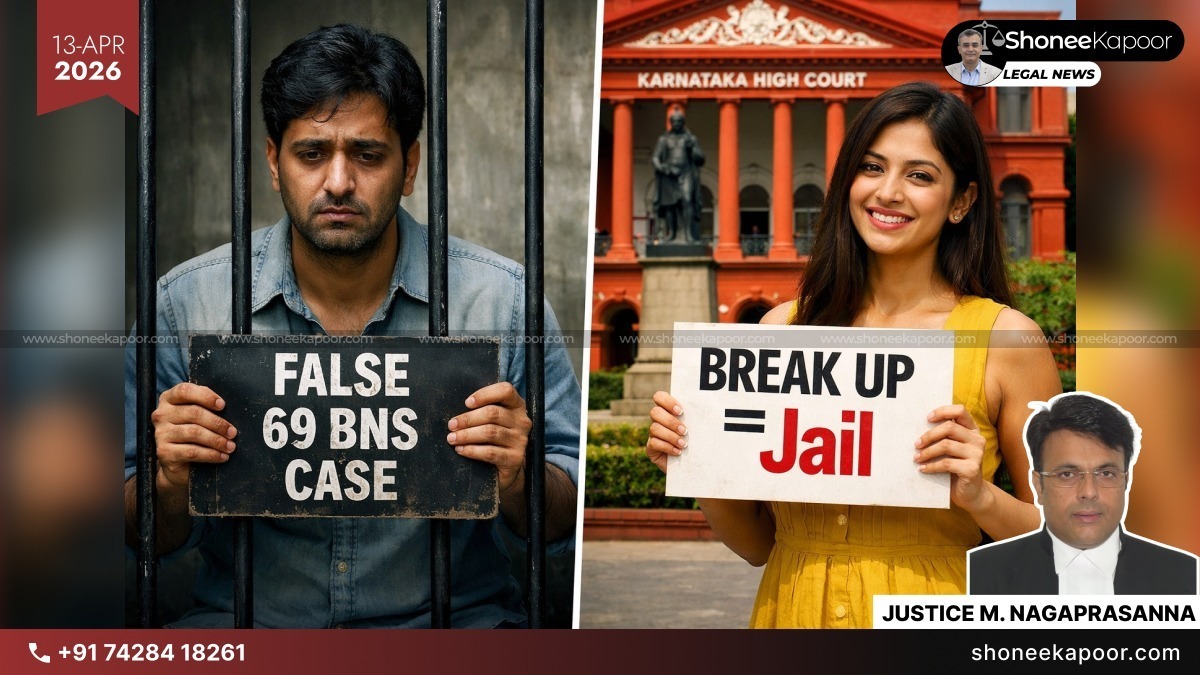
The KarnatakaRelationship ended, and suddenly criminal case? Is every breakup now being turned into a jail ticket for men? Section 69 BNS misuse exposed by Karnataka High Court.
Karnataka High Court Raises Concern Over Misuse of Section 69 BNS
Bengaluru: The Karnataka High Court raised serious concerns over the growing misuse of Section 69 BNS, particularly in cases arising out of failed relationships. Justice M. Nagaprasanna ordered the immediate release of a man who had been in custody for 42 days based on allegations of sexual intercourse on a false promise of marriage. The Court also stayed further investigation in the matter.
Court Observation on Misuse of Law
While granting relief, the court made a strong observation:
“The litigation is with regard to misuse of Section 69 of the BNS and mushrooming of cases before this Court by the day, and in all cases where the relationship ends in a breakup, the man is in the lockup. Therefore, it is necessary for this Court to direct release of the petitioner forthwith.”
Court Finds Relationship Was Consensual
The Court carefully examined the complaint and found that the relationship between the parties was consensual throughout. It noted that there was no allegation of force or coercion at any point.
“All consensual, as not a word of allegation of sexual assault by the petitioner against the complainant is narrated.”
Reliance on Supreme Court Precedents
The bench relied on precedents laid down by the Supreme Court in the following cases:
- Dr Dhruvaram Murlidhar Sonar v. State of Maharashtra
- Samadhan v. State of Maharashtra
These judgements clearly distinguish between breach of promise and criminal intent. Based on these principles, the Court held that continuing criminal proceedings in such circumstances would be legally unsustainable.
Facts of the Case
- Both individuals were colleagues.
- They entered into a relationship that later became physical.
- After around eight months, the relationship ended.
- A complaint was then filed alleging a false promise of marriage.
Court on False Promise of Marriage
However, upon reviewing the complaint, the Court found no material indicating that the promise was deceitful from the beginning.
“Though the provision, i.e., Section 69 of the BNS, would punish a person having sexual intercourse with the victim on the deceitful promise of marriage, in the case at hand there is no indication except the fact that the breach of promise of marriage is an afterthought that springs in the complaint…”
Final Order of the Court
- Allowed the accused’s applications
- Ordered immediate release from custody
- Stayed criminal proceedings before the Magistrate
- Issued notice to the complainant
Explanatory Table – Laws & Legal Position
| Legal Principle / Case | Explanation | Court’s Interpretation |
|---|---|---|
| Consent (General Criminal Law Principle) | Valid consent must be free, informed, and not obtained by fraud | If consent is voluntary and continuous → not an offence |
| Breach of Promise vs Criminal Offence | Mere failure to marry ≠ criminal offence | Must prove promise was false from the beginning |
| Dr Dhruvaram Murlidhar Sonar v. State of Maharashtra | Landmark SC judgment on false promise cases | Distinguishes breach of promise from rape |
| Samadhan v. State of Maharashtra | Reinforces requirement of fraudulent intent | Protects consensual relationships from criminalisation |
Case Details
- Case Title: Achal Singhal v/s State of Karnataka & Anr.
- Case Number: CRL.P 4961/2026
- Counsel for Petitioner: Advocate Aiyappa K.G.
- Bench: Honourable Mr Justice M. Nagaprasanna
- Court: High Court of Karnataka
Key Takeaways
- Courts are now openly acknowledging the routine misuse of Section 69 BNS in failed relationships.
- A breakup is being weaponised into a criminal case, with men directly pushed into custody without prima facie evidence.
- Consent in a long-term relationship cannot be retrospectively converted into “deceit” just because the relationship failed.
- Supreme Court precedents clearly protect men where there is no fraudulent intent from the beginning.
- This order reinforces that criminal law cannot become a tool for emotional revenge after a relationship ends.
Disclaimer: The views and opinions expressed in this article are those of the Indian courts and do not necessarily reflect the official policy or position of “ShoneeKapoor.com” or its affiliates. This article is intended for informational and educational purposes only. The content provided is not legal advice, and viewers should not act upon this information without seeking professional counsel. Viewer discretion is advised.
End Notes:
- https://matrimonialadvocates.com/?s=Karnataka+High+Court
- https://sahodar.in/section-69-of-the-bharatiya-nyaya-sanhita/
- https://www.shoneekapoor.com/prenup-nri-marriage-india-truth/
- https://www.shoneekapoor.com/alimony-maintenance-calculator-divorce-india/
- https://www.shoneekapoor.com/india-canada-divorce-jurisdiction-nri/
- https://www.shoneekapoor.com/498a-nri-husband-canada-case/
- https://www.shoneekapoor.com/legal-news/wp-content/uploads/2026/04/Achal-Singhal-v_s-State-of-Karnataka-Anr.pdf