





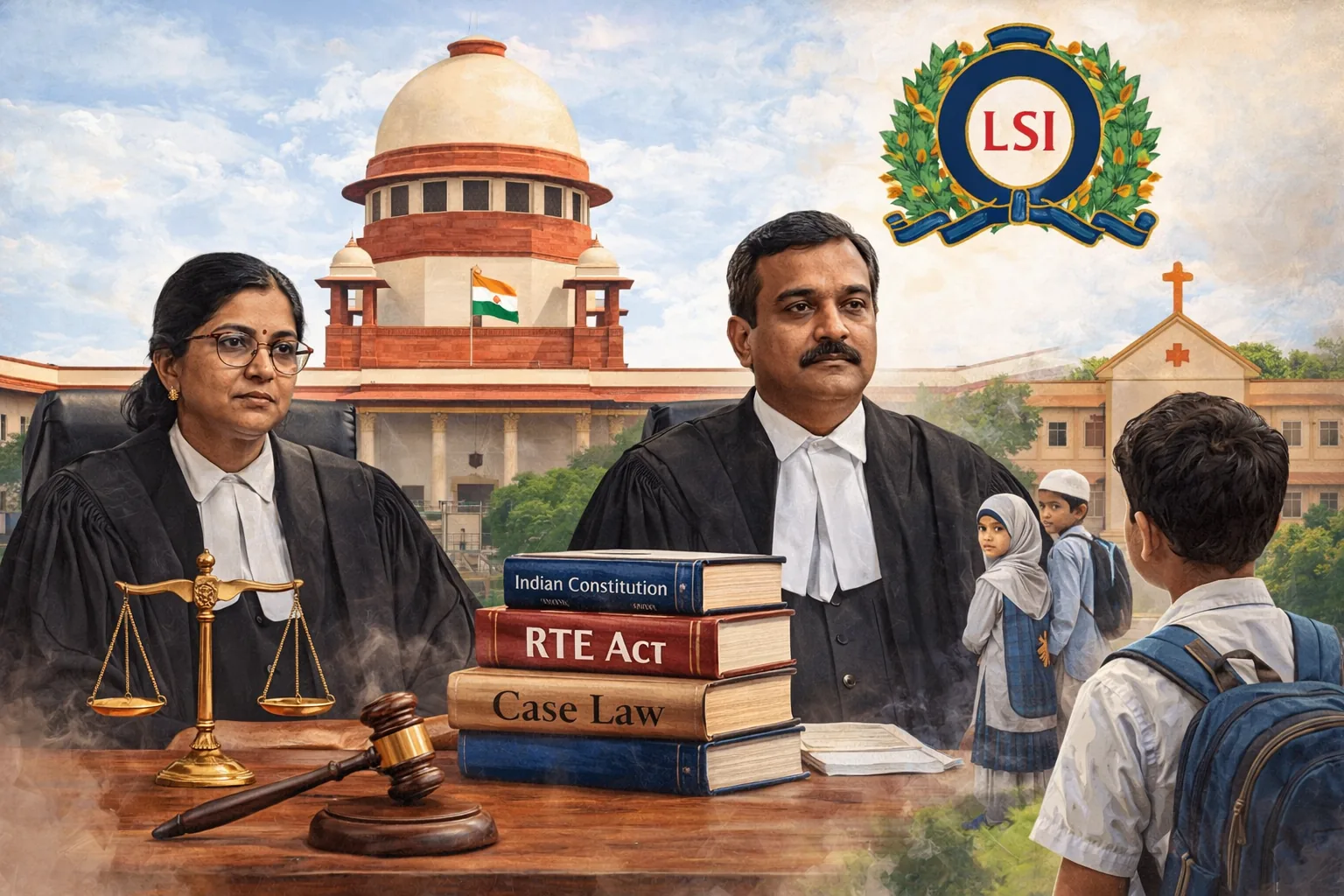
Introduction – The Legal Context of the Right to Education Act
The Right of Children to Free and Compulsory Education Act, 2009, commonly known as the RTE Act, represents a watershed moment in India’s constitutional and educational jurisprudence. Enacted to give effect to Article 21A of the Constitution of India, which was inserted by the 86th Constitutional Amendment in 2002, the RTE Act embodies the fundamental right of every child aged 6 to 14 years to free and compulsory education. This legislative framework transformed education from a directive principle of state policy into a justiciable fundamental right, marking a paradigm shift in how the Indian state approaches its obligation towards children’s education.
The RTE Act encompasses comprehensive provisions that mandate specific standards for schools, teacher qualifications, infrastructure requirements, and most significantly, the reservation of 25% seats in private unaided schools for children from economically weaker sections and disadvantaged groups. The Act’s implementation has been both celebrated as a progressive step towards educational equity and criticized for its practical challenges and constitutional complications, particularly concerning the rights of minority educational institutions.
At the heart of the constitutional tension lies Article 30(1) of the Constitution, which guarantees all minorities, whether based on religion or language, the right to establish and administer educational institutions of their choice. This provision has been interpreted by the Supreme Court as conferring special protection to minority institutions, recognizing their role in preserving and promoting minority culture, language, and identity. The interplay between the universal application of the RTE Act and the special constitutional protection afforded to minority institutions has generated significant legal debate and litigation.
The 2014 Supreme Court judgment in the Society for Unaided Private Schools of Rajasthan v. Union of India case established a crucial precedent by holding that minority educational institutions are exempt from certain provisions of the RTE Act, particularly the 25% reservation requirement. This decision was grounded in the constitutional protection under Article 30(1), which the Court interpreted as preventing the state from imposing obligations that would substantially interfere with the administration of minority institutions.
The recent Supreme Court proceedings, where a bench comprising Justice BV Nagarathna and Justice R Mahadevan imposed a cost of Rs 1 lakh on an NGO for challenging this settled legal position, brings to the forefront critical questions about the finality of judicial decisions, the doctrine of res judicata, and the growing concern over frivolous litigation that threatens to undermine judicial efficiency and authority. The Court’s strong remarks about not bringing down the judiciary by filing such cases reflect a deeper anxiety about the sanctity of judicial pronouncements and the need to maintain institutional integrity.
This incident also highlights the delicate balance courts must strike between ensuring access to justice and preventing abuse of the legal process. While the right to approach courts is fundamental to a democratic society, the filing of petitions that challenge settled law without substantial new grounds or changed circumstances represents a misuse of judicial resources and can erode public confidence in the legal system. The Supreme Court’s stern response serves as a reminder that legal professionals bear a responsibility to advise clients appropriately and to refrain from pursuing litigation that lacks legal merit or seeks to relitigate decided matters.
Understanding the RTE Act, its constitutional foundations, its interaction with minority rights, and the judicial approach to challenges against settled precedents is essential for legal practitioners, educators, policymakers, and citizens concerned with educational equity and constitutional governance. This blog examines these dimensions in detail, providing a comprehensive analysis of the legal landscape surrounding the Right to Education Act in India.
Case Background – Facts, Parties, and Legal Questions
The recent Supreme Court proceedings arose from a writ petition filed under Article 32 of the Constitution by an NGO named United Voice for Education Forum. The petition sought to challenge the constitutional validity of the exemption granted to minority educational institutions from the provisions of the Right to Education Act, 2009. Specifically, the petitioner contended that the exemption granted to minority schools constitutes a blanket immunity that is unconstitutional and violates the principles of equality and the fundamental right to education of children.
The petition directly challenged the Supreme Court’s 2014 landmark judgment in Society for Unaided Private Schools of Rajasthan v. Union of India and Others, wherein a Constitution Bench had examined the validity of various provisions of the RTE Act. In that comprehensive judgment, the Court had held that while the RTE Act applies to all schools except those established, owned, controlled, or managed by minority communities, the 25% reservation provision under Section 12(1)(c) of the Act does not apply to minority institutions protected under Article 30(1) of the Constitution.
The 2014 judgment was the culmination of extensive legal arguments and represented a careful balancing of competing constitutional values. The Constitution Bench had examined whether imposing the RTE Act’s requirements on minority institutions would amount to an infringement of their fundamental right under Article 30(1) to establish and administer educational institutions of their choice. The Court concluded that while minority institutions must maintain certain educational standards, they cannot be compelled to admit students through the 25% reservation mechanism as this would interfere with their administrative autonomy.
The petitioner NGO in the present case argued that this exemption creates an unequal playing field in the education sector, where minority institutions enjoy privileges not available to non-minority private schools. The petition contended that such exemption defeats the very purpose of the RTE Act, which was enacted to ensure universal access to quality education for all children, particularly those from disadvantaged backgrounds. The petitioner suggested that granting blanket immunity to minority schools from RTE obligations undermines the constitutional commitment to educational equity and social justice.
However, the fundamental flaw in the petition was that it sought to challenge a decision of the Supreme Court itself through a writ petition filed under Article 32 before the same Court. This represents a fundamental misunderstanding of judicial hierarchy and the doctrine of precedent in Indian constitutional law. Once the Supreme Court, particularly a Constitution Bench, has pronounced on a constitutional question, that decision becomes binding precedent and cannot be challenged through a fresh writ petition before the same Court.
The appropriate legal remedy, if any, for challenging a Supreme Court judgment would be through a review petition under Article 137 of the Constitution, which must be filed within the prescribed limitation period and can only be entertained on limited grounds such as error apparent on the face of the record. Alternatively, if there are changed circumstances or new legal questions that were not considered in the original judgment, a curative petition might be filed as a last resort. However, filing a fresh writ petition under Article 32 to challenge an existing Supreme Court judgment represents a gross abuse of the legal process.
When the matter came before the bench of Justice BV Nagarathna and Justice R Mahadevan, the Court expressed strong displeasure at the nature of the petition. The bench noted that the petition was not merely misconceived but represented an attack on the judicial system itself. The Court observed that allowing such petitions would create chaos in the legal system, as every litigant dissatisfied with a Supreme Court judgment could file fresh petitions challenging those decisions, thereby rendering the doctrine of finality of judgments meaningless.
The Court was particularly critical of the role of the advocate who had filed the petition, emphasizing that legal professionals have a duty to advise clients properly and to refrain from filing petitions that lack legal merit. The bench remarked that advocates, as officers of the court and law-knowing professionals, should not give advice that leads to such gross abuse of the legal process. The Court indicated that it was restraining itself from taking more serious action, including contempt proceedings, but warned that such conduct could lead to penalties against advocates in future cases.
The bench imposed a cost of Rs 1 lakh on the petitioner, stating that this should serve as a message to others who might contemplate filing similar petitions. The Court emphasized that it was restraining itself to this amount, suggesting that the misconduct warranted even harsher consequences. The imposition of costs serves multiple purposes in such cases: it compensates for the waste of judicial time and resources, it deters future frivolous litigation, and it sends a strong message about the seriousness with which courts view attempts to undermine judicial authority.
The parties in this case represent broader constituencies in the ongoing debate about educational rights in India. The petitioner NGO ostensibly represents the interests of children from disadvantaged backgrounds who might benefit from the 25% reservation in minority schools. On the other side, though not formally represented in this particular proceeding, are minority communities who view the exemption as essential to preserving their constitutional right to maintain their distinct educational institutions. The Supreme Court, in its role as the guardian of the Constitution, must balance these competing interests while also protecting the integrity of its own judicial process.
Court’s Observations – Judicial Reasoning and Legal Significance
The Supreme Court’s observations in this case were marked by an unusual degree of strong language and visible displeasure, reflecting the bench’s serious concern about the nature of the petition and its implications for the judicial system. Justice BV Nagarathna and Justice R Mahadevan did not merely dismiss the petition on technical grounds but used the occasion to deliver a stern message about the sanctity of judicial pronouncements and the consequences of frivolous litigation.
The Court’s primary observation was that the petition represented an attempt to challenge a Supreme Court judgment through a fresh writ petition under Article 32, which is fundamentally impermissible under Indian constitutional law. The bench emphasized that “you cannot do this to Supreme Court,” highlighting that such attempts undermine the entire judicial hierarchy and the doctrine of precedent that forms the backbone of the common law system. This observation underscores a fundamental principle: the Supreme Court’s judgments, particularly those of Constitution Benches, represent the final word on constitutional interpretation and cannot be collaterally challenged through fresh petitions.
The Court remarked that it was “enraged” by the petition, stating that “this is against the entire system of judiciary in this country if you start filing such cases.” This strong language reflects the bench’s view that the petition was not merely a procedural error but an attack on the institutional integrity of the judiciary. The Court’s concern appears to be that if such petitions are entertained or treated lightly, it would open the floodgates to endless challenges against settled law, making it impossible for the legal system to function with any degree of certainty or finality.
Significantly, the Court directed its criticism not only at the petitioner but also at the legal profession more broadly, asking “Advocates are giving such kind of advice?” This observation highlights the Court’s expectation that advocates, as officers of the court, should exercise professional judgment and ethical responsibility in advising clients. The bench suggested that advocates who file such petitions should themselves face penalties, indicating that the Court views this as not merely a client’s error but a professional failing on the part of the lawyer.
The Court characterized the petition as the “grossest abuse” of the legal process, emphasizing that the petitioners were “law knowing citizens, professionals” who should have understood the impropriety of their action. This observation is particularly significant because it suggests that the Court expects a higher standard of conduct from those who are legally trained and should be aware of basic principles of judicial hierarchy and precedent. The Court’s reference to “law knowing citizens” indicates that ignorance of law cannot be an excuse when the petitioner is represented by legal professionals.
The bench stated that it was “restraining” itself by limiting the cost to Rs 1 lakh and not issuing contempt proceedings. This observation is revealing because it suggests that the Court viewed the petition as potentially contemptuous, meaning it could be seen as an attempt to scandalize or lower the authority of the Court. The decision to impose costs rather than initiate contempt proceedings reflects a measured approach, but the warning is clear: future cases of this nature might be treated more severely.
The Court’s remark that “you want to crumble the judiciary of this country” reflects a deep concern about the cumulative effect of such petitions on public confidence in the judicial system. This observation suggests that the Court views frivolous litigation not as isolated incidents but as part of a broader pattern that threatens judicial authority and efficiency. The use of such strong language indicates that the Court sees this as a systemic issue requiring a firm response.
From a legal significance perspective, this judgment reinforces several important principles. First, it reaffirms the doctrine of precedent and the binding nature of Supreme Court judgments. The Court’s strong response makes it clear that settled law cannot be challenged through fresh petitions without proper legal grounds. Second, it emphasizes the professional responsibility of advocates to advise clients appropriately and to refrain from filing meritless petitions. Third, it demonstrates the Court’s willingness to use its power to impose costs as a deterrent against frivolous litigation.
The judgment also has implications for understanding the finality of the 2014 decision on RTE Act exemptions for minority schools. By responding so strongly to this challenge, the Supreme Court has effectively reinforced the precedent established in that case. The Court’s observations suggest that the constitutional balance struck in 2014 between the universal right to education and the special protection for minority institutions is not open to casual reconsideration through fresh petitions.
However, the judgment also raises some questions about access to justice and the space for legitimate challenges to existing precedents. While the Court’s concern about frivolous litigation is valid, there must remain mechanisms for revisiting legal positions when circumstances change or when new constitutional questions arise. The strong language used in this case might have a chilling effect on legitimate petitions that seek to raise genuine legal issues, even if they relate to areas covered by previous judgments.
The Court’s emphasis on the role of advocates is particularly noteworthy in the current legal landscape, where there is growing concern about the quality of legal advice and the proliferation of public interest litigations that serve private interests or lack genuine public interest content. By warning that advocates themselves might face penalties, the Court is attempting to create accountability within the legal profession for the quality and appropriateness of litigation.
Impact – Broader Legal and Practical Implications
The Supreme Court’s strong response in this case has far-reaching implications that extend beyond the immediate parties and touch upon fundamental aspects of judicial functioning, legal practice, educational policy, and constitutional governance in India. Understanding these multifaceted impacts is crucial for appreciating the significance of this judgment in the broader legal landscape.
Impact on Judicial Precedent and Finality of Judgments
The most immediate impact of this judgment is the reinforcement of the principle of finality of judicial decisions, particularly those of the Supreme Court. By imposing substantial costs and using strong language to condemn the petition, the Court has sent a clear message that its judgments, especially those of Constitution Benches, cannot be challenged through fresh writ petitions. This strengthens the doctrine of precedent and ensures that settled legal positions provide certainty and predictability in the legal system. For legal practitioners and litigants, this means that once the Supreme Court has pronounced on a constitutional question, that decision must be accepted as binding unless and until it is modified through proper legal channels such as review or curative petitions.
This emphasis on finality is essential for the functioning of any legal system. Without it, every judgment would be subject to endless relitigation, making it impossible for individuals, institutions, and the government to plan their affairs with any degree of certainty. The judgment thus serves to protect the integrity of the judicial process and to ensure that judicial resources are not wasted on repetitive litigation of settled questions.
Impact on the Legal Profession and Advocate Responsibility
The Court’s criticism of the advocate who filed the petition has significant implications for the legal profession. By suggesting that advocates who file such petitions should face penalties, the Court is emphasizing the professional and ethical responsibilities that lawyers owe to the court and to the legal system. This could lead to greater caution among advocates in accepting cases and advising clients, particularly in matters involving challenges to settled law.
The judgment serves as a reminder that advocates are not merely hired guns who must pursue any case a client wishes to file, but are officers of the court with a duty to uphold the integrity of the legal system. This might encourage more rigorous case evaluation before filing, better client counseling about the merits and risks of litigation, and a more responsible approach to public interest litigation. However, there is also a risk that the strong language used by the Court might create excessive caution, potentially deterring advocates from taking on genuinely novel or challenging cases that might push the boundaries of existing law.
Impact on Educational Policy and Minority Rights
By strongly defending the 2014 judgment that exempted minority schools from certain RTE Act provisions, the Supreme Court has reinforced the constitutional protection afforded to minority educational institutions under Article 30(1). This has significant implications for educational policy in India, as it confirms that minority institutions cannot be compelled to comply with the 25% reservation requirement that applies to other private schools.
For minority communities, this judgment provides reassurance that their constitutional right to establish and administer educational institutions will be protected against attempts to erode it through litigation. It confirms that the special protection under Article 30(1) is not merely a historical artifact but a living constitutional guarantee that the courts will actively defend. This is particularly important in the current political and social climate, where there are ongoing debates about the extent of special protections for minorities.
However, this also means that the goal of universal access to quality education through the RTE Act will continue to face limitations. Children from economically weaker sections will not have access to the 25% reservation in minority schools, which in some areas constitute a significant portion of the private school sector. This creates a tension between the constitutional commitment to educational equity and the protection of minority rights, a tension that the Supreme Court has resolved in favor of minority rights but which continues to generate debate among educators, policymakers, and social activists.
Impact on Frivolous Litigation and Judicial Efficiency
The imposition of Rs 1 lakh cost and the strong language used by the Court represent part of a broader effort by Indian courts to combat frivolous litigation and improve judicial efficiency. India’s courts are notoriously overburdened, with millions of pending cases and long delays in justice delivery. Frivolous petitions that challenge settled law without proper grounds contribute to this backlog and waste precious judicial time that could be devoted to genuine cases.
By imposing substantial costs and warning of potential contempt proceedings, the Court is attempting to create a deterrent effect that will discourage similar petitions in the future. This could contribute to improved judicial efficiency if it successfully reduces the number of meritless cases filed. However, the effectiveness of such deterrents depends on consistent application across cases and courts. If costs are imposed sporadically or inconsistently, they may not have the desired deterrent effect.
Impact on Public Interest Litigation
The judgment also has implications for the practice of public interest litigation (PIL) in India. PIL has been a powerful tool for social justice, allowing NGOs and concerned citizens to bring important issues before the courts even when they are not directly affected. However, PIL has also been criticized for being misused to pursue private agendas, settle scores, or gain publicity. The Supreme Court’s strong response in this case suggests a growing impatience with PILs that lack genuine public interest content or that seek to relitigate settled questions.
This could lead to more stringent scrutiny of PILs at the admission stage, with courts more carefully examining whether a petition raises genuine issues of public importance or merely seeks to challenge existing law without proper grounds. While this might help filter out frivolous PILs, there is also a risk that it might make courts more reluctant to entertain legitimate PILs that challenge government action or seek to expand rights.
Impact on Constitutional Interpretation and Balancing of Rights
At a deeper level, this judgment reflects the ongoing challenge of balancing competing constitutional values in a diverse democracy like India. The tension between the universal right to education and the special protection for minority institutions represents a broader challenge of balancing equality with diversity, individual rights with group rights, and state intervention with institutional autonomy.
The Supreme Court’s strong defense of its 2014 judgment suggests that it views the balance struck in that case as constitutionally sound and not open to easy reconsideration. This has implications for how courts approach similar questions of balancing competing rights in other contexts. It suggests that once a constitutional balance has been carefully struck by a Constitution Bench, it will be defended against challenges unless there are compelling reasons to reconsider.
Long-term Implications for Legal Reform
Finally, this judgment highlights the need for legal reforms to address the problem of frivolous litigation more systematically. While imposing costs in individual cases can have some deterrent effect, a more comprehensive approach might include reforms to the rules of procedure, clearer guidelines for when costs should be imposed, mechanisms for screening petitions at an early stage, and perhaps even disciplinary consequences for repeated filing of frivolous cases.
The judgment also underscores the need for better legal education and professional training that emphasizes ethical responsibilities and the proper use of legal processes. If advocates are better trained to evaluate the merits of cases and to advise clients appropriately, it might reduce the incidence of frivolous litigation at the source.
FAQs – Common Questions About the RTE Act and This Judgment
Q1: What is the Right to Education (RTE) Act, and what are its main provisions?
The Right of Children to Free and Compulsory Education Act, 2009, commonly known as the RTE Act, is a landmark legislation that operationalizes Article 21A of the Constitution of India, which guarantees free and compulsory education as a fundamental right to all children aged 6 to 14 years. The Act was enacted to ensure that every child has access to quality elementary education and to eliminate barriers that prevent children, particularly those from disadvantaged backgrounds, from attending school.
The main provisions of the RTE Act include the following: First, it mandates that every child has the right to free and compulsory education in a neighborhood school until the completion of elementary education. Second, it prohibits all kinds of physical punishment, mental harassment, and discrimination against children. Third, it specifies norms and standards for schools, including infrastructure requirements, teacher-student ratios, and teacher qualifications. Fourth, and most controversially, Section 12(1)(c) of the Act requires private unaided schools to reserve 25% of their seats at the entry level for children from economically weaker sections and disadvantaged groups, with the government reimbursing schools for the cost of this education.
The Act also prohibits schools from charging capitation fees, conducting screening procedures for admission, and holding back or expelling students until the completion of elementary education. It establishes School Management Committees with parent representation to oversee school functioning and creates mechanisms for monitoring implementation and addressing grievances. The RTE Act represents a comprehensive framework for ensuring that education is not merely available but is accessible, affordable, and of acceptable quality for all children in India.
Q2: Why are minority schools exempted from certain provisions of the RTE Act, and is this exemption constitutional?
Minority schools are exempted from certain provisions of the RTE Act, particularly the 25% reservation requirement, based on the constitutional protection provided under Article 30(1) of the Constitution of India. Article 30(1) guarantees all minorities, whether based on religion or language, the right to establish and administer educational institutions of their choice. This provision was included in the Constitution to protect the cultural and educational rights of minority communities and to ensure that they could preserve and transmit their distinct identity, language, and culture through educational institutions.
The Supreme Court, in its 2014 judgment in Society for Unaided Private Schools of Rajasthan v. Union of India, held that applying the 25% reservation requirement to minority institutions would substantially interfere with their right to administer these institutions. The Court reasoned that the right to administer includes the right to admit students of the institution’s choice and that compelling minority schools to admit 25% of students through a government-mandated process would undermine this administrative autonomy.
The constitutional validity of this exemption has been upheld by the Supreme Court based on the principle that Article 30(1) provides special protection to minority institutions that is not available to non-minority institutions. The Court has held that this special protection is justified by the need to safeguard minority communities against potential discrimination and to preserve India’s pluralistic character. While this creates some inequality in the application of the RTE Act, the Court has determined that this inequality is constitutionally mandated and necessary to protect minority rights.
However, it is important to note that minority institutions are not completely exempt from all regulations. They must still maintain educational standards, provide quality education, and comply with regulations that do not substantially interfere with their administrative autonomy. The exemption is specifically from provisions like the 25% reservation that would affect their ability to choose their student body, which the Court has held is central to the right to administer an institution.
Q3: What are the legal remedies available if someone disagrees with a Supreme Court judgment?
If a party disagrees with a Supreme Court judgment, there are limited legal remedies available, reflecting the principle that the Supreme Court is the final arbiter of constitutional and legal questions in India. The most common remedy is filing a review petition under Article 137 of the Constitution, which allows the Supreme Court to review its own judgments. However, review petitions can only be entertained on limited grounds, such as an error apparent on the face of the record, discovery of new and important evidence that was not available earlier despite due diligence, or some other sufficient reason.
A review petition must be filed within 30 days of the judgment (or the date when the applicant became aware of the judgment), and the grounds for review must be substantial. The Supreme Court has held that review is not a rehearing of the case and cannot be used merely because a party disagrees with the judgment or believes the Court reached the wrong conclusion. The error must be obvious and patent, not something that requires elaborate arguments to demonstrate.
If a review petition is dismissed, the final remedy available is a curative petition, which was recognized by the Supreme Court in the case of Rupa Ashok Hurra v. Ashok Hurra (2002). A curative petition can be filed only after a review petition has been dismissed and only on very limited grounds, such as violation of principles of natural justice or bias on the part of the judges. Curative petitions are heard by senior-most judges of the Supreme Court and are entertained only in the rarest of rare cases where there has been a serious miscarriage of justice.
What is not permissible, as this recent judgment makes clear, is filing a fresh writ petition under Article 32 or Article 226 to challenge a Supreme Court judgment. Such petitions are considered an abuse of the legal process and can result in dismissal with costs, as happened in this case. The doctrine of res judicata and the principle of finality of judgments prevent the same matter from being litigated repeatedly, and these principles apply with particular force to Supreme Court judgments, which represent the final word on legal questions in India.
Conclusion – Final Thoughts and Future Developments
The Supreme Court’s strong response to the petition challenging its 2014 judgment on RTE Act exemptions for minority schools represents a significant moment in Indian jurisprudence, one that goes beyond the specific issue of educational rights to touch upon fundamental questions of judicial authority, legal ethics, and the proper functioning of the legal system. The imposition of Rs 1 lakh cost and the stern language used by the bench of Justice BV Nagarathna and Justice R Mahadevan send a clear message that the finality of judicial decisions, particularly those of the Supreme Court, must be respected and that attempts to undermine this finality through improper litigation will be met with serious consequences.
Looking forward, this judgment is likely to have several important effects on the legal landscape in India. First, it will likely lead to greater caution among litigants and advocates in filing petitions that challenge settled law, particularly Supreme Court judgments. This could contribute to improved judicial efficiency by reducing the number of frivolous cases that burden the courts. However, it also raises questions about the balance between deterring frivolous litigation and maintaining access to justice for those with genuine grievances.
Second, the judgment reinforces the constitutional protection afforded to minority educational institutions under Article 30(1) and confirms that the exemption from certain RTE Act provisions is not open to casual reconsideration. This provides certainty to minority communities about their educational rights but also means that the tension between universal educational access and minority rights will continue to be a feature of India’s educational landscape. Future developments in this area are likely to focus on implementation challenges, ensuring that minority institutions maintain quality standards while exercising their administrative autonomy, and exploring ways to expand educational access without infringing on constitutional protections.
Third, the judgment highlights the need for ongoing reform of the legal profession and legal education to ensure that advocates understand their ethical responsibilities and the proper use of legal processes. Professional bodies like the Bar Council of India may need to develop clearer guidelines and more robust enforcement mechanisms to address instances of professional misconduct, including the filing of frivolous petitions. Legal education institutions should place greater emphasis on professional ethics and the responsible exercise of legal rights.
Fourth, the judgment may prompt broader discussions about the mechanisms available for revisiting legal precedents when circumstances change or when new constitutional questions emerge. While the principle of finality is essential for legal certainty, there must also be flexibility to adapt legal interpretations to changing social conditions and evolving constitutional values. The challenge is to create mechanisms that allow for legitimate evolution of the law while preventing endless relitigation of settled questions.
In terms of the RTE Act itself, future developments are likely to focus on improving implementation, addressing gaps in access to quality education, and finding ways to expand the reach of the Act’s benefits while respecting constitutional limitations. There may be efforts to encourage minority institutions to voluntarily participate in programs that expand access for disadvantaged children, even if they cannot be legally compelled to do so. There may also be increased focus on improving government schools and expanding the capacity of the public education system to ensure that all children have access to quality education regardless of the limitations on private school obligations.
The judgment also serves as a reminder of the complex balancing act that courts must perform in a diverse democracy like India, where multiple constitutional values and rights must be harmonized. The tension between equality and diversity, between individual rights and group rights, and between state intervention and institutional autonomy is not unique to the education sector but appears in many areas of constitutional law. How courts navigate these tensions, and how they respond to challenges to their decisions, will shape the evolution of Indian constitutional jurisprudence in the years to come.
Ultimately, this judgment reinforces the principle that the rule of law depends not only on the quality of judicial decisions but also on respect for those decisions once they are made. While there must always be room for legitimate challenges and for the evolution of legal doctrine, the foundation of any legal system is the acceptance that courts’ decisions, particularly those of the highest court, represent authoritative interpretations of the law that must be followed. The Supreme Court’s strong response in this case is an assertion of this principle and a warning that attempts to undermine it will not be tolerated.
How Claw Legaltech Can Help?
Navigating the complexities of education law, constitutional litigation, and understanding landmark judgments like those related to the RTE Act requires access to comprehensive legal resources, efficient case management tools, and up-to-date legal information. This is where Claw Legaltech emerges as an invaluable platform for legal professionals, students, educators, and litigants seeking to understand and engage with India’s legal system effectively.
Legal GPT and AI Case Search for Education Law Research
One of the most powerful features of Claw Legaltech is its Legal GPT, which can draft legal documents, answer complex legal queries, and provide relevant citations from case law and statutes. For matters related to the RTE Act, minority rights, and constitutional law, Legal GPT can help advocates quickly research legal positions, understand precedents, and draft petitions or responses with proper legal backing. The AI Case Search feature complements this by allowing users to find relevant judgments by keyword or contextual search, making it easy to locate cases related to Article 30(1), education rights, or frivolous litigation. Instead of spending hours manually searching through case law databases, legal professionals can use these AI-powered tools to quickly identify relevant precedents and legal principles, significantly improving research efficiency and the quality of legal arguments.
Case Summarizer and Chat with Judgments for Understanding Complex Decisions
Understanding lengthy Supreme Court judgments, particularly those of Constitution Benches that run into hundreds of pages, can be challenging and time-consuming. Claw Legaltech’s Case Summarizer feature provides concise summaries of judgments with proper citations, allowing users to quickly grasp the key holdings, reasoning, and implications of important cases. The Chat with Judgments feature takes this a step further by allowing users to have conversational interactions with judgment texts, asking specific questions about the reasoning, implications, or particular aspects of a decision. For someone trying to understand the 2014 RTE Act judgment or the recent decision imposing costs for challenging it, these features can provide quick, accurate insights without requiring them to read through entire judgment texts, making legal research more accessible and efficient.
Smart Calendar and Case Management for Litigation Tracking
For advocates and litigants involved in education law cases or any litigation related to constitutional rights, Claw Legaltech’s Smart Calendar and Case Management features provide comprehensive tools for tracking hearings, managing deadlines, and organizing case files. The platform allows users to maintain detailed case histories, set reminders for important dates, and receive automated alerts about upcoming hearings or deadlines. This is particularly valuable in complex constitutional litigation where multiple petitions, interventions, and procedural steps must be carefully tracked. The Case Alerts feature ensures that both lawyers and clients receive automatic updates about case developments, ensuring that no important deadline is missed and that all parties remain informed about the progress of their matters. By centralizing case information and automating routine tracking tasks, these features allow legal professionals to focus on substantive legal work rather than administrative details, improving both efficiency and client service.

