- Introduction: What is Postponement?
In Indian jurisprudence, “postponement” refers to the temporary deferral of a legal proceeding, obligation, or the enforcement of a court order. While often used interchangeably with “adjournment” in everyday practice, postponement carries a broader connotation. It may involve delaying the hearing of a case, enforcing a decree, operating a new legal rule, or even restricting media reporting on a sub judice matter.
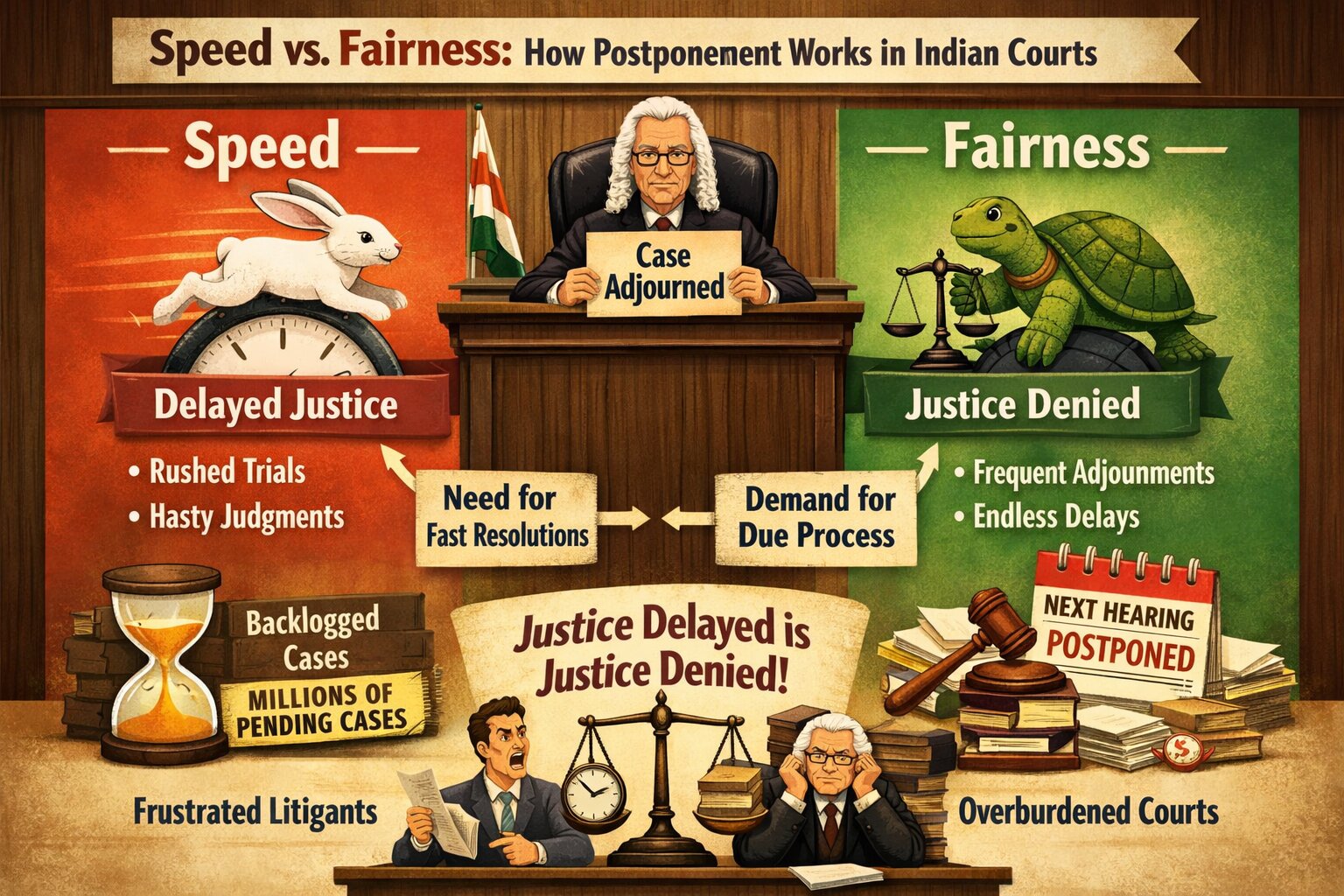
Indian courts constantly navigate a delicate balance between two constitutional imperatives:
Speed: Article 21 of the Constitution guarantees the right to a speedy trial and expeditious justice. With millions of pending cases causing “docket explosion,” courts are under pressure to dispose of matters quickly.
Fairness: Articles 14 and 19 demand equality before the law and reasonable restrictions only when necessary. A litigant with genuine reasons—such as unavoidable illness, unavailability of crucial evidence, or counsel’s sudden incapacity—must not be denied a fair opportunity.
Postponement thus acts as a safety valve in the justice delivery system: a limited exception rather than a routine tool.
- Essential Features of Postponement
A valid postponement is not automatic. It possesses three key characteristics:
Judicial Discretion: There is no vested right to postponement. The court grants it only upon sufficient cause being shown.
Definite Timeline: Postponement must be for a specified period or until a particular event. An indefinite delay is impermissible as it would defeat the ends of justice.
Versatility: It can apply at any stage—pre-trial, during trial, post-conviction (sentencing), or even to regulate external factors such as media coverage that might prejudice a fair trial.
- Legal Framework: Civil vs. Criminal
Recent procedural reforms aim to curb chronic delays while preserving fairness.
Civil Law (Code of Civil Procedure, 1908)
Order XVII Rule 1 CPC governs adjournments in civil suits. The provision states that the court may grant time if sufficient cause is shown, but no adjournment shall be granted more than three times to a party during the hearing of the suit. This “three-adjournment limit” was introduced through the 2002 amendment to prevent cases from becoming endless.
However, the rule is not absolute. Courts may grant further adjournments in exceptional cases for recorded reasons, often coupled with costs imposed on the defaulting party. The objective is to discourage casual requests while allowing genuine flexibility.
Additionally, to avoid conflicting decisions, one court may postpone proceedings when parallel litigation involving the same parties and subject matter is pending elsewhere.
Criminal Law (Bharatiya Nagarik Suraksha Sanhita, 2023 – BNSS)
The BNSS marks a significant shift toward “fast justice.” Section 346 BNSS mandates that once a trial begins, proceedings shall continue from day to day until all witnesses in attendance are examined, unless the court records reasons for adjourning beyond the next day.
For sexual offenses under specified sections of the Bharatiya Nyaya Sanhita (BNS), stricter timelines apply:
- Investigation must generally conclude within two months from the date of the FIR (for rape and related offenses).
- Once the charge sheet is filed, the trial should ideally be completed within two months.
These timelines are direct in nature but reflect Parliament’s strong intent to protect victims and ensure swift accountability. Day-to-day trials are now the norm, with postponements treated as exceptions requiring justification.
- Postponement Orders and Media Reporting
In Sahara India Real Estate Corpn. Ltd. v. SEBI (2012), the Supreme Court recognized the court’s inherent power to issue postponement orders restraining media from publishing prejudicial material during ongoing trials. Such orders are not intended to curb press freedom under Article 19(1)(a) but to protect the accused’s right to a fair trial under Article 21. They are temporary, narrowly tailored, and subject to periodic review. The goal is to prevent “trial by media” that could influence judges, witnesses, or public perception.
- Postponement in Other Spheres
Postponement is not confined to courtrooms. It appears in several contexts:
| Domain | Key Concept | Triggering Circumstances | Legal Purpose / Effect |
| Elections | Postponing Polls | Natural disasters, violence, or death of a candidate | Ensures free and fair elections by preventing disruption or disenfranchisement. |
| Contracts | Force Majeure Clauses | Unforeseeable events like floods or pandemics | Excuses non-performance when external events make fulfillment impossible. |
| Constitutional Law | Prospective Overruling | When immediate enforcement of a new ruling may cause administrative chaos | Applies new judicial interpretations only to future cases, preserving stability. |
6. Distinguishing Related Concepts
Adjournment: Narrow and specific—simply shifting the date of a scheduled hearing.
Postponement: Broader—may delay an event, a process, or the operation of a decision.
Stay: More drastic—it halts the entire proceeding or enforcement, effectively freezing the status quo.
- Safeguards Against Abuse
Courts are vigilant against litigants who use postponement requests to harass opponents or prolong litigation tactically. Key principles include the following:
Bona Fide Requirement: The party must demonstrate genuine effort and sufficient cause. Mere convenience or negligence is insufficient.
Balancing Test: The court weighs the prejudice to the requesting party against the delay and hardship caused to the opponent and the system.
Reasoned Order: Every grant or refusal of postponement must be supported by stating reasons.
Costs: Courts routinely impose costs—sometimes heavy—to deter frivolous requests.
These safeguards ensure postponement serves justice rather than obstructs it.
- Recent Judicial Trends
India’s higher judiciary has intensified its crackdown on the “culture of adjournments.”
In CBI v. Mir Usman @ Ara @ Mir Usman Ali (2025 INSC 1155), the Supreme Court expressed serious concern over the decline of day-to-day trials, especially in sensitive cases involving sexual offenses. The Court urged High Courts to issue circulars directing district judiciaries to revive the old practice of conducting trials continuously once witnesses are in attendance. It emphasized strict compliance with Section 346 BNSS and directed timely completion of proceedings in the specific case before it. The judgment reinforces that piecemeal trials undermine fairness and increase risks of witness influence.
Complementing this, the Supreme Court issued a circular dated 18 March 2026 (F.No. 3/Judl./2026) laying down stricter norms for adjournment requests. Letters seeking adjournment in fresh cases are permitted only once. Requests must mention specific reasons and the number of prior adjournments and be served on the opposite side with proof. Adjournment in regular matters is generally not entertained through letters; exceptional circumstances (such as bereavement or serious medical issues) must be demonstrated to the court’s satisfaction. The circular prioritizes the “mandate of finality” over routine professional convenience.
Internationally, similar trends emphasize expedition alongside fairness. The Highest Regional Court of Bavaria (BayObLG) in 2025 rulings reiterated a high threshold for postponements, holding that claims of illness or other difficulties do not automatically violate the right to be heard if adequate opportunities were provided earlier. In the United Kingdom, decisions such as Grainful Holdings Ltd v. Mineev (2025) underscore that courts will not readily accommodate parties showing lack of diligence or disregard for timelines, particularly in contempt or enforcement proceedings.
Collectively, these developments signal a global judicial shift: courts are increasingly acting as active case managers, where timely resolution is as important as substantive justice.
- Conclusion: Towards a Culture of Finality
For decades, Indian courts grappled with a pervasive “culture of adjournments” that turned justice into a prolonged ordeal for ordinary citizens. Excessive delays eroded public trust, inflated litigation costs, and sometimes allowed powerful parties to wear down weaker opponents.
Today, the doctrine of postponement is being recalibrated. It remains an essential tool for genuine emergencies—whether a pandemic, unforeseen calamity, or rare human error—but it is no longer a casual procedural indulgence. New laws like the BNSS, combined with Supreme Court directives and the 2026 circular, are steadily dismantling unnecessary delay mechanisms.
The emerging “culture of finality” places resolution at the heart of the process. Postponement is now viewed strictly as a principled exception to be used only when the ends of justice would otherwise suffer irreparable harm. By prioritizing speedy yet fair adjudication, the judiciary is reaffirming its commitment to Article 21 while upholding the rule of law.
The message to litigants, lawyers, and all stakeholders is clear: the era of perpetual postponements is drawing to a close. Justice delayed may no longer be justice denied—but in today’s reformed framework, justice must also be justice delivered without avoidable delay.