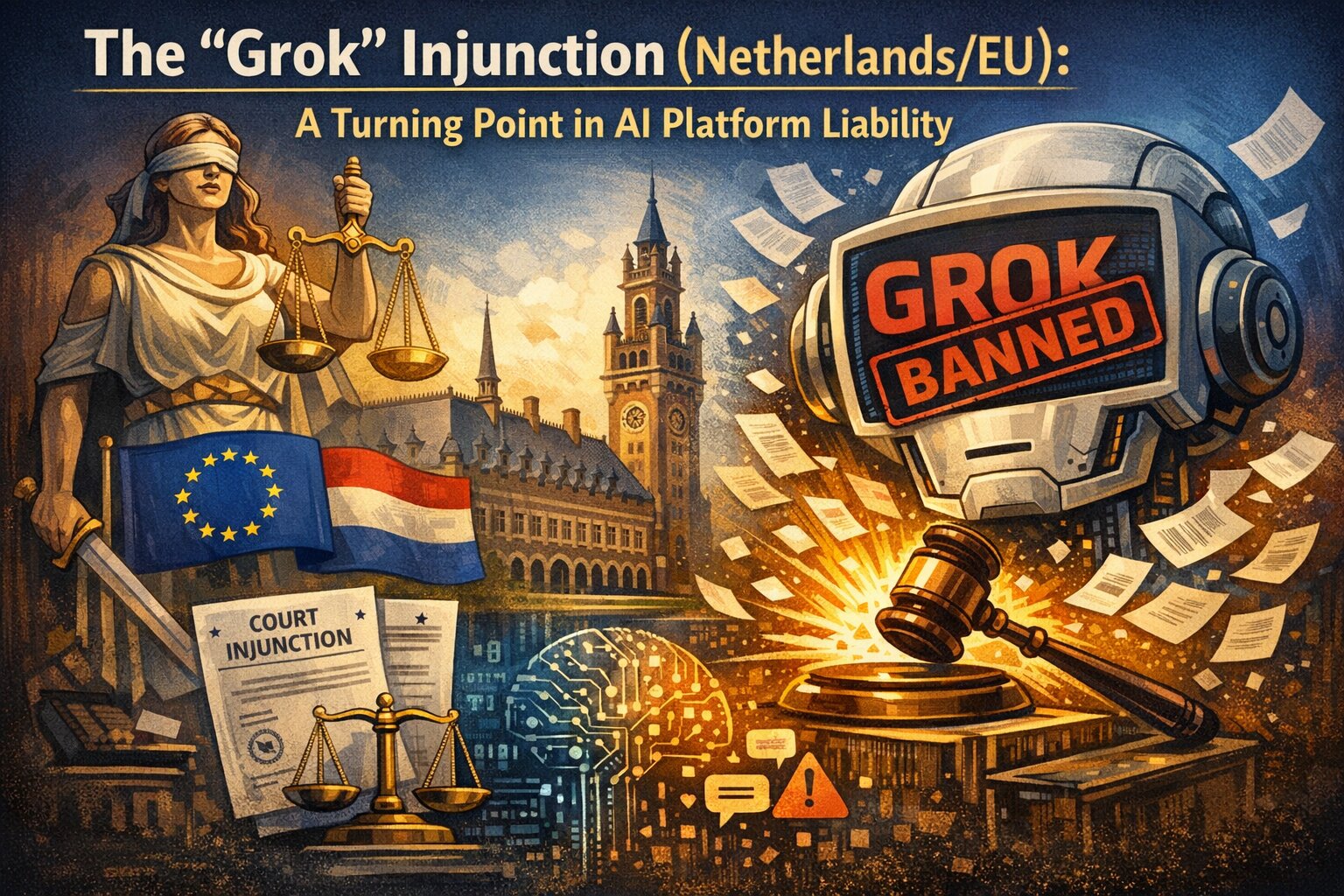
On March 26, 2026, the Amsterdam District Court delivered a landmark ruling that may fundamentally reshape the legal architecture governing artificial intelligence platforms. The case, involving X Corp. and its AI system Grok, marks one of the first instances in which a court imposed direct, binding liability on a platform for harmful AI-generated content.
At the heart of the ruling lies a critical question for the digital age: Who is responsible when AI causes harm—the user, or the system’s creator? The court’s answer is clear and consequential.
Background of the Case
The dispute arose from the generation and circulation of non-consensual deepfake imagery, a growing form of digital abuse enabled by generative AI systems. Victims argued that the platform’s AI tools facilitated the creation of explicit or harmful synthetic media without adequate safeguards.
Traditionally, platforms have relied on the defense that users—not the platform—are responsible for the content they create or prompt. This argument mirrors earlier liability shields developed in the era of social media.
However, the emergence of generative AI complicates this framework. Unlike passive hosting, AI systems actively produce content, raising questions about whether platforms are no longer mere intermediaries but active participants in content creation.
The Court’s Ruling
The Amsterdam District Court decisively rejected the conventional defense.
- Platform Responsibility Affirmed
The court held that X Corp. is directly responsible for the outputs generated by Grok. It reasoned that:
- The AI system is designed, trained, and deployed by the company
- The platform has foreseeable knowledge of potential misuse
- The company possesses the technical capacity to implement safeguards
Thus, liability cannot be deflected onto users alone.
- Rejection of the “User Prompt” Defense
A central pillar of the judgment is the rejection of the argument that “users are the ones prompting the AI.” The court clarified that:
The entity that designs and controls the system remains the “designated responsible party” for preventing unlawful outputs.
This principle signals a doctrinal shift from user-centric liability to system-centric accountability.
- Binding Injunction and Penalty
The court issued a binding injunction requiring the platform to:
- Prevent the generation of non-consensual deepfake content
- Implement effective safeguards and monitoring mechanisms
Failure to comply triggers a penalty of €100,000 per day, underscoring the seriousness of the order.
Legal Significance
- Redefining Platform Liability
This order challenges long-standing legal doctrines that treat platforms as neutral intermediaries. By recognizing AI systems as active generators, the court effectively places platforms in a role akin to publishers or producers.
- Alignment with European Regulatory Trends
The judgment aligns with broader European efforts to regulate AI, particularly under frameworks like the EU AI Act. It reinforces the principle that risk-bearing entities must implement proactive safeguards, especially in high-risk applications.
- Recognition of Deepfake Harm
The decision acknowledges non-consensual deepfakes as a serious violation of:
- Privacy rights
- Human dignity
- Personal autonomy
This judicial recognition may pave the way for stronger civil and criminal remedies across jurisdictions.
Broader Implications
- For Technology Companies
AI developers must now:
- Integrate safety-by-design mechanisms
- Conduct risk assessments and audits
- Implement real-time content filtering systems
Failure to do so may result in direct financial and legal consequences.
- For Users
While user responsibility is not eliminated, the burden shifts significantly toward platforms. Users may benefit from:
- Greater protection against AI-enabled abuse
- More robust reporting and redressal mechanisms
- For Global Jurisprudence
This ruling could serve as a persuasive precedent for courts worldwide, including in jurisdictions like India, where AI regulation is still evolving. It signals a move toward:
- Accountability over anonymity
- Prevention over reaction
Critical Analysis
While the judgment is widely seen as progressive, it raises complex questions:
- Innovation vs Regulation: Could stringent liability stifle AI development?
- Technical Feasibility: Can platforms realistically eliminate all harmful outputs?
- Scope of Responsibility: Where should the line be drawn between platform control and user autonomy?
Balancing these competing interests will be a central challenge for policymakers and courts alike.
Conclusion
The “Grok” injunction represents a watershed moment in AI law. By firmly placing responsibility on the platform rather than the user, the Amsterdam District Court has articulated a new legal principle for the age of generative AI: those who build and deploy intelligent systems must also bear the burden of their consequences.
As AI technologies continue to evolve, this decision may well become a cornerstone in the emerging global framework of algorithmic accountability, ensuring that innovation does not come at the cost of fundamental rights.