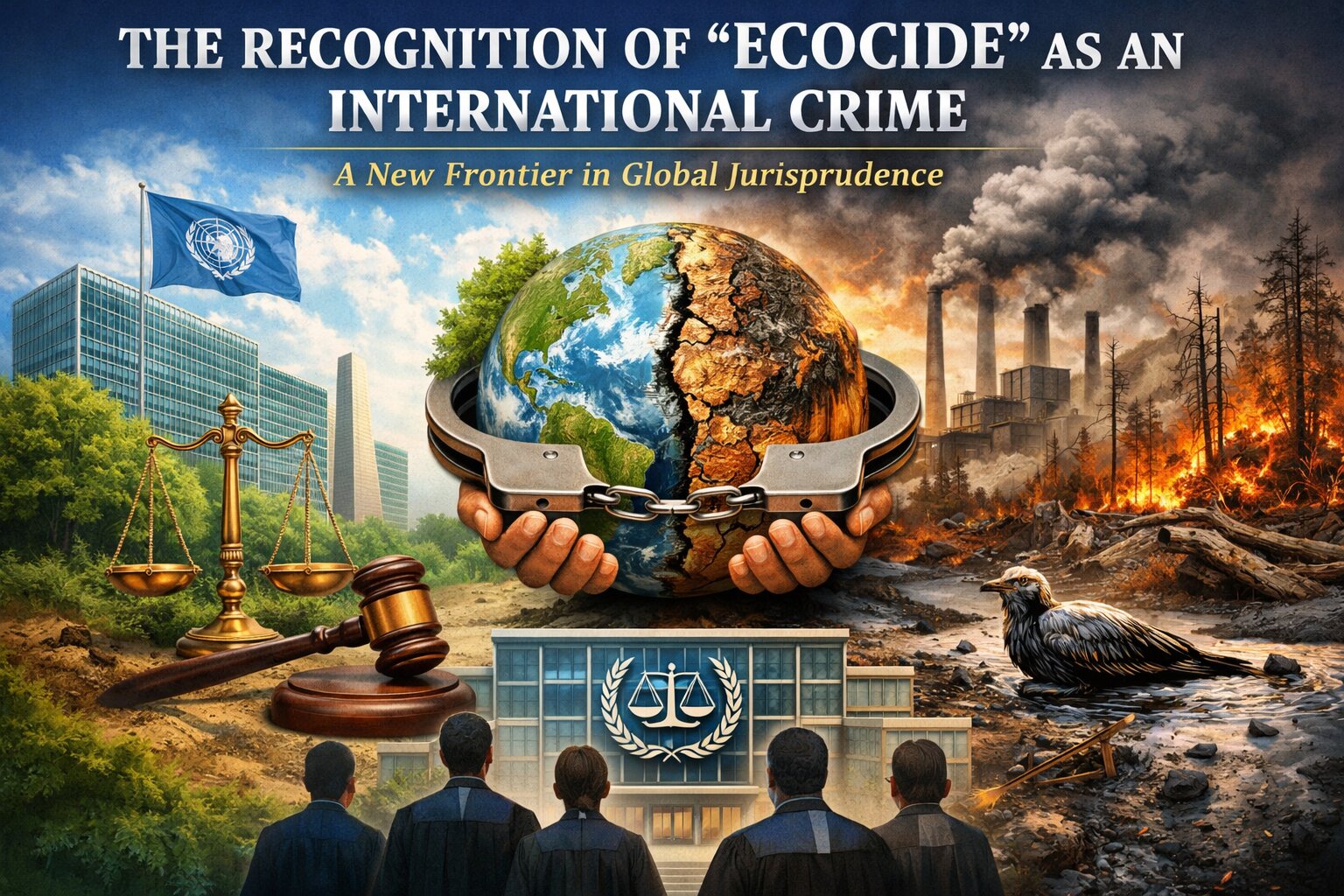
For decades, the international legal order has focused on protecting humanity from the “most serious crimes of concern”—genocide, crimes against humanity, war crimes, and the crime of aggression. However, as the 21st century faces an unprecedented environmental crisis, a global movement has successfully pushed for a fifth pillar: Ecocide.
The recognition of ecocide as an international crime represents a paradigm shift from anthropocentric law (human-centered) to ecocentric jurisprudence, acknowledging that the environment itself possesses a right to protection.
Defining Ecocide: The Legal Framework
In June 2021, an Independent Expert Panel, convened by the Stop Ecocide Foundation, provided a historic consensus definition. By 2026, this definition has become the gold standard for legislative efforts:
“Ecocide means unlawful or wanton acts committed with knowledge that there is a substantial likelihood of severe and either widespread or long-term damage to the environment being caused by those acts.”
Key Legal Elements (The Mens Rea and Actus Reus)
- Unlawful or Wanton: The acts must either violate existing national laws or be committed with “reckless disregard” for outcomes that are clearly disproportionate to the social or economic benefits anticipated.
- Severe: Damage which involves very serious adverse changes, disruption, or harm to any element of the environment.
- Widespread or Long-term: Damage that extends beyond a limited geographic area, crosses state boundaries, or is likely to endure for a significant period (typically interpreted as a generation).
The Road to the Rome Statute
The ultimate goal of environmental advocates is the amendment of the Rome Statute of the International Criminal Court (ICC).
Current Status (2026)
As of early 2026, the movement has moved beyond advocacy into formal diplomatic territory. Several Pacific Island nations and European states have submitted formal proposals to the Assembly of States Parties.
- The “Fifth Crime” Debate: Unlike war crimes (which already prohibit “widespread, long-term and severe damage to the natural environment” under Article 8), an ecocide amendment would criminalize environmental destruction during peacetime.
- Corporate Accountability: One of the most significant impacts of this recognition is the potential to hold individual corporate leaders and government officials criminally liable, rather than simply imposing civil fines on the entities they lead.
National and Regional Adoption
While the ICC amendment remains the “north star,” the doctrine has gained rapid traction at national levels.
- The European Union (2024-2025): The EU’s revised Environmental Crime Directive now requires Member States to criminalize “cases comparable to ecocide,” setting a massive precedent for the Western world.
- Brazil and the Amazon: Following legislative shifts in 2025, Brazil has moved to align its “crimes against nature” with the international definition of ecocide to protect the Amazon rainforest.
- India and Southeast Asia: Legal scholars and judiciaries in the Global South are increasingly invoking the Doctrine of Public Trust and the Polluter Pays Principle to mirror ecocide standards in domestic environmental tribunals.
Challenges and Criticisms
Despite the momentum, the recognition of ecocide faces significant legal and political hurdles:
- The Specificity Problem: Critics argue the terms “wanton” and “severe” are too vague for criminal law, which requires high levels of certainty to ensure due process for the accused.
- Sovereignty Concerns: Developing nations often express concern that ecocide laws could be used as “green imperialism” to stifle industrial growth and resource extraction necessary for poverty alleviation.
- Causality: Proving a direct link between a specific executive’s decision and long-term climate or ecosystem collapse remains a complex evidentiary challenge for prosecutors.
Conclusion: A New Social Contract
The recognition of ecocide as an international crime represents a profound shift in global justice. It marks the end of an era where environmental destruction was dismissed as a mere “cost of doing business.” By elevating mass ecological harm to the same legal status as war crimes, the world is finally acknowledging a hard truth: human security is impossible on a dying planet.As we approach mid-century, this doctrine will become the ultimate tool for accountability. It ensures that the most powerful leaders and corporations are legally bound to protect the Earth, transforming environmental stewardship from a choice into a global mandate.