





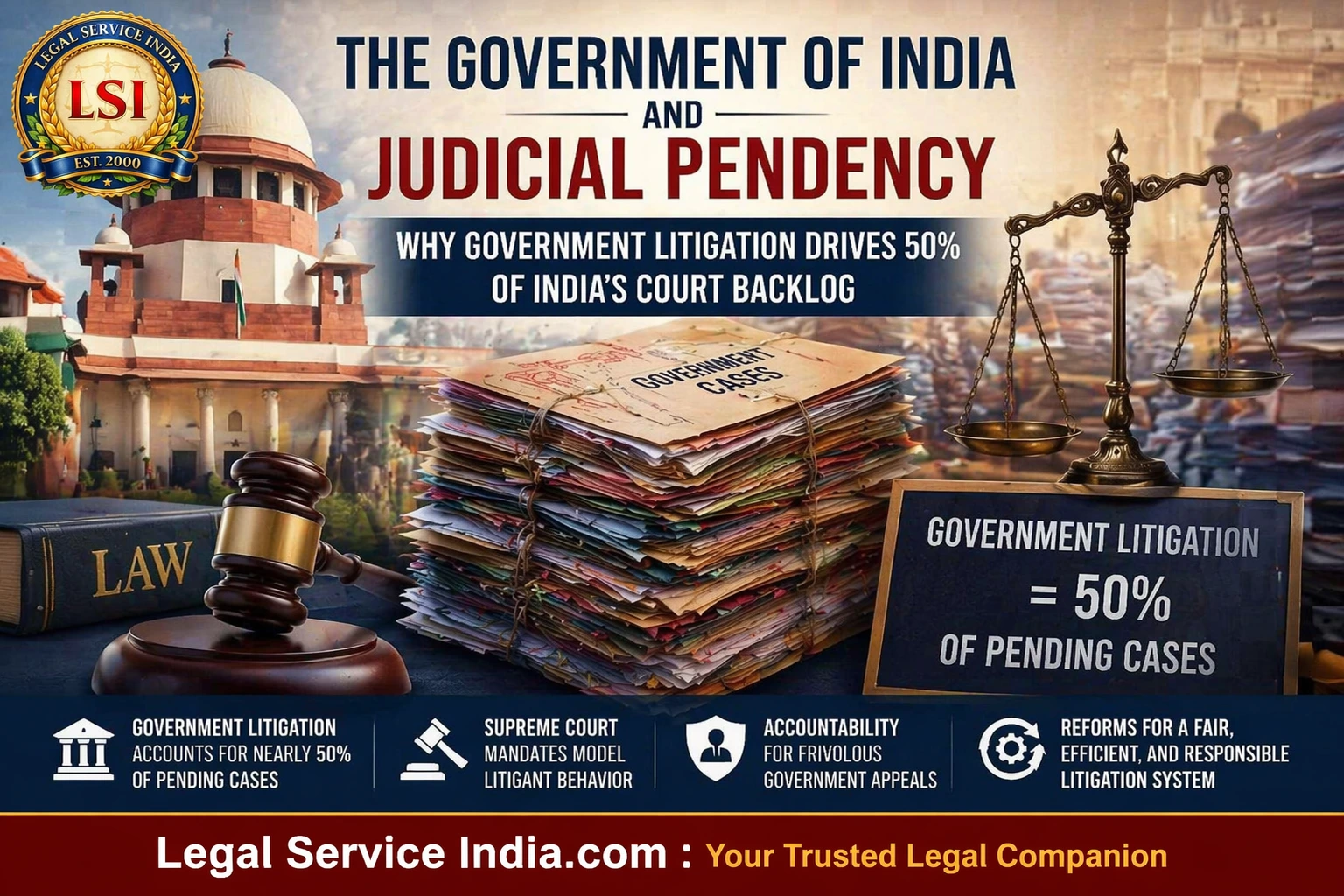
The Government Of India And Judicial Pendency
The Government of India — at the Centre and across States — is the single largest contributor to judicial pendency, accounting for nearly half of all cases pending before Indian courts. Despite repeated Supreme Court mandates directing governments to function as “model litigants,” the executive continues to file frivolous appeals, pursue hyper-technical defences, and exploit public resources to sustain litigation that ought never to have been filed.
This article examines the constitutional and common law foundations of the model litigant doctrine, the cascade of Supreme Court judgments censuring governmental excess, the accountability mechanisms — including personal costs, disciplinary action, and departmental inquiries — being progressively imposed on errant officials, and the systemic reforms proposed by the Apex Court.
The article argues that without institutional will and enforceable personal liability, the model litigant obligation will remain aspirational parchment.
I. Introduction: The Paradox Of The State In Court
The Indian State commands an unrivalled enforcement apparatus — police, revenue officers, district magistrates, and an elaborate administrative machinery. Yet paradoxically, it is also the most litigious entity before the very judiciary that is constitutionally tasked with checking its excesses. A government that ought to be the guardian of citizens’ rights appears, time and again, as their most persistent adversary in court.
Judicial Pendency: Data Overview
The National Judicial Data Grid and successive Law Commission reports paint a grim picture: of the approximately 5.5 crore cases pending across all tiers of the Indian judiciary, government litigation — by Union and State governments, public sector undertakings, and statutory bodies — accounts for nearly fifty percent.
- Government litigation accounts for nearly 50% of total pending cases
- High Courts see over 60% government-related cases
- Union government is a party in over 6.98 lakh cases
- Major contributors: Maharashtra, Uttar Pradesh, and Delhi
- Key dispute categories: Land acquisition and service matters
Key Pendency Statistics
| Category | Details |
|---|---|
| Total Pending Cases | Approximately 5.5 Crore |
| Government Share | Nearly 50% |
| High Court Government Cases | Exceeds 60% |
| Union Government Cases | Over 6.98 Lakh |
| Top States (Pendency) | Maharashtra, Uttar Pradesh, Delhi |
| Common Case Types | Land Acquisition, Service Disputes |
The Model Litigant Doctrine
The Supreme Court of India, confronted with this structural pathology, has over several decades articulated and refined the model litigant doctrine — a principle that imposes a higher duty of fair conduct, restraint, and self-correction upon governmental litigants.
- Requires fairness and responsibility in litigation
- Discourages frivolous and unnecessary appeals
- Promotes accountability in public administration
- Ensures efficient use of judicial and public resources
The doctrine is not charity; it flows directly from Articles 14 and 21 of the Constitution and the rule of law imperative that the State must not weaponise its superior resources to deny citizens the fruits of just decisions.
Scope Of This Article
This article surveys the doctrinal landscape, the landmark cases, the accountability framework, and the institutional reforms that the Supreme Court has both prescribed and begun enforcing.
II. The Constitutional And Common Law Foundations
A. The Model Litigant: Doctrine And Rationale
The concept of the model litigant in Indian jurisprudence draws on two intersecting imperatives. The first is the rule of law principle that governmental power must be exercised fairly and not arbitrarily. The second is the practical recognition that the State, unlike a private party, is not driven by personal interest but is the trustee of public resources and the guarantor of constitutional rights.
A private litigant who loses a case weighs the cost and risk of appeal rationally. A government officer, by contrast, often files an appeal not because it is meritorious, but because the appeal costs nothing from his own pocket, the file moves to a superior and the decision is deferred. The perverse incentive structure that insulates individual officers from the consequence of unjust or frivolous litigation lies at the root of the problem.
- Rule of law requires fairness and non-arbitrariness
- State acts as trustee of public resources
- Government litigation often lacks personal accountability
- System encourages unnecessary appeals
B. Early Foundations: Bhag Singh (1985)
Bhag Singh v. Union Territory of Chandigarh (1985) 3 SCC 737
One of the earliest articulations of governmental restraint in litigation. The Court stressed that public bodies must treat citizens’ claims fairly, without hiding behind purely technical defences unless revenue interest irretrievably demands it. Government, the Court observed, is not like any other litigant; it holds a position of public trust.
This foundational judgment established the principle that the State’s duty of fair dealing does not evaporate when it enters a courtroom. The Court aptly remarked thus:
“The State Government must do what is fair and just to the citizen and should not, as far as possible, except in cases where tax or revenue is received or recovered without protest or where the state Government would otherwise be irretrievably be prejudiced, take up a technical plea to defeat the legitimate and just claim of the citizen.”
C. Urban Improvement Trust, Bikaner (2010) — Articulating The Standard
Urban Improvement Trust, Bikaner v. Mohan Lal (2010) 1 SCC 512
A landmark exposition of the model litigant doctrine. The Supreme Court held that governments and statutory authorities must function as ideal litigants, refraining from raising false contentions, exploiting technical loopholes, or pursuing litigation purely to delay payment of legitimate dues. Justice must flow smoothly; the State must not obstruct its own administration.
The Court’s formulation in Urban Improvement Trust is the locus classicus of the model litigant doctrine in its modern form. It established that the obligation of good faith in litigation is not a counsel of perfection but an enforceable legal standard rooted in constitutional values. The Court observed thus:
“4. It is a matter of concern that such frivolous and unjust litigation by governments and statutory authorities are on the increase. Statutory Authorities exist to discharge statutory functions in public interest. They should be responsible litigants. They cannot raise frivolous and unjust objections, nor act in a callous and highhanded manner. They can not behave like some private litigants with profiteering motives. Nor can they resort to unjust enrichment. They are expected to show remorse or regret when their officers act negligently or in an overbearing manner. When glaring wrong acts by their officers is brought to their notice, for which there is no explanation or excuse, the least that is expected is restitution/restoration to the extent possible with appropriate compensation. Their harsh attitude in regard to genuine grievances of the public and their indulgence in unwarranted litigation requires to be corrected.
“5. This Court has repeatedly expressed the view that the governments and statutory authorities should be model or ideal litigants and should not put forth false, frivolous, vexatious, technical (but unjust) contentions to obstruct the path of justice…”
Key Assumptions Identified By The Court:
- All claims against the government should be resisted up to the highest court
- Avoid decision-making and let courts decide issues
The reluctance to take decisions, or tendency to challenge all orders against them, is not the policy of the governments or statutory authorities, but is attributable to some officers who are responsible for taking decisions and/or officers in charge of litigation.
Vexatious and unnecessary litigation have been clogging the wheels of justice, for too long making it difficult for courts and Tribunals to provide easy and speedy access to justice to bona fide and needy litigants.
D. Dilbagh Rai Jarry Vs. Union Of India
Dilbagh Rai Jarry vs. Union of India [1973 (3) SCC 554]
The Apex Court in the aforesaid judgment extracted with approval, the following statement (from an earlier decision of the Kerala High Court):
“The State, under our Constitution, undertakes economic activities in a vast and widening public sector and inevitably gets involved in disputes with private individuals. But it must be remembered that the State is no ordinary party trying to win a case against one of its own citizens by hook or by crook; for the State’s interest is to meet honest claims, vindicate a substantial defence and never to score a technical point or overreach a weaker party to avoid a just liability or secure an unfair advantage, simply because legal devices provide such an opportunity. The State is a virtuous litigant and looks with unconcern on immoral forensic successes so that if on the merits the case is weak, government shows a willingness to settle the dispute regardless of prestige and other lesser motivations which move private parties to fight in court.
E. Madras Port Trust v. Hymanshu International
Madras Port Trust v. Hymanshu International (1979) 4 SCC 176
“2… It is high time that governments and public authorities adopt the practice of not relying upon technical pleas for the purpose of defeating legitimate claims of citizens and do what is fair and just to the citizens. Of course, if a government or a public authority takes up a technical plea, the Court has to decide it and if the plea is well founded, it has to be upheld by the court, but what we feel is that such a plea should not ordinarily be taken up by a government or a public authority, unless of course the claim is not well-founded and by reason of delay in filing it, the evidence for the purpose of resisting such a claim has become unavailable….”
Quick Summary Of Key Judgments
| Case | Year | Key Principle |
|---|---|---|
| Bhag Singh v. UT Chandigarh | 1985 | Fair dealing; avoid technical defences |
| Urban Improvement Trust v. Mohan Lal | 2010 | Model litigant doctrine formalized |
| Dilbagh Rai Jarry v. Union of India | 1973 | State must act as virtuous litigant |
| Madras Port Trust v. Hymanshu International | 1979 | Avoid technical pleas against citizens |
III. The Anatomy Of The Problem: Government As Top Litigant
A. The Scale Of The Crisis:
The sheer numerical weight of government-sponsored litigation distorts the entire judicial ecosystem. Consider the following data points drawn from judicial reports and Law Commission studies:
- Over 6.98 lakh cases involve the Union Government alone across various courts and tribunals.
- State governments collectively add millions more, with High Courts in UP, Maharashtra, and Delhi bearing the heaviest loads.
- Approximately 85% of the 5.5 crore pending cases are in district courts; nearly half are government-related.
- Land acquisition disputes, service matters, tax appeals, and insurance claims form the bulk of government litigation.
- A significant percentage of government appeals are filed merely to preserve the right to appeal, or to delay execution of decrees.
| Key Indicator | Details |
|---|---|
| Union Government Cases | Over 6.98 lakh |
| Total Pending Cases | 5.5 crore |
| District Court Share | 85% |
| Government Share | Nearly 50% |
The systemic effect is devastating: genuine private disputes are buried under an avalanche of governmental dockets; judicial resources are consumed adjudicating matters that should have been resolved administratively; and citizens who have obtained decrees wait years — sometimes decades — for execution.
B. Structural Causes Of Excessive Government Litigation:
The Supreme Court’s judgments have identified several structural causes that perpetuate governmental over-litigation:
- Perverse Incentive Structure: Insulation of individual officers from litigation costs, creating a moral hazard.
- Lack Of Pre-Filing Review: Absence of institutional mechanisms for filtering meritless appeals before filing.
- Legislative Ambiguity: Vague or contradictory legislative provisions that force parties to litigate for interpretation.
- Executive Inaction: Executive departments that fail to implement judicial directions, compelling further litigation by the affected citizen.
- “Appeal As Default” Culture: Routine appeals even against settled law, merely because an adverse order was passed.
C. Common Cause v. Union Of India (2017) 9 SCC 499 – The Systemic Rebuke
The case constitutes a systemic rebuke of the reflexive appeal-culture that often characterises State agencies. The Court expressed concern that public authorities resort to litigation not on substantial merit but as a means of delaying compliance with obligations clearly imposed by statute, thereby contributing to clogged dockets and undermining public trust in the administration of justice.
In this context, the judgment reinforces the model-litigant ethos by emphasising that the State is not a mere private litigant with whom the Court may deal indulgently. As a constitutional entity, the Union and its instrumentalities are bound to conduct litigation in a manner that supports, rather than burdens, the justice-delivery system, and to discharge statutorily imposed obligations without resorting to avoidable appeals.
IV. Supreme Court Directives: Mandating Systemic Change
The Three-Pronged Directive Framework
Synthesising across multiple judgments, the Supreme Court’s directives to reduce governmental litigation may be distilled into a three-pronged framework:
- Policy Mandate: Adopt a formal “no appeal unless necessary” policy with specific criteria for meritorious appeals approved at a senior level.
- Institutional Mechanism: Appoint designated nodal officers in each department, with personal accountability for case filtration, monitoring, and withdrawal of untenable matters.
- ADR Priority: Deploy mediation under Section 89 CPC, pre-litigation arbitration, and lok adalats as default dispute resolution mechanisms for government disputes, reserving courts for genuine questions of law or public importance.
V. Judicial Observations: The Judges Speak Plainly
1. Justice B.V. Nagarathna And The “Model Litigant”:
Justice Nagarathna has repeatedly said that the State, instead of acting as a model litigant, is the largest generator of litigation through routine and unnecessary appeals. She has flagged the paradox where the government publicly laments judicial backlog while being the biggest litigator and feeding that backlog.
She has also pointed to bureaucratic and financial incentives: not appealing may be seen as laxity, while filing appeals is treated as “due diligence,” even when there is no real public-interest justification, which encourages over-litigation.
She deliberated the issue in her speech at the 1st SCBA National Conference, “Reimagining Judicial Governance: Strengthening Institutions for Democratic Justice,” held at Bengaluru on 21 March 2026.
2. Chief Justice N.V. Ramana (2022 Observations)
At the Joint Conference of Chief Ministers and Chief Justices of High Courts in April 2022, CJI Ramana stated that governments are the “biggest litigants,” accounting for nearly 50% of all pending cases.
He identified non-performance of the executive and legislative failure to enact clear laws as key drivers of litigation, giving examples such as inter-departmental disputes, PSU disputes, and poor implementation of earlier decisions. He also emphasised that executive inaction and ambiguous laws “burden the courts,” and that the very organs that create these conditions should not pose as innocent victims of litigation.
VI. The Accountability Framework: From Rebuke to Remedy
The recognition that judicial censure alone does not change institutional behaviour has driven the Supreme Court to progressively construct a multi-layered accountability framework for government litigants. The framework operates at four levels: personal costs, institutional fines, departmental disciplinary proceedings, and systemic directives.
A. Personal Costs Imposed On Officials
Special Land Acquisition Officer v. Vithal Rao (2023)
| Case Details | Description |
|---|---|
| Case | SLP(C) No. 20070/2023 |
| Date | September 6, 2023 |
| Judges | Justices B.R. Gavai and Sudhanshu Dhuliya |
Imposed Costs
The Court imposed a personal cost of Rs. 5 lakhs on the Karnataka Special Land Acquisition Officer for filing a frivolous SLP at the execution stage, after the land acquisition award had attained finality. The costs were split as Rs. 2.5 lakhs each to the Supreme Court Advocates on Record Association (library) and Supreme Court Bar Association, payable within four weeks.
Recovery From Officer
While the judgment criticized officers for filing frivolous petitions “merely because they do not have to pay… from their own pocket” and aimed to deter misuse of public resources, it did not explicitly direct recovery from the officer’s salary. The costs were imposed personally on the officer (not the State), shifting the burden from the exchequer.
Key Principle
- Reinforces accountability by piercing the “institutional veil”
- Shifts financial consequences directly to the officer
- Acts as a deterrent against frivolous litigation
—
B. State Of Madhya Pradesh v. Ramkumar Choudhary (2024)
SLP (C) No. 48636/2024 decided by Justices JB Pardiwala and R Mahadevan on November 29, 2024.
The Supreme Court of India issued directions in late 2024 holding officers accountable for delays in government appeals, stemming from a Madhya Pradesh case with a 1,788-day delay in an appeal over government land. The Madhya Pradesh High Court had rejected the state’s second appeal on similar grounds, involving 1,300 hectares of land in Katni district.
Directions Issued
- Pinpoint officers causing inordinate delays leading to dismissed appeals and revenue losses
- Overhaul litigation processes for timely filing
- Impose penalties on culpable officers matching financial loss to the government exchequer
Valuation Principle
This introduces a direct compensatory mechanism, where penalties equal actual public harm (e.g., lost revenue from dismissed claims), moving beyond symbolic fines to enforce accountability in state litigation. —
C. Departmental Disciplinary Proceedings
The Supreme Court has repeatedly directed that abuse of judicial process through routine frivolous appeals must be met with formal departmental action under service rules. The framework envisioned by the Court includes:
- Internal departmental inquiry to identify the officer responsible
- Issuance of formal charge sheet for abuse of process or negligence
- Penalties ranging from warnings to suspension
- Contempt proceedings for persistent violations
—
D. State Of Jharkhand Case (October 2024)
SLP dismissed by Justices B.R. Gavai and Sandeep R. Bhat.
- Frivolous SLP dismissed
- Cost of Rs. 1 lakh imposed
- Recovery proceedings permitted against responsible officer
The judgment noted that repeated warnings from the Supreme Court over decades had been consistently ignored and that the time for mere censure had passed. —
E. Supreme Court Imposes ₹25,000 Costs On Union Of India (2026)
On April 1, 2026, a Supreme Court bench of Justices BV Nagarathna and Ujjal Bhuyan dismissed SLP (C) No. 12124/2026 (Union of India v. Sukhwinder Singh), imposing ₹25,000 costs on the Union for challenging a Punjab & Haryana High Court order.
Court’s Key Observations
- Union termed as the “biggest litigant” contributing to pendency
- Questioned unnecessary escalation to Supreme Court
- Highlighted proportionality in punishment
- Referred to efforts to curb unnecessary litigation
Significance
The order reinforces judicial restraint on state appeals, penalising frivolous SLPs while upholding proportionality in disciplinary actions for minor lapses amid personal circumstances. —
VII. High Court Contributions To The Framework
The model litigant doctrine is not exclusively a Supreme Court phenomenon. High Courts have independently reinforced the principle, sometimes with greater specificity:
A. Bombay High Court — Tax Department Cost Recovery (2014)
In a tax matter decided in 2014, the Bombay High Court levied an exemplary cost of Rs. 1 lakh for filing a frivolous appeal asking the department to recover it from the officials involved and also take disciplinary action against them.
“The Revenue officers must realize that executive power is in the nature of a Trust. Public money cannot be wasted in frivolous litigation.”
Key Observations
- Public officials act as trustees of public resources
- Frivolous litigation wastes judicial time
- Recovery from responsible officers is justified
- Decisions must be rational and in public interest
—
B. Allahabad High Court — Service Disputes
The Allahabad High Court has, in numerous service and land acquisition matters, imposed enhanced costs on the State for filing appeals in the face of binding precedent.
- Re-litigation of settled issues discouraged
- Seen as undermining constitutional order
- Treated as potential contempt in certain cases
VIII. Proposed And Mandated Reforms:
The Supreme Court’s reform agenda, consolidated across multiple judgments, is comprehensive in scope and precise in direction:
A. National Litigation Policy
India’s National Litigation Policy (NLP) was first announced in 2010, with the express objective of transforming the Government from a compulsive litigant to a responsible and accountable one. The policy endorsed a “no appeal unless necessary” standard and contemplated empowering officers at appropriate levels to settle or withdraw cases. Implementation, however, has remained fitful, and successive versions of the NLP have not produced the structural transformation envisioned by the Court.
B. Mandatory Nodal Officers — Mohanbhai Patel Compliance
The Mohanbhai Patel direction to appoint nodal officers in each government department and statutory body has been restated in subsequent judgments. Nodal officers are expected to:
- Maintain a database of pending government cases by subject, vintage, and legal sustainability.
- Recommend withdrawal of cases that have no reasonable prospect of success.
- Monitor cases where finality has been attained but execution is being resisted.
- Coordinate with departmental legal officers and government counsel to apply consistent pre-filing standards.
C. Mandatory Mediation — Section 89 CPC
Section 89 of the Code of Civil Procedure, 1908 empowers courts to refer disputes to alternative dispute resolution mechanisms. The Supreme Court has repeatedly directed that government departments, before filing or contesting a matter, must explore and exhaust the mediation and settlement avenues offered by Section 89. In service disputes and land compensation matters especially, structured mediation is both feasible and likely to produce quicker, less expensive, and more durable resolutions than adversarial litigation.
D. Legislature’s Role: Clarity Over Ambiguity
The Court has placed a remedial obligation on the legislature itself. Ambiguous statutory provisions that generate predictable litigation — particularly in tax, land acquisition, and service law — must be revisited and clarified by way of legislative amendment. The executive and legislature together bear a constitutional responsibility to reduce the litigation-generating opacity in the statute book.
IX. Critical Assessment: Aspiration Versus Enforcement:
The model litigant doctrine, for all its jurisprudential richness, faces a serious implementation deficit. The reasons are institutional and cultural:
- Judgments imposing personal costs on officers are rarely followed through with actual recovery proceedings within the departments.
- Nodal officers, where appointed, frequently lack the authority or institutional support to actually withdraw cases approved by senior officers.
- Government counsel in courts often have financial incentives to prolong litigation — their fees are tied to hearings, not to swift resolution.
- The political economy of public service protects officers from consequences: departmental inquiries are rarely initiated, and when initiated, rarely concluded.
The National Litigation Policy, while sound in principle, lacks a statutory basis and is therefore not directly enforceable in courts.
The Supreme Court’s response to this implementation deficit has been to sharpen the tools of accountability — moving from institutional fines to personal recovery, from recommendations to binding directions. The trajectory is clear: the Court is progressively raising the cost of governmental over-litigation for individual officers. But for the doctrine to truly transform conduct, two structural changes are indispensable.
First, the NLP must be given statutory force — it must be enacted as a law, with defined pre-filing standards, mandatory withdrawal protocols, and personal liability provisions. Second, internal disciplinary proceedings against officers who file or approve frivolous litigation must be made automatic — triggered by a cost order from the court, not discretionary at the departmental level.
X. Conclusion:
The Government of India’s status as the nation’s largest litigant is not merely a judicial curiosity — it is a constitutional pathology. When the State, which is constitutionally obligated to protect and advance citizens’ rights, becomes their most persistent adversary in court, the rule of law is compromised at its source.
The model litigant doctrine — developed through six decades of Supreme Court jurisprudence from Bhag Singh (1985) through Urban Improvement Trust (2010), Common Cause (2017), Mohanbhai Patel (2020), and the accountability directions of 2023-2024 — represents the constitutional judiciary’s sustained effort to discipline governmental excess. The doctrine is both a standard of conduct and an accountability mechanism: it tells governments how they must behave in court, and it increasingly provides judges the tools to ensure that those who cause the State to misbehave bear personal consequences.
The challenge ahead is institutional. Judicial censure, however emphatic, cannot alone transform a culture of reflexive appeal. That transformation requires legislative action to mandate pre-filing review, statutory backing for the NLP, automatic disciplinary proceedings following cost orders, and a genuine realignment of incentives within the civil service so that restraint in litigation becomes professionally rewarding rather than bureaucratically risky.
Until that structural transformation is achieved, India’s dockets will continue to be weighed down by the unruly litigant in robes — the very State that its Constitution created to serve justice.

