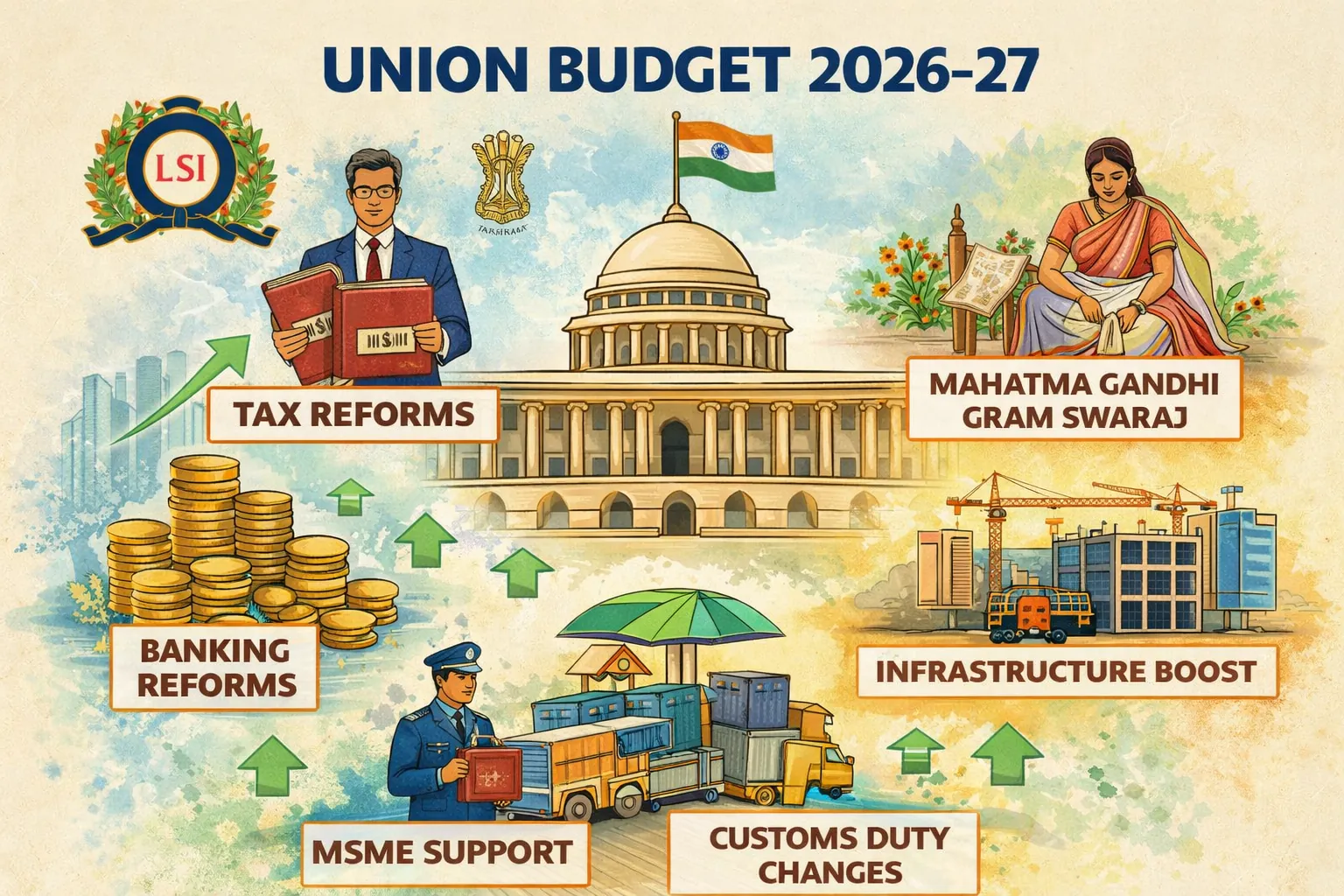
Union Budget 2026–27: Key Announcements And What They Mean For India
The Finance Minister has just concluded the Union Budget speech for the financial year 2026–27, and it comes packed with several important policy decisions that will shape India’s economic direction in the coming years. From tax reforms and banking restructuring to MSME support and infrastructure spending, the budget attempts to balance growth, compliance, and long-term development.
Budget Overview
1. Acceptance of the 16th Finance Commission Report
One of the most crucial developments is the formal acceptance and tabling of the 16th Finance Commission (FC) recommendations.
- The 15th Finance Commission was applicable until 2026.
- From 2026 to 2031, the recommendations of the 16th FC will apply.
- The commission, chaired by economist Arvind Panagariya, has recommended continuing the vertical devolution of 41%, meaning 41% of central tax revenues will be transferred to states.
- Additionally, the Centre has allocated ₹1.4 lakh crore as grants to states based on principles suggested by the commission.
This ensures fiscal stability for states and strengthens cooperative federalism.
2. Changes in Buyback of Shares Taxation
Earlier, promoters used buybacks as a tax-saving tool through arbitrage. To curb misuse:
- Buyback income will now be treated as capital gains.
- A 30% capital gains tax will apply.
- On top of this, an additional buyback tax will also be levied.
While this offers some relief to smaller promoters, it prevents large investors from exploiting loopholes.
3. Increase in Securities Transaction Tax (STT)
The government has increased STT on futures trading:
| Category | Earlier Rate | New Rate |
|---|---|---|
| STT on Futures | 0.02% | 0.05% |
This decision triggered an immediate negative reaction in the stock market, with most indices turning red. The move aims to regulate speculative trading but may increase costs for active traders.
4. Minimum Alternate Tax (MAT) Reforms
MAT ensures companies cannot reduce tax liability to zero using legal tricks.
Key Changes
- MAT rate reduced from 15% to 14%.
- However, from next year onwards, MAT credits will no longer be available.
This means MAT becomes the final tax, eliminating future adjustments and making corporate tax more predictable but stricter.
5. New Income Tax Law from Next Year
One of the biggest structural reforms is the implementation of the new Income Tax Act, replacing the outdated 1961 law.
Highlights
- Simpler language.
- Easier compliance.
- New tax forms will be released soon.
- Designed for the “common man”.
This is expected to significantly reduce confusion, litigation, and compliance burden.
6. Mahatma Gandhi Gram Swaraj Initiative
A new rural development initiative has been announced focusing on Khadi industries.
Objectives
- Skill training.
- Increased production.
- Export promotion.
Linked with One District One Product (ODOP) scheme.
This aims to strengthen local economies and promote self-reliant villages.
7. Major Push for MSMEs
Micro, Small and Medium Enterprises (MSMEs) get strong support:
a) Equity Support Fund
A ₹10,000 crore fund will provide equity financing to MSMEs.
b) Additional Funding to Atmanirbhar Bharat
More resources allocated to the self-reliant India initiative launched in 2021.
c) TReDS Platform Mandate
All Central Public Sector Companies must use the TReDS platform for MSME payments.
This improves liquidity and reduces payment delays.
8. Banking Sector Reforms for Viksit Bharat 2047
Banks are expected to play a central role in India’s growth journey.
- National Infrastructure Pipeline targets ₹110 lakh crore investment.
- Banks and Development Finance Institutions will lead infrastructure lending.
- A high-level committee will study and recommend structural reforms in the banking system.
This aligns with India’s long-term vision of becoming a developed economy by 2047.
9. Record Public Capital Expenditure
Public capex continues to rise:
- Allocated ₹12.2 lakh crore for infrastructure.
- States will continue receiving 50-year interest-free loans.
This sends a strong signal to the private sector and boosts employment and economic momentum.
10. Customs Duty Reforms
Several reforms have been introduced to improve ease of doing business:
Key Exemptions
- Cancer drugs – fully exempted.
- Nuclear power imports – exempted regardless of project size.
- Personal imports – reduced duties.
Other Improvements
- Simplified documentation.
- Reduced official intervention.
- Faster clearance procedures.
These changes aim to reduce manufacturing costs and improve export competitiveness.
Final Thoughts
This budget is not just about numbers—it reflects a strategic shift towards:
- Simpler taxation.
- Stronger state finances.
- MSME resilience.
- Banking reform.
- Massive infrastructure investment.
While the announcements are promising, the real test lies in implementation. A detailed sector-wise analysis—covering agriculture, exports, fiscal management, and industrial policy—will reveal the true impact.
In short, Union Budget 2026–27 lays the foundation for India’s economic roadmap for the next decade, with a clear focus on growth, transparency, and long-term sustainability.