
The Amistad Case by Doug Linder
The improbable voyage of the schooner Amistad and the court proceedings and diplomatic maneuverings that resulted from that voyage form one of the most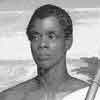 significant stories of the nineteenth century. When Steven Spielberg
chose the Amistad case as the subject of his 1997 feature film (LINK TO
REVIEWS), he finally brought it the attention the case had long deserved,
but never received. The Amistad case energized the fledgling abolitionist
movement and intensified conflict over slavery, prompted a former
President to go before the Supreme Court and condemn the policies of a
present Administration, soured diplomatic relations between the United
States and Spain for a generation, and created a wave of interest in
sending Christian missionaries to Africa.
significant stories of the nineteenth century. When Steven Spielberg
chose the Amistad case as the subject of his 1997 feature film (LINK TO
REVIEWS), he finally brought it the attention the case had long deserved,
but never received. The Amistad case energized the fledgling abolitionist
movement and intensified conflict over slavery, prompted a former
President to go before the Supreme Court and condemn the policies of a
present Administration, soured diplomatic relations between the United
States and Spain for a generation, and created a wave of interest in
sending Christian missionaries to Africa.Two sea captains, Peletiah Fordham and Henry Green, were shooting birds among the dunes at the eastern tip of Long Island on the morning of August 26, 1839, when they were startled to encounter four black men wearing only blankets. Once the blacks were assured through sign language that they were not in slaveholding country, they led Fordham and Green to a point in the dunes where they could see a black schooner, flagless with its sails in tatters, sitting at anchor a mile or so from the beach. Another smaller boat was on the beach, guarded by more black men, many of whom were wearing necklaces and bracelets of gold doubloons. One of the black men, who appeared to be the leader of the group, told Fordham and Green that there were two trunkfuls of gold aboard the schooner, and that they would be given to whoever outfitted them with provisions and helped them sail back to their African homeland. Green suggested that if they got the trunks he would help them return to Africa.
Green's and Fordham's dreams of riches were interrupted by a brig of the U. S. Coast Guard, the Washington, which intercepted the rowboat as it made its way back to the schooner. The commander of the brig, Lieutenant Thomas Gedney, boarded the schooner and ordered, at gunpoint, all hands below the deck. Two Spaniards emerged from below. One was old, bearded, and sobbing. The other was a man in his mid-twenties. Jose Ruiz, the younger man, spoke English and eagerly began to tell the tale of mutiny, blood, deceit, and desperation aboard the Amistad.
The schooner had left Havana on June 28, bound for Puerto Principe, a Cuban coastal town. Aboard the Amistad were five whites, a mulatto cook, a black cabin boy, and fifty-three slaves. Ruiz had bought forty-nine adult male slaves at the Havana market. The older, bearded white, Pedro Montes, had bought four child slaves, including three girls. On the fourth night at sea, the slaves managed to free themselves from their irons. In the ensuing struggle, the Africans killed the captain, Ramon Ferrer, and a mulatto cook. (According to the story later told by the Africans, the mulatto cook had told the slaves that they would be chopped to pieces and salted as meat for the Spaniards when the ship arrived at its destination.) Two crewman abandoned ship in the stern boat. Montes and Ruiz were spared, apparently because their help was thought necessary in steering the ship to Africa. Montes sailed toward Africa, but slowly and only during the day. At night, he reversed course and headed due west, hoping to landfall in the southern United States. After six weeks of zig-zagging at sea, the Amistad arrived in New York.
(What Ruiz did not say was that the slaves were were recently brought from Africa and brought to Cuba in direct contravention of an 1817 treaty between Spain and Britain prohibiting the importation of slave to Spanish colonies. Using falsified passports, corrupt officials, and nighttime landings, slave traders often were successful in eluding the British ships that patrolled waters in an effort to enforce the importation ban.)
As Ruiz told his story, an athletic-looking black man, naked except for a gold necklace, suddenly appeared from below and leaped off the boat. The Washington gave chase, but the man was a strong swimmer, constantly diving as the ship neared. Tiring, the man took off his necklace, letting it--to the dismay of Gedney--fall to the bottom of the sea. Finally, crew members recaptured the black man, later known as Cinque, and put him into chains. The Amistad was towed to New London, Connecticut, where its arrival would dominate the news for weeks to come.
The United States Attorney for Connecticut, William S. Holabird, ordered a judicial hearing on the Washington. It was unclear to Holabird, as it was to many, whether a crime had been committed, who had committed it, or whether U. S. courts even had jurisdiction. There was also the matter of salvage rights, which were claimed by Gedney and the Washington crew. The Amistad's cargo of wine, saddles, gold, and silk was worth an estimated $40,000 in 1839 dollars, and the slaves had a market value of at least half that much.
The district judge for Connecticut was Andrew T. Judson, an appointee of then President Martin Van Buren. Judson was not likely to sympathize with the Africans, having six years earlier prosecuted a Connecticut schoolmistress for establishing a school for Negroes that Judson claimed violated a state law against encouraging black migration. (When the jury was unable to reach a verdict in the case, a mob set fire to the schoolmistress's house.)
On August 29, 1839, three days after the schooner's discovery, Judge Judson opened a hearing on complaints of murder and piracy filed by Montes and Ruiz. Thirty-nine Africans (of the forty-three who had survived the weeks at sea) were present, including Cinque, who appeared wearing a red flannel shirt, white duck pants, and manacles. He appeared calm and mute, occasionally making a motion with his hand to his throat to suggest a hanging.
The three principal witnesses at the hearing were the first mate of the Washington and Montes and Ruiz. The first mate described what happened when the Amistad was first boarded. Montes and Ruiz described the mutiny and subsequent weeks at sea. Ruiz testified:
"I took an oar and tried to quell the mutiny. I cried 'No! No!.' I then heard one of the crew cry murder. I then heard the captain order the cabin boy to go below and get some bread to throw among the negroes, hoping to pacify them. I did not see the captain killed."
Montes added his description of events on the fourth night at sea:
"Between three and four was awakened by a noise which was caused by blows to the mulatto cook. I went on deck and they attacked me. I seized a stick and a knife with a view to defend myself....At this time [Cinque] wounded me on the head severely with one of the sugar knives, also on the arm. I then ran below and stowed myself between two barrels, wrapped up in a sail. [Cinque] rushed after me and attempted to kill me, but was prevented by the interference of another man....I was then taken on deck and tied to the hand of Ruiz."
After listening to the testimony, Judge Judson referred the case for trial in Circuit Court, where in 1839 all federal criminal trials were held, and ordered the Africans put into custody at the county jail in New Haven. The Amistads became a huge attraction. As many as 5,000 people a day visited the jail. The jailer charged "one New York shilling" (about twelve cents) for close looks at the captives. The Africans also attracted scientific interest. A phrenologist examined the captives and took "life masks" which were later put on public display. The New Haven jail was relatively loose. Jailers took the children, "robust" and "full of hilarity," on wagon rides. The adults were allowed daily exercise on New Haven's green, where their cavorting, somersaults, and acrobatic leaps surprised residents unaccustomed to such public displays of exuberance.
For most New Englanders the Amistads were a curiosity. For a small, but growing, group of abolitionists, however, they were a cause and an opportunity. Abolitionist leader Lewis Tappan described the capture of the Africans as a "providential occurrence" that might allow "the heart of the nation" to be touched "through the power of sympathy." The "Amistad Committee" was quickly formed and soon the group had enlisted legal help, including that of Roger Baldwin, who would later become the governor of Connecticut.
Spain, meanwhile, pressed the United States to return the schooner to its Cuban owners, concede that the U. S. courts had no jurisdiction over Spanish subjects, and return the Amistads to Havana. The Van Buren Administration was anxious to comply with the Spanish demands, but there was this matter of due process of law. The Administration, through District Attorney Holabird, crafted legal arguments that it hoped would produce the results sought by Spain.
On September 14, 1939, the Amistads were sent by canal boat and stage to Hartford for their trial in the Circuit courtroom of Judge Smith Thompson, who also served (as was then the custom for Circuit Court judges) as a justice on the United States Supreme Court. Holabird asked the court to turn all the prisoners over to the President and to let him decide this matter that bore heavily on the relations between great powers. Baldwin, for the defense, argued that "no power on earth has the right to reduce [the Africans] to slavery" and the United States should never stoop so low as to become a "slave-catcher for foreign slave-holders." Judge Thompson preferred to evade the larger debate over abolition and rested his decision on jurisdictional grounds. He decided after three days of argument that because the alleged mutiny and murders occurred in international waters and did not involve U.. S. citizens, the court had no jurisdiction to consider the criminal charges. Were the slaves "property"? That was a matter, Judge Thompson ruled, that had to be decided first in the district court. Thompson ruled that the Africans, although no longer considered prisoners, should be detained until the district court could decide whether they were property and--if they were property--who owned them.
The defense devoted considerable time to the task of trying to locate someone familiar with the language spoken by the Africans. Dr. Josiah Gibbs, a Yale philologist, and a clergymen who trained the deaf and dumb examined the Africans. They concluded that the Amistads were Mende, from a region south of Freetown in what is now Sierra Leone. Gibbs learned to count in Mende, then wandered up and down the waterfronts of New York counting in Mende, looking for signs of recognition among the Africans he encountered. Finally his efforts were successful, and a Mende speaker, James Covey, was brought to New Haven.
The full story of the Africans' adventures began to come out. The Amistad captives had first met at a slave factory in Lomboko after having been kidnapped by African slavers. They along with about 600 other Africans were loaded aboard the Portugeese ship Tecora and taken via the infamous "Middle Passage" across the Atlantic. The slaves were kept naked, flogged for not eating, and chained in a half-lying position. Many died and sea and were tossed overboard. Landing at night in Havana, they were taken to the "barracoon," or slave market where ten days later they were bought by Ruiz and Montes. On the fourth night of the Amistad's voyage, Cinque used a nail to break the chain that fastened all the slaves to the wall, and the mutiny began.
Life in Connecticut for the Amistads began to take on a semblance of normalcy. For two to five hours a day they were instructed in English and theology by students of the Yale Divinity school. Bonds between some of the Africans and their teachers began to develop. Still, it was a trying time for many of the Amistads, experiencing their first harsh weather, exposed to new diseases, and the length of their separation from their homeland growing with no end in sight. Tu-a became the first African to die in New Haven, occasioning a raucous funeral that raised many New Englanders' eyebrows.
The Amistad civil trial began on November 19, 1839 in Hartford. After two days of testimony, the trial was adjourned until January 7, 1840. In the New Haven harbor was the naval schooner Grampus, sent there by President Van Buren to sail the Amistads back to Cuba should the court rule, as expected, in the government's favor. Van Buren's secret orders provided that the Africans were to be rushed immediately to the ship and placed in irons before an appeal could be filed, and that the Grampus should sail for Havana unless an "appeal shall actually have been interposed."
Baldwin and the Amistads' lawyers produced several witnesses to support their claim that the Africans were illegally imported from Africa and were therefore the property of no one. Dr. Gibbs, as a linguistic expert, testified that the Amistads spoke Mende, not Spanish. Cinque and Grabeau, another of the Africans, recounted (through James Covey, their interpreter) the story of their capture, voyage across the Atlantic, sale in Havana, mutiny, and eventual arrival in Long Island. Spectators reportedly listened to Cinque "with breathless attention." The New Haven Herald reported that he "manifested a high degree of sagacity, of keeness, and decision." Sullivan Haley testified that Ruiz, now back in Cuba, had admitted that the captives were not legal slaves. Francis Bacon, a local resident who had visited the west African coast in the summer of 1839 described how Lomboko was frequented by Cuban traders and how the slave trade was "the universal business of the country." (The slave factory at Lomboko, incidentally, had been raided by the British one month before the trial, an all slaves held there had been liberated.) Baldwin also introduced the deposition of Dr. Richard Madden, an abolitionist and the British anti-slavery commissioner in Cuba. He described how Cuban authorities "winked at the slave trade in return for $10 to $15 a slave," used fraudulent documents to deceive inspectors, and would without hesitation kill the Amistad blacks should they be returned to Cuba. (LINK TO MADDEN DEPOSITION)(After giving his deposition, Madden returned to London where, in an audience with Queen Victoria, he explained the facts surrounding the Amistad Affair.)
District Attorney Holabird introduced statements from the Spanish consul urging that the Amistads be returned to Spain and presented testimony and depositions of crew members of the Washington describing their discovery and capture of the Amistad , while Gedney's counsel tried to establish that Cinque was himself a slave trader.
Judge Judson announced his decision on January 13, 1840, after a weekend of deliberation. He ruled that the Amistad captives were "born free" and kidnapped in violation of international law. They had mutinied, he said, out of a "desire of winning their liberty and of returning to their families and kindred." He ordered that the Amistads be "delivered to President Van Buren for transport back to Africa." He ended his opinion with the observation, "Cinque and Grabeau shall not sigh for Africa in vain. Bloody as may be their hands, they shall yet embrace their kindred." The Grampus sailed out of New Haven harbor without its black passengers. Van Buren was described as "greatly dissatisfied."
The Administration appealed Judson's decision, but it was affirmed by Circuit Judge Thompson. The Administration again appealed, this time to the United States Supreme Court, where five of the nine justices were southerners who either owned or had owned slaves.
After an appeal was made to the Supreme Court, Lewis Tappan visited John Quincy Adams at his home in Massachusetts in an effort to persuade "Old Man Eloquent" to argue the Africans case in Washington. Former President Adams, then 74 and a member of Congress, at first resisted, pleading age and infirmity. But Adams believed firmly in the rightness of the cause, and eventually agreed to join Baldwin in arguments before the Court. "By the blessing of God, I will argue the case before the Supreme Court," Adams was quoted as saying. That October, 1840 date he wrote in his diary: "I implore the mercy of God to control my temper, to enlighten my soul, and to give me utterance, that I may prove myself in every respect equal to the task."
The next month Adams stopped by Westville, near New Haven, to visit his clients. He found them all in a thirty-foot-by- twenty-foot room, taken up almost entirely by thirty-six cots. Adams shook hands with Cinque and Grabeau, telling them "God willing, we will make you free." Later, Adams would receive touching letters from two of the younger Africans, Ka-le and Kin-na.
On Monday, February 22, 1841, arguments began in the Supreme Court's crowded chamber in the U.S. Capitol.(Among those in attendance was Francis Scott Key, author of the Star Spangled Banner and now an attorney, who approached Adams and offered his advice on the case.) Attorney General Henry Gilpin, arguing for the government, told the Court that it should not "go behind" the Amistad's papers and make inquiry as to their accuracy, but should accept them on their face in order to show proper respect for another sovereign nation. Roger Baldwin followed Gipin, making many of the same arguments that been persuasive in the district and circuit courts. (LINK TO BALDWIN ARGUMENT). John Quincy Adams began his argument on February 24th. He did not disappoint. He argued that if the President had the power to send the Africans to Cuba, he would equally as well have the power to seize forty Americans and send them overseas for trial. He argued that Spain was asking the President to "first turn man-robber,...next turn jailer,... and lastly turn catchpole and convey them to Havana, to appease the vengeance of the African slave-traders of the barracoons." He attacked the President for his ordering a naval vessel to stand ready in New Haven harbor, he attacked a southern intellectual's defense of slavery, and he quoted the Declaration of Independence: "The moment you come to the Declaration of Independence, that every man has a right to life and liberty, an inalienable right, this case is decided. I ask nothing more in behalf of these unfortunate men than this Declaration."
Adams ended his Supreme Court argument on a personal, reflective note:
"May it please your Honors: On the 7th of February, 1804, now more than thirty-seven years past, my name was entered, and yet stands recorded, on both the rolls, as one of the Attorneys and Counselors of this Court. Five years later, in February and March, 1809, I appeared for the last time before this Court, in defense of the cause of justice, and of important rights, in which many of my fellow-citizens had property to a large amount at stake. Very shortly afterwards, I was called to the discharge of other duties--first in distant lands, and in later years, within our own country, but in different departments of her Government. Little did I imagine that I should ever again be required to claim the right of appearing in the capacity of an office of this Court; yet such has been the dictate of my destiny--and I appear again to plead the cause of justice and now of liberty and life, in behalf of many of my fellow men, before the same Court, which in a former age, I had addressed in support of rights of property. I stand again, I trust for the last time, before the same Court--hic caestus, artemque repono. I stand before the same Court, but not before the same judges--nor aided by the same associates--nor resisted by the same opponents. As I cast my eyes along those seats of honor and of public trust, now occupied y you, they seek in vain for one of those honored and honorable persons whose indulgence listened then to my voice. Marshall--Cushing--Chase--Washington--Johnson--Livingston--Todd-- Where are they? ...Where is the marshal--where are t he criers of the Court? Alas! where is one of the very judges of the Court, arbiters of life and death, before whom I commenced this anxious argument, even now prematurely closed? Where are they all? Gone! Gone! All gone!-- Gone from the services which, in their day and generation, they faithfully rendered to their country. . . . In taking, then, my final leave of this Bar, and of this Honorable Court, I can only ejaculate a fervent petition to Heaven, that every member of it may go to his final account with as little of earthly frailty to answer for as those illustrious dead, and that you may, every one, after the close of a long and virtuous career in this world, be received at the portals of the next with the approving sentence, ‘Well done, good and faithful servant; enter thou into the joy of they Lord.'"
On March 9, 1841, the Supreme Court announced its decision. Justice Story, speaking for the Court, said that the Amistads were "kidnapped Africans, who by the laws of Spain itself were entitled to their freedom." As justification for the Court's decision, Justice Story relied largely on the narrower arguments of Roger Baldwin, rather than the "interesting remarks" of John Quincy Adams. The Africans were free: they could stay or they could return to Africa. (The decision was, of course, by no means a repudiation of slavery, and clearly implied that if the Amistads had been brought from Africa prior to the 1820 treaty banning importation of slaves, they would have been considered property of Ruiz and Montes and been returned to Cuba.)
Reactions to the decision varied. Adams wrote that he was filled with "great joy." The Amistads were described as "ecstatic." Lewis Tappan and other evangelical abolitionists saw an opportunity for the Amistads to become the key to an effort to bring Christianity to black Africa. The Spanish government angered and somewhat mystified by the Court's action, began a long series of unsuccessful diplomatic efforts to obtain indemnification for loss of the Amistad and the her cargo.
Efforts began to raise the money necessary to transport the Amistads back to their Mende homeland. Some local residents complained when the need for money caused some of the Africans to begin to charge for jumping, talking, and singing. Cinque asked $3 for a song. The Amistad Committee put together a sort of traveling show, holding church "meetings" in which the Africans would describe their homes and their kidnapping, sing native songs, and read from the Bible. Cinque quickly developed a reputation as a powerful orator.
The Amistads, strangers in a strange land, were not without their problems. One of the Amistads, Fon-ne, drowned in a pond, an apparent suicide. Grabeau was the victim of an assault. Others were the victims of racial taunts. Cinque was involved in a brawl with some local rowdies. It was, everyone recognized, time to go. Tappan redoubled efforts to recruit missionaries to accompany the Africans back to Sierra Leone.
In November, 1841, the ship Gentleman was chartered for $1840 to carry the Africans back to Freetown, where the Governor of Sierra Leone said the group would be met and guided on a four day journey to Mendeland. After a moving and tearful round of goodbyes, the thirty-five surviving Africans of the Amistad and four American missionaries boarded the Gentleman, bound for West Africa. (Only one African, Sarah, would ever return to America. She attended Oberlin College.)
After fifty days at sea, the Gentleman put down anchor in Freetown harbor. It didn't take long for the missionaries to realize they had their work cut out for them. After disembarking, some of the Africans began to strip and engage in "heathenish dancing." British missionaries in Freetown told the Americans that their plan to establish a mission in Mendeland was folly. Soon the missionaries wrote letters complaining of their Amistad students: some fell back to their "licentious habits," some disappeared, some were just trouble. Others, such as Kin-na, were clearly torn by the pull of two different worlds, becoming an ordained minister but practicing polygamy. The missionaries also contended with rats (Brother Raymond killed 164 in a single day), the 175 annual inches of rain, malaria and yellow fever ("black vomit.") One by one, the missionaries died and were replaced by others. With the new arrivals, the character of the mission might also change. Tolerance might turn to hell-fire and ex-communication.
The last of the Amistad Africans to have contact with the mission was Cinque. In 1879, old and emaciated, he stumbled into the mission to die and was buried among the graves of the American missionaries.
Although every American President from the time of the Amistad decision of the Supreme Court until 1860 urged that Spain be compensated, efforts to appropriate funds for such a purpose were consistently stymied in the House. John Quincy Adams led the opposition to compensation efforts until his death in 1847, calling the proposal "a robbery of the people of the United States." With the election of Abraham Lincoln in 1860, Spain's efforts came to an end.
An Account of Events in Salem
by Douglas LinderFrom June through September of 1692, nineteen men and women, all having been convicted of witchcraft, were carted to Gallows Hill, a barren slope near Salem
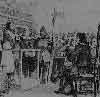 Village, for hanging. Another man of over eighty years was
pressed to death under heavy stones for refusing to submit to a trial on
witchcraft charges. Hundreds of others faced accusations of witchcraft.
Dozens languished in jail for months without trials. Then, almost as soon
as it had begun, the hysteria that swept through Puritan Massachusetts
ended.
Village, for hanging. Another man of over eighty years was
pressed to death under heavy stones for refusing to submit to a trial on
witchcraft charges. Hundreds of others faced accusations of witchcraft.
Dozens languished in jail for months without trials. Then, almost as soon
as it had begun, the hysteria that swept through Puritan Massachusetts
ended.Why did this travesty of justice occur? Why did it occur in Salem? Nothing about this tragedy was inevitable. Only an unfortunate combination of economic conditions, congregational strife, teenage boredom, and personal jealousies can account for the spiraling accusations, trials, and executions that occurred in the spring and summer of 1692.
In 1688, John Putnam, one of the most influential elders of Salem Village, invited Samuel Parris, formerly a marginally successful planter and merchant in Barbados, to preach in the Village church. A year later, after negotiations over salary, inflation adjustments, and free firewood, Parris accepted the job as Village minister. He moved to Salem Village with his wife Elizabeth, his six-year-old daughter Betty, niece Abagail Williams, and slave Tituba, a West African native acquired by Parris in Barbados.
The Salem that became the new home of Parris was in the midst of change: a mercantile elite was beginning to develop, prominent people were becoming less willing to assume positions as town leaders, two clans (the Putnams and the Porters) were competing for control of the village and its pulpit, and a debate was raging over how independent Salem Village, tied more to the interior agricultural regions, should be from Salem, a center of sea trade.
Sometime during February of the exceptionally cold winter of 1692, young Betty Parris became strangely ill. She dashed about, dove under furniture, contorted in pain, and complained of fever. The cause of her symptoms may have been some combination of stress, asthma, guilt, child abuse, epilepsy, and delusional psychosis, but there were other theories. Cotton Matherhad recently published a popular book, "Memorable Providences," describing the suspected witchcraft of an Irish washerwoman in Boston, and Betty's behavior in some ways mirrored that of the afflicted person described in Mather's widely read and discussed book. It was easy to believe in 1692 in Salem, with an Indian war raging and the village in political turmoil, that the devil was close at hand. Talk of witchcraft increased when other playmates of Betty, including eleven-year-old Ann Putnam, seventeen-year-old Mercy Lewis, and Mary Walcott, began to exhibit similar unusual behavior. When his own nostrums failed to effect a cure, William Griggs, a doctor called to examine the girls, suggested that the girls' problems might have a supernatural origin. The widespread belief that witches targeted children made the doctor's diagnosis seem increasing likely.
A neighbor, Mary Sibley, proposed a form of counter magic. She told Tituba to bake a rye cake with the urine of the afflicted victim and feed the cake to a dog. ( Dogs were believed to be used by witches as agents to carry out their devilish commands.) By this time, suspicion had already begun to focus on Tituba, who had been known to tell the girls tales of omens, voodoo, and witchcraft from her native folklore. Her participation in the urine cake episode made her an even more obvious scapegoat for the inexplicable.
Meanwhile, the number of girls afflicted continued to grow, rising to seven with the addition of Ann Putnam, Elizabeth Hubbard, Susannah Sheldon, and Mary Warren. According to historian Peter Hoffer, the girls "turned themselves from a circle of friends into a gang of juvenile delinquents." ( Many people of the period complained that young people lacked the piety and sense of purpose of the founders' generation.) The girls contorted into grotesque poses, fell down into frozen postures, and complained of biting and pinching sensations. In a village where everyone believed that the devil was real, close at hand, and acted in the real world, the suspected affliction of the girls became an obsession.
Sometime after February 25, when Tituba baked the witch cake, and February 29, when arrest warrants were issued against Tituba and two other women, Betty Parris and Abigail Williams named their afflictors and the witchhunt began. The consistency of the two girls' accusations suggests strongly that the girls worked out their stories together. Soon Ann Putnam and Mercy Lewis were also reporting seeing "witches flying through the winter mist." The prominent Putnam family supported the girls' accusations, putting considerable impetus behind the prosecutions.
The first three to be accused of witchcraft were Tituba, Sarah Good, and Sarah Osborn. Tituba was an obvious choice (LINK TO TITUBA'S EXAMINATION). Good was a beggar and social misfit who lived wherever someone would house her (LINK TO GOOD'S EXAMINATION) (LINK TO GOOD'S TRIAL), and Osborn was old, quarrelsome, and had not attended church for over a year. The Putnams brought their complaint against the three women to county magistrates Jonathan Corwin and John Hathorne, who scheduled examinations for the suspected witches for March 1, 1692 in Ingersoll's tavern. When hundreds showed up, the examinations were moved to the meeting house. At the examinations, the girls described attacks by the specters of the three women, and fell into their by then perfected pattern of contortions when in the presence of one of the suspects. Other villagers came forward to offer stories of cheese and butter mysteriously gone bad or animals born with deformities after visits by one of the suspects.The magistrates, in the common practice of the time, asked the same questions of each suspect over and over: Were they witches? Had the seen the Devil? How, if they are were not witches, did they explain the contortions seemingly caused by their presence? The style and form of the questions indicates that the magistrates thought the women guilty.
The matter might have ended with admonishments were it not for Tituba. After first adamantly denying any guilt, afraid perhaps of being made a scapegoat, Tituba claimed that she was approached by a tall man from Boston--obviously the Devil--who sometimes appeared as a dog or a hog and who asked her to sign in his book and to do his work. Yes, Tituba declared, she was a witch, and moreover she and four other witches, including Good and Osborn, had flown through the air on their poles. She had tried to run to Reverend Parris for counsel, she said, but the Devil had blocked her path. Tituba's confession succeeded in transforming her from a possible scapegoat to a central figure in the expanding prosecutions. Her confession also served to silence most skeptics, and Parris and other local ministers began witch hunting with zeal.
Soon, according to their own reports, the spectral forms of other women began attacking the afflicted girls. Martha Corey, Rebecca Nurse, Sarah Cloyce, and Mary Easty were accused of witchcraft. During a March 20 church service, Ann Putnam suddenly shouted, "Look where Goodwife Cloyce sits on the beam suckling her yellow bird between her fingers!" Soon Ann's mother, Ann Putnam, Sr., would join the accusers. Dorcas Good, four-year-old daughter of Sarah Good, became the first child to be accused of witchcraft when three of the girls complained that they were bitten by the specter of Dorcas. (The four-year-old was arrested, kept in jail for eight months, watched her mother get carried off to the gallows, and would "cry her heart out, and go insane.") The girls accusations and their ever more polished performances, including the new act of being struck dumb, played to large and believing audiences.
Stuck in jail with the damning testimony of the afflicted girls widely accepted, suspects began to see confession as a way to avoid the gallows. Deliverance Hobbs became the second witch to confess, admitting to pinching three of the girls at the Devil's command and flying on a pole to attend a witches' Sabbath in an open field. Jails approached capacity and the colony "teetered on the brink of chaos" when Governor Phips returned from England. Fast action, he decided, was required.
Phips created a new court, the "court of oyer and terminer," to hear the witchcraft cases. Five judges, including three close friends of Cotton Mather, were appointed to the court. Chief Justice, and most influential member of the court, was a gung-ho witch hunter named William Stoughton. Mather urged Stoughton and the other judges to credit confessions and admit "spectral evidence" (testimony by afflicted persons that they had been visited by a suspect's specter). Ministers were looked to for guidance by the judges, who were generally without legal training, on matters pertaining to witchcraft. Mather's advice was heeded. the judges also decided to allow the so-called "touching test" (defendants were asked to touch afflicted persons to see if their touch, as was generally assumed of the touch of witches, would stop their contortions) and examination of the bodies of accused for evidence of "witches' marks" (moles or the like upon which a witch's familiar might suck) (SCENE DEPICTING EXAMINATION FOR MARKS). Evidence that would be excluded from modern courtrooms-- hearsay, gossip, stories, unsupported assertions, surmises-- was also generally admitted. Many protections that modern defendants take for granted were lacking in Salem: accused witches had no legal counsel, could not have witnesses testify under oath on their behalf, and had no formal avenues of appeal. Defendants could, however, speak for themselves, produce evidence, and cross-examine their accusers. The degree to which defendants in Salem were able to take advantage of their modest protections varied considerably, depending on their own acuteness and their influence in the community.
The first accused witch to be brought to trial was Bridget Bishop. Almost sixty years old, owner of a house of ill repute, critical of her neighbors, and reluctant to pay her her bills, Bishop was a likely candidate for an accusation of witchcraft (LINK TO EXAMINATION OF BISHOP). The fact that Thomas Newton, special prosecutor, selected Bishop for his first prosecution suggests that he believed the stronger case could be made against her than any of the other suspect witches. At Bishop's trial on June 2, 1692, a field hand testified that he saw Bishop's image stealing eggs and then saw her transform herself into a cat. Deliverance Hobbs, by then clearly insane, and Mary Warren, both confessed witches, testified that Bishop was one of them. A villager named Samuel Grey told the court that Bishop visited his bed at night and tormented him. A jury of matrons assigned to examine Bishop's body reported that they found an "excrescence of flesh." Several of the afflicted girls testified that Bishop's specter afflicted them. Numerous other villagers described why they thought Bishop was responsible for various bits of bad luck that had befallen them. There was even testimony that while being transported under guard past the Salem meeting house, she looked at the building and caused a part of it to fall to the ground. Bishop's jury returned a verdict of guilty . One of the judges, Nathaniel Saltonstall, aghast at the conduct of the trial, resigned from the court. Chief Justice Stoughton signed Bishop's death warrant, and on June 10, 1692, Bishop was carted to Gallows Hill and hanged (LINK TO IMAGE OF BISHOP'S HANGING).
As the summer of 1692 warmed, the pace of trials picked up. Not all defendants were as disreputable as Bridget Bishop. Rebecca Nurse was a pious, respected woman whose specter, according to Ann Putnam, Jr. and Abagail Williams, attacked them in mid March of 1692 (LINK TO EXAMINATION OF NURSE). Ann Putnam, Sr. added her complaint that Nurse demanded that she sign the Devil's book, then pinched her. Nurse was one of three Towne sisters , all identified as witches, who were members of a Topsfield family that had a long-standing quarrel with the Putnam family. Apart from the evidence of Putnam family members, the major piece of evidence against Nurse appeared to be testimony indicating that soon after Nurse lectured Benjamin Houlton for allowing his pig to root in her garden, Houlton died. The Nurse jury returned a verdict of not guilty, much to the displeasure of Chief Justice Stoughton, who told the jury to go back and consider again a statement of Nurse's that might be considered an admission of guilt (but more likely an indication of confusion about the question, as Nurse was old and nearly deaf). The jury reconvened, this time coming back with a verdict of guilty(LINK TO NURSE TRIAL). On July 19, 1692, Nurse rode with four other convicted witches to Gallows Hill.
Persons who scoffed at accusations of witchcraft risked becoming targets of accusations themselves. One man who was openly critical of the trials paid for his skepticism with his life. John Proctor, a central figure in Arthur Miller's fictionalized account of the Salem witchhunt, The Crucible, was an opinionated tavern owner who openly denounced the witchhunt. Testifying against Proctor were Ann Putnam, Abagail Williams, Indian John (a slave of Samuel Parris who worked in a competing tavern), and eighteen-year-old Elizabeth Booth, who testified that ghosts had come to her and accused Proctor of serial murder. Proctor fought back, accusing confessed witches of lying, complaining of torture, and demanding that his trial be moved to Boston. The efforts proved futile. Proctor was hanged. His wife Elizabeth, who was also convicted of witchcraft, was spared execution because of her pregnancy (reprieved "for the belly").
No execution caused more unease in Salem than that of the village's ex-minister, George Burroughs. Burroughs, who was living in Maine in 1692, was identified by several of his accusers as the ringleader of the witches. Mercy Lewis, the most imaginative and forceful of the young accusers, offered unusually vivid testimony against Burroughs. Lewis told the court that Burroughs flew her to the top of a mountain and, pointing toward the surrounding land, promised her all the kingdoms if only she would sign in his book (a story very similar to that found in Matthew 4:8). Lewis said, "I would not writ if he had throwed me down on one hundred pitchforks." At an execution, a defendant in the Puritan colonies was expected to confess, and thus to save his soul. When Burroughs on Gallows Hill continued to insist on his innocence and then recited the Lord's Prayer perfectly (something witches were thought incapable of doing), the crowd was reportedly "greatly moved." Cotton Mather, who was in attendance, intervened and reminded the crowd that Burroughs had had his day in court and lost.
One victim of the Salem witchhunt was not hanged, but rather pressed under heavy stones for two days until his death. Such was the fate of octogenarian Giles Corey who, after spending five months in chains in a Salem jail with his also accused wife, had nothing but contempt for the proceedings. Seeing the futility of a trial and hoping that by avoiding a conviction his farm, that would otherwise go the state, might go to his two sons-in-law, Corey refused to stand for trial. The penalty for such a refusal was peine et fort, or pressing. Three days after Corey's death, on September 22, 1692, eight more convicted witches, including Giles' wife Martha, were hanged. They were the last victims of the witchhunt.
By early autumn of 1692, Salem's lust for blood was ebbing. Doubts were developing as to how so many respectable people could be guilty. Reverend John Hale said, " It cannot be imagined that in a place of so much knowledge, so many in so small compass of land should abominably leap into the Devil's lap at once." The educated elite of the colony began efforts to end the witch-hunting hysteria that had enveloped Salem. Increase Mather, the father of Cotton, published what has been called "America's first tract on evidence," a work entitled Cases of Conscience, which argued that it "were better that ten suspected witches should escape than one innocent person should be condemned." Increase Mather urged the court to exclude spectral evidence. Samuel Willard, a highly regarded Boston minister, circulated Some Miscellany Observations, which suggested that the Devil might create the specter of an innocent person. Mather's and Willard's works were given to Governor Phips. The writings most likely influenced the decision of Phips to order the court to exclude spectral evidence and touching tests and to require proof of guilt by clear and convincing evidence. With spectral evidence not admitted, twenty-eight of the last thirty-three witchcraft trials ended in acquittals. The three convicted witches were later pardoned. In May of 1693, Phips released from prison all remaining accused or convicted witches.
By the time the witchhunt ended, nineteen convicted witches were executed (LINK TO LIST OF DEAD), at least four accused witches had died in prison, and one man, Giles Corey, had been pressed to death. About one to two hundred other persons were arrested and imprisoned on witchcraft charges. Two dogs were executed as suspected accomplices of witches.
A period of atonement began in the colony. Samuel Sewall, one of the judges, issued a public confession of guilt and an apology. Several jurors came forward to say that they were "sadly deluded and mistaken" in their judgments. Reverend Samuel Parris conceded errors of judgment, but mostly shifted blame to others. Parris was replaced as minister of Salem village by Thomas Green, who devoted his career to putting his torn congregation back together. Governor Phips blamed the entire affair on William Stroughton. Stroughton, clearly more to blame than anyone for the tragic episode, refused to apologize or explain himself. He criticized Phips for interfering just when he was about to "clear the land" of witches. Stoughton became the next governor of Massachusetts.
The witches disappeared, but witchhunting in America did not. Each generation must learn the lessons of history or risk repeating its mistakes. Salem should warn us to think hard about how to best safeguard and improve our system of justice.
How To Submit Your Article:
Follow the Procedure Below To Submit Your Articles

Submit your Article by using our online form
Click here
Note* we only accept Original Articles, we will not accept
Articles Already Published in other websites.
For Further Details Contact:
[email protected]
 Right Away Call us at Ph no: 9650499965
Articles of Yesteryears
Click on the link Below to check articles submitted in previous years:Latest Articles - Law Articles 2017 - Law Articles 2016 - Law Articles 2015 - Law Articles 2014 - Law Articles 2013 - Law Articles 2012 - Law Articles 2011 - Law Articles 2010 - Law Articles 2009 - Law Articles 2008 - Articles 2007 - Law Articles 2006 - Law Articles 2000-05 - Archive
File Your Copyright - Right Now!
 Online Copyright Registration in India Call us at: 9891244487 / or email at: [email protected] |
Lawyers in India - Search By City |
|||
|
Delhi Chandigarh Allahabad Lucknow Noida Gurgaon Faridabad Jalandhar Vapi |
Mumbai Pune Nagpur Nashik Ahmedabad Surat Indore Agra Jalgaon |
Kolkata Siliguri Durgapur Janjgir Jaipur Ludhiana Dimapur Guwahati Amritsar |
Chennai Jamshedpur Hyderabad Coimbatore Eluru Belgaum Cochin Rajkot Jodhpur |