





Introduction
Rose is a flower which is known for its beauty and smell, isn’t it?
What if I tell you that the CGPDTM had accepted their first smell mark which smells like roses. Rose scented tyre trademark filed by Japanese company Sumitomo rubber was accepted by the Trademark Registry, which is a huge milestone to expand the protection beyond visuals to smells.
Application Details
The application was filed under class 12 for tyres which smell like roses. The trademark Act emphasises on distinctiveness, history and usage of marks, shape, color whereas in this case, the submission of the applicant was pertaining to the distinctiveness of the rose fragrance presented in the tyres. However, rose is a usual smell/fragrance which can be recognised easily, even by a person with an average intelligence.
Appointment Of Amicus Curiae
The CGPDTM appointed Shri Pravin Anand as amicus curiae to ensure an informed and balanced decision. His submissions provided clarity on both legal doctrine and scientific applicability.
Legal Framework
Definition Of Trademark Under The Trademark Act, 1999
The Trademark Act, 1999 defines trademark as follows under section 2(1)(zb)
“Trade Mark” means a mark capable of being represented graphically and which is capable of distinguishing the goods or services of one person from those of others and may include the shape of goods, their packaging and combination of colours.
Graphical Representation Under Trademark Rules, 2017
Rule 2(1)(k) of Trademark Rules, 2017 defines graphical representation as follows under:
Graphical representation means the representation of a trademark for goods or services represented or capable of being represented in paper and includes representation in digitised form.
For any Trademark to be registered/accepted as a Trademark before the Trademark Registry, it should be graphically represented as it is a mark which is used for trading goods and services.
Distinctiveness And Registration
The applicant’s mark was registered as it has acquired distinctiveness since they have infused their tyres with rose scent and there are no other products/goods in the market which are similar to this. It is an out of the box thinking, where nobody would associate tyres with rose scent and it is recognised worldwide for its unique idea.
The Applicant’s team made an all-out effort to register their smell mark and made India join the olfactory mark Club with:
- USA
- UK
- EU
- Australia
- Canada
- South Korea
- New Zealand
- Peru
- Colombia
- The UAE
Concept Of Distinctiveness
With regard to the distinctiveness of the Mark, Arbitrary Trademarks are common Tradenames/marks that have zero correlation with the associated goods and services, such as Apple for phones and Crocs for footwear. Likewise, the applicant team had submitted that even though the smell of the rose is common and precise, a person with average intelligence and imperfect recollection would not get confused with regard to the reminiscence of the rose smell in tyres as they are distinctive and a stark contrast compared to the usual rubber smell of the tyres. It is definitely iconic and one of a kind to mix the rose smell with rubber tyres.
Graphical Representation As Per The Trademark Act, 1999
Since Graphical representation of a mark is a mandatory criteria for acceptance or registration of a trademark, the applicant submitted a description which was prepared by Prof. Pritish Varadwaj, Neetesh Purohit and Dr. Sunit Yadav of the Indian Institute of Information Technology, Allahadabad and the same is as follows:
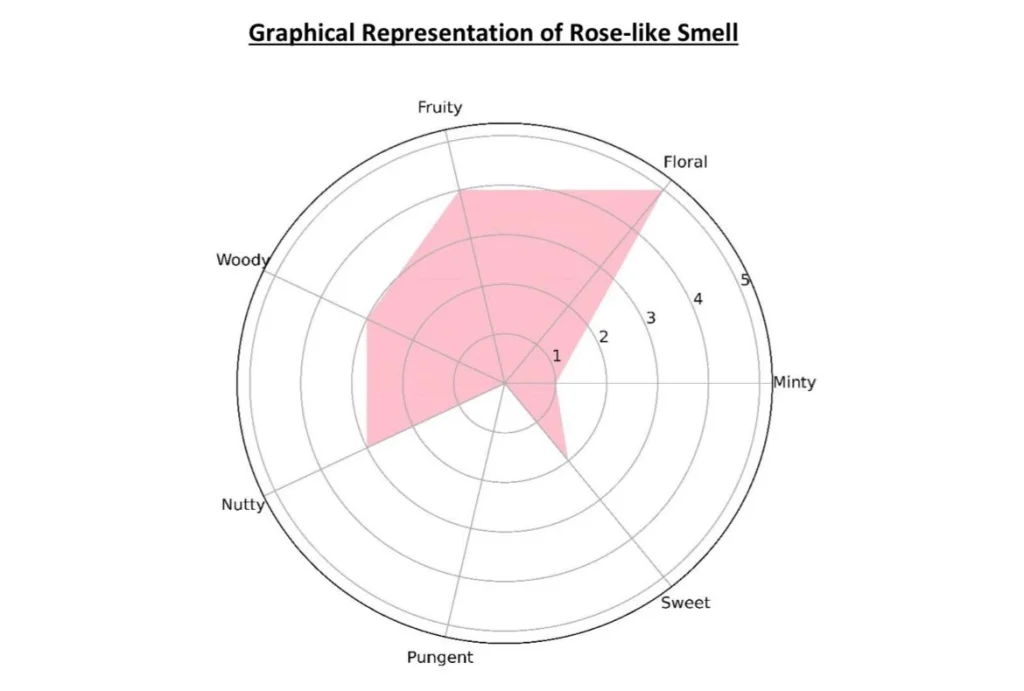
The above graphical representation depicts the 7 fundamental smells of the rose and an algebraic average of Vectors and the same was submitted to the Trademark Registry.
Decision Of CGPDTM
The CGPDTM concluded that the scientific model (Graphical representation of the Rose smell) satisfied the criteria, and the scent was inherently distinctive. Hence, the application was advertised as an olfactory mark under section 20.
Foreign Registration Reference
The applicant emphasised on their UK registered trademark application no. UK00002001416 for the very same scent.
Smell Marks In Other Countries
Looks like Sumitomo has been making heads turn since 1996, since the UK registered its first smell mark applied for the very same rose fragrance tyres.
United States — First Smell Mark (1990)
US was the primal country to register the smell mark in history which was in 1990, Please re: In re Celia, dba Clarke’s Osewez, 17 USPQ2d 1238 (TTAB) 1990.
This is an intriguing case, the applicant was refused by USPTO stating that the consumers will tend to assume that it is a fragrance of origin” and considered as de jure functional.
However, in an appeal to TTAB, the board stated that it has the capacity to be registered as a smell mark as it has a high impact, fresh, floral fragrance reminiscent of Plumeria Blossoms on embroidery yarn.
The applicant stated that there is no other company which is selling embroidery yarn with floral fragrance and it has achieved its distinctiveness for their complete sealed kit consists of scented yarn for making a scented skunk through its customers and how popular it is in the public standpoint.
The examining attorney conceded that the applicant’s scent in the product is distinctive and served as a feature rather than a source identifier “Clarke’s distinctive Sof-Scented Yarns”, and there are references or indications to the peculiar fragrance.
After careful consideration, the refusal was reversed.
Registered Smell Marks — Notable Examples
- Plumeria blossom fragrance on embroidery yarn (USA)
- Play-Doh scent (USA)
- Crayon scent (Canada)
Play-Doh Scent Trademark
The well known play-doh scent which is loved by the fans all over the world is also a registered trademark under US trademark office.
The play – doh in a unique smell which is a combination of a sweet slightly musky, vanilla like fragrance, with slight overtones of cherry and the natural smell of a wheat based salty dough, play-doh was launched in the year 1956 and ever since the inception, the distinctive smell was famously known as play-doh scent res Ipsa loquitur that it has acquired recognition among the public.
Canada — First Smell Mark (2019)
Canada’s first smell mark was registered in the year 2019 by Crayola Properties Inc for a crayon scent mark.
This crayon scent mark describes a unique scent of pungent, alice fragrance with faint hydrocarbon wax and clay notes in connection with crayons.
Summary Table
| Country | Year | Smell Mark | Product |
|---|---|---|---|
| United States | 1990 | Plumeria blossom fragrance | Embroidery yarn |
| United States | — | Play-Doh scent | Modeling compound |
| Canada | 2019 | Crayon scent | Crayons |
| United Kingdom | 1996 | Rose fragrance tyres | Tyres |
Legality of Non-Conventional Marks
The Non-Conventional marks include touch, colour, shape, texture, sound, taste, etc. They are not covered under the virtue of Conventional Trademarks and these were provided protection under the act only when they are graphically represented. The Non-Conventional marks are registered when they have the ability to be distinctive from other products from the mind of customers.
Types Of Non-Conventional Marks
- Touch
- Colour
- Shape
- Texture
- Sound
- Taste
Legal Framework And WTO Compliance
We have adhered to World Trade Organisation (WTO) and followed the provisions laid down in the TRIPS agreement, section 2(b) of the Act which defines the Trademark including Non-Conventional marks. The amended version of Trademark Rules, 2017 has permitted the digitised graphical representation to ease the process of registration of non conventional marks and they have stepped into the Indian jurisprudence.
Taste Marks (Non-Conventional Mark)
India hasn’t registered its Taste Mark as it is hard to graphically represent a taste and to bring out the essence of the taste in written form could be ambiguous and confusing.
Further, there is no provision or statute that mentions about the Registration process of Taste Marks and the doctrine of functionality makes it harder to create a factor of exclusivity which is inherent in obtaining registration of a taste mark.
Reasons For Non-Registration Of Taste Marks
- Difficulty in graphical representation
- Ambiguity in written description of taste
- No statutory provision for registration
- Doctrine of functionality restricting exclusivity
Growing Importance Of Non-Conventional Marks
Non – Conventional marks are no longer a nook, they are rapidly growing as an integral part for the global branding strategies.
Conclusion
In essence, the trademark should be unique and distinctive enough to differentiate one’s product and services from others in the market, thereby avoiding confusion among customers. There is no provision or statute that says that a trademark should be of only words and letters.
Registration of Olfactory Mark is a milestone in India and it is the new Trademark trend and with the current technological advancements, the trademark registry might open doors for taste marks and other sensory marks too, provided that the applicants’ Trademark meets the requirements of distinctiveness and graphical representation as per the Indian Trademark Law.

