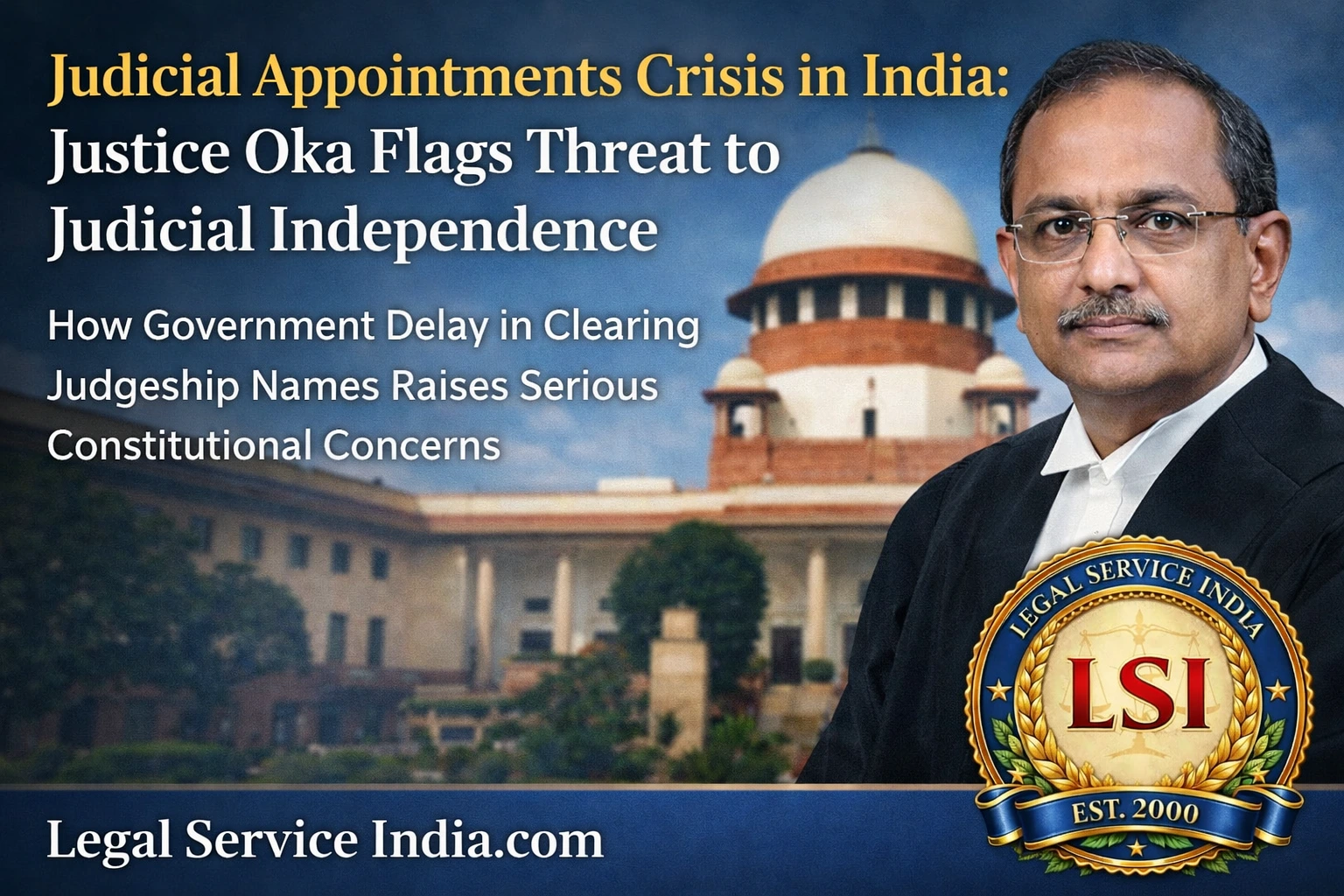
Government Inaction on Judicial Appointments: A Quiet Threat to Judicial Independence
By a Supreme Court Practitioner (25+ Years at the Bar)
In the daily churn of constitutional litigation, some issues flash brightly and fade. Others, quieter in tone but profound in implication, shape the very architecture of our democracy. The recent observations of Justice Abhay S. Oka—that the government has not been clearing names recommended for judgeship—fall squarely in the latter category.
This is not merely an administrative lapse. It is a constitutional moment.
The Constitutional Context: Appointments and the Collegium System
The appointment of judges to the higher judiciary in India is governed by Articles 124 and 217 of the Constitution. Over time, through the celebrated Three Judges Cases—notably, the Supreme Court Advocates-on-Record Association v. the Union of India—the collegium system emerged as the controlling mechanism.
How The Collegium System Works
- The judiciary recommends names for appointment and elevation
- The executive may seek clarification or return a recommendation once
- However, if the collegium reiterates its recommendation, constitutional convention mandates acceptance
The present controversy arises from an alleged departure from this settled convention.
Justice Oka’s Observation: More Than a Passing Remark
When a sitting judge of the Supreme Court publicly notes that recommended names are not being cleared, it signals a breakdown—not of procedure alone, but of trust between constitutional organs.
Such observations must be read not as criticism but as a constitutional alarm bell.
Judicial Independence: Part of the Basic Structure
The doctrine of basic structure, evolved in Kesavananda Bharati v. State of Kerala, firmly places judicial independence beyond the reach of ordinary political contestation.
Constitutional Risks Arising from Delay
- Delays judicial appointments indefinitely
- Selectively processes recommendations
- Exerts indirect pressure through inaction
…raises serious constitutional concerns.
This is because independence is not only about removal or control—it is also about appointments.
Executive Delay as a Form of Control
Traditionally, interference is imagined as overt—dismissals, transfers, or legislative overrides. But in modern constitutional practice, delay itself can become a tool of influence.
Impact of Delay on Judiciary
- Courts function with reduced strength
- Case backlogs worsen
- Existing judges are overburdened
- Litigants suffer delayed justice
In effect, justice is not denied by decree but by erosion of capacity.
Separation of Powers Under Strain
The Constitution envisages a delicate balance between the legislature, executive, and judiciary. The collegium system, whatever its imperfections, represents a judicially evolved mechanism to preserve that balance.
Institutional Impact
- Disrupts equilibrium between institutions
- Affects independence of judicial functioning
- Disturbs constitutional scheme
This is not confrontation—it is constitutional friction.
The Real-World Impact: Vacancies and Delays
India’s higher judiciary already faces significant vacancies. The consequences are visible:
| Issue | Impact |
|---|---|
| Judicial Vacancies | Reduced bench strength |
| Case Backlog | Crores of pending cases |
| Delay in Justice | Erosion of public trust |
| Overburdened Judges | Decline in efficiency |
When recommendations remain pending, these problems deepen.
A Constitutional Convention at Risk
It is important to understand that the collegium system operates not merely on written rules but on constitutional conventions—mutual respect and adherence to established practice.
Key Constitutional Convention
- Reiterated recommendations must be accepted
If this convention weakens, the system risks sliding into uncertainty and institutional conflict.
Long-Term Constitutional Consequences
The issue is not about one set of appointments. It is about the precedent being set.
Future Risks
- Future governments may adopt similar practices
- Judicial appointments may become politicized indirectly
- The judiciary’s institutional independence may erode gradually
Constitutional damage rarely occurs in a single stroke—it unfolds incrementally.
A Lawyer’s Perspective: Why This Matters Deeply
Having spent over two decades before the Supreme Court, one learns that the strength of the judiciary lies not only in its judgments but also in its institutional integrity.
Pillars of Judicial Independence
- Security of tenure
- Freedom from external pressure
- A fair and timely appointments process
Delay, when systemic, is indistinguishable from denial.
The Way Forward: Restoring Constitutional Balance
The solution lies not in confrontation but in constitutional fidelity:
- The executive must adhere to established conventions
- The collegium must maintain transparency and consistency
- Institutional dialogue must replace silent standoffs
Above all, the Constitution must remain the guiding force—not expediency.
Conclusion: A Moment of Quiet Constitutional Significance
Justice Abhay Oka’s remarks are not dramatic, but they are deeply consequential. They highlight a subtle yet serious challenge to the independence of the judiciary, a cornerstone of India’s constitutional democracy.
In constitutional law, some battles are fought loudly in courtrooms. Others unfold silently in corridors of power.
This is one such moment.
And history will judge how it is resolved.