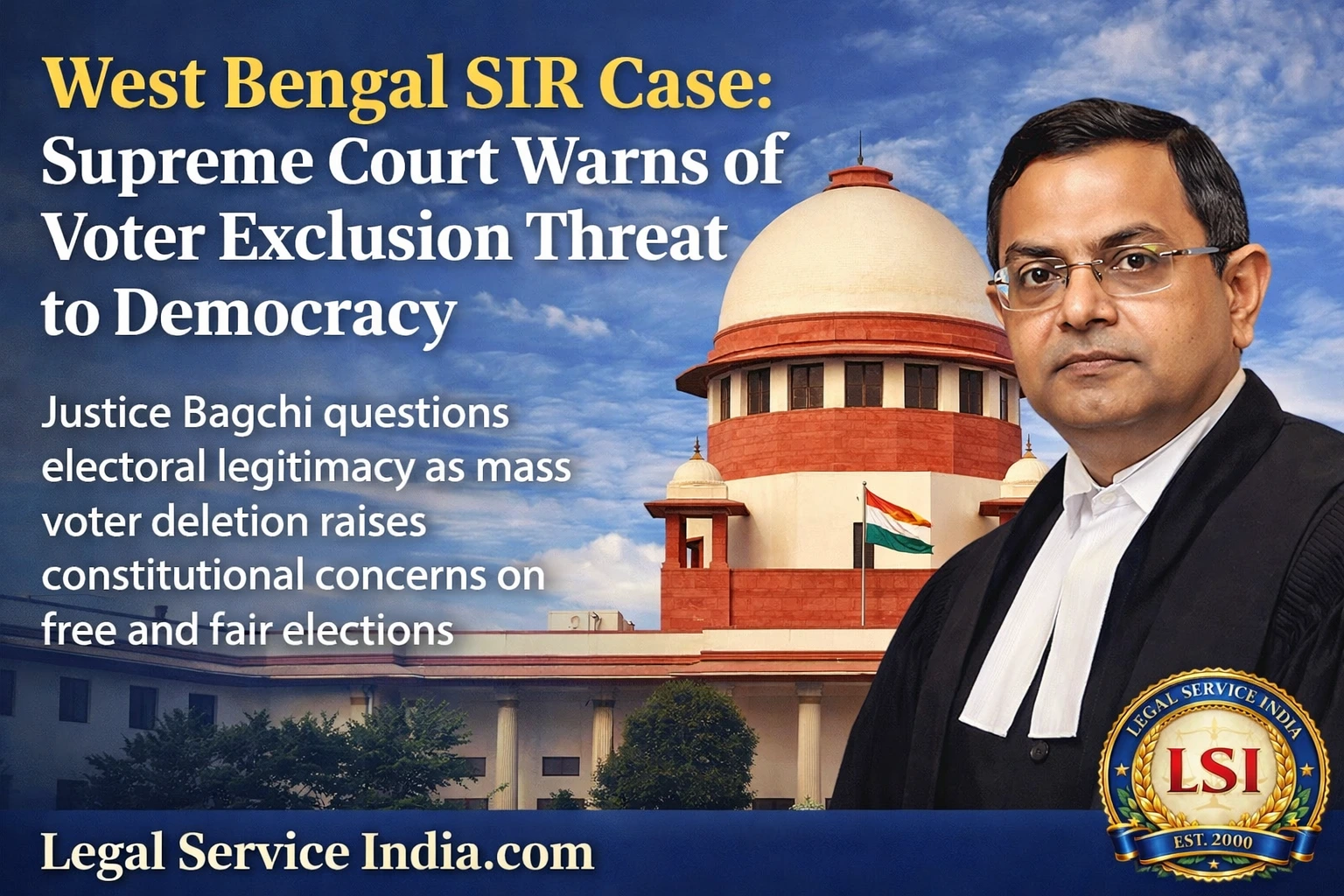
West Bengal Sir Controversy: Supreme Court Flags Risk To Electoral Legitimacy
“If the winning margin is 2%, & 15% couldn’t vote?” — Justice Bagchi Raises A Constitutional Alarm
Citation: In Re: Special Intensive Revision of Electoral Rolls (West Bengal), Supreme Court of India, 2026 (Oral Observations by Justice Joymalya Bagchi)
Introduction: When Procedure Threatens Democracy
After over two decades of practice before the Supreme Court of India, one develops a certain instinct—an ability to distinguish routine procedural disputes from those rare moments when the Court signals a deeper constitutional anxiety. The present controversy arising out of the Special Intensive Revision (SIR) of electoral rolls in West Bengal falls unmistakably in the latter category.
Justice Joymalya Bagchi’s pointed query—“If the winning margin is 2% and 15% of the electorate could not vote, what happens then?”—is not a casual courtroom remark. It is, in my considered opinion, a constitutional warning shot, aimed at preserving the foundational principle of free and fair elections, which forms part of the basic structure of the Constitution.
The Legal Framework: Power Of The Election Commission
The Election Commission of India (ECI) derives its authority primarily from:
- Article 324 of the Constitution of India — Vesting superintendence, direction, and control of elections
- Representation of the People Act, 1950 — Governing preparation and revision of electoral rolls
- Representation of the People Act, 1951 — Governing conduct of elections and election disputes
There is no quarrel with the proposition that the ECI is empowered—indeed, duty-bound—to ensure the purity of electoral rolls. However, the present case raises a more nuanced question:
Can the exercise of such power, if resulting in large-scale exclusion of voters, undermine the very democratic legitimacy it seeks to protect?
What Happened In West Bengal: The Controversy In Brief
The special intensive revision exercise in West Bengal reportedly resulted in the following:
- Mass deletion of voter names running into millions
- Introduction of a new category termed “logical discrepancy”
- Requirement of additional documentation for previously enrolled voters
More troublingly, it was argued before the court that:
- Even after adjudication, a substantial percentage of exclusions remained intact
- The appellate and verification mechanisms were overburdened and imperfect
This triggered judicial concern not merely about administrative efficiency but about systemic disenfranchisement.
Justice Bagchi’s Observations: A Doctrinal Shift In The Making
1. Electoral Legitimacy And Quantitative Disenfranchisement
The most significant contribution of the hearing lies in the articulation—albeit at a preliminary stage—of what may evolve into a new doctrine:
If the number of excluded voters exceeds or substantially impacts the victory margin, the legitimacy of the election itself may be called into question.
Traditionally, election law under Section 100 of the Representation of the People Act, 1951, focuses on:
- Corrupt practices
- Improper acceptance or rejection of nominations
- Material effect on the result
However, systemic voter exclusion has not been explicitly recognised as a ground. Justice Bagchi’s observation opens the door for a jurisprudential expansion—what I would describe as the “Quantitative Disenfranchisement Test”.
2. Deviation From Established Practice: Bihar Vs West Bengal
| Aspect | Bihar | West Bengal |
|---|---|---|
| Verification Approach | Relaxed | Stricter |
| Documentation | Minimal | Expanded Requirements |
| Focus | Inclusion | Discrepancy Detection |
From a constitutional standpoint, this raises issues under the following:
- Article 14 (Equality before law)
- Doctrine of non-arbitrariness
3. Human Error And Administrative Realities
- Officers handling hundreds or thousands of cases daily
- Even 70% accuracy considered acceptable administratively
However:
In matters of voting rights, even a small percentage of error can translate into massive democratic distortion.
4. Due Process And The Right To Be Heard
- Was there a meaningful opportunity to be heard?
- Were decisions reasoned and transparent?
The principle of audi alteram partem remains central to fairness.
Constitutional Dimensions: Beyond Statutory Rights
1. Free And Fair Elections As Basic Structure
The Supreme Court has consistently held that free and fair elections form part of the basic structure of the Constitution.
2. Nature Of The Right To Vote
- Statutory in origin
- Constitutional in effect
- Core to democratic participation
3. The Article 14 Challenge
Differential treatment between states without a rational basis may amount to arbitrariness.
Broader Implications: Where This Case May Lead
1. Recognition Of Disenfranchisement As A Ground
- Possible election invalidation
- Judicial scrutiny of voter exclusion
2. Evolution Of Electoral Due Process
- Stronger appellate mechanisms
- Transparency in deletion
- Technology-backed verification
3. Recalibration Of ECI’s Powers
- Subject to judicial review
- Bound by constitutional principles
Conclusion: A Moment Of Constitutional Reckoning
The West Bengal SIR controversy is not merely about voter lists—it is about the integrity of the democratic process itself.
Democracy is not validated by the conduct of elections alone but by the inclusiveness of participation.
If a system permits the exclusion of a significant segment of the electorate—particularly in closely contested elections—it risks transforming democracy into a procedural illusion.
This case may well mark the beginning of a new chapter in Indian election law—one where the focus shifts from mere procedural compliance to substantive democratic legitimacy.
Citation:
- Case Title: In Re: Special Intensive Revision of Electoral Rolls (West Bengal)
- Court: Supreme Court of India
- Bench: Justice Joymalya Bagchi & Ors.
- Year: 2026
- Citation: 2026 SCC OnLine SC (Oral Observations – Electoral Roll Revision Matter)