





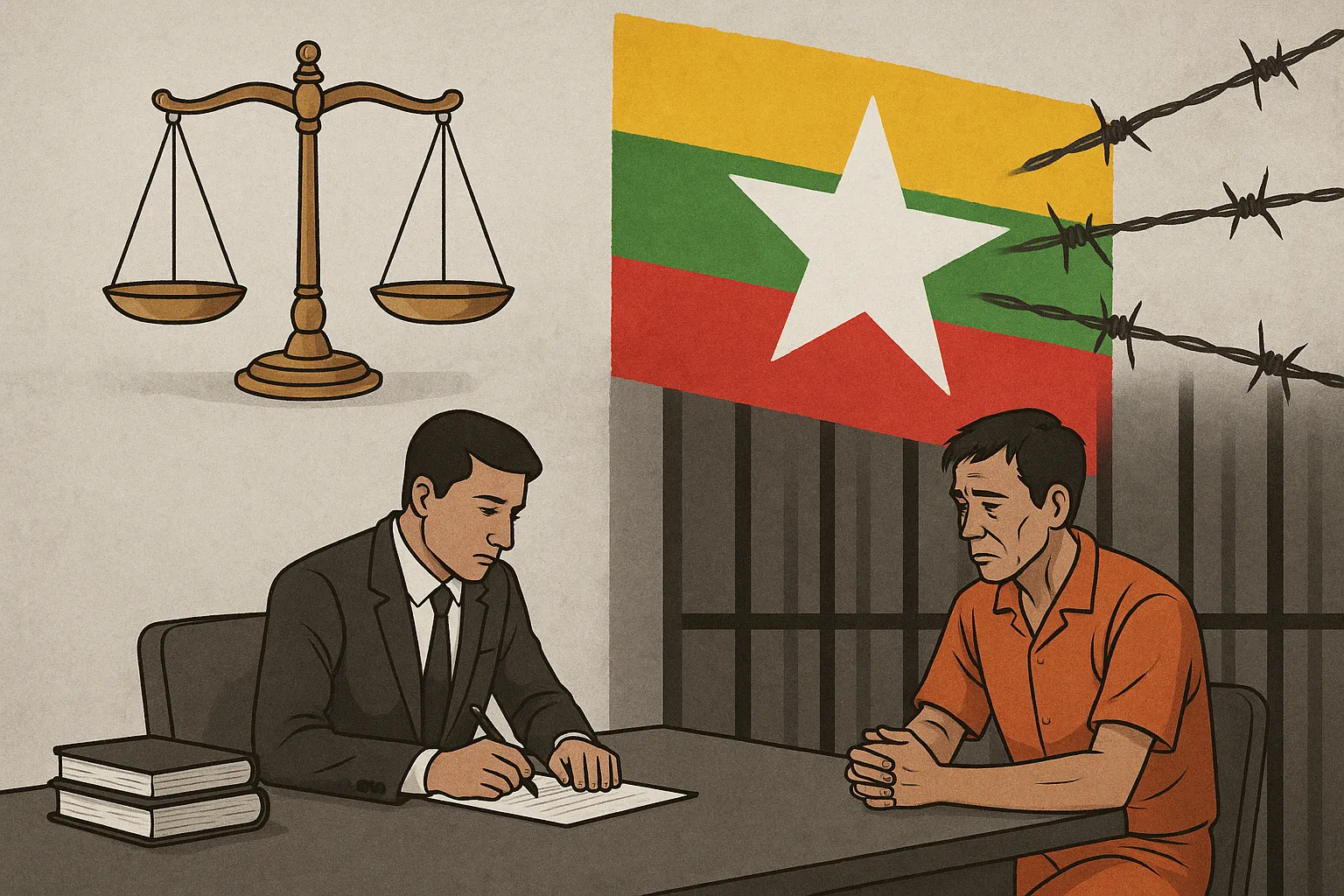
Abstract
This report examines Myanmar’s legal aid system from its establishment through the 2016 Legal Aid Law to the present crisis following the February 2021 military coup. The analysis reveals how Myanmar progressed from having minimal formal legal aid infrastructure to developing a comprehensive national system with government boards and civil society partnerships between 2016-2021. However, the military takeover systematically dismantled these institutions, forcing international organizations and courageous civil society groups to provide legal services under dangerous conditions.
The report documents the collapse of government legal aid boards, restrictive amendments to legal aid legislation, mass arrests creating overwhelming demand for services, and the persistent barriers facing both legal aid providers and justice seekers. Despite severe repression, organizations continue delivering critical legal representation to thousands, including politically sensitive cases. The findings highlight both the fragility of legal aid systems under authoritarian rule and the extraordinary resilience of human rights defenders operating in crisis environments.
Executive Summary
Myanmar’s legal aid system has undergone dramatic transformation over the past decade, moving from significant progress toward democratization and access to justice between 2016-2021, to severe disruption following the military coup in February 2021. The country adopted a national legal aid law in 2016[1], marking a historic milestone. However, the current environment presents extraordinary challenges, with government-supported legal aid boards collapsing after the military takeover[2], leaving international and civil society organizations to fill critical gaps in legal services.
Historical Development
Pre-2016: Laying The Groundwork
Myanmar’s journey toward establishing a formal legal aid system began in earnest during the country’s democratization period starting in 2011. Prior to this, legal aid services were largely provided through informal networks and civil society organizations operating in a restrictive environment.
Myanmar’s participation in the International Legal Aid Conference in June 2014 was a pivotal moment that helped lead to the adoption of national legal aid legislation.[3] During this period, various stakeholders including international organizations, civil society groups, and lawyers began collaborating to develop a sustainable legal aid framework.
A 2016 mapping exercise identified approximately 50 legal aid service providers operating in and around major cities including Mandalay, Myitkyina, Taunggyi, and Yangon[4], demonstrating the growing landscape of legal assistance before formal legislation was enacted.
The 2016 Legal Aid Law
In 2016, Myanmar took a tremendous step forward by adopting a national legal aid law[5], formally known as Pyidaungsu Hluttaw Law No. 10/2016. This legislation established the legal framework for providing systematic legal assistance to vulnerable populations who could not afford legal representation.
The law created a formal structure including the Union Legal Aid Board (ULAB) at the national level, with subsidiary boards established at regional and township levels. The Union Legal Aid Board was formed by the Union Supreme Court on November 15, 2017, and formally began operations shortly thereafter.[6]
Key Objectives Of The Legal Aid System
The legal aid framework was designed to achieve several critical objectives:
- Expanding access to legal aid for vulnerable populations
- Reducing pretrial detention
- Preventing torture and coercion
- Decreasing time between arrest and first contact with a lawyer
- Protecting children and youth[7]
Institutional Structure
Government Bodies
| Institution | Description |
|---|---|
| Union Legal Aid Board (ULAB) | The primary government entity responsible for coordinating legal aid services nationwide. The ULAB worked with international partners and coordinated with local legal aid boards at state and regional levels. |
| Regional and Township Legal Aid Boards | These subsidiary bodies were established to deliver legal aid services at the local level, making assistance more accessible to communities throughout the country. |
| Supreme Court and Ministry of Legal Affairs | These bodies provided oversight and administrative support for the legal aid system, with the Supreme Court playing a key role in appointing board members and establishing operational guidelines. |
Civil Society Organizations
- International Bridges to Justice (IBJ): IBJ first visited Myanmar in 2011 and by 2017 established a full country program with five justice centers strategically placed in important cities throughout Myanmar.[8] Since February 2019, IBJ had a Memorandum of Agreement with the Union Legal Aid Board, working closely with local LABs.
- Legal Aid Network: Founded on October 30, 2012, by human rights lawyer Aung Htoo, the Legal Aid Network is committed to facilitating efforts of grassroots people, activists, civil society organizations, lawyers and legal teams to achieve human rights.[9]
- The International Legal Foundation (ILF): The ILF established its Myanmar program with an office in Yangon in 2017 and has since grown to serve communities in Yangon, Mandalay, Pathein, Lashio, and Rakhine State.[10]
- Justice For All Law Firm: Justice For All is a founding member of Myanmar Legal Aid Network and deeply involved in advocacy to pass legal aid law and legal aid mechanisms in Myanmar.[11]
Types Of Legal Aid Service Providers
Legal aid service providers in Myanmar generally fall into two main categories with divergent organizational structures, mandates, and approaches[12], typically divided between organizations providing direct legal representation and those focusing on legal awareness, education, and alternative dispute resolution services.
Scope Of Legal Aid Services
- Criminal Defense: Representation for individuals accused of crimes, particularly those facing serious charges who cannot afford private counsel. This includes representation during police custody, pretrial proceedings, and trials.
- Civil Matters: Assistance with civil disputes including property rights, family law matters, and contractual disputes.
- Labor Rights: Legal aid services focused on labor rights issues including contract terms, wage payment, probation, overtime, leave, termination, social security, occupational safety and health, collective bargaining, forced labor, child labor, dispute resolution, and workplace discrimination.[13]
- Juvenile Justice: Special focus on protecting the rights of children and youth involved in the justice system, including work with Social Welfare Departments under the Child Rights Law.
- Alternative Dispute Resolution: Community members and legal aid service providers alike reported an overwhelming preference for alternative dispute resolution mechanisms where possible.[14]
The Impact of the 2021 Military Coup
The February 2021 military takeover fundamentally disrupted Myanmar’s legal aid system and created an unprecedented crisis for access to justice.
Collapse of Government Legal Aid
Myanmar’s government-supported legal aid boards simply collapsed after the military takeover. This left a massive gap in legal services for vulnerable populations at precisely the moment when such services became most critical.
U Nyan Win, head of the Union Legal Aid Board, was arrested following the coup, exemplifying the broader assault on legal institutions and the rule of law.
Amendments Restricting Legal Aid
- In May 2021, the military regime made key amendments to the 2016 Legal Aid Law that removed legal aid services at least during pre-trial detention, a critical phase when detainees are particularly at risk of arbitrary detention, torture and ill-treatment.[15]
- The amendments removed all independence of the legal aid bodies and instead gave full control to the Supreme Court, supported by the Cabinet—both bodies dominated by the military.[16]
Civil Society Response
- IBJ-Myanmar stepped to fill the leadership gap created by the collapse of government legal services and became the leading legal aid service willing to take on sensitive cases.[17]
- Up until 2023, IBJ-Myanmar lawyers provided legal representation to over 6,000 individuals, with over 1,256 of these cases being political in nature.[18]
- Organizations like IBJ developed specialized resources to navigate the challenging environment. IBJ prepared a comprehensive primer in Burmese entitled “Practice Tips for Representing Clients During the State of Emergency in Myanmar,” providing legal interpretations and lawful defense strategies for those accused of offenses.[19]
Current Challenges (2024-2025)
Security Threats and Operational Constraints
IBJ-Myanmar developed policies and procedures for dealing with security threats created by the government, as well as threats from the COVID-19 crisis and dangers produced by civil conflict.[20] Legal aid providers and their clients face harassment, detention, and violence for their work.
Systematic Barriers to Justice
- Legal aid service providers reported that key obstacles to their work included corruption in the justice system and a lack of legal awareness by the general public.[21]
- Justice seekers identified lack of legal awareness, distrust in justice institutions, and apprehension of lawyers as among the most pressing barriers to justice in Myanmar.[22]
Mass Arrests and Political Cases
The military junta has conducted widespread arrests of political opponents, protesters, and civil society activists.
| Category | Status as of December 2024 |
|---|---|
| National League for Democracy Party Members Arrested | About 3,000 |
| Members Still in Detention | At least 1,600 |
This has created overwhelming demand for legal aid services at a time when the system’s capacity has been severely diminished.[23]
Limited Geographic Coverage
Current legal aid support has been reduced to target areas including Bago, Kayin, Mandalay, Mon, Nay Pyi Taw, Shan, and Yangon, with projects in other areas not being funded.[24] This reflects the challenging operational environment and limited resources available for legal aid work.
Humanitarian Crisis Context
In 2024, the military-created human rights crisis imposed unprecedented suffering on the people in Myanmar, as the military’s attacks against civilians, denial of humanitarian aid, and systematic violations of human rights further expanded in scope and intensity. This broader context has created massive additional legal aid needs while simultaneously making service delivery more dangerous and difficult.[25]
International Support and Partnerships
International organizations and donors have played crucial roles in sustaining legal aid services:
- USAID: USAID’s Promoting Rule of Law in Myanmar (PRLM) was a five-year, $23 million project working to protect human rights and increase access to justice, providing assistance to the Union Legal Aid Board and the Independent Lawyers Association of Myanmar.[26]
- European Union and UK Government: MyJustice, funded by the European Union and British Embassy, organized workshops on legal aid systems and supported capacity building.[27]
- United Nations Development Programme: UNDP has provided funding for civil society organizations and legal aid service providers, particularly focusing on labor rights and vulnerable populations.
ILF lawyers in Myanmar received well over 6,000 hours of intensive mentoring from experienced public defenders through the International Fellows program[28], demonstrating the importance of international technical assistance.
Key Achievements Despite Challenges
Despite the extraordinarily difficult environment, legal aid providers have achieved significant results:
- Thousands of individuals have received legal representation who otherwise would have faced the justice system alone
- Legal aid organizations have successfully defended clients in politically sensitive cases
- Capacity building efforts have trained hundreds of lawyers in human rights defense
- Documentation of human rights violations has supported international accountability efforts
- Legal awareness programs have reached vulnerable communities
Ongoing Issues and Gaps
| Issue Area | Description |
|---|---|
| Access to Pre-Trial Legal Aid | The 2021 amendments effectively eliminated legal aid during the crucial pre-trial detention phase when detainees are most vulnerable. |
| Political Cases | Legal aid for those accused of political offenses remains extremely limited, with most providers facing security risks when taking such cases. |
| Geographic Disparities | Rural and conflict-affected areas have minimal access to legal aid services. |
| Lack of Independence | The legal aid system under military control lacks the independence necessary to effectively challenge government actions. |
| Resource Constraints | Funding limitations restrict the scope and scale of legal aid services that can be provided. |
| Attorney Safety | Lawyers providing legal aid face harassment, threats, and arrest, creating a chilling effect on willingness to represent sensitive cases. |
Conclusion
Myanmar’s legal aid system represents a story of remarkable progress followed by severe setback. The 2016 Legal Aid Law established a promising framework for expanding access to justice, and the period from 2017-2021 saw significant development of institutional capacity and service delivery. However, the February 2021 military coup decimated government legal aid structures and created an environment where legal aid work itself has become dangerous.
International organizations and courageous civil society groups have maintained critical legal aid services despite extraordinary risks, but the system operates far below the capacity needed to meet the population’s needs. The legal aid landscape in Myanmar today is characterized by resilience and determination in the face of systematic repression, with providers working creatively to deliver services while navigating severe security constraints.
Looking forward, rebuilding Myanmar’s legal aid system will require not only restoration of legal frameworks and institutions but also addressing the fundamental issues of judicial independence, rule of law, and accountability that have been severely compromised since 2021. The experience of Myanmar’s legal aid providers during this crisis period demonstrates both the vital importance of such services and the extraordinary courage of those who continue to provide them under the most challenging circumstances.
References
- International Legal Foundation, “Myanmar Program Overview”, available at: https://www.theilf.org/myanmar (Last Accessed on 30th November, 2025).
- International Bridges to Justice, “IBJ-Myanmar: Providing Legal Services During Crisis”, available at: https://www.ibj.org/global-impact/country-programs/myanmar/ (Last Accessed on 30th November, 2025).
- Supra n.1.
- The Asia Foundation, “Supporting the Transition: Understanding Aid to Myanmar Since 2011”, available at: https://asiafoundation.org/wp-content/uploads/2018/03/Supporting-the-Transition-Understanding-Aid-to-Myanmar-since-2011_ENG.pdf (Last Accessed on 30th November, 2025).
- Supra n.1.
- MyJustice Programme, “Danish Institute for Human Rights”, available at: https://www.humanrights.dk/projects/myjustice-programme-myanmar (Last Accessed on 30th November, 2025).
- Supra n.1.
- Supra n.2.
- Ibid.
- Supra n.1.
- Justice For All Law Firm, “Organizational Background”.
- Supra n.4.
- Annual Report (2024): UNDP – Rule of Law and Human Rights, Myanmar, available at: https://rolhr.undp.org/annualreport/2024/impact/asia-pacific/myanmar.html (Last Accessed on 30th November, 2025).
- Supra n.4.
- Human Rights Watch, “Myanmar: Post-Coup Legal Changes Erode Human Rights”, available at: https://www.hrw.org/news/2021/03/02/myanmar-post-coup-legal-changes-erode-human-rights (Last Accessed on 30th November, 2025).
- Ibid.
- Supra n.2.
- Ibid.
- Ibid.
- Supra n.1.
- Supra n.4.
- Ibid.
- Human Rights Watch, “World Report 2024: Myanmar”, available at: https://www.hrw.org/world-report/2024/country-chapters/Myanmar (Last Accessed on 30th November, 2025).
- Ibid.
- Human Rights Watch, “Myanmar: Military Abuses Against Civilians Intensify”, available at: https://www.hrw.org/news/2024/01/30/myanmar-military-abuses-against-civilians-intensify (Last Accessed on 30th November, 2025).
- USAID, “Promoting Rule of Law in Myanmar”, available at: https://sam.gov/opp/25f5e346c999430b8add29dca24b3a0c/view (Last Accessed on 30th November, 2025).
- MyJustice, available at: https://myjusticemyanmar.org/ (Last Accessed on 30th November, 2025).
- Supra n.1.
