Introduction: When Technology Enters the Family Courtroom
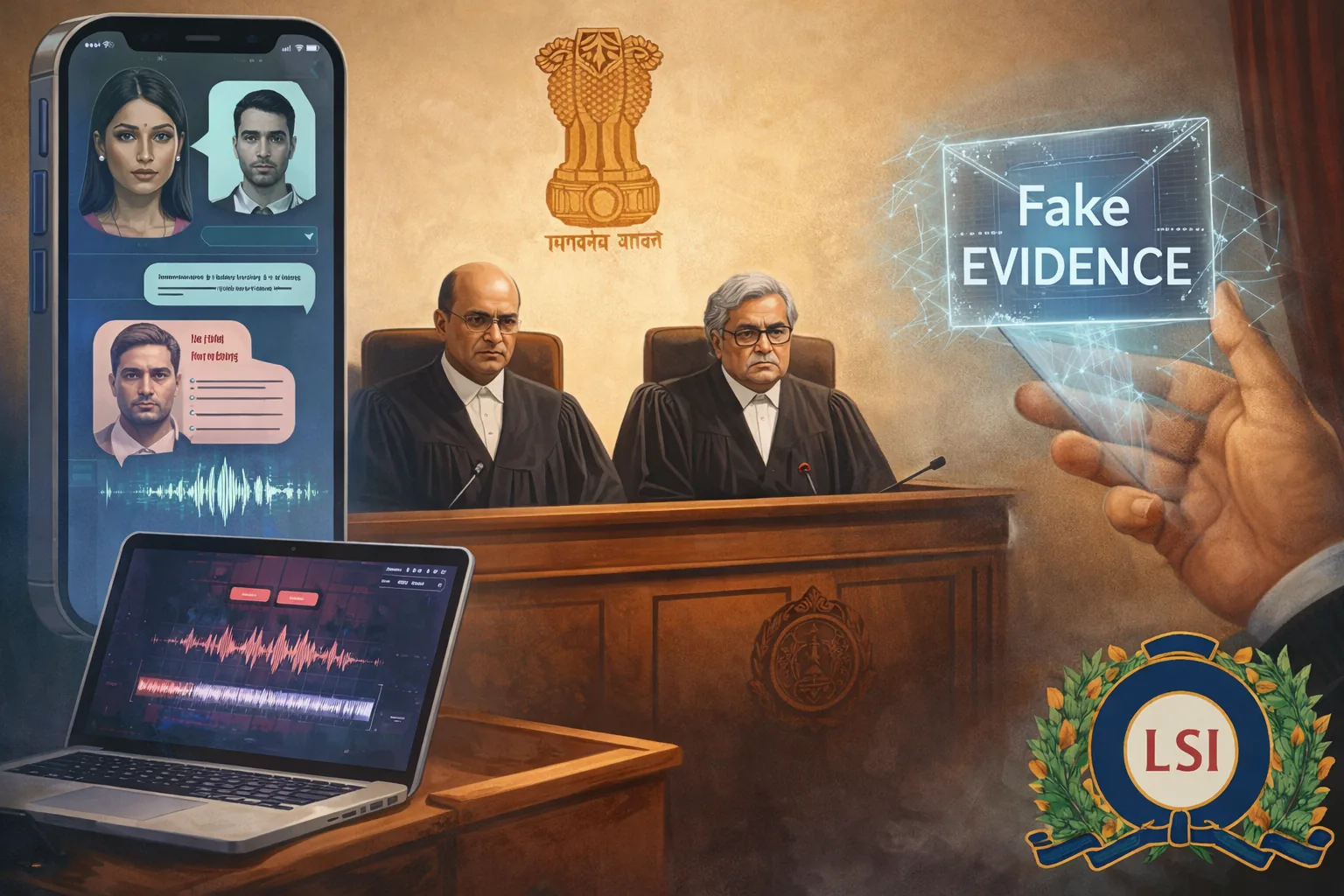
Matrimonial litigation has always been emotionally charged. Allegations of cruelty, harassment, and betrayal often dominate pleadings, sometimes overshadowing the real issues that led to marital collapse. What is new—and deeply troubling—is the emergence of artificial intelligence as a tool for fabricating evidence, a concern that has now found explicit judicial recognition.
In a recent decision delivered on January 20, 2026, the Supreme Court of India issued strong observations while dissolving a marriage on the ground of irretrievable breakdown. Though the parties were anonymised as X v. Y to protect privacy, the implications of the ruling extend far beyond this single dispute.
The judgment is not merely about divorce; it is about truth, technology, and trust in the justice system.
The Case in Focus: X v. Y (2026)
The matter before the Court involved a marriage that had clearly collapsed beyond repair. Years of litigation, mutual accusations, and emotional exhaustion convinced the Bench that reconciliation was impossible.
While granting divorce on the ground of irretrievable breakdown of marriage, the Bench—comprising Justice Rajesh Bindal and Justice Manmohan—made candid and cautionary remarks about a disturbing trend:
Parties in matrimonial disputes are increasingly manufacturing evidence, including through AI-generated material, to “teach the other side a lesson.”
This observation marks a significant moment in Indian family law jurisprudence.
Judicial Concerns: Fabrication, Falsehood, and the Weaponisation of AI
1. False Allegations as a Litigation Strategy
The Court acknowledged what family courts witness daily: false or exaggerated allegations have become routine in matrimonial disputes. Such claims, once introduced, harden positions, destroy any remaining goodwill, and convert private disputes into prolonged legal battles.
2. AI-Generated and Manipulated Evidence
What elevates this judgment is its recognition that technology has altered the nature of falsehood. AI tools can now generate:
- Fabricated chat transcripts
- Deepfake audio recordings
- Manipulated photographs and videos
- Synthetic emails and documents
Unlike traditional false evidence, AI-generated material is harder to detect, especially at the trial court level.
3. Impact on the Justice System
The Court warned that fabricated digital evidence:
- Misleads courts
- Delays justice
- Increases docket burden
- Undermines faith in judicial outcomes
In family law, where decisions affect personal liberty, children, and dignity, the damage is particularly severe.
Mediation Before Litigation: A Judicial Course Correction
The Bench strongly reiterated that mediation should be the first recourse, not the last resort.
By urging parties to explore mediation before approaching police authorities or courts, the Supreme Court signalled a policy shift toward:
- Reducing adversarial hostility
- Preventing criminalisation of marital discord
- Preserving dignity and privacy
This approach aligns with the broader judicial philosophy that family disputes require healing, not punishment.
Irretrievable Breakdown of Marriage: A Growing Judicial Doctrine
Although not yet a statutory ground under the Hindu Marriage Act, the Supreme Court has repeatedly exercised its constitutional powers to dissolve marriages that are emotionally and practically dead.
The X v. Y decision strengthens this line of reasoning by recognising that:
- A marriage without trust cannot be revived by law
- Prolonged litigation serves no societal purpose
- Forced continuation often results in further cruelty
Comparative Perspective: How Other Jurisdictions Are Responding
United Kingdom
Courts in England and Wales, under the UK Supreme Court, have embraced no-fault divorce, removing incentives to fabricate allegations altogether. The emphasis is on ending the marriage with dignity, not proving blame.
United States
Several US family courts have begun scrutinising deepfake evidence. In states like California and New York, courts increasingly rely on digital forensic experts to authenticate electronic material before relying on it.
European Union
The EU has moved proactively through the AI Act, proposing strict rules on deepfakes and synthetic media, especially where legal rights are at stake. Family law cases are recognised as high-risk zones for AI misuse.
These international developments underline that India is not alone in confronting this challenge—but it must act swiftly.
Safeguards the Indian Legal System Must Consider
Drawing from global best practices and the Supreme Court’s warning, several safeguards are urgently needed:
1. Mandatory Digital Forensic Verification
Courts should require forensic authentication of disputed digital evidence in matrimonial cases.
2. Adverse Inference for Proven Fabrication
Parties found guilty of producing AI-fabricated evidence should face:
- Cost penalties
- Adverse findings on credibility
- Possible prosecution for perjury
3. Mediation Screening at Entry Stage
Family courts should mandatorily assess mediation viability before issuing summons.
4. Judicial Training on AI Risks
Judges at all levels must receive training to understand:
- Deepfake indicators
- Metadata manipulation
- Limits of visual and audio “proof”
Why This Judgment Matters
This decision is significant because it does three critical things simultaneously:
- Names the problem – AI misuse in family litigation
- Addresses the symptom – irretrievable marital breakdown
- Points to the cure – mediation, restraint, and truth
By acknowledging the reality of technological abuse, the Supreme Court has taken the first step toward future-proofing family justice.
Conclusion: Technology Must Serve Justice, Not Sabotage It
Marriage may fail—but justice must not.
The Supreme Court’s observations in X v. Y serve as a reminder that law cannot remain technologically naïve. As artificial intelligence grows more sophisticated, so must judicial safeguards.
At its core, this judgment is a call for ethical litigation, responsible use of technology, and a return to the humane resolution of family disputes. If courts, lawyers, and litigants heed this warning, matrimonial justice in India may yet emerge stronger, fairer, and more credible in the digital age.
Safeguards the Indian Legal System Must Consider
Drawing from global best practices and the Supreme Court’s warning, several safeguards are urgently needed:
1. Mandatory Digital Forensic Verification
Courts should require forensic authentication of disputed digital evidence in matrimonial cases.
2. Adverse Inference for Proven Fabrication
Parties found guilty of producing AI-fabricated evidence should face:
- Cost penalties
- Adverse findings on credibility
- Possible prosecution for perjury
3. Mediation Screening at Entry Stage
Family courts should mandatorily assess mediation viability before issuing summons.
4. Judicial Training on AI Risks
Judges at all levels must receive training to understand:
- Deepfake indicators
- Metadata manipulation
- Limits of visual and audio “proof”
Why This Judgment Matters
This decision is significant because it does three critical things simultaneously:
- Names the problem – AI misuse in family litigation
- Addresses the symptom – irretrievable marital breakdown
- Points to the cure – mediation, restraint, and truth
By acknowledging the reality of technological abuse, the Supreme Court has taken the first step toward future-proofing family justice.
Conclusion: Technology Must Serve Justice, Not Sabotage It
Marriage may fail—but justice must not.
The Supreme Court’s observations in X v. Y serve as a reminder that law cannot remain technologically naïve. As artificial intelligence grows more sophisticated, so must judicial safeguards.
At its core, this judgment is a call for ethical litigation, responsible use of technology, and a return to the humane resolution of family disputes. If courts, lawyers, and litigants heed this warning, matrimonial justice in India may yet emerge stronger, fairer, and more credible in the digital age.