





Introduction
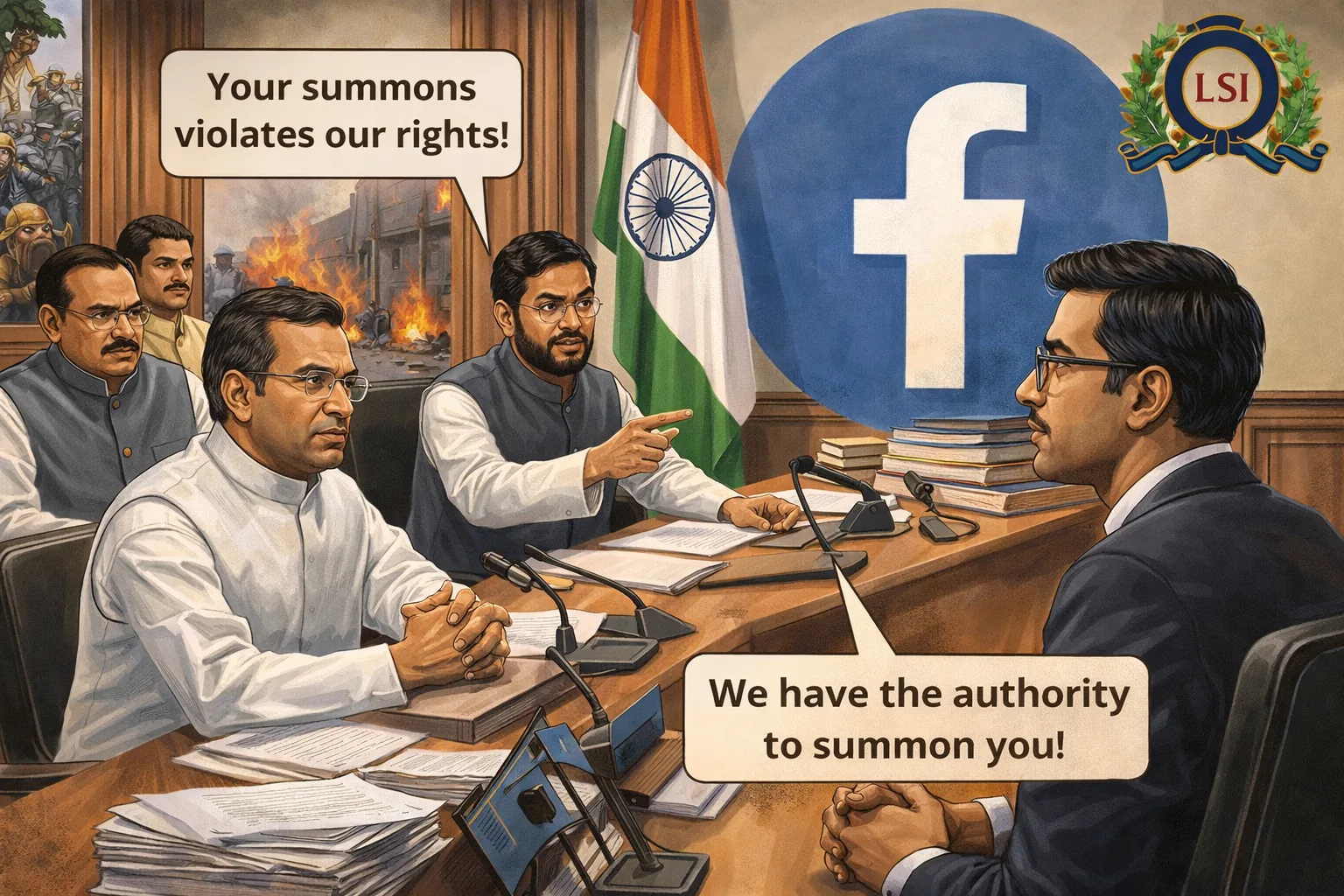
Can a state legislative assembly summon a private tech executive for its platform’s role in spreading hate speech and violence? In the age of digital platforms where technological advancements like social media have a widespread influence all over the public, elections, and in some cases even communal harmony, there exists a pressing need to study the legal and constitutional effects of regulation of digital platforms as this field remains largely unexplored.
The case of Ajit Mohan v. Legislative Assembly, NCT Delhi (2021)[1] addresses this issue. It offers critical insights into topics such as:
- Legislative privileges
- Legislative powers and competence
- Cooperative federalism
- The role of government in regulating digital platforms
The Supreme Court clarified the issue of legislative privilege and defined the limits of legislative oversight over corporations like Facebook, while also highlighting the nature of federalism in this digital age.
Scope of the Project
This project will critically analyse the constitutional issues, factual background, and judgment, along with its impact on:
- The privileges of the legislature
- The liability of intermediaries
- The regulation of social media platforms for content moderation
It will further discuss the boundaries of legislative power and the extent to which democracies can hold these social media platforms accountable.
Understanding the Dispute
In wake of the Delhi riots of 2020, which resulted in destruction of life, property, disruption of essential services in the national capital. Following the riots, Facebook faced accusations of spreading hate speech and amplifying violence by promoting content which led to communal tension.
In response for this the Delhi Legislative Assembly formed a committee on peace and Harmony on March 2, 2020, chaired by Hon’ble Member of Legislative Assembly Raghav Chadha with its objectives as mentioned in the committees Terms of Reference which outlines the purpose and structure of committee as follows:
Objectives of the Committee on Peace and Harmony
| Sl. No. | Objective |
|---|---|
| 1 | Examining and identifying the measures to prevent communal tension. |
| 2 | Examining possible factors that could lead to communal tension in Delhi. |
| 3 | Studying the role of social media platforms in promoting hate speech and misinformation. |
| 4 | Recommending possible measures to ensure peace, harmony and social stability. |
| 5 | Investigating complaints related to hate speech and communal violence. |
Allegations Against Facebook and Issuance of Summons
The committee received thousands of complaints many of which pointed out that Facebook is a platform which is spreading hate speech and violence.
The wall street article published on August 14, 2020 titled as “Facebook’s Hate Speech Rules Collide with Indian Politics”[2] alleges that Facebook favored political interest through the content moderation policies, Which will allow the hate speech to promote violence.
Peace and Harmony Committee issued summon (First Impugned Summon) to Mr. Ajit Mohan.
Response from Facebook
Facebook refused to appear before the committee arguing that the regulation of intermediaries like Facebook falls under the jurisdiction of Union Government under the Information Technology Act, 2000.
The Company further clarified that it has already testified before Parliamentary Standing committee on Information Technology September 2, 2020 in the subject “Safeguarding Citizens’ Rights and Prevention of Misuse of Social/Online News Media Platforms” [3]and there was no need to participate before the Assembly proceedings.
The Delhi Legislative Assembly responded to the same by issuing fresh summons on September 18, 2020 to Ajit Mohan to appear before the assembly on September 23, 2020 and warned that failure to comply with same could amount to breach of legislative privilege.
This second impugned summon which triggered the filing of the proceedings under Article 32 of the Indian Constitution by Ajit Mohan as Petitioner no. 1 and Facebook India Online Services which is Petitioner no. 2 with company Facebook Inc., US as Petitioner no. 3.
Key Legal Issues And Supreme Court’s Rulings
Issue No. 1: Authority Of The Peace And Harmony Committee To Summon
Does the Peace and Harmony Committee of the Delhi Legislative Assembly have the authority to summon the Managing Director of Facebook India, and Does such a summon constitute an exercise of legislative privilege that can be challenged in court?
The supreme Court while addressing the above issue of legislative privilege and whether the Delhi Legislative Assembly’s Peace and Harmony Committee has the power to summon the non-members, was of the view that it is very clear from Article 194(3) of the Constitution [4]which defines the privileges of State Legislature, including its committees, as are those that existed before the enactment of Section 26 of the 44th Constitutional Amendment Act, 1978.
The Committee in the present case has merely issued a summon, and has not used any privilege power yet. Even in case of breach of privilege, the committee would only be able to recommend action to the Assembly, which would then decide whether to proceed.
The supreme Court also rejected the petitioner’s attempt to pre-emptively challenge the Assembly’s jurisdiction at such an early stage. The case of C. Subramaniam v. Speaker, Tamil Nadu Assembly (1969)[5], was referred and it emphasized that courts have refrained from intervening in legislative matters unless a final privilege action has already been taken.
The Supreme Court reiterated that the legislative committees are an essential extension of the Legislature and these committees play a very significant role in informed governance by relying on the judgement of Kalpana Mehta v. Union of India[6].
The Court emphasized that legislative committees even if they extend beyond the direct legislative matters, they should be given the widest possible functional scope, as their role is to deliberate on social issues. Also highlighting that committees play a significant inquisitorial role in investigating complex social problems before legislation is formulated.
- Examining witnesses
- Gathering insights from various stakeholders
These are all parts of process. Therefore, rejecting the argument that Facebook India’s Managing Director was an “outsider” who should not be summoned.
Issue No. 2: Alleged Infringement Of Fundamental Rights
Whether the summons issued to the Managing Director of Facebook India in relation to Delhi riots, constitutes an infringement of fundamental rights under Article 19(1)(a) and That the mere threat of “necessary action” which could lead to a breach of privilege proceedings infringed upon right to privacy and free speech?
While addressing the issue of whether the summons which were issued to the Facebook India’s Managing Director (MD) in connection with the Delhi riots infringed upon his fundamental rights Art 19(1)(a) of the Constitution, the Supreme Court ruled that the petitioners’ plea was premature.
The was held by the Court that no action has yet been taken against the petitioner, nor there was any intended, provided that Facebook India’s authorized representative has participated in the proceedings as a witness.
It was held that the summons was lawfully issued by a empowered committee, although the subject of legislative competence, is discussed separately.
As per Section 33 of the GNCTD Act, 1992[7], derived from article 239AA (7) of the Constitution[8], which governs the proceedings, the committee was merely conducting an inquiry.
Further, under Article 194 of the Constitution, protections are extended to the proceedings before the Assembly or its Committees, which covers the depositions made by both members and non-members.
It was further stated by the Court that while a summoned witness had the option to refuse to answer a specific question, the refusal should be justified with good reasons.
It would be then examined by the committee the validity of such refusals as per the applicable rules.
| Aspect | Supreme Court Observation |
|---|---|
| Stage Of Proceedings | Plea Held To Be Premature |
| Issuance Of Summons | Lawfully Issued By Empowered Committee |
| Witness Rights | Right To Refuse With Valid Justification |
Issue No. 3: Legislative Competence Of Delhi Legislative Assembly
Whether the Delhi Legislative Assembly, through its Peace and Harmony Committee, has the legislative competence to summon Facebook India’s Managing Director in relation to the Delhi riots, given the constitutional division of powers between the Union and State governments? or
The Supreme Court has recognized that the Government of the NCT of Delhi has not the same legislative competence as other States, because some subjects are excluded from List II [9](State List), namely public order, police and land (entries 1, 2 and 18 of List II) which are matters of exclusive jurisdiction of the Union Government.
But the Court made it clear that it does not mean that the Delhi Assembly and its committees are precluded altogether from examining matters of peace and harmony.
As an intermediary, the Petitioners argued that Facebook is governed only by the Information Technology (IT) Act 2000[10], under which only the Central Government has the power to issue directions under Section 69A.
The apex Court’s ruling in the landmark case of Shreya Singhal v. Union of India (2015)[11] provided support to this argument. Laid down a procedure under which the public access to online content could be blocked under the IT Act by Union of India (2015).
On this issue, the Court recognized the principle of collaborative federalism, namely that the Centre and the State must operate within their respective legislative spheres.
If the Delhi Assembly intrudes upon the matters that are the subject of the List I (Union List) or vice versa, it will upset the constitutional balance of power.
The Court, however, threw out Mr. Salve’s contention that Facebook’s role in the riots was beyond the Committee’s jurisdiction, since Facebook is not a passive platform, but a platform that actively shapes public discourse, including political conflicts.
The Court also reiterated that law and order is a Union subject, but held that the Committee could base its legitimacy on several entries in List II and List III (Concurrent List) without trespassing on the exclusive jurisdiction of the Centre.
Therefore, Facebook was not permitted to ignore completely the Committee’s summons of 03.02.2021.
Recent Policy Developments on Legislative Authority and Intermediaries
This judgement talks about several significant developments in the regulation of intermediaries’ regulation and its governance, that the regulatory scrutiny on these digital platforms has intensified.
It was proposed by the Commons Privileges Committee to the Parliamentary Committee (Witnesses) Bill to criminalize in case of refusal to appear before the Parliamentary Committees in the UK[12].
In the US, the CEOs of Facebook, Google, and Twitter were summoned by the House Energy and Commerce Committee regarding the misinformation on election fraud and COVID-19, while emphasizing on the failure of self-regulation in curbing disinformation.[13]
Policy Developments in India
Meanwhile in India, the Personal Data Protection Bill, 2019[14], is under review by Joint Parliamentary Committee since 2020, summoning major digital entities.
Additionally, the Information Technology (Intermediary Guidelines and Digital Media Ethics Code) Rules, 2021[15], introduces a variety of due diligence norms which are strict and are facing challenges in multiple High Courts.
Legislative Changes Concerning Delhi Assembly
Furthermore, the Delhi Assembly’s Legislative and investigative authority were limited and the term ‘Government’ was redefined as Lieutenant Governor (LG) after the amendment in Government of National Capital Territory of Delhi (GNCTD) Act, 1991.
This was seen as a reaction to the Executive-Legislative conflicts, and is currently under judicial scrutiny.
Comparative Overview of Key Developments
| Jurisdiction | Key Development |
|---|---|
| United Kingdom | It was proposed by the Commons Privileges Committee to the Parliamentary Committee (Witnesses) Bill to criminalize in case of refusal to appear before the Parliamentary Committees in the UK[12]. |
| United States | The CEOs of Facebook, Google, and Twitter were summoned by the House Energy and Commerce Committee regarding the misinformation on election fraud and COVID-19, while emphasizing on the failure of self-regulation in curbing disinformation.[13] |
| India | The Personal Data Protection Bill, 2019[14], is under review by Joint Parliamentary Committee since 2020, summoning major digital entities, and the Information Technology (Intermediary Guidelines and Digital Media Ethics Code) Rules, 2021[15], introduces a variety of due diligence norms which are strict and are facing challenges in multiple High Courts. |
Conclusion
The Court acknowledged the Assembly’s power to initiate the privilege proceedings and summon both the members as well as non-members.
It upheld the right to initiate privilege proceedings and compel attendance noted that the plea was premature at this stage.
It reiterated that the Delhi Legislative Assembly cannot regulate the role of intermediaries, and law and order and police matters as it is limited by Entries 1 and 2 of List II.
- The Peace and Harmony Committee was within its rights to deal with the issue on measures to combat online hate speech and the role of this in inciting violence, provided that this did not interfere with the realm of public order and policing.
- The committee must not interfere in restricted domains and the petitioners can refrain from answering on those subjects.
- It was further stated by the Court that while a summoned witness had the option to refuse to answer a specific question, the refusal should be justified with good reasons.
The Supreme Court dismissed the writ petition with these clarifications, setting constitutional boundaries and procedural safeguards. End Notes:
- Ajit Mohan v Legislative Assembly, NCT Delhi (2021) 3 SCC 675
- Jeff Horwitz, ‘Facebook’s Hate Speech Rules Collide With Indian Politics’ The Wall Street Journal (New York, 14 August 2020)
- Lok Sabha Secretariat, ‘Report of the Parliamentary Standing Committee on Information Technology on Safeguarding Citizens’ Rights and Prevention of Misuse of Social/Online News Media Platforms’ (2020)
- Constitution of India 1950
- C Subramaniam v Speaker, Tamil Nadu Assembly (1969) 3 SCC 497
- Kalpana Mehta v Union of India (2018) 7 SCC 1
- Government of National Capital Territory of Delhi Act 1991
- Constitution of India 1950
- Constitution of India 1950
- Information Technology Act 2000
- Shreya Singhal v Union of India (2015) 5 SCC 1
- UK Parliament, House of Commons Privileges Committee, ‘Report on Legislative Committees and Witnesses’ (2021)
- US House Energy and Commerce Committee, ‘Hearing on Misinformation and Social Media: Testimony of Facebook, Google, and Twitter CEOs’ (2021)
- Personal Data Protection Bill 2019
- Information Technology (Intermediary Guidelines and Digital Media Ethics Code) Rules 2021

