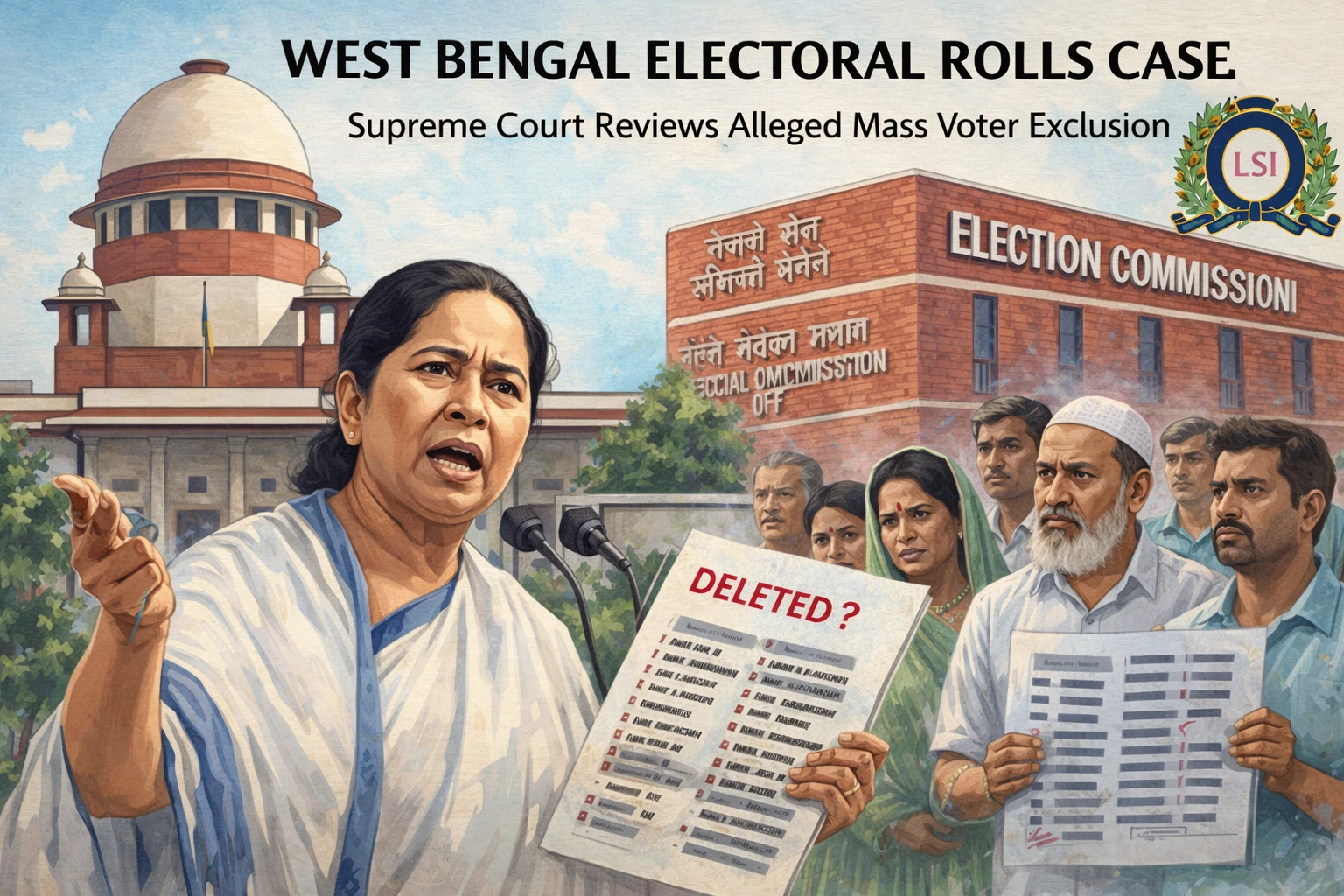
The West Bengal Electoral Rolls Case
A Constitutional Test of India’s Democratic Foundations
The West Bengal Electoral Rolls Case has emerged as one of the most significant constitutional disputes in recent years, striking at the very heart of India’s democratic system — the citizen’s right to vote. What began as a routine administrative exercise has evolved into a serious legal and political confrontation, raising fundamental questions about electoral fairness, constitutional safeguards, and the limits of state power.
At the centre of the controversy lies the Special Intensive Revision (SIR) of electoral rolls initiated by the Election Commission of India (ECI) in West Bengal. The exercise, ostensibly aimed at improving the accuracy of voter lists, has triggered widespread allegations of mass deletions, procedural unfairness, and the potential disenfranchisement of genuine voters.
Background and Timeline of the Dispute
The dispute did not arise overnight. A brief chronology reveals how an administrative process escalated into a constitutional crisis:
- The ECI announced a Special Intensive Revision of electoral rolls in West Bengal.
- Field-level verification and document checks were initiated across districts.
- Complaints surfaced regarding large-scale deletions and coercive verification practices.
- Civil society groups and political parties raised alarms over voter exclusion.
- Multiple petitions were filed before the Supreme Court of India challenging the manner of implementation.
- In an unprecedented move, the Chief Minister of West Bengal filed her own petition and indicated her intention to appear personally before the Court.
This sequence transformed SIR from a technical exercise into a matter of national democratic concern.
What Is the Special Intensive Revision (SIR)?
Electoral rolls in India are periodically updated to remove duplicate entries, deceased voters, and to include newly eligible citizens. The Special Intensive Revision is a more rigorous form of this process, involving:
- Door-to-door verification
- Mandatory production of identity and residence documents
- Deletion of names where verification fails
In theory, SIR is meant to strengthen electoral integrity. In practice, critics argue that when conducted hastily, mechanically, or without adequate safeguards, it risks excluding precisely those citizens who are already on the margins — migrant workers, the urban poor, minorities, and informal-sector labourers.
The Core Constitutional Issues Before the Supreme Court
The challenge before the Supreme Court goes far beyond administrative efficiency. The petitions raise profound constitutional questions, including:
- Whether the manner of conducting SIR violates Article 326, which guarantees adult suffrage.
- Whether arbitrary deletions offend Article 14, the right to equality before law.
- Whether the loss of political voice impacts Article 21, which protects dignity and meaningful participation in civic life.
- Whether large-scale voter exclusion undermines the basic structure of the Constitution, which includes free and fair elections.
Petitioners allege that names are being deleted without adequate notice, that poor and migrant voters are unable to furnish documents on demand, and that the burden of proof has been unfairly shifted from the state to the citizen. The fear is not of isolated error, but of systemic exclusion capable of distorting the democratic will.
A Rare Constitutional Moment: The Chief Minister Steps In
In an extraordinary and rare development, Mamata Banerjee has approached the Supreme Court in her own capacity and expressed her intention to appear personally before the Bench.
Sitting Chief Ministers seldom become direct litigants in electoral disputes. Typically, such matters are handled through the state machinery or political parties. Her personal intervention elevates the case from a procedural disagreement to a constitutional moment, signalling:
- The gravity of the alleged disenfranchisement
- The political sensitivity of voter deletions
- The apprehension that democratic legitimacy itself may be at stake
Describing the exercise as a “silent assault on democracy,” she has warned that unchecked voter revisions could exclude the poor, minorities, and internal migrants from the electoral process.
The Bench and the Nature of Judicial Scrutiny
The matter is being heard by a Bench led by Surya Kant. Early observations from the Court suggest a clear concern that electoral integrity cannot be pursued at the cost of constitutional fairness.
The Court is expected to closely examine the following issues:
Judicial Focus Areas
| Judicial Focus Area | Key Question |
|---|---|
| Due Process | Were voters given proper notice and opportunity to be heard? |
| Proportionality | Were deletions excessive or arbitrary in relation to the stated objective? |
| Safeguards | Do adequate appeal and correction mechanisms exist? |
| Fundamental Rights | Are constitutional rights being indirectly curtailed through administrative action? |
The scrutiny reflects the Court’s long-standing view that independent constitutional bodies, while powerful, are not beyond judicial review.
Why This Case Matters Beyond West Bengal
This case transcends state boundaries and carries national implications.
1. The Meaning of the Right to Vote
While voting is not classified as a fundamental right in strict terms, the Supreme Court has consistently recognised it as a constitutional right central to democracy. Any action that weakens it attracts strict scrutiny.
2. Limits on the Election Commission’s Powers
The judgment may clarify the boundaries of the ECI’s discretion, reaffirming that administrative efficiency cannot override equality, dignity, and fairness.
3. The Future of Electoral Reforms
With increasing reliance on data-driven verification and documentation, this case may shape how voter roll revisions are conducted across India, setting standards for transparency and inclusion.
Possible Directions the Court May Consider
The Supreme Court may issue directions such as:
- Suspension or modification of the ongoing SIR
- Mandatory prior notice and hearing before deletion of names
- Restoration of deleted names pending appeal
- Uniform national guidelines for future intensive revisions
Any such directions would significantly recalibrate the balance between administrative control and democratic access.
The Larger Democratic Question
At its core, the case raises a profound constitutional dilemma:
- Should the state presume citizens to be voters unless proven otherwise,
- Or should citizens be compelled to repeatedly prove their eligibility?
In a country marked by internal migration, informal employment, and documentation gaps, shifting the burden entirely onto voters risks transforming democracy into a privilege of paperwork rather than a right of participation.
Conclusion: A Test of Constitutional Conscience
The West Bengal Electoral Rolls Case is not merely about rules, procedures, or political rivalry. It is a test of India’s constitutional conscience.
The Supreme Court’s verdict will determine whether electoral reforms deepen democracy or quietly hollow it out. With a sitting Chief Minister stepping into the courtroom and the nation watching closely, the case may well become a landmark on the future of voting rights in India.
The Constitution does not envision democracy as a privilege earned through documents, but as a right exercised through participation. Any system that forgets this risks losing its democratic soul.
The Bench and the Nature of Judicial Scrutiny
The matter is being heard by a Bench led by Surya Kant. Early observations from the Court suggest a clear concern that electoral integrity cannot be pursued at the cost of constitutional fairness.
The Court is expected to closely examine the following issues:
Judicial Focus Areas
| Judicial Focus Area | Key Question |
|---|---|
| Due Process | Were voters given proper notice and opportunity to be heard? |
| Proportionality | Were deletions excessive or arbitrary in relation to the stated objective? |
| Safeguards | Do adequate appeal and correction mechanisms exist? |
| Fundamental Rights | Are constitutional rights being indirectly curtailed through administrative action? |
The scrutiny reflects the Court’s long-standing view that independent constitutional bodies, while powerful, are not beyond judicial review.
Why This Case Matters Beyond West Bengal
This case transcends state boundaries and carries national implications.
1. The Meaning of the Right to Vote
While voting is not classified as a fundamental right in strict terms, the Supreme Court has consistently recognised it as a constitutional right central to democracy. Any action that weakens it attracts strict scrutiny.
2. Limits on the Election Commission’s Powers
The judgment may clarify the boundaries of the ECI’s discretion, reaffirming that administrative efficiency cannot override equality, dignity, and fairness.
3. The Future of Electoral Reforms
With increasing reliance on data-driven verification and documentation, this case may shape how voter roll revisions are conducted across India, setting standards for transparency and inclusion.
Possible Directions the Court May Consider
The Supreme Court may issue directions such as:
- Suspension or modification of the ongoing SIR
- Mandatory prior notice and hearing before deletion of names
- Restoration of deleted names pending appeal
- Uniform national guidelines for future intensive revisions
Any such directions would significantly recalibrate the balance between administrative control and democratic access.
The Larger Democratic Question
At its core, the case raises a profound constitutional dilemma:
- Should the state presume citizens to be voters unless proven otherwise,
- Or should citizens be compelled to repeatedly prove their eligibility?
In a country marked by internal migration, informal employment, and documentation gaps, shifting the burden entirely onto voters risks transforming democracy into a privilege of paperwork rather than a right of participation.
Conclusion: A Test of Constitutional Conscience
The West Bengal Electoral Rolls Case is not merely about rules, procedures, or political rivalry. It is a test of India’s constitutional conscience.
The Supreme Court’s verdict will determine whether electoral reforms deepen democracy or quietly hollow it out. With a sitting Chief Minister stepping into the courtroom and the nation watching closely, the case may well become a landmark on the future of voting rights in India.
The Constitution does not envision democracy as a privilege earned through documents, but as a right exercised through participation. Any system that forgets this risks losing its democratic soul.