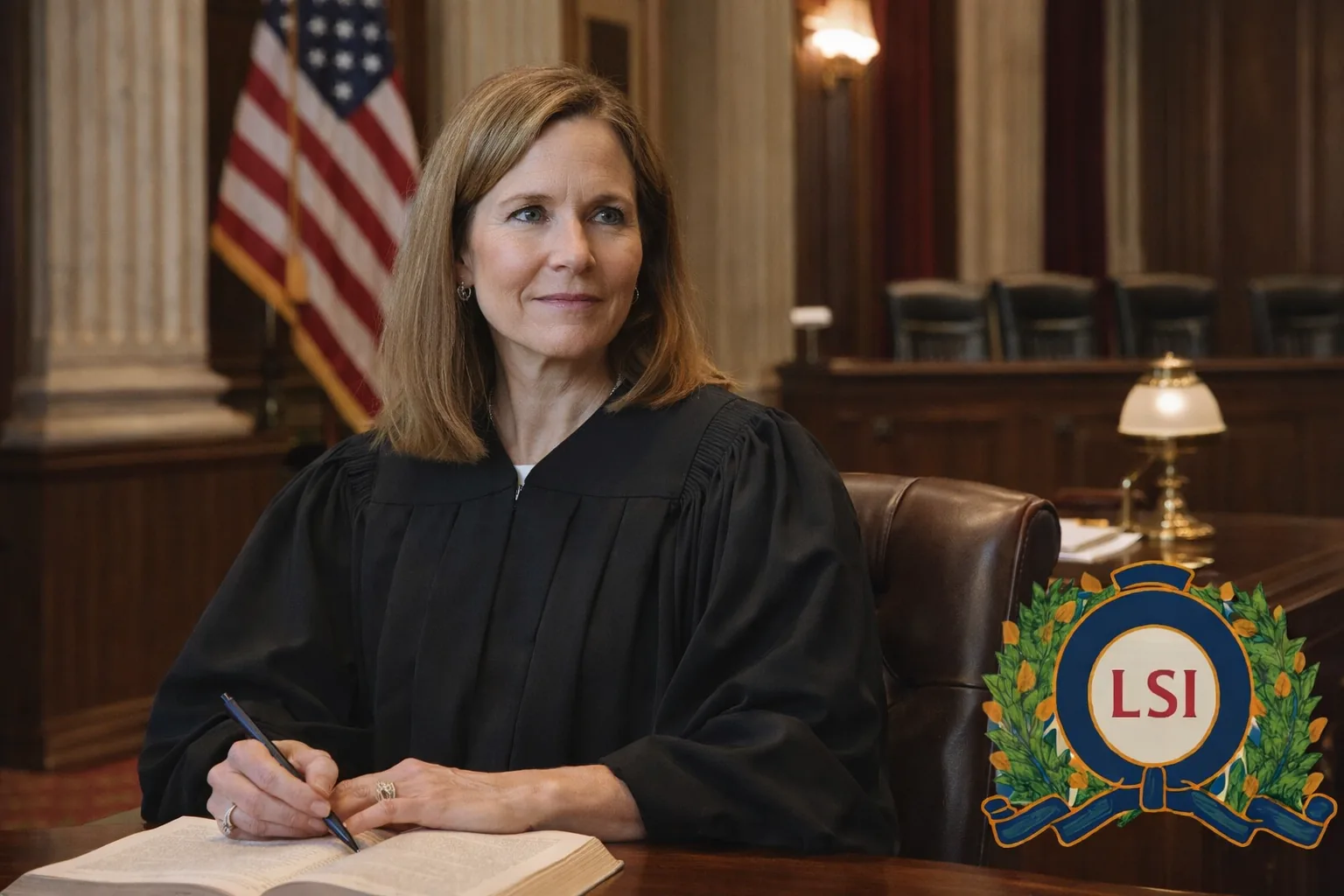
History Watching the Present
There are rooms in public life where history does not merely hang on the walls — it quietly watches the present. In the chamber of the United States Supreme Court, portraits of past Chief Justices form an unbroken chain of institutional memory. Notably, every face is male. That absence is not rhetorical symbolism; it is historical fact. The Court, like the Republic itself, has evolved slowly, sometimes painfully, toward inclusion.
Constitutional Position of the Court
From the beginning in 1787, the Supreme Court occupied a peculiar constitutional position. It was the only federal court created directly by the Constitution; all other federal courts came into existence by congressional choice. With no inherited case law and no prior decisions to guide it, the Court had to construct its authority from the Constitution alone. Over time, precedents multiplied and doctrine deepened, but the essential achievement was institutional — the Court established itself as a co-equal branch, independent of both Congress and the Executive.
Key Institutional Features
- Only federal court created directly by the Constitution
- No prior case law at the beginning
- Authority built solely from constitutional interpretation
- Established independence from Congress and the Executive
Judicial Restraint and Method
Justice Amy Coney Barrett’s constitutional outlook emerges from that long tradition. Her approach is not presented as personal philosophy but as disciplined restraint. She sees the judicial task as following the law where it leads, not where preference or expectation suggests. The judge does not arrive at a desired outcome and justify it; she begins with the text, the briefs, prior cases, and the structure of legal reasoning, and ends wherever those materials compel.
Sources Used in Decision Making
| Source | Purpose |
|---|---|
| Text | Primary legal meaning |
| Briefs | Arguments presented by parties |
| Prior cases | Guidance from precedent |
| Legal reasoning structure | Logical consistency |
Disagreement Among Justices
In her view, disagreement among justices does not arise because they read different authorities, but because difficult cases exist precisely where lower courts have already disagreed. Law, at the highest level, is hard — and the Court exists to resolve that difficulty, not eliminate it.
Independence Beyond Appointment
Much of the public conversation about the Court treats appointments as destiny. Presidents nominate justices, and therefore, many assume, justices remain extensions of presidential politics. Barrett rejects that premise outright. The Constitution’s grant of life tenure and salary protection exists specifically to sever that dependence. Appointment may be political; judging must not be.
Constitutional Safeguards
- Life tenure
- Salary protection
- Institutional independence
Separation of Powers
The Court, she insists, is not a political branch. Congress legislates policy. The President executes it. The judiciary interprets law. That distinction is not semantic — it defines legitimacy. Black robes symbolize neutrality, not ideology; justices sit by seniority rather than party alignment to underscore that they represent no constituency.
Roles of Government Branches
| Branch | Primary Function |
|---|---|
| Congress | Legislates policy |
| President | Executes policy |
| Judiciary | Interprets law |
Public Trust and Transparency
Public trust matters deeply to her, but not as an instruction manual for decisions. Trust grows from understanding, and understanding grows from transparency: the Court must publish its reasoning. Unlike other branches, it must show its work.
The Slow Court And The Fast Docket
The Supreme Court traditionally moves deliberately — almost famously so. Its halls even contain turtle imagery to symbolize institutional patience. Yet modern litigation increasingly arrives through emergency applications requiring immediate action.
These emergency orders, sometimes called the “shadow docket,” do not decide final legality. They are temporary judgments about whether a policy should pause while litigation continues. The Court asks: who is likely to prevail, and what harms might occur in the meantime?
- Temporary judgments
- Not final legality
- Assess likelihood of success
- Assess possible harm during litigation
The distinction matters. When the Court permits a policy to operate temporarily, it has not endorsed the policy’s constitutionality. It has only decided that, at that stage, the legal standards for emergency relief were not met.
| Type Of Decision | Meaning |
|---|---|
| Temporary Emergency Order | Allows policy during litigation |
| Final Judgment | Decides constitutionality |
The Misunderstood Birthright Citizenship Case
One of the most controversial recent rulings concerned challenges to an executive order on citizenship. Public debate treated the case as if the Court had ruled on birthright citizenship itself. It did not.
The question before the Court was technical: whether the Judiciary Act of 1789 authorizes district courts to issue universal injunctions — orders blocking a policy nationwide even for non-parties. The Court addressed only judicial power, not presidential power and not citizenship rights. The constitutional merits remain for future litigation.
- Issue: Judicial authority
- Not addressed: Citizenship rights
- Not addressed: Presidential power
- Merits deferred for future litigation
To Barrett, the distinction illustrates a larger principle: courts must respect limits. From the earliest days — when President George Washington sought advisory input and the Court refused — the judiciary has confined itself to actual cases and controversies. A court that decides everything would cease to be a court.
Judging Without Favor
Critics sometimes argue that emergency rulings allow unlawful policies to persist. Barrett frames the issue differently: interim relief requires tentative judgments under multiple legal factors, including likelihood of success and irreparable harm. It is not a scoreboard between political actors but a procedural necessity.
- Likelihood of success
- Irreparable harm
- Procedural necessity
The Court cannot adjust outcomes to balance appearances, she emphasizes. A legal judgment cannot be calibrated to seem fair across administrations. The right answer may be unpopular — and often is.
Constitutional Interpretation And The Abortion Decision
Her explanation of the Court’s abortion ruling rests not on moral conclusions but constitutional methodology. The case turned on the doctrine of substantive due process under the Fourteenth Amendment — the idea that certain unenumerated liberties are so deeply rooted in the nation’s history and traditions that they are protected even if not listed in the text.
The Court concluded abortion did not meet that historical test. The ruling therefore returned authority to the democratic process and the states. It did not declare abortion immoral or illegal nationwide; it determined who decides.
| Question | Court’s Finding |
|---|---|
| Is Abortion Nationally Decided? | No |
| Who Decides? | States And Democratic Process |
That “who decides” question, for Barrett, defines constitutional law. Some matters the Constitution removes from majority rule — like speech or religion. Others remain within democratic governance. Courts err when they choose policies instead of identifying the proper decision-maker.
- Removed From Majority Rule: Speech, Religion
- Left To Democracy: Policy Choices
She also distinguishes the ruling from other precedents involving marriage, contraception, and intimacy, which the Court has previously recognized as fundamental rights. Each doctrine depends on its own historical and legal grounding.
Precedent And The Possibility Of Error
Respect for precedent does not mean immobility. The doctrine of stare decisis includes mechanisms for overruling decisions when they prove egregiously wrong. Without that flexibility, landmark corrections — such as desegregation jurisprudence overturning earlier rulings — would never have occurred.
Judicial ethics forbid promises during confirmation hearings precisely because judges must remain open-minded in actual cases. A judge who pledges outcomes ceases to judge.
Law, Not Personality
Barrett consciously distances her role from commentary. She declines to pre-judge future disputes — including executive authority questions — because judging requires briefs, arguments, colleagues’ views, and deliberation. Initial instincts often change during that process. Anything else would be improvisation, not adjudication.
Criticism, praise, and even threats are treated alike: irrelevant to reasoning. Violence against judges, she stresses, must never become the cost of public service, but neither admiration nor hostility should influence decisions.
The Countermajoritarian Duty
Courts sometimes invalidate popular laws. This is not activism but constitutional design. The judiciary protects minority rights and structural limits when majorities overreach. The Constitution anticipates tension between democracy and legality — and assigns the judiciary the unpopular role when necessary.
A constitutional crisis, she suggests cautiously, is less a definable moment than a recurring challenge in American history. The nation has endured civil war, economic collapse, and social upheaval. Through all of it, the constitutional structure persisted because institutions adhered to their roles.
The Court As A Mirror Of Its Time
The Supreme Court does not select controversies; society sends them. Each era’s disputes — economic regulation, civil rights, executive power — appear in its docket. The Court reflects the nation’s conflicts, not its own ambitions.
In private conference, only the nine justices deliberate — no clerks, no staff. The image contrasts sharply with public perception of strategic maneuvering. The Court’s most persistent misconception, in Barrett’s telling, is that it behaves like a partisan body. Inside, she says, it behaves like a legal one.
Continuity And Humility
Barrett acknowledges intellectual kinship with the interpretive method associated with Justice Antonin Scalia: textualism and originalism, focusing on meaning at enactment rather than evolving preference. Yet she recognizes the docket changes with history. Each generation’s problems are different; the method remains constant.
- Textualism
- Originalism
- Meaning at enactment
- Method constant despite changing disputes
The lifetime appointment, she views less as power than stewardship — participation in a centuries-long conversation about law that will outlast every individual justice. Decisions today govern presidents not yet elected and disputes not yet imagined.
The Court, in this conception, is neither guardian of ideology nor engineer of social policy. It is a translator — from constitutional text and legal tradition into present application.
And translation, by its nature, demands fidelity more than authorship.
About Justice Amy Coney Barrett
| Full name | Amy Vivian Coney Barrett |
|---|---|
| Born | January 28, 1972 — New Orleans, Louisiana, USA |
| Current role | Associate Justice of the Supreme Court of the United States (since October 27, 2020) |
Early Life & Education
Amy Coney Barrett grew up in a Catholic family in Louisiana. She was known as an outstanding student from an early age.
- Bachelor’s degree: Rhodes College (summa cum laude, English literature)
- Law degree: Notre Dame Law School (first in class; Executive Editor of Law Review)
After law school, she clerked for two prominent judges, including U.S. Supreme Court Justice Antonin Scalia, whose textualist approach to interpreting the Constitution deeply influenced her legal philosophy.
Academic Career
Before becoming a judge, Barrett spent nearly two decades as a professor at Notre Dame Law School, where she taught constitutional law, federal courts, and statutory interpretation.
She gained a reputation as a brilliant but calm and clear legal thinker, admired by both conservative and liberal students.
Judicial Career
- 2017: Appointed to the U.S. Court of Appeals for the Seventh Circuit
- 2020: Nominated by President Donald Trump to the U.S. Supreme Court
Confirmed at age 48, making her one of the youngest justices in modern times
Legal Philosophy
Barrett is widely considered a textualist and originalist, meaning:
- Laws should be interpreted based on the actual words written
- The Constitution should be understood according to its original public meaning at the time it was adopted
This approach follows the intellectual tradition of her mentor, Justice Scalia.
Notable Significance
- Fifth woman ever appointed to the U.S. Supreme Court
- Mother of seven children, including two adopted from Haiti
- Seen as a key conservative voice on the Court
Top Lawyers in United States – Search by City
| New York Lawyers | Los Angeles Lawyers | Chicago Lawyers |
| San Diego Lawyers | Boston Lawyers | Houston Lawyers |
| Sacramento Lawyers | Austin Lawyers | San Jose Lawyers |
| Philadelphia Lawyers | San Francisco Lawyers |