Introduction
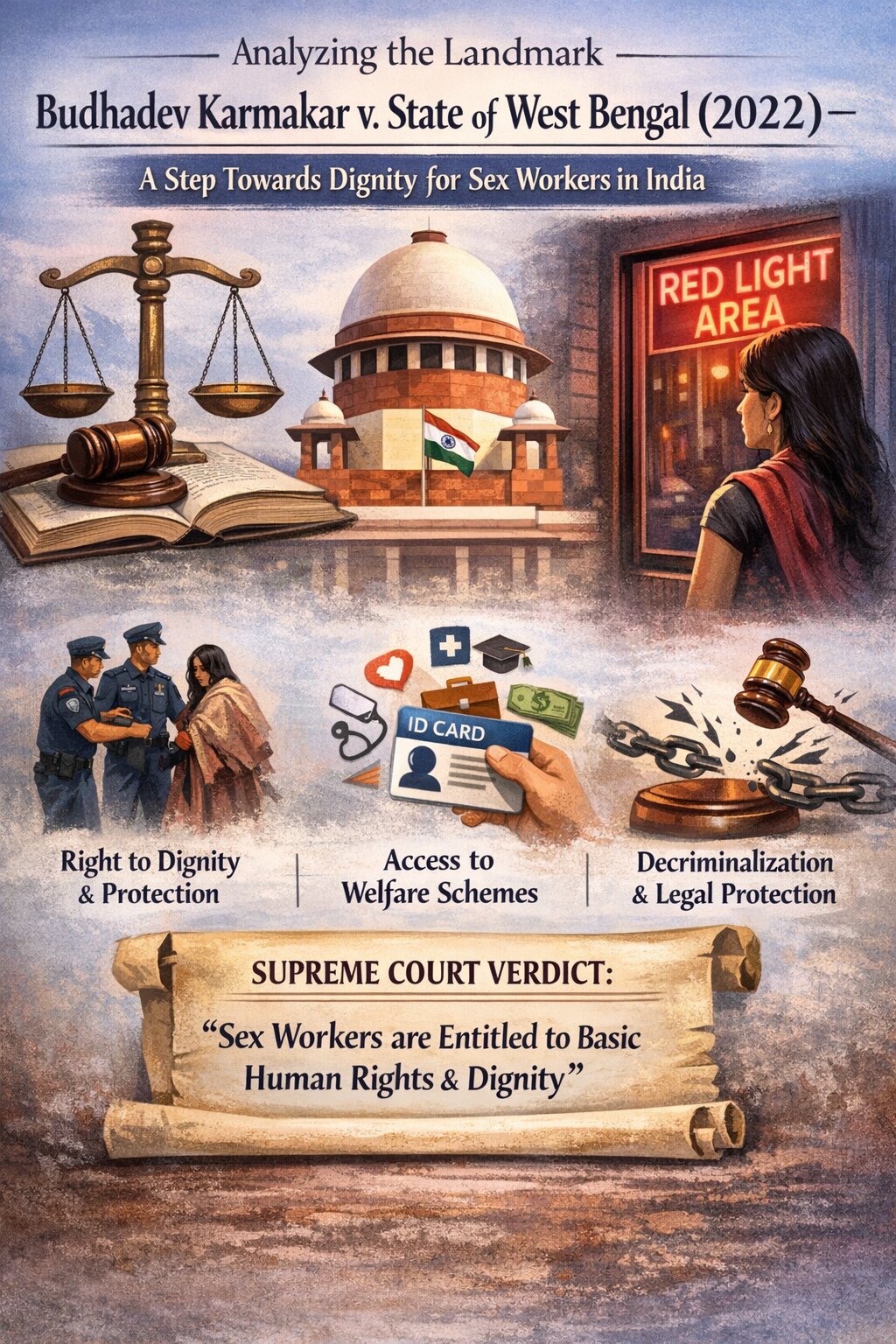
In a pivotal moment for human rights in India, the Supreme Court on May 19, 2022, delivered an order in Budhadev Karmakar v. State of West Bengal that consensual adult sex work is not per se illegal and that sex workers are entitled to constitutional protections and dignity. This ruling, emerging from a brutal murder case that evolved into a public interest litigation (PIL) like character, underscores the judiciary’s role in addressing societal stigmas and ensuring dignity for marginalized groups. By invoking Article 21 of the Indian Constitution – which guarantees the right to life and personal liberty, including the right to live with dignity – the Court issued comprehensive directions to protect sex workers from discrimination, harassment, and exploitation. This article analyses the background, key elements of the judgment, its implications, potential shortcomings, and broader socio-legal context, drawing on legal analyses and comparative perspectives.
Background of the Case
The case originated in 1999 when Budhadev Karmakar was convicted for the gruesome murder of Chaya Rani Pal, a sex worker in Kolkata’s red-light area, by repeatedly banging her head against a wall after she refused his demands. Karmakar’s appeal reached the Supreme Court in 2010, where his life sentence was upheld in 2011. However, Justices Markandey Katju and Gyan Sudha Misra imparted a Public Interest Litigation–like character to the proceedings, highlighting the systemic vulnerabilities of sex workers. They observed that sex workers often enter the profession due to poverty and social exclusion, not choice, and deserve rehabilitation and dignity rather than criminalization.
In 2011, the Court appointed a panel chaired by Senior Advocate Pradip Ghosh to study three core issues: preventing trafficking, rehabilitating sex workers who wish to exit the profession, and creating conditions for those continuing in sex work to live with dignity under Article 21. The panel, comprising legal experts, NGOs, and representatives from sex worker communities, submitted interim reports and a final comprehensive report in 2016 after extensive consultations. Despite government deliberations, no legislation followed, prompting the Court in 2022 – under Justices L. Nageswara Rao, B.R. Gavai, and A.S. Bopanna – to exercise its powers under Article 142 to issue binding directions until a dedicated law is enacted.
Key Elements of the 2022 Order
The Court’s order is grounded in the recognition that sex workers, like all citizens, are entitled to equal protection under the law (Article 14), reasonable restrictions on freedoms (Article 19), and a dignified life (Article 21). It clarifies that while the Immoral Traffic (Prevention) Act, 1956 (ITPA) criminalizes activities like running brothels, pimping, and trafficking, voluntary sex work between consenting adults is not illegal. The judgment emphasizes “age” and “consent” as pivotal factors consistent with prior criminal jurisprudence consistent with prior criminal jurisprudence in applying criminal law.
Drawing from the panel’s recommendations, the Court issued 13 specific directions to bridge legislative gaps:
- Sex workers are entitled to equal protection of the law; police must not interfere in consensual adult sex work.
- Complaints by sex workers of any offence must be taken seriously and acted upon legally.
- Sex worker victims of sexual assault must receive immediate medical assistance as per CrPC Section 357C (Section 397 BNSS) and government guidelines.
- During brothel raids, voluntary sex workers should not be arrested, harassed, or victimized.
- State governments must survey ITPA Protective Homes and release detained adult women against their will in a time-bound manner.
- Police must be sensitized to treat sex workers with dignity and prohibit abuse or coercion.
- Media must follow Press Council guidelines to protect identities; violations under IPC Section 354C (Section 77 BNS) should be enforced.
- Health measures like condom use should not be treated as evidence of offences.
- Sex workers or their representatives must be involved in policy decisions affecting them.
- Legal Services Authorities must conduct workshops on sex workers’ rights and access to justice.
- Children of sex workers should not be separated from mothers solely due to the profession; verification is required before assuming trafficking.
- The Union of India must respond to remaining panel recommendations.
- Aadhaar cards and other identity documents must be issued to sex workers without residence proof, ensuring confidentiality.
These directions aim to decriminalize aspects of sex work, reduce police overreach, and integrate sex workers into mainstream welfare systems.
Positive Aspects and Implications
The judgment marks a progressive shift in India’s approach to sex work, aligning it with human rights principles. By declaring sex work a “profession,” it challenges deep-rooted societal stigma and empowers approximately 1.2 million sex workers (as per NACO estimates) to claim rights like voter IDs, ration cards, and banking services. This could reduce exploitation by traffickers and police, who often extort or abuse sex workers under the guise of ITPA enforcement.
Legally, it reinforces judicial activism in filling legislative voids, as seen in prior cases like Vishaka v. State of Rajasthan (on sexual harassment guidelines). For law enforcement, mandatory sensitization programs could curb arbitrary raids and violence, fostering trust and encouraging reporting of crimes like trafficking. Socially, involving sex worker collectives in policymaking promotes inclusivity, potentially leading to better health outcomes (e.g., HIV prevention) and economic opportunities.
The ruling also has broader implications for gender justice. Feminist scholars argue it upholds bodily autonomy and economic rights, viewing sex work as labour rather than moral deviance. In a post-#MeToo era, it extends protections to vulnerable women, trans, and non-binary individuals in the industry, potentially reducing intergenerational poverty by safeguarding children from separation.
Criticisms and Challenges
Despite its merits, the judgment has drawn critiques for not going far enough. It does not repeal or amend the ITPA, which critics say ambiguously criminalizes solicitation and living off earnings, leaving room for misuse. Implementation remains a hurdle: Reports indicate uneven compliance, with police raids continuing in states like Maharashtra and Karnataka, often conflating voluntary work with trafficking. Societal stigma persists, hindering access to education, healthcare, and housing for sex workers and their families.
Some abolitionist feminists contend that recognizing sex work as a profession normalizes exploitation, ignoring structural inequalities like poverty and caste that drive entry into the field. They argue for a Nordic model (criminalizing buyers) over decriminalization, citing risks of increased trafficking. Additionally, the order’s focus on rehabilitation for those wishing to exit is under-resourced, with Protective Homes often resembling detention centres rather than supportive facilities.
Comparative Perspectives
Internationally, India’s approach now leans toward partial decriminalization, similar to New Zealand’s Prostitution Reform Act 2003, which treats sex work as labour with health and safety regulations, reducing violence and improving police relations. Germany’s regulatory model, requiring licensing and taxation, integrates sex workers into the economy but faces criticism for bureaucratic barriers. In contrast, Canada’s Bedford v. Canada (2013) struck down laws endangering sex workers, emphasizing security under their Charter of Rights. India could draw from these to enact comprehensive legislation, incorporating labour rights like minimum wages and unionization, while strengthening anti-trafficking measures.
Conclusion
The Budhadev Karmakar judgment is a watershed in affirming sex workers’ humanity and constitutional rights, shifting the narrative from criminality to dignity. It substantiates claims that withholding protections from sex workers perpetuates inequality, even if politically contentious. However, true progress hinges on robust implementation, legislative reform, and societal attitude shifts. As India grapples with balancing morality, rights, and public health, this ruling paves the way for a more equitable framework – one where sex workers can live and work without fear, embodying the constitutional promise of justice for all.