





Supreme Court And High Court Judgments On Attendance Policies
The recent Supreme Court judgment and the Delhi High Court judgment in the Sushant Rohilla case on November 3rd 2025 concerning university attendance policies and examination eligibility has sparked widespread debate across India.
Historic Stance On Mandatory Attendance
The Supreme Court of India has historically upheld mandatory attendance (usually 75%), stating that academic discipline cannot be compromised and restricted universities from barring students from appearing in examinations solely on the basis of attendance shortages.
Shift From Debarment To Proportional Academic Penalty
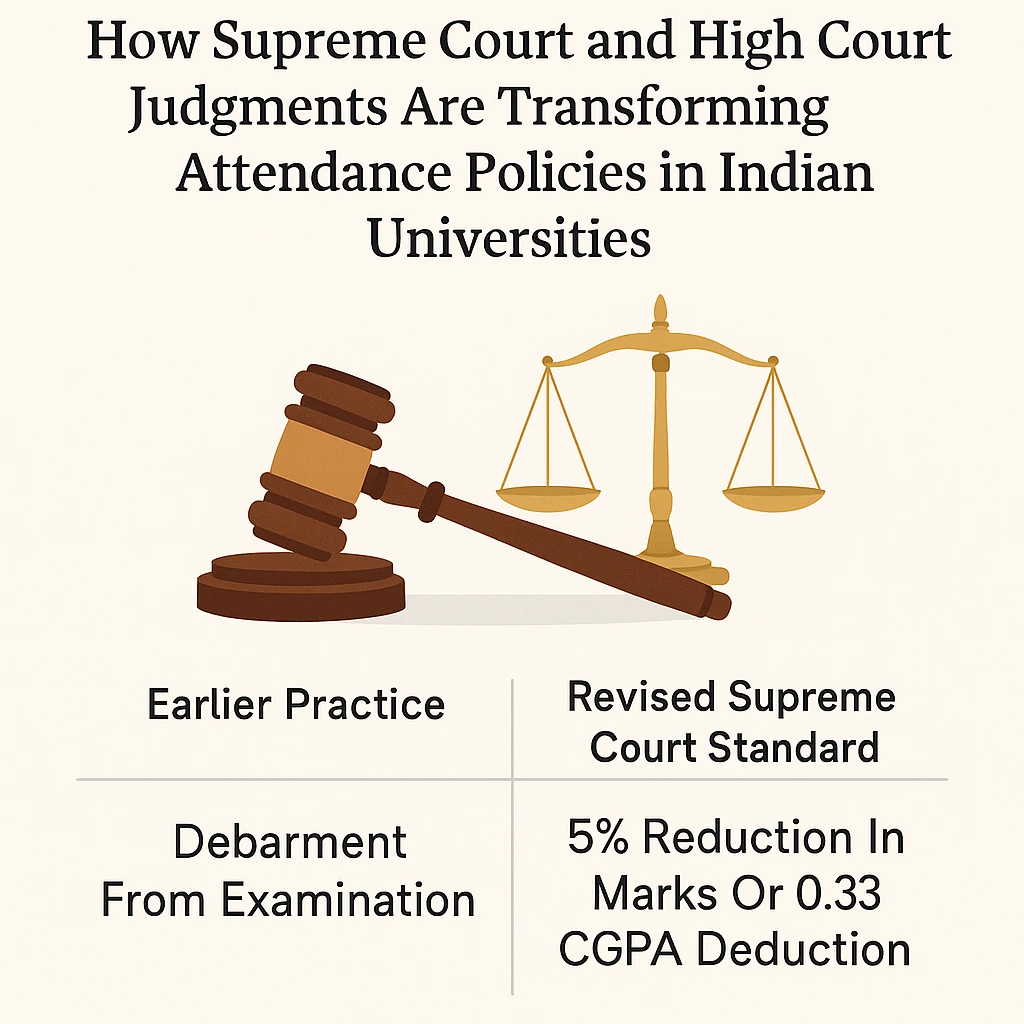
Crucially, the Court has replaced the punitive practice of ‘debarment’ with a proportional academic penalty, ruling that the maximum consequence for attendance shortage shall be a 5% reduction in marks or 0.33 CGPA deduction (The Hindu)
| Earlier Practice | Revised Supreme Court Standard |
|---|---|
| Debarment From Examination | 5% Reduction In Marks Or 0.33 CGPA Deduction |
This marks a crucial transformation in the academic landscape, challenging decades-old norms rooted in procedural rigidity rather than outcome-based assessment.
Right To Education And Administrative Balance
The Court emphasized that the right to education must remain central in academic administration.
While acknowledging that attendance policies aim to ensure student engagement, the Court noted that rigid enforcement can become a barrier rather than a facilitator of learning particularly when absences stem from genuine circumstances such as:
- Medical emergencies
- Financial hardships
- Mental health issues
- Participation in recognized extracurricular and professional-building activities
Impact On Legal Education And Bar Council Norms
This principle is especially relevant in legal education, where norms like the Bar Council of India’s 70% mandatory attendance rule have long governed eligibility.
The Court directed universities to re-evaluate such norms and held that no student shall be detained solely due to attendance shortage.
Thus, the punitive approach has evolved from denial of opportunity to proportionate academic consequence.
A Comparative Global Perspective On Educational Autonomy
The Indian Supreme Court’s move mirrors a long-standing philosophical divide in global academia regarding mandatory attendance. While it is inaccurate to generalize “the West” as uniformly laissez-faire, many prominent educational systems indeed adopt a more student-led approach that places greater emphasis on self-governance and accountability.
Regional Approaches To Attendance Policies
- North America: Many liberal arts and graduate programs in the US and Canada view class attendance as an expectation of the learning contract, not a strict regulatory requirement enforced by debarment. However, this is not universal. Specific programs, such as Law Schools (governed by ABA standards), and institutions that accept international students (due to visa compliance), often maintain extremely strict attendance monitoring and reporting requirements. Their core difference lies in the motivation—focused on regulatory compliance or academic integrity—rather than simply punitive institutional control.
- Continental Europe: Universities often align their policies with the belief that a student, once enrolled, is a responsible adult whose choice to attend class is intrinsically linked to their pursuit of knowledge, not an externally enforced rule.
Comparative Insight On The Indian Verdict
This comparative analysis reveals that the Indian verdict is not an embrace of anarchy but rather a calibrated move towards systems that trust the student to manage their time, while using grade penalties rather than debarment as a mechanism for encouraging engagement.
The Conflict: Autonomy Vs. Empirical Academic Performance
Despite the court’s stance on flexibility, empirical evidence globally affirms a positive link between classroom presence and academic performance:
- Students with 75%+ attendance consistently score higher than those below the threshold.
- Correlation coefficients range from moderate (r≈0.43) to high (r≈0.71) in different disciplines.
- However, studies also suggest that beyond 75–80% attendance, the performance gap is not statistically large, showing that attendance is influential but not the sole determinant factors like self-study and ability matter substantially. (Indian Journal of Clinical Anatomy and Physiology)
Attendance Vs. Performance Summary
| Attendance Level | Observed Academic Impact |
|---|---|
| Below 75% | Lower average academic performance |
| 75%–80% | Noticeable improvement in scores |
| Above 80% | Marginal performance gains |
The Core Intellectual Challenge Of The Verdict
The most significant intellectual challenge posed by this ruling lies in the direct conflict between the principle of student autonomy (which the Court supports) and established empirical evidence on academic performance (which institutions often rely on to enforce attendance).
While the verdict champions the right to choose, data universally affirms the positive correlation between classroom presence and academic achievement. A meta-analysis conducted by Credé, J. J., Roch, S. G., & Kieszczynka, U. M. in the year 2010, for instance, concluded that students with attendance consistently above the 75% threshold scored an average of 28% higher in end-of-semester examinations compared to their peers with lower attendance. This data is not an arbitrary metric but a clear indicator of the value of sustained engagement with pedagogical instruction and peer interaction. (sagepub)
Legal Priority Over Academic Recommendation
The progressive nature of the Supreme Court’s judgment, therefore, must be understood as a legal priority over an academic recommendation. The court is essentially stating: while high attendance is desirable for academic success, the institutional penalty for low attendance cannot be so severe as to prematurely terminate a student’s academic journey. The reduced penalty shifts the burden of academic consequences back to the student, where the ultimate impact of non-attendance is reflected in their final grade, not their eligibility to sit for the exam.
Implications: Progress With Caution
Potential Benefits
- Empowers student autonomy in managing their education.
- Reduces unjust penalization during unavoidable hardships.
- Promotes innovation in evaluation systems internal assessments, project-based learning, and digital learning models.
- Reduces stress and academic pressure linked to attendance restrictions.
Potential Challenges
- Risks of reduced classroom engagement, especially among students who depend on structured learning.
- Greater burden on faculty to maintain motivation and participation.
- Inequality concerns in a country where many rely solely on classroom teaching, absence may deepen learning gaps.
- Might diminish the culture of collaborative and interactive education in discussion-based disciplines.
Benefits vs Challenges: Quick Comparison
| Potential Benefits | Potential Challenges |
|---|---|
| Empowers student autonomy | Risk of reduced classroom engagement |
| Reduces unjust penalization | Greater burden on faculty |
| Promotes innovation in evaluation systems | Inequality concerns in access to learning |
| Reduces academic stress | May weaken collaborative learning culture |
Balanced Reform Strategy For India
The question of whether the traditional attendance system or the new flexible approach is “better” does not lend itself to a definitive answer, as the effectiveness of each model depends on the educational context. For India, the most sustainable solution lies in adopting a balanced reform strategy that integrates flexible attendance policies with clearly defined exceptions, robust continuous assessments tied to meaningful learning outcomes, and accessible mechanisms for academic recovery and constructive feedback.
At the same time, universities must work toward creating engaging and high-quality classroom experiences that naturally encourage students to attend. Ultimately, the aim should be to foster a learning environment where students participate not out of fear of debarment, but because they are genuinely motivated and intellectually interested in the academic process. (Times of India)
Sushant Rohilla Judgment: Legal And Academic Impact
The judgment in the Sushant Rohilla case is more than just a bureaucratic modification; it is a profound legal intervention in the paternalistic structure of Indian higher education. By standardizing the maximum penalty to a 5% mark or 0.33 CGPA deduction, the Supreme Court has stripped institutions of their harshest disciplinary weapon—the power of debarment—and replaced it with a measured, proportional grade reduction.
Shift From Punishment To Participation
This requires institutions to evolve from passive enforcers to active facilitators. Instead of relying on a punitive attendance policy, universities must now justify classroom attendance by improving the quality and relevance of the instruction, thus making attendance an academic necessity rather than a legal compulsion.
The Supreme Court hasn’t abolished the importance of attendance; it has simply outsourced the consequence. The challenge now rests with the institutions to innovate their pedagogy to compel attendance, and with students to exercise their newfound autonomy responsibly, knowing that their final grade, not their eligibility, is the ultimate measure of their engagement. References:
- https://www.linkedin.com/in/s-praphulla-jyotsna-reddy-820b0a36a/
- https://www.thehindu.com/news/national/no-law-student-should-be-detained-from-sitting-in-exams-for-lack-of-attendance-delhi-hc/article70235626.ece
- https://ijcap.org/archive/volume/10/issue/4/article/22979#:~:text=Group A showed a stronger,percentage%2C mean marks also increased
- https://journals.sagepub.com/doi/abs/10.3102/0034654310362998
- https://timesofindia.indiatimes.com/city/kolkata/mental-well-being-in-mind-iit-kgp-wont-deregister-students-for-lack-of-attendance/articleshow/124677681.cms
Written By: S Praphulla Jyotsna Reddy – Symbiosis Law School, Nagpur

