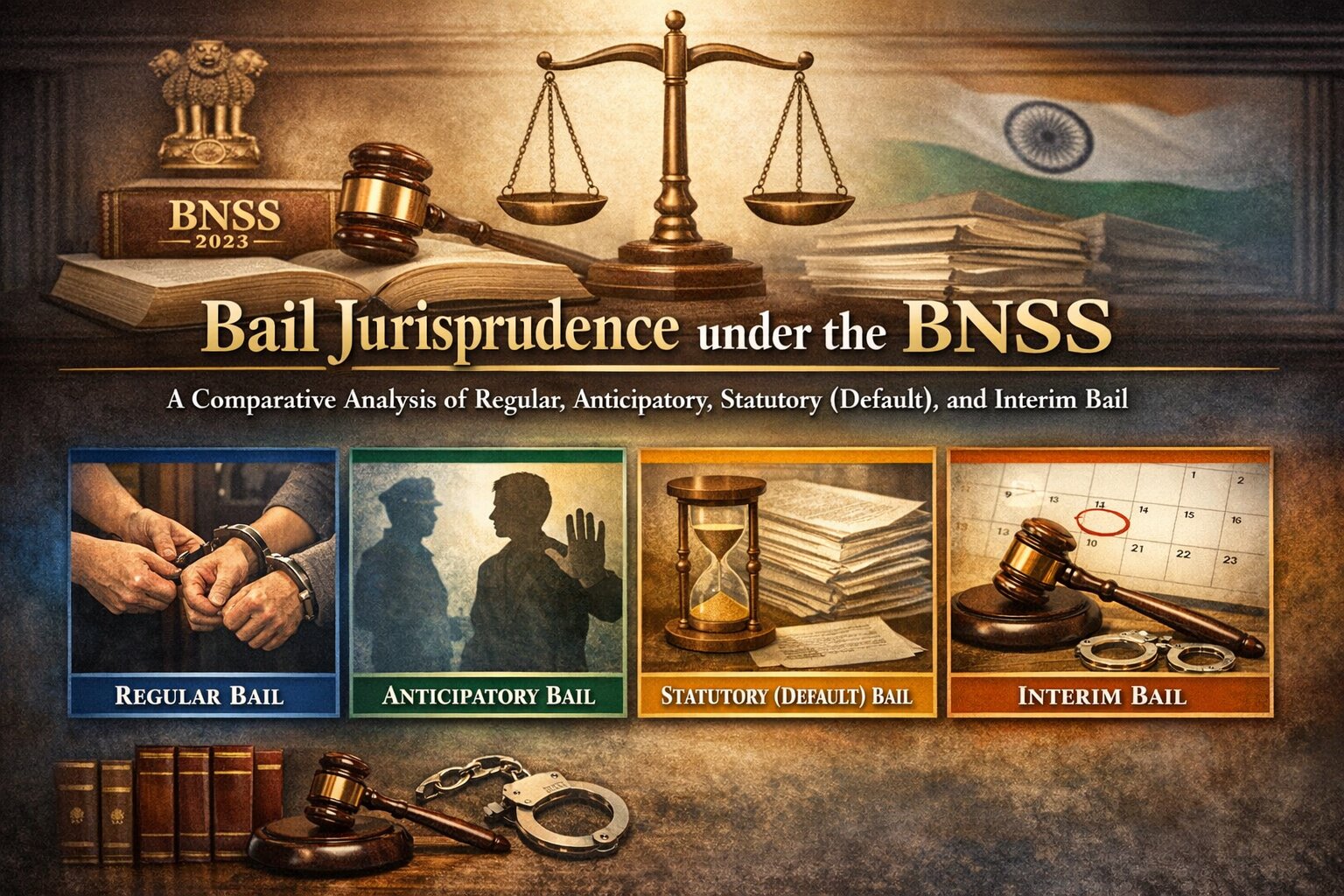
The law of bail constitutes one of the most significant procedural safeguards within the criminal justice system, reflecting the constitutional commitment to the protection of personal liberty under Article 21 of the Constitution of India. With the enactment of the Bharatiya Nagarik Suraksha Sanhita (BNSS), 2023, which replaces the Code of Criminal Procedure, 1973, the legal framework governing bail continues to evolve while preserving the essential balance between individual liberty and the interests of society.
Indian criminal procedure recognizes four principal forms of bail: Regular Bail, Anticipatory Bail, Statutory (Default) Bail, and Interim Bail. Each of these mechanisms operates at different stages of the criminal process and serves distinct legal objectives within the broader framework of procedural justice. While regular bail facilitates the release of an accused person after arrest, anticipatory bail operates as a preventive safeguard against potential arrest. Statutory or default bail arises from investigative delay beyond the prescribed statutory period, thereby protecting the accused from prolonged detention, whereas interim bail functions as a temporary judicial arrangement pending the final determination of a bail application.
Liberty remains the cornerstone of democratic governance and forms the foundation of criminal procedural law in India. The presumption of innocence until proven guilty is a fundamental principle that guides the criminal justice system and informs the law relating to pre-trial detention. Bail jurisprudence flows directly from this principle, ensuring that individuals are not subjected to unnecessary incarceration before their guilt has been judicially determined by a competent court.
Indian courts have consistently reaffirmed the guiding principle that “bail is the rule and jail is the exception.” Although contemporary practice suggests that this doctrine is not uniformly applied across jurisdictions, it nonetheless reflects the constitutional guarantee of personal liberty under Article 21 of the Constitution of India, which mandates that no person shall be deprived of life or personal liberty except in accordance with the procedure established by law. In this constitutional framework, the law of bail serves not merely as a procedural device but as a vital safeguard against arbitrary detention, reinforcing the balance between the rights of the individual and the interests of justice.
The Bharatiya Nagarik Suraksha Sanhita (BNSS), 2023, which replaces the Code of Criminal Procedure, 1973, preserves the framework governing bail while reorganizing its statutory provisions. Within this legal structure, courts recognize four primary categories of bail:
- Regular Bail
- Anticipatory Bail
- Statutory (Default) Bail
- Interim Bail
Although these forms of bail share the common objective of protecting personal liberty, they differ in their legal basis, procedural stage, scope of application, and judicial philosophy. Understanding these distinctions is essential for judges, investigators, lawyers, and scholars of criminal law.
The following comparative table outlines the major distinctions among these four types of bail.
Comparative Table: Types of Bail under BNSS
|
No. |
Basis of Difference |
Regular Bail |
Anticipatory Bail |
Statutory (Default) Bail |
Interim Bail |
|
1 |
Stage |
After arrest |
Before arrest |
After custody beyond statutory period |
Pending bail decision |
|
2 |
Purpose |
Release from custody |
Protection against arrest |
Safeguard against prolonged detention |
Temporary relief |
|
3 |
Legal Basis |
Sec. 480 & 483 BNSS |
Sec. 482 BNSS |
Sec. 187 BNSS |
Judicial discretion |
|
4 |
Nature |
Substantive relief |
Preventive relief |
Statutory right |
Stopgap measure |
|
5 |
Right vs. Discretion |
Discretionary (except bailable offences) |
Discretionary |
Right of accused |
Discretionary |
|
6 |
Duration |
Until trial/cancellation |
Until trial/cancellation |
Continues until trial |
Short term |
|
7 |
Trigger |
Arrest already made |
Apprehension of arrest |
Delay in charge sheet |
Bail hearing adjourned |
|
8 |
Court Power |
Magistrate, Sessions, High Court, Supreme Court |
Sessions, High Court, Supreme Court |
Magistrate |
Any bail court |
|
9 |
Conditions |
Restrictions possible |
Strict conditions |
Minimal |
Conditional |
|
10 |
Scope of Offences |
Bailable & non-bailable |
Non-bailable only |
All offences |
Any offence |
|
11 |
Effect on Arrest |
Releases after arrest |
Prevents arrest |
Releases after statutory period |
Prevents immediate detention |
|
12 |
Documentation |
Bail bond, surety |
Bail bond, surety |
Bail bond, surety |
Bail bond, surety |
|
13 |
Judicial Philosophy |
Balance liberty & investigation |
Protect liberty from misuse |
Protect liberty from state delay |
Protect liberty pending decision |
|
14 |
Constitutional Link |
Article 21 |
Article 21 |
Article 21 |
Article 21 |
|
15 |
Outcome |
Accused free during trial |
Accused avoids arrest |
Accused released |
Accused free until bail decided |
|
16 |
Cancellation |
If conditions violated |
If conditions violated |
Rare |
Lapses automatically |
|
17 |
Judicial Interpretation |
Common practice |
Gurbaksh Singh Sibbia v. State of Punjab (1980) → Defined principles of anticipatory bail and judicial discretion. |
Uday Mohanlal Acharya v. State of Maharashtra (2001) → Strengthened the right to default bail when investigation delays occur. |
Gudikanti Narasimhulu v. Public Prosecutor (1978) → Introduced a human-rights and liberty perspective in bail. |
|
18 |
Risk of Misuse |
Bail jumping |
Shielding accused |
Delay tactics |
Repeated extensions |
|
19 |
Public Interest Factor |
Public interest becomes relevant when the offence affects society at large |
Public interest is given significant priority |
Public interest is balanced with delay in investigation or trial |
Public interest is weighed against the need for immediate action |
|
20 |
Final Objective |
Ensure liberty during trial |
Prevent harassment |
Prevent illegal custody |
Protect liberty until substantive order |
Regular Bail: The Traditional Post-Arrest Remedy
Regular bail represents the most commonly invoked form of bail in criminal proceedings. It is typically sought after the arrest of an accused person, enabling them to secure temporary release from custody while the investigation or trial continues.
Under Sections 480 and 483 of the BNSS, courts possess the authority to grant bail depending on the nature of the offence, the severity of the allegations, and the broader interests of justice. In cases involving bailable offences, bail is generally granted as a matter of right. However, in non-bailable offences, the decision rests within the discretion of the court.
The court evaluates several factors when deciding a regular bail application, including:
- The gravity of the offence
- The likelihood of the accused fleeing from justice
- The possibility of tampering with evidence
- The potential for influencing witnesses
- The antecedents of the accused
The judicial philosophy underlying regular bail seeks to balance individual liberty with the effective conduct of investigation and trial.
Anticipatory Bail: Protection Against Arbitrary Arrest
Anticipatory bail, codified under Section 482 of the BNSS, provides a preventive legal remedy for individuals who apprehend arrest in a non-bailable offence. Unlike regular bail, which operates after arrest, anticipatory bail operates before arrest, thereby protecting individuals from unnecessary or malicious detention.
The landmark Supreme Court judgment in Gurbaksh Singh Sibbia v. State of Punjab (1980) remains the authoritative precedent governing anticipatory bail. The Court held that anticipatory bail is an extraordinary but essential remedy intended to safeguard personal liberty against arbitrary state action.
The Court also emphasized that anticipatory bail must not be granted routinely; rather, courts must exercise careful judicial discretion while considering factors such as:
- The seriousness of the alleged offence
- The applicant’s antecedents
- The possibility of absconding
- The likelihood of misuse of liberty
Anticipatory bail thus functions as a preventive shield against potential abuse of the arrest power.
Statutory (Default) Bail: A Procedural Safeguard Against Prolonged Detention
Statutory bail, often referred to as default bail, arises when the investigating agency fails to complete the investigation within the time period prescribed by law. Under Section 187 of the BNSS, if the charge sheet is not filed within the statutory time limit, the accused acquires a legal right to be released on bail.
This form of bail differs fundamentally from other forms because it is not discretionary but rather a statutory entitlement.
The Supreme Court in Uday Mohanlal Acharya v. State of Maharashtra (2001) clarified that the right to default bail becomes enforceable once the statutory period expires and the accused expresses readiness to furnish bail.
Default bail serves two essential purposes:
- It protects individuals from indefinite detention during investigation.
- It ensures investigative efficiency and accountability within law enforcement agencies.
By linking liberty with procedural compliance, default bail reinforces the constitutional guarantee of personal liberty.
Interim Bail: Temporary Judicial Protection
Interim bail is a temporary form of bail granted while a court is considering a regular or anticipatory bail application. Although it is not expressly codified in the BNSS, courts exercise inherent judicial powers to grant interim bail in appropriate circumstances.
The purpose of interim bail is to prevent unnecessary detention when a bail application requires further hearing or consideration. Courts may grant interim bail for short durations, often subject to conditions such as surrender of passport or restrictions on travel.
In Gudikanti Narasimhulu v. Public Prosecutor (1978), the Supreme Court emphasized that bail decisions must incorporate a human-rights perspective, reflecting the importance of personal liberty within the criminal justice system.
Interim bail therefore acts as a procedural safeguard ensuring that liberty is not unduly compromised while judicial proceedings are pending.
Balancing Liberty and Public Interest
While the protection of personal liberty remains the central objective of bail jurisprudence, courts must also consider public interest and societal security. In cases involving serious crimes such as terrorism, economic offences, or organized crime, courts often adopt a more cautious approach.
The judiciary therefore performs a delicate balancing act between:
- Individual liberty, and
- The collective interest of society
The four forms of bail illustrate different approaches to this balance:
- Regular bail weighs liberty against investigative needs.
- Anticipatory bail protects individuals from misuse of arrest powers.
- Default bail safeguards liberty against investigative delay.
- Interim bail ensures temporary protection during judicial deliberation.
Together, they create a multi-layered system of procedural safeguards.
Recent Supreme Court Developments in Bail Jurisprudence
Satender Kumar Antil v. CBI (2022; follow-up 2023–24): Issued detailed guidelines against routine arrests; strongly reaffirmed that “bail is the rule and jail the exception” for offences punishable up to seven years.
Manish Sisodia v. CBI & ED (2024): Granted regular bail due to extended pre-trial detention and trial delays, ruling that prolonged incarceration can breach Article 21 and the right to speedy trial.
Sushila Aggarwal v. State (NCT of Delhi) (2020; consistently reaffirmed): Held that anticipatory bail should generally not be time-bound and may endure till trial’s end unless compelling reasons warrant restriction.
Aman Preet Singh v. CBI (2021; applied in subsequent rulings): Clarified that anticipatory bail cannot be refused merely because of serious allegations when the accused cooperates and presents no flight risk.
Ritu Chhabaria v. Union of India (2023): Reaffirmed that default bail is an absolute, indefeasible right upon expiry of the statutory investigation period and cannot be defeated by filing incomplete charge sheets.
- Ravindran v. Directorate of Revenue Intelligence (2021; followed thereafter): Ruled that the right to default bail crystallises and becomes enforceable the moment the accused applies after the statutory period lapses.
Ashish Mishra v. State of Uttar Pradesh (Lakhimpur Kheri, 2023–24 orders): Granted interim bail with stringent conditions, illustrating interim bail as effective temporary relief pending final bail decision.
Gurbaksh Singh Sibbia v. State of Punjab (1980): The Supreme Court ruled that anticipatory bail should be granted judiciously, not mechanically denied. It stressed protecting personal liberty under Article 21 from arbitrary arrest, affirming courts’ wide discretion while prioritising safeguards against misuse of power.
These rulings collectively strengthen the constitutional commitment to safeguarding personal liberty in criminal proceedings while ensuring a fair balance with investigative and public-interest needs.
Conclusion
Bail jurisprudence under the Bharatiya Nagarik Suraksha Sanhita, 2023 continues to reflect the constitutional vision of a criminal justice system that respects both liberty and justice. The four forms of bail—Regular, Anticipatory, Statutory (Default), and Interim—operate at different stages of criminal proceedings but collectively ensure that detention does not become arbitrary or excessive.
Through judicial interpretation and constitutional principles, Indian courts have consistently reinforced the idea that personal liberty cannot be curtailed without compelling justification.
In this context, bail serves not merely as a procedural device but as a vital instrument of constitutional governance, safeguarding individual rights while maintaining the integrity of the criminal justice system.