





The Protection of Children From Sexual Offences Act, 2012: Objectives and Scope
The Protection of Children from Sexual Offences Act, 2012 was enacted with the noble objective of safeguarding children from sexual assault, sexual harassment, and pornography. Section 2(d) of the Act defines a “child” as any person below the age of eighteen years, while Section 4 prescribes a punishment of not less than ten years, which may extend to imprisonment for life, for committing penetrative sexual assault against a child.
Consent and the Rigid Statutory Framework
A significant feature of the Act is that the consent of the child has no legal value, and an offence is punishable even if the act was consensual. This rigid framework has given rise to a serious moral and legal dilemma.
The Double-Edged Nature of the Law
While the Act serves as a crucial protective mechanism, it also operates as a double-edged sword. On one hand, it seeks to shield children from sexual exploitation; on the other, it often prejudices their personal autonomy and right to privacy. Subjecting adolescents involved in consensual romantic relationships to the same harsh penal consequences as sexual offenders may prove counter-productive and may ultimately defeat the very purpose of the legislation.
Judicial Responses: High Court Perspectives
Madras High Court
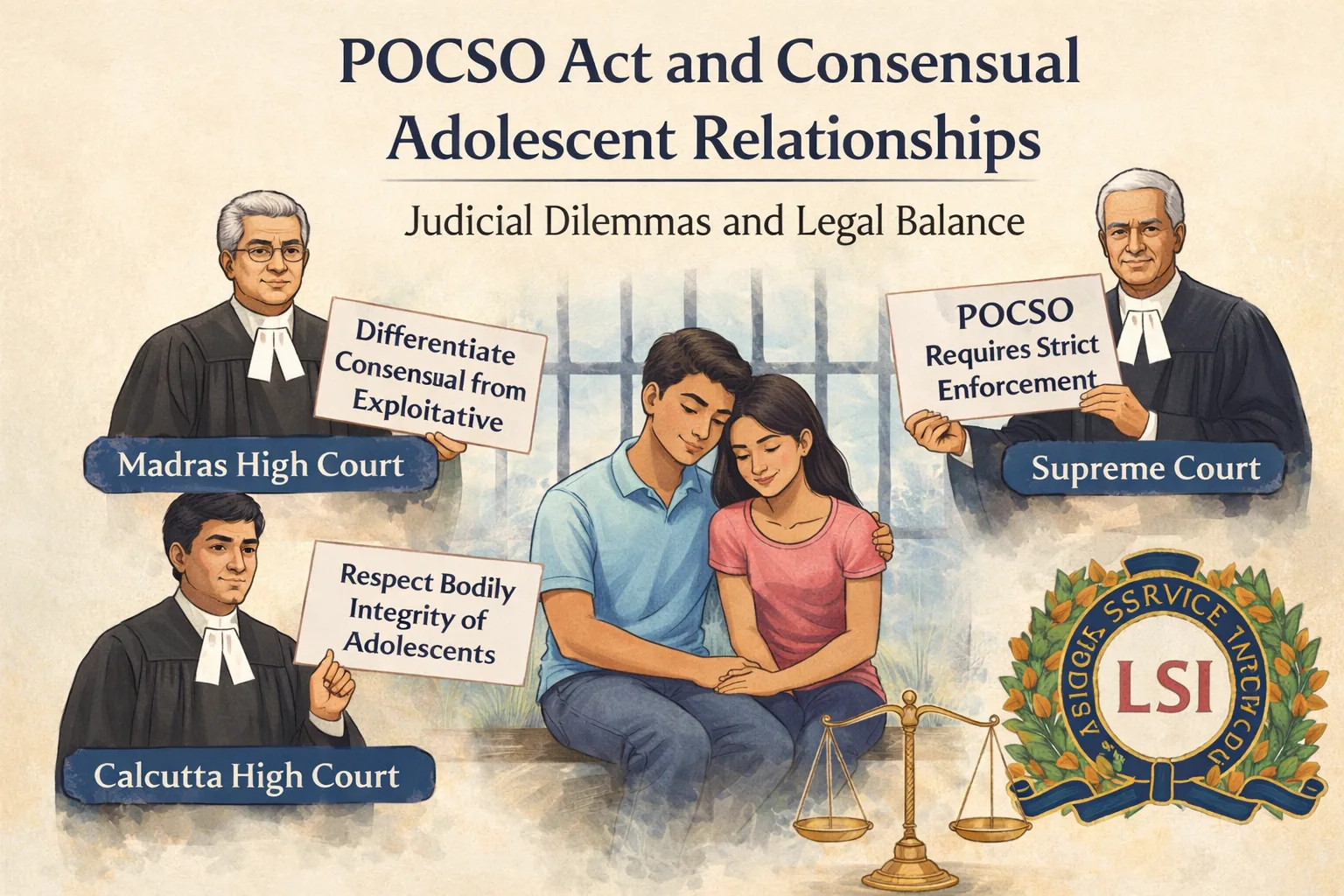
Judicial responses to this issue have been varied. The Madras High Court, in Vijayalakshmi v. State, observed that punishing an adolescent boy who entered into a consensual relationship with a minor girl by treating him as an offender was never the intent behind the enactment of the POCSO Act. The Court highlighted the need to differentiate between exploitative conduct and consensual relationships between adolescents.
Calcutta High Court
Similarly, the Calcutta High Court in Pankaj @ Pravat v. State of West Bengal held that equating consensual and non-exploitative sexual acts with rape or aggravated penetrative sexual assault undermines the bodily integrity and dignity of adolescents. Although the law aims to protect all persons below eighteen years from sexual abuse, its unintended consequence has been the deprivation of liberty of young individuals engaged in consensual relationships.
Supreme Court’s Restrictive Approach
However, the Supreme Court adopted a more restrictive approach while taking suo motu cognisance in In Re: Right to Privacy of Adolescents. The Court disapproved of suggestions that the POCSO Act should be amended to decriminalise consensual sexual acts involving adolescents above sixteen years of age. It emphasised that courts are bound to implement the law as enacted and cannot dilute its provisions under the guise of interpretation.
The Need for a Balanced Application of the Law
Thus, divergent judicial opinions continue to surround the application of the POCSO Act to consensual adolescent relationships. There is a pressing need to strike a balance between the strict enforcement of the law and the exercise of judicial discretion in cases where rigid application may cause more harm than good.
As argued by the Union of India in Nipun Saxena v. Union of India, the “bright-line rule” replaces subjective assessments of consent with an objective standard intended to protect minors. Nevertheless, limited judicial discretion in appropriate cases may ensure that the law fulfils its true purpose without unjustly penalising adolescents.
Written By: Ayushi Mishra, 5th Year B.A. LL.B. Student – Jamia Millia Islamia, New Delhi
