Introduction
Improvised Explosive Devices (IEDs) continue to represent a persistent and lethal threat across contemporary security environments, ranging from asymmetric conflict zones to densely populated urban settings. Their low cost, adaptability, and capacity for concealment have resulted in a disproportionate impact on civilian populations, security personnel, and first responders. Consequently, counter-IED (C-IED) strategies have increasingly relied on a mix of technological tools, including metal detectors, sensors, and robotic platforms.
Despite these advances, no artificial system has yet replicated the adaptability, sensitivity, and operational versatility of trained canine detection units. Capable of identifying trace explosive odours in complex and dynamic environments, canine teams remain an indispensable component of modern C-IED frameworks. Their rapid deployment, mobility, and reliability under operational conditions make them a strategic asset that complements—and in many contexts surpasses—purely technology-driven detection solutions.
The Nature of the IED Threat
IEDs are highly adaptable and deceptive. They may be person-borne, vehicle-borne, roadside, buried, or concealed in everyday objects. Their components include explosive charges, initiators, fuses, detonators, and triggers. These elements can vary widely in composition, including:
- High-order military explosives (e.g., RDX, PETN)
- Low-order blasting agents (e.g., ANFO, homemade mixtures)
- Minimal or non-metallic components
- Complex triggering mechanisms (remote, pressure, timer, command)
The clandestine nature of IEDs makes detection extremely challenging. Traditional metal detection tools (HHMD and DFMD) are limited against low-metal or non-metal devices. Similarly, stand-off sensors or imaging technologies may struggle with cluttered environments or require line-of-sight. Canines offer an olfactory advantage: they detect volatile organic compounds associated with explosive materials regardless of concealment, metal content, or surface visibility.
Scientific Basis of Canine Detection
Dogs possess one of the most advanced olfactory systems in the animal kingdom. Their ability to detect minute concentrations of specific chemical compounds exceeds that of the best artificial sensors. Key scientific factors include:
- Olfactory Sensitivity
Dogs have up to 300 million olfactory receptors, compared with approximately 6 million in humans. Their olfactory bulb, the brain region processing smell, is significantly larger proportionally than in humans. This anatomical advantage allows detection of explosive vapor molecules at parts-per-trillion levels.
- Explosive Chemical Signatures
Explosives emit specific volatile organic compounds (VOCs). While the explosive material itself may be non-volatile, trace residues evaporate and cling to surfaces. Canines are trained to recognize signature odours of common explosive agents such as:
- TNT (2,4,6-trinitrotoluene)
- RDX (cyclotrimethylene trinitramine)
- PETN (pentaerythritol tetranitrate)
- TATP (triacetone triperoxide)
- ANFO (Ammonium Nitrate Fuel Oil)
By focusing on VOC profiles rather than bulk material, canines detect IEDs regardless of metal content or packaging.
- Behavioral Cueing
Trained canines do not simply “smell” explosives; they are conditioned to communicate detection through trained alerts (e.g., sit, bark, point). This ensures reliable interpretation by the handler and minimizes false alarms.
Training of IED Detection Canines
The training of explosive detection dogs (EDDs) is rigorous, specialized, and continuous. Canine selection and training protocols vary by country and organization but share common principles:
Selection and Temperament
Not all breeds are equally suited. Successful detection dogs often exhibit:
- High drive (motivation and focus)
- Strong play/reward motivation
- Stable temperament under stress
- Social adaptability
Common breeds include German Shepherds, Belgian Malinois, Labrador Retrievers, and Spaniels, though mixed breeds can also excel.
Foundational Scent Training
Initial training begins with conditioning the dog to associate target odours with rewards (toys or food). The process includes:
- Odor imprinting: Dogs learn specific explosive VOCs.
- Search pattern training: Dogs are guided to systematically search areas and objects.
- Alert behavior conditioning: Dogs are trained to give clear, consistent alerts upon odor detection.
Advanced Scenario Training
Once foundational skills are established, dogs are exposed to increasingly complex environments:
- Vehicles and luggage
- Crowded public spaces
- Field environments with wind and variable terrain
- Concealed or layered odour scenarios
This phase ensures operational readiness, with emphasis on environmental distractions, noise, and presence of non-target odours.
Handler Integration
Canine effectiveness depends equally on handlers. Handlers are trained to:
- Read canine behavior and subtle cues
- Maintain search discipline
- Manage safety and engagement protocols
- Conduct joint training exercises
The handler-dog team is the functional unit, and cohesive training ensures optimal performance.
Operational Deployment of Canine Units
IED detection canine units are deployed across a wide variety of security missions:
- Checkpoints and Perimeter Sweeps
Canines rapidly screen vehicles, baggage, and pedestrians. Their mobility and speed reduce bottlenecks and enable high-volume screening more effectively than static equipment.
- Route and Area Clearance
Before troop movement or VIP convoys, canine teams sweep routes for hidden devices. Their ability to work across diverse terrain makes them invaluable in counter-insurgency contexts.
- Critical Infrastructure Protection
Airports, train stations, ports, government complexes, and public venues rely on canine units to augment electronic sensors and CCTV systems.
Post-Blast Investigation
- Canines are also trained for post-blast explosive residue detection, helping forensic teams identify explosive signatures and device components.
Community Engagement and Deterrence
- The visible presence of canine teams enhances public confidence and acts as a deterrent against hostile actors considering IED attacks.
Advantages of Canine Detection Units
- Superior Olfactory Capability: Dogs can detect odours that remain undetectable to current artificial sensors, especially at low concentrations or in complex scent environments.
- Mobility and Flexibility: Canine teams can operate across varied terrains—urban, rural, indoor, and outdoor—without requiring power sources or fixed infrastructure.
- Rapid Screening: Teams can cover large areas quickly, enabling real-time responses and dynamic search operations.
- Low False Alarm Rate (When Well-Trained and Properly Handled): When supported by rigorous training, regular certification, and competent handler interpretation, canine detection units demonstrate a high degree of specificity in identifying explosive odours. Their ability to discriminate target scents from background or non-threat odours significantly reduces false positives, thereby minimizing unnecessary evacuations, operational delays, and resource expenditure. However, this reliability is directly contingent upon consistent training standards, handler proficiency, and appropriate deployment conditions.
- Psychological Deterrence: The presence of canines may dissuade hostile actors from attempting to plant IEDs in high-security zones.
Limitations and Challenges
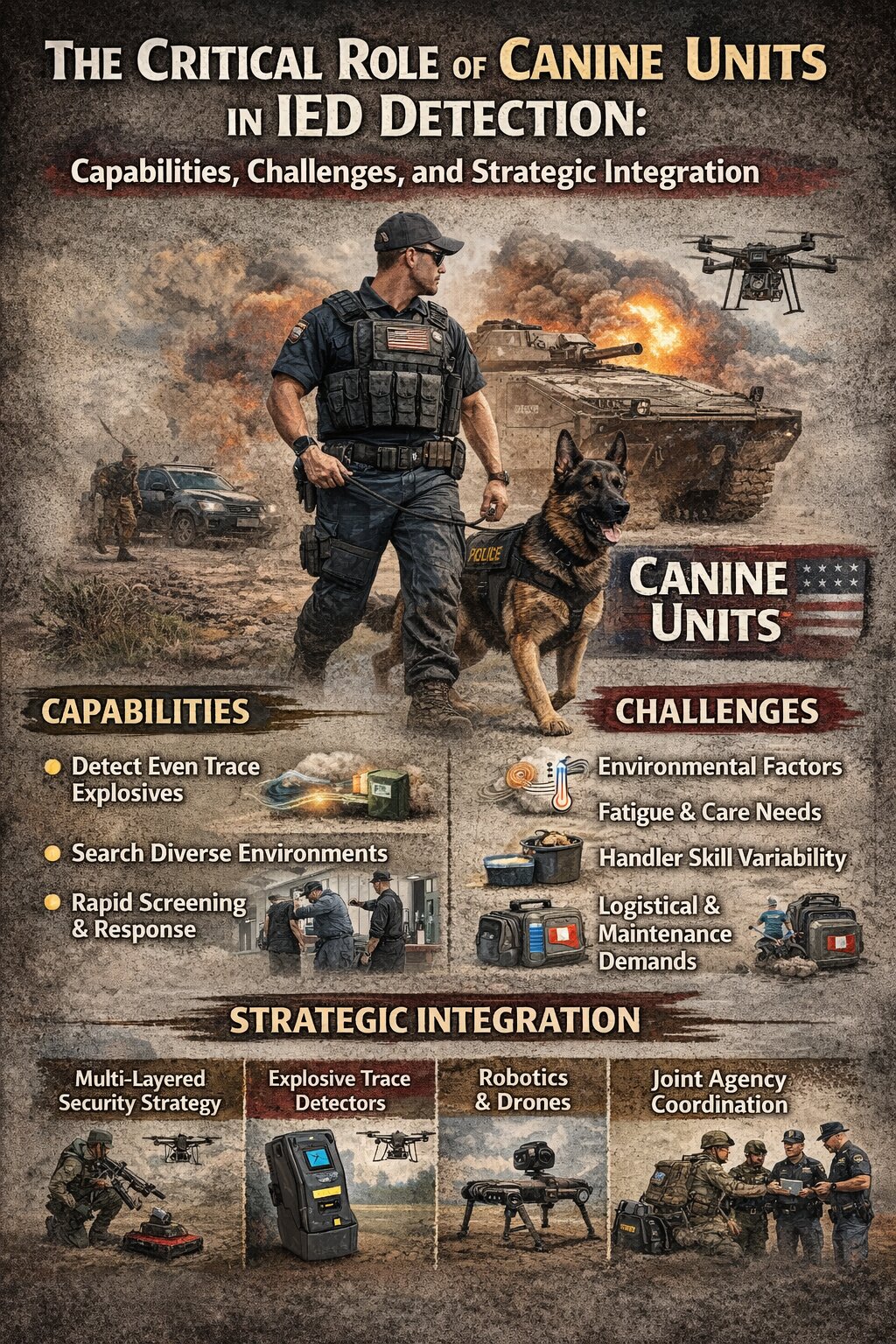
While canines are highly effective, they are not a stand-alone solution. Challenges include:
- Environmental Factors: Wind, temperature, humidity, and competing odours can affect scent dispersal and detection reliability.
- Fatigue and Operational Limits: Canines require rest, hydration, and care. Long shifts, heat exposure, or stress can degrade performance.
- Handler Skill Variability: Effectiveness depends on the handler’s ability to interpret behavior and manage search protocols.
- Maintenance and Logistics: Feeding, veterinary care, training facilities, and rotational rest cycles require sustained logistical support and costs.
- Vulnerability to Chemical Countermeasures: In rare cases, adversaries have attempted to mask explosive odours, although effective masking agents remain limited and typically detectable by trained dogs.
Supporting Technologies and Integrated Approaches
Canines work best as part of a multi-layered C-IED strategy. Technologies that complement canine units include:
- Explosive Trace Detectors (ETDs): Canine alerts can be followed by ETD scans to confirm trace residues.
- Ground-Penetrating Radar (GPR): For buried IEDs, GPR can assist where canine detection is difficult due to soil conditions.
- Robotics and UGVs: Unmanned ground vehicles equipped with sensors can access high-risk zones with canine guidance.
- Chemical Sensors and Mass Spectrometry: These tools provide analytical confirmation after canine initial detection.
Combining human-canine teams with technological sensors enhances overall detection accuracy and operational resilience.
Global Practices and Standards
Various nations and international organizations maintain canine C-IED standards:
- NATO/NAGS: “NATO Allied Group of Experts on Dog Utilization” provides standardized training and evaluation protocols for explosive detection dog teams.
- FBI Bomb Dog Programs: In law enforcement contexts, the FBI and partner agencies maintain rigorous certification and recertification standards.
- Military Canine Programs: Armed forces worldwide (US, UK, India, Israel) integrate canine units into combat engineer and EOD (Explosive Ordnance Disposal) units.
- International Collaboration: Cross-border training, exchange programs, and joint exercises help disseminate best-practices and enhance interoperability.
Policy and Institutional Considerations
To maximize the strategic value of canine units, security agencies must address:
- Resource Allocation: Investment in training centres, veterinary support, facility infrastructure, and sustainment funding.
- Standardization: Adoption of common certification metrics and periodic evaluation to maintain effectiveness.
- Interagency Coordination: Law enforcement, border security, military, and intelligence agencies should share canine capabilities and operational data.
- Research and Development: Continuous research on canine olfaction, scent detection science, and integration with emerging technologies.
- Community and Ethical Standards: Ensuring animal welfare, ethical deployment practices, and public communication strategies that build trust.
Future Directions and Innovation: Emerging research areas include:
- Bio-Electronic Olfactory Sensors: Efforts to develop electronic noses inspired by canine olfaction may one day augment or emulate biological detection.
- Genetic and Behavioral Profiling: Advances in genomic science might improve canine selection and training efficiency.
- Machine-Assisted Scent Analysis: Integrating artificial intelligence with chemical sensor data to interpret patterns and support canine alerts.
Despite technological progress, the biological advantage of canine olfaction remains unparalleled, and investment in canine units is expected to continue.
Conclusion
Canine detection units constitute a uniquely effective, adaptable, and time-tested capability in countering the evolving threat posed by Improvised Explosive Devices. Their unmatched olfactory sensitivity, when combined with disciplined training, skilled handler integration, and complementary technological support, enables reliable detection across environments where purely technical systems often face limitations. In both military and civilian security contexts, canine teams continue to deliver operational value that remains difficult to replicate through artificial means.
However, the effectiveness of canine units is neither automatic nor self-sustaining. It depends on sustained institutional investment, standardized training and certification regimes, inter-agency coordination, and robust welfare and logistical support frameworks. When strategically integrated into multi-layered C-IED architectures, canine detection units significantly enhance detection accuracy, operational resilience, and public confidence.
For security planners and policymakers, sustaining and modernizing canine detection capabilities is therefore not a legacy choice, but a strategic necessity—one that reinforces preparedness, deterrence, and the protection of lives and critical infrastructure in an increasingly complex threat environment.