





Introduction
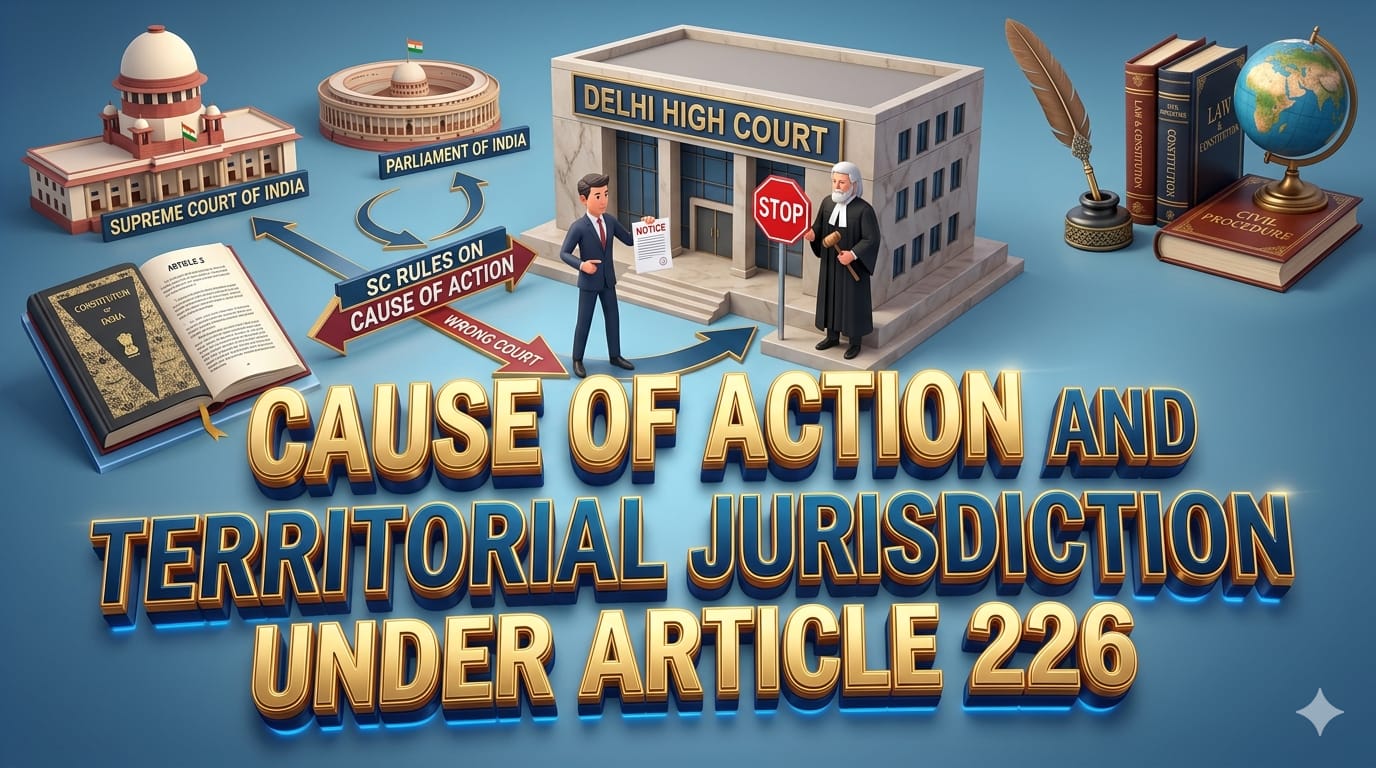
A company facing a tough notice under a new banking law passed by Parliament in Delhi, wants to challenge the entire law as unconstitutional, so it rushes to the Delhi High Court simply because Parliament sits there. The High Court says no, you cannot file here. The Supreme Court agrees and explains in crystal-clear terms why. This 2004 judgment is like a rulebook for every citizen or business wanting to question a central law in court. It tells us that just because the law was made in Delhi does not mean Delhi courts get automatic power to hear the case. There must be a real link – something actually happened to you in that court’s area. The decision protects courts from being flooded with cases from across India and ensures fairness by sending disputes to the right place.
Key Takeaways
- Delhi High Court does not automatically get jurisdiction for central laws.
- A real “cause of action” must arise within the court’s territorial limits.
- Prevents misuse of jurisdiction and forum shopping.
- Ensures judicial efficiency and fairness.
Factual Background
Kusum Ingots & Alloys Ltd. was a company with its registered office in Mumbai. It had taken a loan from the Bhopal branch of the State Bank of India. When the company faced repayment issues, the bank issued a notice from Bhopal under the new Securitisation and Reconstruction of Financial Assets and Enforcement of Security Interest Act, 2002 (SARFAESI Act). This law was passed by Parliament and applied all over India. The company did not like the law itself and wanted to argue that the whole Act was unconstitutional. Instead of filing in Mumbai or Bhopal where the loan and notice were handled, it chose the Delhi High Court. The only reason given was that the law was made by Parliament sitting in Delhi and the Union of India has its office there.
Factual Summary
| Aspect | Details |
|---|---|
| Company Location | Mumbai |
| Loan Branch | Bhopal (State Bank of India) |
| Law Involved | SARFAESI Act, 2002 |
| Notice Issued From | Bhopal |
| Petition Filed In | Delhi High Court |
| Reason for Delhi Filing | Parliament located in Delhi |
Procedural Background
The company filed a writ petition in the Delhi High Court questioning the constitutional validity of the SARFAESI Act. The High Court dismissed the petition straight away, saying it had no territorial jurisdiction because no part of the cause of action had arisen in Delhi. The company appealed to the Supreme Court of India. Before the Supreme Court, the company repeated the same argument: since the constitutionality of a parliamentary law was in question and Parliament sits in Delhi, the Delhi High Court must have power to hear it. The Union of India opposed the appeal and said the petition was rightly thrown out because the loan, the bank branch, and the notice were all in Bhopal and Mumbai, not Delhi.
Procedural Flow
- Writ Petition filed in Delhi High Court
- Delhi High Court dismissed for lack of jurisdiction
- Appeal filed before Supreme Court of India
- Union of India opposed the appeal
Reasoning
The Supreme Court began by explaining what “cause of action” really means in simple words. Cause of action is the complete set of facts that give you the right to sue. It is not every tiny detail mentioned in the petition, but only those important facts that prove your legal right and connect directly to the relief you want. Even if a small part of those facts happens inside a High Court’s area, that court can hear the case. But the court warned that this small part cannot be used as a trick to drag every case to Delhi.
The judges drew a sharp line between “legislation” and “executive action”. Legislation means the Act passed by Parliament or a State Assembly, or even rules made under it. Simply passing a law in Delhi does not create any cause of action anywhere. The law applies to the whole country once the President signs it and it is published in the Gazette. A person can challenge it only when that law actually affects him or her – when some official applies it and causes real harm or civil consequences. Until then, there is no dispute to decide, and no court can jump in. A writ court cannot decide big constitutional questions in a vacuum with no real victim in its territory.
The Supreme Court said the mere fact that the Union of India’s office or Parliament is in Delhi does not give the Delhi High Court power over every challenge to central laws. If that were true, every citizen from Kashmir to Kanyakumari could file in Delhi and overload the court. The judges looked at the exact words of Article 226(2) of the Constitution, which allows a High Court to act only where the cause of action arises wholly or in part. They compared it with Section 20(c) of the Civil Procedure Code and said the same principles apply to writ petitions too.
The Court also explained that when an order is passed by any authority – even under a new law – the place where that order is issued becomes part of the cause of action. If there is an appeal or revision, the place where that higher order is passed also counts. But the place where the law itself was debated or signed does not count. The Supreme Court rejected the company’s argument completely and said the Delhi High Court was right to dismiss the petition.
Core Legal Principles
- Cause of action must have a real and substantial connection to the court’s territory.
- Legislation alone does not create cause of action.
- Executive action (like notices/orders) creates jurisdiction.
- Article 226(2) governs territorial jurisdiction in writ petitions.
- Prevents forum shopping and judicial overload.
Judgements With Complete Citation And Their Context Discussed
The Supreme Court discussed several earlier cases to build its reasoning step by step.
- Oil & Natural Gas Commission v. Utpal Kumar Basu ((1994) 4 SCC 711): The Court had already held that territorial jurisdiction depends only on the facts pleaded in the petition, not on whether those facts are true or false. It also made clear that sending a fax or receiving a reply in Calcutta does not create jurisdiction there if the main dispute is elsewhere. The same principle was used here to show that the company’s petition had no real Delhi connection.
- State of Rajasthan v. Swaika Properties ((1985) 3 SCC 217): The Court ruled that merely serving a notice does not create cause of action unless the notice itself is the core of the dispute. This helped explain why the mere existence of the SARFAESI Act in the statute book was not enough.
- Aligarh Muslim University v. Vinay Engg. Enterprises (P) Ltd. ((1994) 4 SCC 710): This case was cited to criticise parties who deliberately choose a wrong court. The judges said the company’s move to Delhi looked like forum shopping.
- Union of India v. Adani Exports Ltd. ((2002) 1 SCC 567): Reinforced that only facts having a direct nexus with the prayer matter. Facts with no link to the relief cannot create jurisdiction.
- National Textile Corpn. Ltd. v. Haribox Swalram ((2004) 9 SCC 786): Reiterated that only facts having a direct nexus with the prayer matter are relevant for jurisdiction.
- Nasiruddin v. STAT ((1975) 2 SCC 671): The Supreme Court clarified that this ruling related to appellate orders passed in a particular place, not the seat of the legislature.
- U.P. Rashtriya Chini Mill Adhikari Parishad v. State of U.P. ((1995) 4 SCC 738): The Court overruled this case on the relevant point, distinguishing it from the present issue.
- Lt. Col. Khajoor Singh v. Union of India (AIR 1961 SC 532): This case was distinguished because it was decided before Article 226(2) was added to the Constitution. The old rule no longer applies.
- Abdul Kafi Khan v. Union of India (AIR 1979 Cal 354): Referred to support the view that Delhi cannot become the default forum for every central law challenge.
Summary Of Case Laws And Principles
| Case Name | Citation | Principle Laid Down |
|---|---|---|
| Oil & Natural Gas Commission v. Utpal Kumar Basu | (1994) 4 SCC 711 | Jurisdiction depends on pleaded facts, not their truth |
| State of Rajasthan v. Swaika Properties | (1985) 3 SCC 217 | Notice alone does not create cause of action |
| Aligarh Muslim University v. Vinay Engg. Enterprises (P) Ltd. | (1994) 4 SCC 710 | Forum shopping discouraged |
| Union of India v. Adani Exports Ltd. | (2002) 1 SCC 567 | Only relevant facts create jurisdiction |
| National Textile Corpn. Ltd. v. Haribox Swalram | (2004) 9 SCC 786 | Direct nexus required with relief sought |
The Final Decision Of Court
The Supreme Court dismissed the company’s appeal in full. It confirmed that the Delhi High Court had correctly refused to entertain the writ petition. The company was told it should have approached the High Court having territorial jurisdiction over Mumbai or Bhopal where the loan and the bank notice originated. The Court made it clear that no costs were awarded.
Point Of Law Settled In The Case
This judgment settled a very important rule that still guides every High Court in India today. The seat of Parliament or the Union Government in Delhi does not by itself create territorial jurisdiction for the Delhi High Court to hear challenges to the constitutional validity of central laws. A writ petition can be filed only where the cause of action arises – that is, where the law has actually been applied to the petitioner and caused real civil consequences. Mere framing or passing of legislation anywhere in India does not give rise to a cause of action. Even a small part of the cause of action can give jurisdiction, but courts can still refuse the case under the doctrine of forum conveniens if it is not the most convenient place. This principle applies equally to challenges against parliamentary Acts, delegated legislation, rules, or executive orders. The decision prevents misuse of Delhi courts and ensures that disputes are heard where they actually belong, making justice faster and fairer for ordinary citizens and businesses.
Case Details
| Particulars | Details |
|---|---|
| Case Title | Kusum Ingots & Alloys Ltd. Vs Union of India and Another |
| Date of Order | 28 April 2004 |
| Case Number | Civil Appeal No. 9159 of 2003 |
| Neutral Citation | (2004) 6 Supreme Court Cases 254 |
| Name of Court | Supreme Court of India |
| Name of Hon’ble Judge | Hon’ble Mr. Justice S.B. Sinha (for the Bench comprising Hon’ble Mr. Justice V.N. Khare, C.J., Hon’ble Mr. Justice S.B. Sinha and Hon’ble Mr. Justice S.H. Kapadia) |

