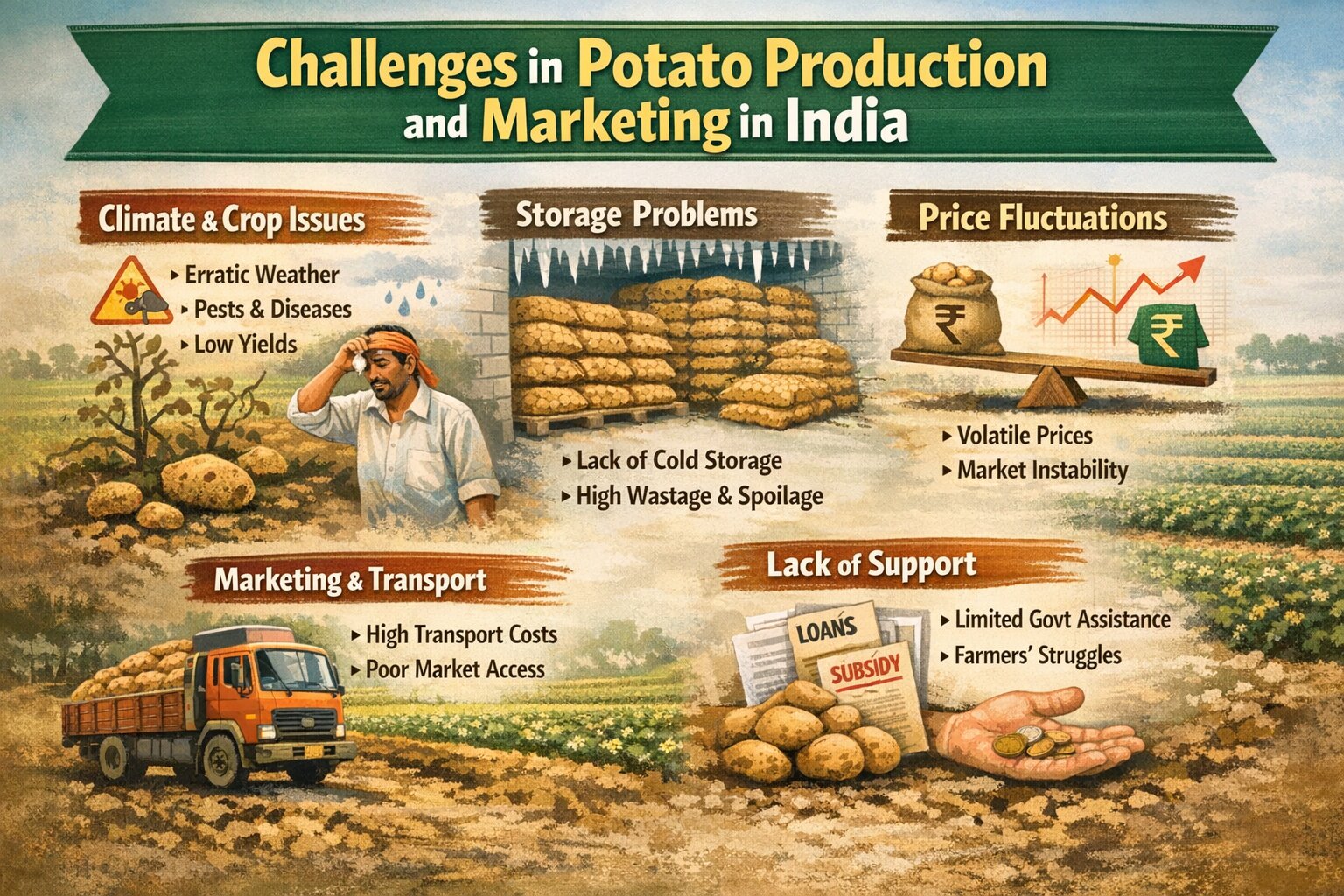
Potato is one of the most important food crops in India and serves as a staple vegetable for millions of people. India is among the largest producers of potatoes in the world, with major production centres in states such as Uttar Pradesh, West Bengal, Punjab, Bihar, and Gujarat. Despite its importance, the potato sector in India is plagued by several structural problems related to production, storage, marketing, and price stability. These problems not only affect farmers’ incomes but also create volatility in consumer prices.
Production Challenges
One of the primary issues in potato cultivation is the fluctuation in production due to climatic conditions, input costs, and lack of planning. Farmers often expand potato cultivation when prices are high in the previous season, leading to overproduction in the following year. This results in market glut and price crashes. For instance, in West Bengal, bumper harvests have pushed farm-gate prices to as low as ₹4–6 per kg, even though the production cost is around ₹8 per kg, causing heavy losses to farmers.
Another challenge is the rising cost of agricultural inputs such as seeds, fertilizers, pesticides, irrigation, and labour. Potato cultivation is input-intensive, and small and marginal farmers often struggle to bear these costs. Additionally, farmers often lack access to good quality seed varieties, modern machines, and proper agricultural guidance, which lowers productivity and increases the chances of crop failure.
Cold Storage Challenges
Beyond cultivation, effective storage is crucial to prevent losses and stabilize prices. Potatoes are highly perishable and require proper storage facilities to maintain quality and prevent sprouting or rotting. Cold storage plays a crucial role in stabilizing supply throughout the year.
However, India’s potato cold storage infrastructure faces multiple challenges that affect both farmers and the overall supply chain. Many storage units are outdated or poorly maintained, lacking modern temperature, humidity, and ventilation controls. This leads to high post-harvest losses due to spoilage, sprouting, or disease. Frequent power outages and high electricity costs further increase operational expenses. Limited storage capacity during peak harvest seasons forces farmers to sell their potatoes immediately at low prices, resulting in distress sales and reduced earnings.
Additional issues include uneven geographic distribution and inefficient logistics. Many cold storages are concentrated in certain states, leaving other potato-producing regions underserved. Poor handling during loading, unloading, and transport further reduces quality. Inadequate regulatory oversight and low access to financial support prevent modernization, limiting the sector’s efficiency. Collectively, these factors hinder India’s ability to maintain consistent supply, stabilize prices, and improve export potential.
West Bengal, the second-largest potato-producing state, contributes nearly 23% of national output, with major production districts including Hooghly, Purba Bardhaman, Paschim Medinipur, and Bankura. Despite having around 575–588 cold storages, with a total capacity of 70–75 lakh tonnes, production in good harvest years often reaches 14–17 million tonnes. This large gap between production and storage capacity puts enormous pressure on the system, forcing farmers to sell immediately at low prices.
Other challenges in West Bengal’s cold storage sector include high operating costs due to rising electricity, labour, and maintenance expenses. Many facilities are technologically outdated, reducing efficiency, while market uncertainties, price fluctuations, and difficulties in securing storage space or bonds further complicate operations. Experts estimate that the state needs an additional 30–40 lakh tonnes of storage capacity and modernization of existing units to manage surplus production effectively and prevent distress sales. Strengthening cold storage infrastructure is therefore crucial for stabilizing the potato market and protecting farmers’ incomes in West Bengal.
Price Fluctuations
Even with storage, market dynamics often lead to sharp price fluctuations. The potato market in India is characterized by extreme price volatility. In some years, prices collapse due to surplus production, while in other years they shoot up due to supply shortages. Such fluctuations create uncertainty for both farmers and consumers.
Another serious issue is the large gap between farm-gate prices and retail prices. Even when farmers are forced to sell potatoes at very low prices, consumers often continue to pay much higher prices in urban markets. This disparity is largely due to the dominance of intermediaries and traders in the supply chain. In some cases, farmers have sold potatoes at ₹6 per kg while retail prices remained around ₹14–17 per kg in cities.
The government sometimes stabilizes potato prices through MSP, direct procurement, or stock limits to prevent hoarding.
However, these measures are often not implemented regularly or effectively. For example, procurement may start late, MSP may not be announced or enforced properly, and stock limits may be applied only for a short period.
Because of these delays and weak implementation, these policies do not always succeed in balancing supply and demand, and therefore fail to keep potato prices stable for both farmers and consumers.
Marketing and Distribution Problems
Marketing of potatoes in India is also hampered by several structural issues. Agricultural produce markets are often controlled by middlemen, commission agents, and traders who influence prices and restrict farmers’ bargaining power. Farmers usually sell their produce in local mandis immediately after harvest because they lack storage, transportation, or access to distant markets.
Export barriers also affect the potato sector. In certain years, disruptions in export markets or trade routes reduce demand for surplus potatoes. For example, political instability and closure of export corridors to neighbouring countries have restricted potato exports from eastern India, leaving large stocks unsold in cold storages.
Furthermore, India has limited potato processing capacity compared to its production. A significant portion of potatoes is consumed as fresh produce, and only a small share is processed into products such as chips, fries, and starch. Lack of processing industries prevents value addition and worsens the problem of oversupply.
Socio-Economic Impact on Farmers
The combined problems of excess production, lack of adequate storage, and unstable prices create serious difficulties for potato farmers. When there is a bumper harvest but not enough storage space, farmers are often forced to sell their potatoes at very low prices, which reduces their income and increases their debt, especially among small and marginal farmers. In some years, farmers suffer heavy losses even after producing a large crop. Such price crashes can cause losses worth thousands of crores in the potato sector. This uncertainty discourages farmers from growing potatoes in the future, and if many farmers reduce cultivation, it may lead to shortages and sharp price increases in the following years.
Possible Solutions
To address the problems faced by the potato sector, several policy and structural measures are needed. These include expanding and modernizing cold storage and cold chain infrastructure to reduce post-harvest losses and allow farmers to store their produce for longer periods.
The government could also promote potato processing industries such as chips, fries, and starch units to increase value addition and absorb surplus production. Farmer Producer Organizations (FPOs) should be strengthened so that farmers can collectively market their produce and reduce dependence on middlemen.
In addition, there should be better market information and price forecasting systems to help farmers plan cultivation according to demand. The government could also facilitate inter-state and international trade to manage surplus production and prevent market gluts.
Effective price stabilization measures, including procurement and buffer stock mechanisms, can help protect farmers from distress sales. Further, improving rural roads, transportation, access to affordable credit, and providing better quality seeds and modern farming technology can also significantly strengthen the potato supply chain and ensure stable incomes for farmers.
Causes of Increase in the Price of Potato Bags
The rise in the price of potato bags in India is mainly driven by the increasing cost of raw materials and production. Potato bags are generally made from jute or polypropylene, and the prices of these materials have increased due to higher input costs, fluctuations in global crude oil prices (affecting plastic polymers), and irregular supply of raw jute.
In addition, rising labour wages, electricity tariffs, and transportation expenses have increased the manufacturing cost of bags. Seasonal demand during the potato harvesting and storage period also leads to a surge in purchases by farmers, traders, and cold storage owners, pushing prices upward. Government regulations regarding jute packaging and limited production capacity of jute mills further restrict supply, which ultimately results in higher prices of potato bags in the market.
The price of nylon yarn has risen by around 7% per kg, leading to a corresponding increase in the cost of finished products like potato sacks, as seen in districts of West Bengal such as Hooghly.
The Iran–Israel conflict can indirectly push up potato bag prices in India. Made from jute or petroleum-based polypropylene, these bags are affected by rising crude oil prices and higher logistics costs due to the war. As a result, even distant geopolitical tensions can increase the cost of packaging for agricultural products.
In India, matters relating to nylon yarn are primarily handled by the Department of Chemicals and Petrochemicals under the Ministry of Chemicals and Fertilizers, as nylon yarn is a synthetic polymer product derived from petrochemicals. This department is responsible for policy, production, and regulation of petrochemical products including synthetic fibres and yarn. If any regulatory intervention such as price control or supply regulation becomes necessary in the public interest, the Central Government may also take action under the Essential Commodities Act, 1955, depending on the circumstances.
Potato Processing Units in West Bengal
Potato processing units in West Bengal remain relatively limited despite the state being one of the largest producers of potatoes in India. Most potatoes are sold as fresh produce, while only a small portion is processed into products such as chips, French fries, flakes, and starch. The lack of sufficient processing industries means that surplus potatoes during bumper harvests cannot be effectively utilized, leading to market gluts and sharp falls in prices. Establishing more potato processing units can help absorb excess production, reduce wastage, and create additional demand for potatoes. It can also generate employment, promote value addition, and provide farmers with more stable and diversified market opportunities in the state.
India’s Potato Export Landscape and Structural Challenges
India is now the world’s second-largest potato producer, hitting a record 58 million tonnes in the 2025–26 season. This huge surplus has pushed a move from selling basic table potatoes to high-value items like frozen fries and flakes for the Middle East, Southeast Asia, and Russia. New government policies and special “Export Clusters” in Gujarat and Uttar Pradesh have improved the supply chain. These steps help Indian potatoes compete better with European and American brands on both price and quantity.
However, the industry faces major logistics and infrastructure problems that hurt its global standing. A massive shortage of nearly 15 million tonnes in modern cold-storage space causes high spoilage and lower quality during long trips. Additionally, the expensive cost of moving goods from inland farms to big ports like Mundra often cancels out the low cost of growing them. This makes Indian potatoes less competitive against products from smaller countries with faster, cheaper transport systems.
On the legal side, Indian exporters often struggle with very strict health and safety rules set by wealthier nations. Problems like “Potato Cyst Nematode” pests or high chemical residues frequently lead to rejected shipments because many Indian farms lack international “Good Agricultural Practices” certifications for tracking. Furthermore, while India grows plenty of cooking potatoes, it lacks enough industrial-grade varieties needed for snacks. This gap prevents India from fully leading the profitable global market for processed potato products.
Conclusion
The Indian potato sector stands at a crossroads: record production is undermined by storage deficits and high logistical costs. While states like West Bengal and Uttar Pradesh drive national output, the recurring cycle of “bumper-harvest-led price crashes” and the dominance of intermediaries continue to trigger financial distress for small-scale farmers.
To transition from a volatile domestic commodity to a competitive global powerhouse, India must urgently bridge the gap between production and processing, modernize its aging infrastructure to meet international phytosanitary standards, and expand the cultivation of industrial-grade varieties.
Ultimately, stabilizing this sector requires a synchronized approach of government procurement, the strengthening of Farmer Producer Organizations (FPOs), and a significant investment in value-added processing units to turn a perishable surplus into a stable economic asset.