





Introduction
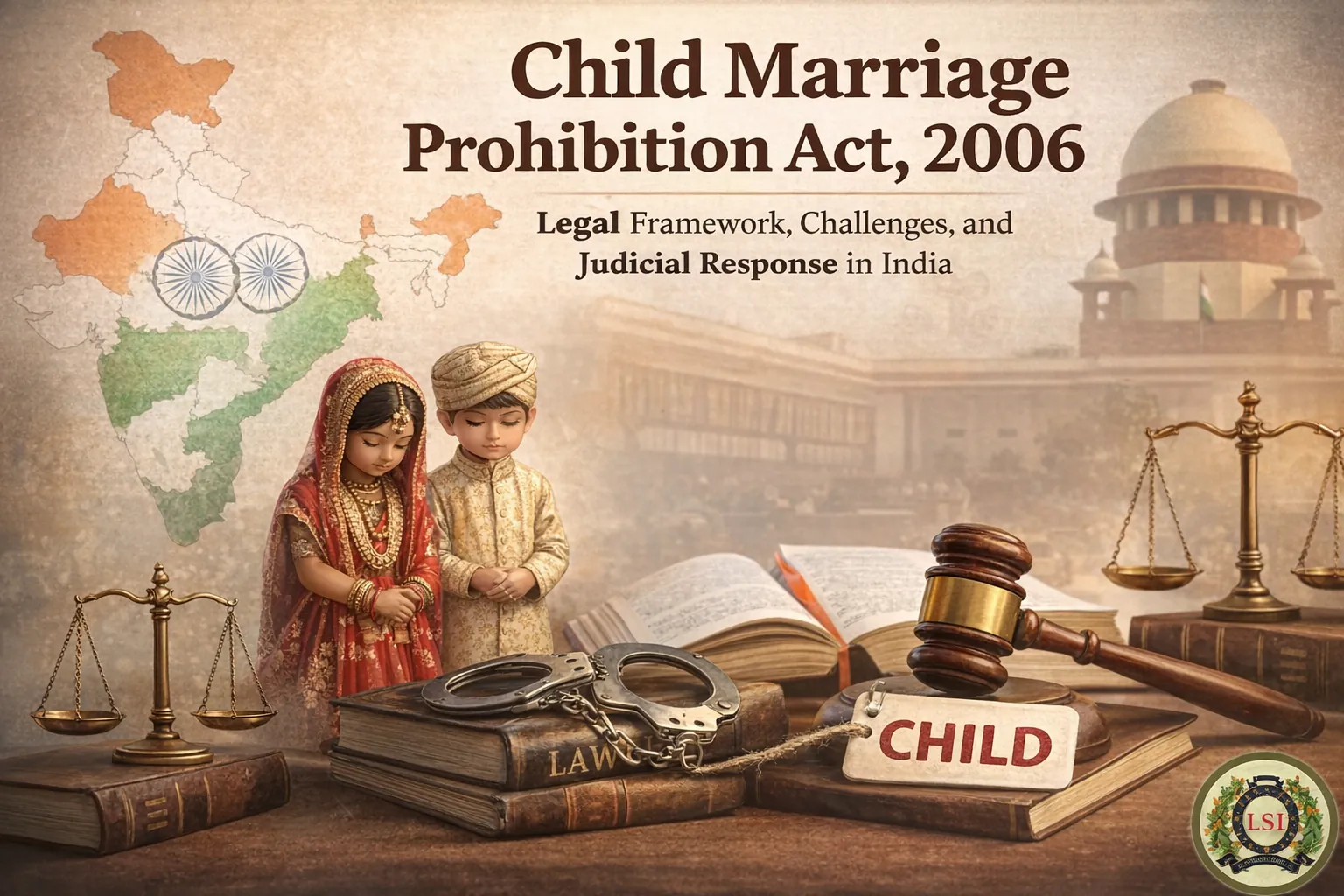
Child marriage remains a persistent social issue in India despite legal measures like the Child Marriage Prohibition Act, 2006, which prohibits the marriage of girls below 18 and boys below 21. The Act aims to protect children from early marriage, safeguard their health, education, and overall development, and ensure gender equality. However, its enforcement faces significant challenges due to deep-rooted socio-cultural norms, poverty, illiteracy, and lack of awareness among communities. This research explores the reasons behind the Act’s limited effectiveness, analyzing social, economic, and administrative factors that contribute to its continued failure in preventing child marriages.
Legal Framework and Provisions
The Child Marriage Prohibition Act, 2006, provides the legal framework to prevent and punish child marriages in India. It declares marriages involving girls below 18 and boys below 21 as illegal and voidable, and prescribes punishments including imprisonment up to two years and fines up to one lakh rupees for those who solemnize or facilitate such marriages. The Act also empowers district authorities to prevent child marriages and protect victims. Complementary laws, such as the Prohibition of Child Marriage Rules, 2016, and provisions under the Protection of Children from Sexual Offences (POCSO) Act, strengthen enforcement, though implementation remains inconsistent.
Implementation Challenges
Despite its stringent provisions, the Child Marriage Prohibition Act often fails in practice due to social, economic, and administrative challenges.
- Deep-rooted patriarchal norms and traditional customs encourage early marriage, especially in rural areas.
- Poverty and lack of education push families to marry off children to reduce financial burdens.
- Weak enforcement, delayed legal action, and limited awareness about the law undermine its effectiveness.
- Societal pressure and fear of social stigma discourage reporting.
- Authorities face resource constraints and coordination issues.
These factors collectively result in the continued prevalence of child marriages, highlighting a gap between law and societal practice.
The Child Marriage Prohibition Act, 2006
The Child Marriage Prohibition Act, 2006, is a comprehensive legislation aimed at preventing child marriages in India. It defines a child as a girl below 18 years and a boy below 21 years and prohibits their marriage. The Act criminalizes the solemnization of child marriages and any act that facilitates such unions, including promoting or permitting them. Offenders can face imprisonment of up to two years and fines up to one lakh rupees. The law also empowers district authorities to prevent child marriages and protect children at risk. Despite its legal strength, enforcement remains a major challenge.
Punishments
The Child Marriage Prohibition Act, 2006, prescribes strict punishments to deter child marriages.
| Offence | Prescribed Punishment |
|---|---|
| Performing, conducting, or directing a child marriage | Imprisonment up to two years and fine up to one lakh rupees |
| Promoting or permitting a child marriage (including parents or guardians) | Imprisonment up to two years and fine up to one lakh rupees |
| Failure to prevent a child marriage despite authority | Preventive measures such as restraining orders and counseling |
Additionally, the Act allows district authorities to take preventive measures, including restraining orders and counseling for families. Despite these provisions, punishments are often underutilized due to social pressure, lack of awareness, and inadequate reporting mechanisms, limiting the Act’s effectiveness.
Cases
1) Independent Thought vs Union of India
Court and Bench
- Court: Supreme Court of India — Civil Original Jurisdiction
- Judgment Date: 11 October 2017
- Bench: Madan B. Lokur & Deepak Gupta, JJ
Facts of the Case
- Petitioner: Independent Thought, a child rights NGO.
- Respondent: Union of India.
- At the time, Indian Penal Code (IPC) Section 375 (defining rape) included Exception 2, which stated: Sexual intercourse by a man with his own wife is not rape, provided the wife is not under 15 years of age.
- Meanwhile, the age of consent under Section 375 was raised to 18 years by the Criminal Law (Amendment) Act, 2013. Yet, Exception 2 was not updated.
- This meant that a husband could have non-consensual sexual intercourse with his wife aged 15–18 years without committing rape under the IPC.
Legal Issues
The Supreme Court framed and addressed the following main questions:
- Whether sexual intercourse by a husband with his wife, if she is between 15 and 18 years old, can be excluded from the definition of rape under Exception 2 of Section 375 IPC?
- Whether Exception 2 to Section 375 IPC — which allows marital intercourse with a minor wife (15–18 years) without constituting rape — is constitutional?
- Whether the distinction between a married girl child and an unmarried girl child regarding consent is reasonable and justifiable?
Judgment (Supreme Court)
Key Holding
The Supreme Court struck down Exception 2 to Section 375 IPC to the extent it applies to girls aged 15 to 18 years.
The Court held that sexual intercourse with a girl below 18 years of age — whether married or unmarried — is rape.
Reasoning
- The Court found Exception 2 arbitrary and discriminatory because:
- It creates an artificial distinction between a married and unmarried girl child.
- Marriage does not change a “girl child”’s status; she remains a minor under 18 years with the inability to give valid consent.
- Consent cannot be presumed for girls below 18 regardless of marital status, as she is legally incapable of giving consent until 18.
- The distinction was found to be violative of Articles 14, 15(3), and 21 of the Constitution (equality, special provision for women/children, and personal liberty/bodily integrity).
- The Court stressed that child marriage itself is prohibited under the Prohibition of Child Marriage Act, 2006, though not void — it is voidable at the option of the child.
Legal Impact / Significance
- The ruling aligns the age of consent with the age of majority (18 years) for sexual activity, removing the marital exemption for minors.
- After this judgment, a husband having sexual intercourse with his wife who is between 15–18 years can be prosecuted for rape under Section 375 IPC.
- However, the Court clarified that it is not addressing general marital rape for women over 18 years — that issue was not before the Court.
Summary of Legal Change
| Provision | Before Judgment | After Judgment |
|---|---|---|
| Section 375 IPC | Allowed intercourse with a married girl aged 15+ without constituting rape (Exception 2) | No exception for 15–18; sexual intercourse with a minor is rape |
| Age of Consent | 18 years | Continues to be 18 years for all persons (no marital exception) |
The Court effectively held that marriage does not legitimize sex with a minor.
2) Shabnam vs State of Haryana and Others
Court and Citation
- High Court: Punjab & Haryana High Court at Chandigarh
- Decision Date: 14 March 2013
- Citation: CRM No. 10230 of 2013 & CRM-A No. 82-MA of 2013 (O & M)
Facts of the Case
- The applicant (Shabnam) filed a complaint alleging dowry-related cruelty, harassment, rape, and other offences by her husband Firoz and his family.
- Based on her complaint, an FIR (No. 738/2010) was registered for offences under Sections 498A (cruelty), 406 (breach of trust), 506 (criminal intimidation), and 376 (rape) of the Indian Penal Code (IPC).
- At the trial level, Firoz (husband) was convicted for offences under Sections 498A and 506 IPC and sentenced to 2 years’ rigorous imprisonment plus fine.
- However, the other accused (Firoz’s mother, sister-in-law, and brother-in-law) were acquitted by the trial court on the charges against them.
Legal Issue
Shabnam sought leave from the High Court to file an appeal under Section 378(4) Cr.P.C. against the acquittal of the relatives of her husband (Respondents No. 2–4), arguing that the acquittal was improper.
High Court’s Analysis
The High Court reviewed the trial court’s findings and evidence, especially regarding:
- Whether there was sufficient proof linking the acquitted relatives to the alleged cruelty and dowry demands;
- Whether the evidence supported rape allegations against Salim (brother-in-law);
- Whether the prosecution’s case suffered from vagueness and lack of corroboration.
Key Observations
- Rape allegation: The trial court found no substantive evidence to prove that the brother-in-law committed rape — attributing inconsistencies and improvements in statements.
- Vague dowry allegations: Claims against the acquitted relatives for demanding personal items (earrings, chain) were held to be vague and uncorroborated — especially since some lived elsewhere and no direct proof of cruelty by them was shown.
- Entrustment/misappropriation of dowry: No clear evidence was produced linking any accused (other than Firoz) to misappropriation of dowry.
- Benefit of doubt: Citing settled principles in Indian criminal law, the High Court reiterated that in cases of reasonable doubt, the benefit must go to the accused — especially in appeals against acquittal.
High Court’s Decision
The application for leave to appeal against acquittal was dismissed. There was no misreading of evidence or perverse judgment by the trial court warranting interference.
Impact On Society
Child marriage has far-reaching negative effects on society, despite the Child Marriage Prohibition Act, 2006. Early marriage deprives children of education, limiting future employment opportunities and perpetuating cycles of poverty. It poses serious health risks, particularly for young girls who face complications during early pregnancies. Socially, it reinforces gender inequality, restricting girls’ autonomy and decision-making power. Child marriages also contribute to higher rates of domestic violence and psychological trauma. Communities suffer as potential human capital is lost, and the nation’s socio-economic development is hindered. These societal consequences highlight the urgent need for stricter enforcement and awareness programs.
Conclusion
The Child Marriage Prohibition Act, 2006, represents a critical legal step toward protecting children, yet its effectiveness is limited by deep-rooted social, economic, and cultural challenges. Persistent poverty, lack of education, and traditional norms continue to drive child marriages, while weak enforcement and limited awareness hinder the law’s implementation. Cases from courts underscore the need for stricter action, but societal change remains slow. Combating child marriage requires a holistic approach, combining legal enforcement with community education, empowerment of girls, and social support systems. Only through coordinated efforts can India hope to eliminate this practice and safeguard its children’s future.
Impact on Society
Child marriage has far-reaching negative effects on society, despite the Child Marriage Prohibition Act, 2006. Early marriage deprives children of education, limiting future employment opportunities and perpetuating cycles of poverty. It poses serious health risks, particularly for young girls who face complications during early pregnancies. Socially, it reinforces gender inequality, restricting girls’ autonomy and decision-making power. Child marriages also contribute to higher rates of domestic violence and psychological trauma. Communities suffer as potential human capital is lost, and the nation’s socio-economic development is hindered. These societal consequences highlight the urgent need for stricter enforcement and awareness programs.
Key Societal Consequences
- Deprivation of education and reduced future employment opportunities
- Perpetuation of poverty across generations
- Serious health risks, especially for young girls during early pregnancies
- Reinforcement of gender inequality and loss of autonomy for girls
- Increased incidence of domestic violence and psychological trauma
- Loss of human capital affecting national socio-economic development
Summary of Impacts
| Area Affected | Impact |
|---|---|
| Education | Early marriage deprives children of education and skills development |
| Health | Increased maternal health risks and pregnancy-related complications |
| Gender Equality | Restrictions on autonomy and decision-making power of girls |
| Social Well-being | Higher rates of domestic violence and psychological trauma |
| Economic Development | Loss of human capital and hindered socio-economic growth |
Conclusion
The Child Marriage Prohibition Act, 2006, represents a critical legal step toward protecting children, yet its effectiveness is limited by deep-rooted social, economic, and cultural challenges. Persistent poverty, lack of education, and traditional norms continue to drive child marriages, while weak enforcement and limited awareness hinder the law’s implementation. Cases from courts underscore the need for stricter action, but societal change remains slow. Combating child marriage requires a holistic approach, combining legal enforcement with community education, empowerment of girls, and social support systems. Only through coordinated efforts can India hope to eliminate this practice and safeguard its children’s future.
Reference
- Independent Thought vs Union Of India on 11 October, 2017
https://share.google/ZwV6z1IBdJXeFfnxe - Shabnam vs State Of Haryana And Others on 14 March, 2013
https://share.google/qVRvoYPfKsbouiYhf
Written By: Kherin Trufina. A

