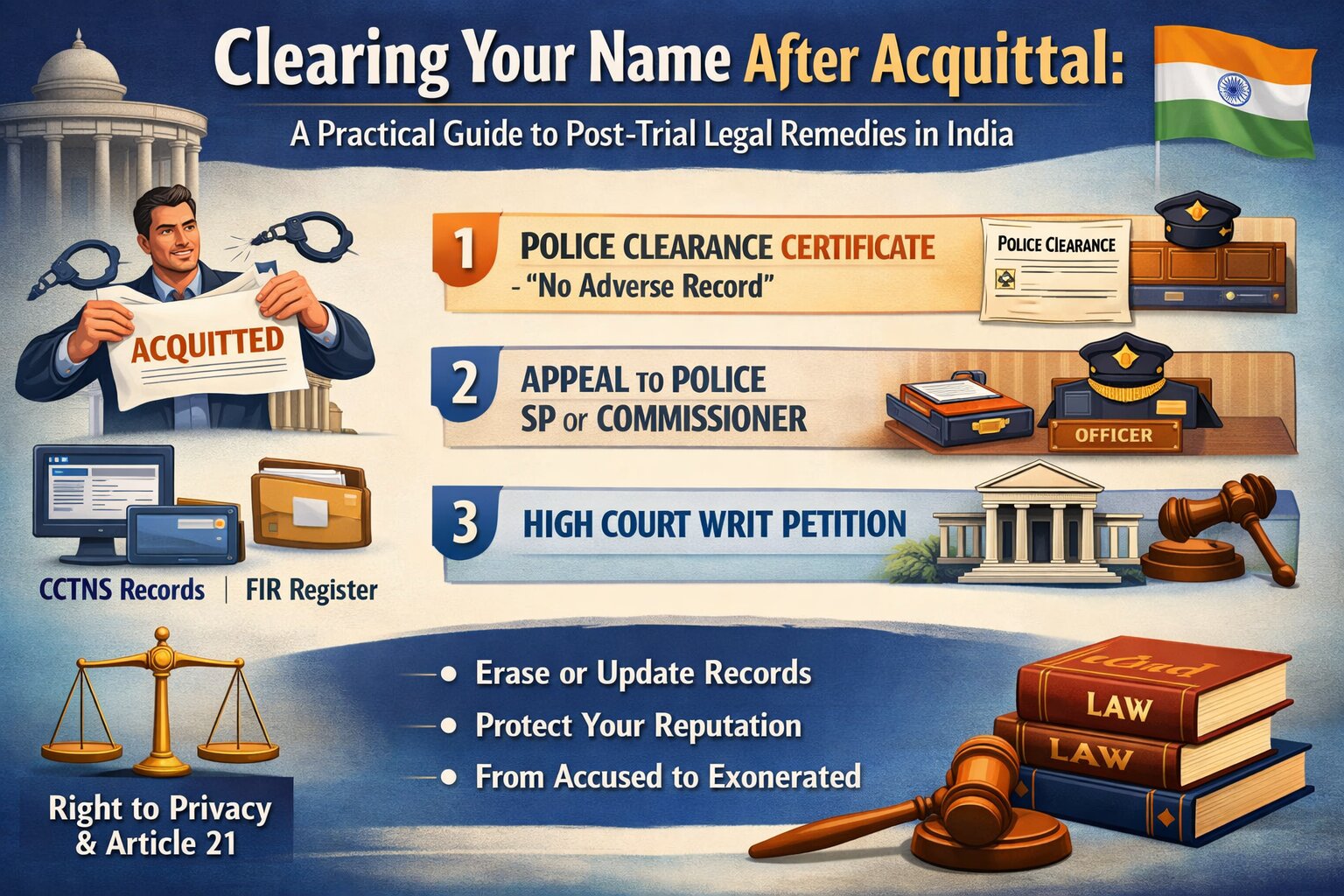
The Legal Reality: Retention vs. Erasure
In the Indian criminal justice system, an acquittal or discharge does not automatically erase an individual’s record from police databases. Instead, such records typically continue to exist in various official repositories, including:
- CCTNS (Crime and Criminal Tracking Network & Systems): A nationwide digital database maintained by police authorities.
- FIR Registers: Both physical and digitized records of the original complaint.
- Surveillance Records: Including “history sheets” or “rowdy sheets,” Active Criminal List, and Khatiyan Register, etc depending on the nature of allegations.
The Structural Gap
India does not yet have a dedicated statutory framework for expungement of criminal records. Consequently, individuals must rely on constitutional remedies—primarily the Right to Privacy and Reputation under Article 21—to ensure that an acquittal has meaningful, practical effect.
Step-by-Step Legal Strategy
Step 1: Obtain a Police Clearance Certificate (PCC)
Action:
Apply through:
- Local police station, or
- Passport Seva Portal
Strategy:
Attach a certified copy of the acquittal or discharge order.
Outcome
While historical records remain, the PCC often reflects:
- “No Adverse Record” or
- “Acquitted”
This is typically sufficient for:
- Employment verification
- Visa processing
- Educational admissions
Step 2: Representation to Senior Police Authorities
If residual records create tangible prejudice (e.g., job rejection), submit a formal representation to:
- Superintendent of Police (SP), or
- Commissioner of Police
Legal Argument:
Retention of a record as “active” post-acquittal is arbitrary and violates the fundamental right to dignity and reputation under Article 21.
Relief Sought:
- Update status in CCTNS and internal systems to “Acquitted”
- Remove any adverse or misleading classification
Key Authority:
The landmark judgment in Justice K.S. Puttaswamy v. Union of India (2017), which recognized informational privacy as a fundamental right.
Writ Petition Before the High Court
If administrative remedies fail, the appropriate recourse is a writ petition under Article 226 before the jurisdictional High Court.
Remedy:
Seek a Writ of Mandamus directing authorities to:
- Correct records
- Mask or redact personal details
- Prevent continued reputational harm
Judicial Trend:
High Courts across India—including those in Karnataka, Delhi, and Madras—have increasingly acknowledged a form of the “Right to be Forgotten”, particularly for acquitted individuals.
Courts have granted relief such as:
- Redaction of names from online judgments
- De-indexing from search engines
- Directions to police to update digital records
Legal Foundations and Evolving Jurisprudence
|
Legal Basis |
Significance |
|
Article 21 (Constitution of India) |
Encompasses the right to life, dignity, and reputation |
|
Justice K.S. Puttaswamy (2017) |
Recognizes privacy, including informational control, as a fundamental right |
|
High Court Jurisprudence |
Emerging recognition of the “Right to be Forgotten” in post-acquittal contexts |
Practical Realities and Strategic Considerations
Erasure vs. Annotation: Complete deletion of FIR records is rare, as they are treated as historical documents. However, courts and authorities may be compelled to update the status to reflect acquittal, ensuring no misleading inference persists.
Administrative Delay: Updates in systems like CCTNS can be slow and often require sustained follow-up.
Documentation is Critical: Maintain multiple certified copies of:
- Acquittal orders
- Bail orders (if relevant)
- Closure reports
These documents serve as primary proof of exoneration in all administrative and legal proceedings.
Recent Indian Case Laws on Post-Acquittal Privacy and Record Correction
The Indian judiciary is currently navigating the delicate tension between Article 21 (Right to Life and Dignity) and the principle of Open Justice. Following the landmark Justice K.S. Puttaswamy v. Union of India decision, which solidified privacy as a fundamental right, courts have begun carving out protections for acquitted individuals seeking to reclaim their reputations.
Key Judicial Developments
- Recognition of Reputational Harm: In Zulfiqar Ahman Khan v. Quintillion Media, the court acknowledged that the indefinite digital footprint of a case can cause ongoing prejudice, even after an individual is cleared of charges.
- Redaction and Masking: The case of Karthick Theodore v. Registrar General marked a significant shift, where the court permitted the removal of an acquittal judgment from private legal databases to prevent “digital stigmatization.”
- The “Open Justice” Constraint: The right to be forgotten is not an absolute shield. In Vysakh K.G. v. Union of India, the court maintained that judicial records are public documents, citing the necessity of transparency in the legal system.
The Evolving Legal Standard
The current judicial approach is a balancing act. While absolute deletion of official court records remains rare to preserve the integrity of the judicial archive, courts are increasingly amenable to limited remedies, such as:
- Masking of names in online search engine results.
- Redacting personal identifiers from public-facing databases.
- Correcting outdated records to prominently reflect the final acquittal status.
These remedies are often evaluated on a case-by-case basis, weighing the sensitivity of the offence against the public’s right to know.
Conclusion
An acquittal means the law recognizes you as innocent, but in practice, your records are not automatically cleared. Since India does not have a formal system to erase such records, you may need to take steps yourself. This includes relying on your fundamental rights under Article 21 of the Constitution of India, especially the right to privacy and reputation, and requesting authorities to update or correct your records.
With patience and the right legal approach, you can ensure that your acquittal is properly reflected in official records. Over time, this helps you move beyond the stigma of being accused and regain your reputation, both in government records and in everyday life.