





Introduction
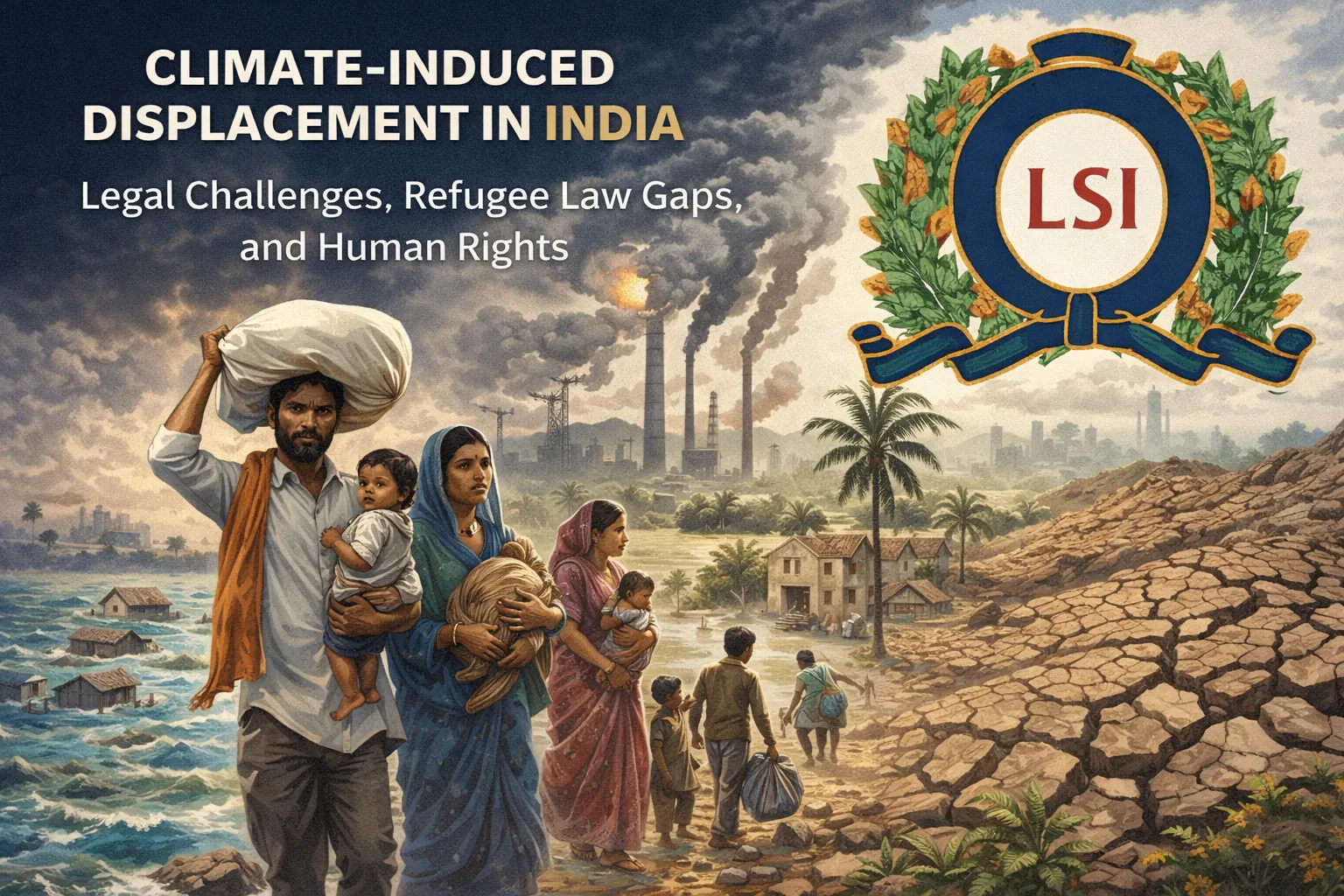
Climate change has emerged as a significant driver of human mobility across the globe. Rising sea levels, recurring floods, prolonged droughts, and ecological degradation have increasingly compelled populations to relocate, often under conditions of compulsion rather than choice. Despite the growing scale of such movement, persons displaced due to climate-related factors continue to occupy an uncertain position within existing legal frameworks. The absence of formal recognition results in a persistent protection gap, leaving affected individuals without enforceable rights or long-term safeguards.
India, given its geographic diversity and socio-economic vulnerability, witnesses substantial internal displacement linked to climate variability and environmental stress. Yet, Indian law has not conceptualised climate-induced displacement as a rights-based concern. This article examines the conceptual ambiguity surrounding climate displacement, the limitations of international legal regimes, and the inadequacy of domestic responses, while exploring the potential role of constitutional adjudication and judicial precedent in addressing this emerging challenge.
Conceptual Challenges Surrounding the Term “Climate Refugee”
The expression “climate refugee” is frequently employed in academic and policy discourse to describe individuals displaced due to environmental or climatic factors. However, as analysed by the European Parliamentary Research Service in The Concept of ‘Climate Refugee’: Towards a Possible Definition, the term lacks legal validity under international law. Its usage presents conceptual difficulties because it draws upon an established legal category that is narrowly defined and context-specific.
Limitations Under the 1951 Refugee Convention
Under the 1951 Refugee Convention, refugee status is contingent upon a well-founded fear of persecution on specific grounds such as race, religion, nationality, political opinion, or membership of a particular social group. Climate-related harm does not ordinarily meet this threshold, as environmental processes are non-discriminatory and generally not attributable to deliberate state action. Consequently, individuals displaced by climate-related factors fall outside the scope of conventional refugee protection.
Key Reasons for Exclusion From Refugee Protection
- Refugee status requires persecution linked to specific protected grounds.
- Environmental and climatic processes are typically non-discriminatory in nature.
- Climate-related harm is generally not attributable to intentional state action.
- Existing international refugee law is narrowly defined and context-specific.
Absence of Binding International Legal Obligations
At present, climate-induced displacement does not give rise to enforceable obligations under international refugee law or customary international law.
As explained by :contentReference[oaicite:0]{index=0} in International Law, binding international obligations typically arise through treaties, established custom, or general principles recognised by states.
In the absence of a specific treaty or settled customary norm addressing climate displacement, states retain wide discretion over migration control and admission policies.
Limited Scope of Human Rights Protection
- Although international human rights instruments provide limited safeguards such as protection against arbitrary deprivation of life or inhuman treatment, they do not establish a comprehensive protection regime comparable to refugee law.
- Human rights law may, in exceptional cases, restrict expulsion, but it does not impose a general obligation upon states to admit or permanently protect displaced persons.
- As a result, climate-displaced populations remain dependent on discretionary and temporary humanitarian responses rather than legally enforceable entitlements.
Limitations of Recognising Refugee Status for Climate Displacement
The :contentReference[oaicite:1]{index=1}, in its Outlook on Migration, Environment and Climate Change, highlights that climate-related migration is rarely attributable to a single causal factor.
Environmental stress often interacts with economic vulnerability, social inequality, and governance failures, making it difficult to isolate climate change as the sole driver of displacement.
This complexity challenges the feasibility of incorporating climate displacement within a rigid refugee framework.
Policy Initiatives and Alternative Approaches
Initiatives such as the :contentReference[oaicite:2]{index=2} have similarly concluded that the creation of a new refugee category would be politically contentious and practically ineffective.
- Instead, they advocate flexible policy mechanisms such as temporary protection.
- They support planned relocation.
- They promote migration management strategies.
Importantly, an exclusive refugee-based approach may inadvertently exclude individuals displaced by intersecting environmental and socio-economic factors, thereby narrowing rather than expanding protection.
Climate-Induced Displacement as a Human Rights Concern
Scientific and policy bodies increasingly acknowledge the broader human rights implications of climate-induced displacement. The Intergovernmental Panel on Climate Change has observed that climate-related displacement exacerbates food insecurity, resource competition, and social instability, disproportionately affecting marginalised populations.
In many instances, such displacement results in long-term or permanent loss of habitat and livelihood. Despite this recognition, international and regional policy frameworks have stopped short of translating vulnerability into binding legal obligations.
International And Regional Policy Gaps
For instance, the European Union’s New Pact on Migration and Asylum recognises climate change as a contributing factor to migration but does not treat it as an independent basis for protection. This reflects a broader reluctance among states to formalise climate vulnerability within rights-based legal regimes.
Key Observations By Scientific And Policy Bodies
- Climate-related displacement exacerbates food insecurity.
- Climate-related displacement intensifies resource competition.
- Climate-related displacement contributes to social instability.
- Marginalised populations are disproportionately affected.
Indian Legal Framework: A Fragmented Response
India lacks a dedicated legal framework addressing climate-induced displacement. Existing mechanisms operate in a fragmented manner through disaster management and environmental regulation.
Disaster Management Act, 2005: Limited Scope
The Disaster Management Act, 2005 focuses primarily on emergency relief and short-term rehabilitation, without recognising displacement as a continuing rights-based issue.
Environmental Regulation And The National Green Tribunal
Similarly, environmental statutes and the jurisprudence of the National Green Tribunal concentrate on ecological harm rather than the human consequences of displacement.
Constitutional Interpretation Under Article 21
Although Indian courts have expanded the scope of Article 21 of the Constitution to include the right to livelihood, shelter, and a healthy environment, climate-induced displacement has not yet been addressed as an independent constitutional concern.
Consequently, affected populations remain reliant on administrative discretion rather than enforceable legal guarantees.
Comparative Legal And Policy Overview
| Legal Or Policy Framework | Approach To Climate-Induced Displacement |
|---|---|
| Intergovernmental Panel on Climate Change | Observes that climate-related displacement exacerbates food insecurity, resource competition, and social instability, disproportionately affecting marginalised populations. |
| European Union’s New Pact on Migration and Asylum | Recognises climate change as a contributing factor to migration but does not treat it as an independent basis for protection. |
| Disaster Management Act, 2005 (India) | Focuses primarily on emergency relief and short-term rehabilitation, without recognising displacement as a continuing rights-based issue. |
| Indian Constitutional Jurisprudence (Article 21) | Includes the right to livelihood, shelter, and a healthy environment, but climate-induced displacement has not yet been addressed as an independent constitutional concern. |
Constitutional Jurisprudence on Displacement and Environmental Harm
Indian constitutional jurisprudence has consistently interpreted Article 21 in an expansive manner to protect human dignity, livelihood, shelter, and environmental well-being.
Article 21 and the Right to Livelihood
In Olga Tellis v. Bombay Municipal Corporation (1985), the Supreme Court recognised the right to livelihood as an essential component of the right to life, noting that deprivation of livelihood effectively undermines the ability to live with dignity. This reasoning assumes particular relevance where climate-related events compel communities to abandon their homes and sources of subsistence.
Right to Shelter and a Habitable Environment
Similarly, in Chameli Singh v. State of Uttar Pradesh (1996), the Court affirmed that the right to shelter under Article 21 extends beyond physical accommodation to include a secure and habitable living environment. Climate-induced loss of housing due to floods, coastal erosion, or desertification directly impairs this constitutional guarantee.
Environmental Protection as a Facet of the Right to Life
The Court has also recognised the right to a clean and healthy environment as intrinsic to the right to life. In Subhash Kumar v. State of Bihar (1991), environmental pollution affecting quality of life was held to violate Article 21, thereby imposing a duty upon the State to prevent environmental harm.
Further, in Municipal Council, Ratlam v. Vardichan (1980), the Court emphasised that constitutional and statutory obligations cannot be evaded on grounds of administrative or financial incapacity when human dignity is at stake.
Collective Constitutional Foundation
Collectively, these judgments provide a constitutional foundation for recognising climate-induced displacement as engaging Article 21.
Judicial Development, Stare Decisis, and Possible Solutions
In the absence of comprehensive legislation, judicial intervention offers a viable pathway for addressing climate-induced displacement. The doctrine of stare decisis enables courts to develop constitutional principles incrementally through precedent.
Indian courts have historically relied on this doctrine to expand the content of Article 21 in response to evolving social and environmental realities.
State Obligations and a Rights-Based Framework
By recognising climate-induced displacement as a violation of the right to life and dignity, courts could articulate state obligations relating to rehabilitation, resettlement, and livelihood security.
Once established through judicial decisions, these principles would acquire normative force through precedent, gradually shaping a coherent rights-based framework in the absence of legislative action.
Conclusion
Climate-induced displacement exposes a significant legal and policy vacuum at the intersection of environmental protection, human rights, and migration governance.
Existing international refugee law is ill-equipped to address this phenomenon, while India’s domestic response remains fragmented and relief-centric.
A rights-based approach grounded in constitutional principles, supported by judicial innovation and reinforced through stare decisis, offers a pragmatic and legally sound pathway to ensure that environmental protection does not come at the cost of human dignity.
References
- European Parliamentary Research Service, The Concept of ‘Climate Refugee’.
- International Organization for Migration, Outlook on Migration, Environment and Climate Change.
- Malcolm N. Shaw, International Law.
- Intergovernmental Panel on Climate Change, Assessment Reports.
- Olga Tellis v. Bombay Municipal Corporation (1985) 3 SCC 545.
- Chameli Singh v. State of Uttar Pradesh (1996) 2 SCC 549.
- Subhash Kumar v. State of Bihar (1991) 1 SCC 598.
- Municipal Council, Ratlam v. Vardichan (1980) 4 SCC 162.
Written By: Mahek Saraf, 5th Year, B.A. LL.B., ILS Law College, Pune
