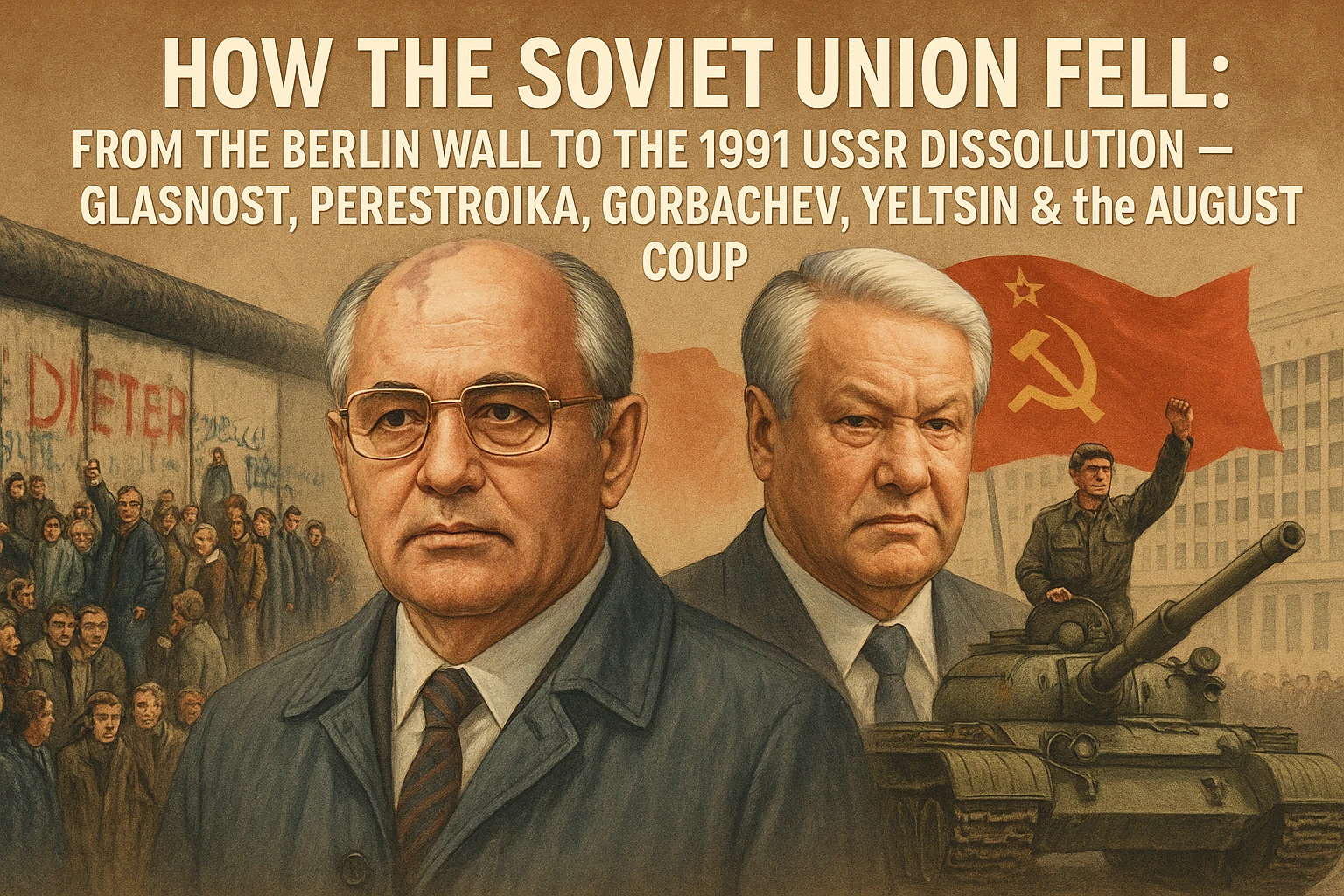
How the Soviet Union Fell: From the Berlin Wall to the 1991 USSR Dissolution — Glasnost, Perestroika, Gorbachev, Yeltsin & the August Coup
November 1989 feels like one of those historical hinge moments — a day when a world people had lived under for decades suddenly began to tilt. Crowds of Berliners clambering across broken sections of the Wall became the image everybody remembers: a literal breach in the Iron Curtain and a symbolic punctuation mark on the Cold War. But history rarely moves in single, clean strokes. Between that night in Berlin and the Soviet Union’s dissolution two years later, a chain of meetings, reforms, blunders and brave acts stacked like dominos — and then tumbled.
This is a compact retelling of that rapid collapse: where reform met resistance, how a cautious leader opened a Pandora’s box, and how events both planned and improvised finished what decades of pressure had begun.
From opening a window to opening a wound
When Mikhail Gorbachev rose to the top of the Soviet system in 1985 he brought two slogans that sounded revolutionary inside an authoritarian system: glasnost (openness) and perestroika (restructuring). They promised more freedom of speech and the slow remaking of the Soviet economy and institutions. Those were seismic ideas inside a polity built on secrecy and top-down control. The immediate effect: people suddenly could say things they had only whispered, and once the whispers became speech it was impossible to put the genie back in the bottle.
At first the changes were hopeful. Censorship eased, arbitrary arrests declined, and debates moved from the margins into public forums. But openness without economic stability proved perilous. Price liberalizations and half-measures in economic reform led to shortages, runaway inflation in some sectors, unpaid wages and pensions, and a rapid erosion of ordinary people’s daily comforts. The moral authority of the central government weakened just as popular expectations rose.
A stormy summit and a new tone
In early December 1989 — famously under rough seas off Malta — Gorbachev met George H. W. Bush. The images were odd: two leaders, seasick and awkward, exchanging a new diplomatic script. For the superpowers, the Malta meeting symbolized the end of the Cold War rhetoric that had dominated international life for forty years. Bush’s public line — that the Soviet Union was “no longer our enemy” — and the handshake that followed helped change the geopolitical commonsense. The superpower rivalry was not erased overnight, but it became politically and morally harder to sustain.
This shift in tone mattered for the Soviet Union at home. Gorbachev’s bid to cut the arms race and redirect resources toward reform depended, in part, on establishing new relations with the West. But promises and meetings could not compensate for collapsing internal revenue, eroding public services, or the political pushback from conservative guardians of the old system.
The Baltic spark and the contagion of independence
The liberation of satellite states and the reawakening of suppressed national identities proved contagious. In Lithuania, Latvia and Estonia bold pushes for independence captured imaginations and hearts. Gorbachev’s trip to Vilnius to gauge sentiment — and the unanimous replies he reportedly received — revealed a truth he could not easily reconcile with the Soviet constitutional order: republics wanted to decide their own fate.
When Lithuanian leaders declared independence, the move became a test case. The Kremlin’s hesitation, its legalistic responses and the use of force in places produced tragic and galvanizing consequences: deaths in the Baltic capitals outraged domestic publics and Western opinion alike. Each clampdown pushed more people toward the conclusion that the old structures were breaking and, increasingly, that they were illegitimate.
Economics: the emergency that never came
Gorbachev’s political project depended on economic success. He and his reformers floated ambitious timetables — even a famed “500-day” plan proposed by some to democratize and liberalize fast — but transforming a centrally planned economy into a market one is immensely difficult. Partial liberalization without market institutions produced empty shelves, wild currency rates on the black market, and social dislocation. The ruble’s fall, unpaid wages and the appearance of visible poverty shattered the imagined social contract and undermined the reformers’ credibility.
Internationally, Western leaders debated whether to prop up Gorbachev with large financial packages. Offers fell short of the scale that might have steadying effects, and political calculations about post-Soviet arrangements made Western capitals hedge their bets — sometimes in ways that empowered domestic opponents of Gorbachev.
The August coup: the regime’s last throw
By August 1991 a small circle of hardline apparatchiks, alarmed at the prospect of a treaty that would turn the USSR into a looser federation of sovereign republics, tried to seize power. They announced Gorbachev’s incapacity, imposed curfews and declared a state of emergency. Tanks rolled into Moscow.
What saved the day was a mix of miscalculation by the coup plotters and extraordinary public courage. Boris Yeltsin — newly elected president of the Russian republic — climbed onto a tank in front of the Russian White House and called for resistance. Crowds converged. Soldiers, many of them young conscripts, hesitated. For the first time in Soviet history, ordinary citizens confronted military force and compelled it to stand down. The coup collapsed in a matter of days, but the result was not a restoration of Gorbachev’s authority: his position was fatally weakened, while republic-level leaders gained momentum.
The final unraveling
After the failed coup the political center dissolved further. Republics declared independence, and shadow negotiations and secret pacts reshaped politics faster than any formal treaty could. In December 1991 — through the agreements signed by Russia, Ukraine and Belarus — the leaders effectively declared the Soviet Union’s end and created a loose Commonwealth of Independent States. On 25 December 1991, Mikhail Gorbachev resigned; the hammer and sickle flag was lowered from the Kremlin for the last time. The Soviet Union, which had endured two world wars, revolution and a century of global contention, ceased to exist as a single sovereign entity.
Legacy: courage, error, and the weight of transitions
History rarely frames heroes and villains in simple terms. Gorbachev opened space for speech and dismantled a global antagonism that had cost billions and millions of lives. Yet his reforms were uneven; economic missteps and political caution at key moments left him vulnerable. Yeltsin’s boldness sealed his own rise but also ushered in a tumultuous, often brutal, market transition for Russia. For millions across the former USSR, the end of communism meant liberation — for others it meant chaos, uncertainty and suffering.
What 1989–1991 teaches us is less a tidy moral than a lesson in complexity: opening authoritarian systems can unleash emancipatory energies that cannot be perfectly controlled; the pace of reform matters; and international promises and domestic politics are easily mismatched. The collapse of the Soviet Union was the product of ideas, institutions, personalities and accidents. Its reverberations continue to shape geopolitics, economics and collective memory to this day.