





Access to Justice: An Unequal Reality
Access to justice is often described as the backbone of a democratic society, yet in reality, this access is not always equal for everyone. Many people in India—especially in rural areas, tribal regions, crowded urban slums, and underprivileged communities—continue to face difficulties in approaching the formal court system.
Court procedures are complicated, cases drag on for years, lawyers’ fees are expensive, and navigating the justice system requires knowledge that most ordinary people simply do not possess. For them, walking into a court can feel intimidating, confusing, and financially burdensome.
In such a situation, alternative methods of dispute resolution become extremely important. Among these, community mediation and Lok Adalats stand out as two of the most effective grassroots mechanisms that bring justice closer to the people and make it more accessible, affordable, and humane.
Community Mediation: The Core Idea
Community mediation is based on the simple idea that disagreements and conflicts can be resolved through conversation and mutual understanding rather than through aggressive litigation. This method encourages disputing parties to sit together, speak openly, listen to each other’s concerns, and try to find a solution that works for both sides.
Instead of a judge deciding who wins or who loses, the mediator helps the parties reach a voluntary agreement. This makes mediation a more peaceful and relationship-friendly method of dispute resolution.
In many Indian families, villages, and communities, informal forms of mediation have existed for centuries—elders or respected individuals were often asked to settle disputes. Modern community mediation builds on this traditional idea but adds neutrality, fairness, and trained mediators to make the process more reliable.
Traditional Roots and Modern Structure
- Historically practiced through elders and respected community members
- Modern mediation introduces neutrality and fairness
- Use of trained mediators to ensure reliability
A Safe and Familiar Environment
One of the biggest strengths of community mediation is that it takes place in a familiar environment. People feel safe and comfortable expressing themselves openly, especially when the process is held in their own community, in their own language, and without the formality of a courtroom.
For women, elderly people, persons with disabilities, migrant workers, and other vulnerable groups, courts may seem frightening. Mediation provides a friendly space where they feel heard and respected. This allows them to participate more confidently.
Disputes Where Mediation Is Most Effective
- Family disputes
- Neighbourhood conflicts
- Landlord and tenant issues
- Disputes involving farmers
- Small business disagreements
- Local commercial transactions
In such cases, maintaining long-term relationships is more important than securing a legal victory. Courts often damage relationships because the outcome favours one party and blames the other. Mediation, on the other hand, allows both sides to walk away with dignity and harmony restored.
Cost and Speed: Key Advantages
Cost and speed are two other major advantages. Litigation can be painfully slow in India; cases sometimes remain pending for decades. Legal fees, documentation charges, transport expenses, and repeated hearings add to the burden.
Community mediation avoids all these hurdles. Most mediation sessions are free or very low cost. The process is quick, informal, and often completed in one or two meetings. This makes mediation accessible to people who cannot afford long legal battles but still want justice.
Litigation Versus Community Mediation
| Aspect | Litigation | Community Mediation |
|---|---|---|
| Cost | Expensive | Free or very low cost |
| Time | Years or decades | One or two meetings |
| Environment | Formal and intimidating | Familiar and friendly |
| Outcome | Win–lose | Mutual agreement |
Challenges and Necessary Safeguards
Despite these strengths, community mediation is not without challenges. Trained mediators are essential because an unskilled or biased mediator can unintentionally favour one party, especially if the other party is socially weaker or economically dependent.
Gender-based disputes, for example, require mediators who are sensitive to the power imbalance between men and women. Similarly, caste-based or community-based conflicts need mediators who can ensure fairness despite social hierarchies.
Without proper training and guidelines, mediation can sometimes result in pressured settlements that do not reflect true consent. Therefore, for mediation to succeed, the system must ensure neutrality, confidentiality, and voluntary participation.
Lok Adalats As A Formal System Of Alternative Dispute Resolution
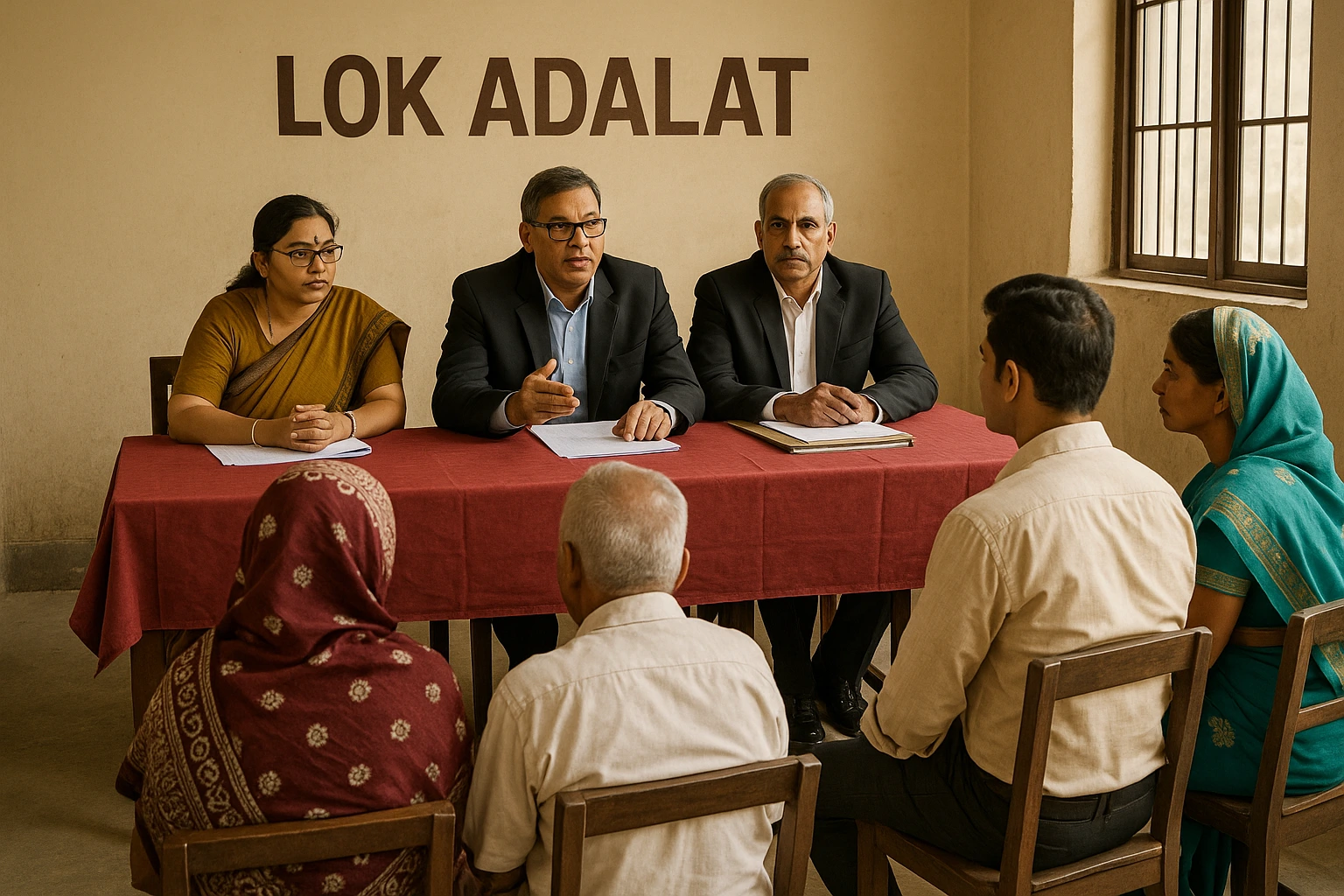
While community mediation develops informally and socially, India has also built a strong formal system of alternative dispute resolution through the Lok Adalats. Lok Adalat, which means “People’s Court,” was developed to provide a simple and speedy platform where legal disputes can be settled without the long wait of court trials. Lok Adalats operate under the Legal Services Authorities Act, which aims to provide legal assistance to weaker sections of society. These forums encourage compromise and settlement rather than adversarial judgment. If both parties reach an agreement, the decision is final, binding, and has the same effect as a decree passed by a civil court.
Types Of Cases Handled By Lok Adalats
Lok Adalats deal with a wide variety of cases such as motor accident compensation claims, cheque bounce cases, bank loan recovery matters, family disputes, labour disputes, electricity bill settlements, pension and service matters, and some criminal matters that are allowed to be compromised. Many of these cases involve people who cannot afford long court delays, and quick resolution is far more beneficial for them.
| Category | Examples Of Cases |
|---|---|
| Civil And Financial Matters | Motor accident compensation claims, cheque bounce cases, bank loan recovery matters |
| Family And Labour Disputes | Family disputes, labour disputes |
| Public Utility And Service Matters | Electricity bill settlements, pension and service matters |
| Compounding Criminal Matters | Some criminal matters that are allowed to be compromised |
National Lok Adalats And Mass Disposal Of Cases
Lok Adalats are often organized in large drives across the country, known as National Lok Adalats, where lakhs of cases are disposed of in a single day. This not only brings relief to the parties but also reduces the burden on courts.
Environment And Procedure In Lok Adalats
The atmosphere in a Lok Adalat is different from a court. Instead of strict laws and formal procedures, the focus is on discussion, compromise, and fairness. Lawyers and judges act more like facilitators. They guide the parties toward understanding each other’s position and exploring possible settlement options.
- Emphasis on discussion, compromise, and fairness
- Lawyers and judges function as facilitators rather than adversaries
- Informal and approachable setting for litigants
Accessibility, Affordability, And Finality
For many litigants, especially those from rural or low-income backgrounds, this informal environment is less intimidating and more approachable. The absence of court fees also makes the process affordable. Once a settlement is reached, no appeal is allowed, which prevents further delay and ensures finality.
Concerns Related to Lok Adalats
However, Lok Adalats too have certain concerns. Sometimes, government agencies or private institutions may push for settlement to reduce financial liability or close pending cases. This may create pressure on the weaker party to accept a compromise even if they deserve a better outcome in court. Also, because Lok Adalats focus mainly on settlement, complex legal issues may not get full attention. Some critics worry that the desire to dispose of cases quickly might overshadow the need for justice in individual cases.
Therefore, it is important that Lok Adalats maintain balance—promoting settlement while ensuring fairness and respect for legal rights.
Role in Enhancing Access to Justice
Despite these challenges, community mediation and Lok Adalats play a vital role in enhancing access to justice in India. They remove barriers like cost, distance, fear, and procedural complexity. People get solutions faster, and disputes do not drag on unnecessarily.
- These systems also reduce pressure on courts, allowing judges to focus on serious criminal cases, constitutional matters, and issues that truly require judicial examination.
- Moreover, they promote a culture of peaceful dispute resolution, reducing social tension and strengthening community bonds.
Improvements Needed to Strengthen Grassroots ADR Mechanisms
Expanding Legal Awareness
To strengthen these grassroots ADR mechanisms further, several improvements are needed. First, legal awareness must be expanded. Many people are unaware of mediation centres, legal aid clinics, and Lok Adalat procedures.
Government agencies, NGOs, law colleges, and local institutions should organize awareness camps, especially in rural and tribal areas, to educate people about their options.
Improving Mediator Training Programs
Second, mediator training programs must be improved.
- Mediators should be taught communication skills.
- They should be trained in conflict management techniques.
- They should develop an understanding of human psychology.
- They should be sensitive to gender and caste issues.
- They should learn how to handle power imbalance and ensure that both parties participate freely.
Connecting ADR with Legal Aid Services
Third, community mediation and Lok Adalats should be closely connected to legal aid services. Parties must have the opportunity to consult legal aid lawyers to understand their rights before they agree to a settlement. This prevents exploitation and ensures that settlements are fair.
Use of Technology to Improve Accessibility
Fourth, technology can be used to make ADR more accessible.
- Online mediation platforms
- Digital Lok Adalat hearings
- Video conferencing facilities
- Mobile Lok Adalats
- Tele-legal services
These can help reach people who cannot travel to cities or district headquarters. During the COVID-19 pandemic, online dispute resolution proved extremely useful, and this practice can be expanded further.
Identifying Disputes Suitable for ADR
It is also important to clearly identify which disputes are suitable for ADR. Not all matters should be mediated or settled in Lok Adalats.
| Disputes Not Suitable for ADR | Reason for Formal Court Handling |
|---|---|
| Serious criminal offences | Require strict judicial scrutiny and punishment |
| Domestic violence cases | Involve protection of victims and statutory safeguards |
| Sexual offences | Cannot be compromised or settled |
| Complex property disputes | Involve intricate legal and factual questions |
| Constitutional matters | Require authoritative judicial interpretation |
Mediation and settlement should never be used to silence a victim or bypass legal rights that protect vulnerable groups. Screening committees and legal services authorities must carefully evaluate each case before sending it to ADR.
Humanizing Justice Through Grassroots ADR
What makes grassroots ADR powerful is its ability to humanize justice. Instead of rigid procedures, parties experience empathy, dialogue, and understanding. Instead of long trials, they get solutions that are practical and tailored to their needs. Instead of hostility, they receive opportunities for reconciliation. This not only solves the immediate problem but also builds trust in the justice system.
Advancing Constitutional Values and Social Justice
In a broader sense, strengthening community mediation and Lok Adalats supports the constitutional promise of equality, fairness, and social justice. It ensures that justice does not remain confined to the wealthy or educated. It empowers communities to resolve conflicts peacefully and responsibly.
- It reduces violence
- It prevents disputes from escalating
- It encourages social harmony
- It makes the justice system more efficient, approachable, and responsive to ordinary people
Community Mediation and Lok Adalats as Pillars of Justice
Community mediation and Lok Adalats are essential pillars of a people-centered justice system. They offer speed, affordability, convenience, dignity, and accessibility—qualities that are often missing in formal courts.
Addressing Challenges and Strengthening ADR Mechanisms
While challenges remain, they can be addressed through better training, clear guidelines, legal awareness, technology, and strong institutional support.
Toward a More Inclusive and Humane Justice System
As India continues to struggle with court delays and rising litigation, grassroots ADR mechanisms provide a hopeful path toward a more inclusive and humane justice system. If strengthened properly, they have the potential to transform how justice is delivered and ensure that every citizen—regardless of wealth, caste, gender, or geography—can claim their right to fair and timely resolution of disputes.

