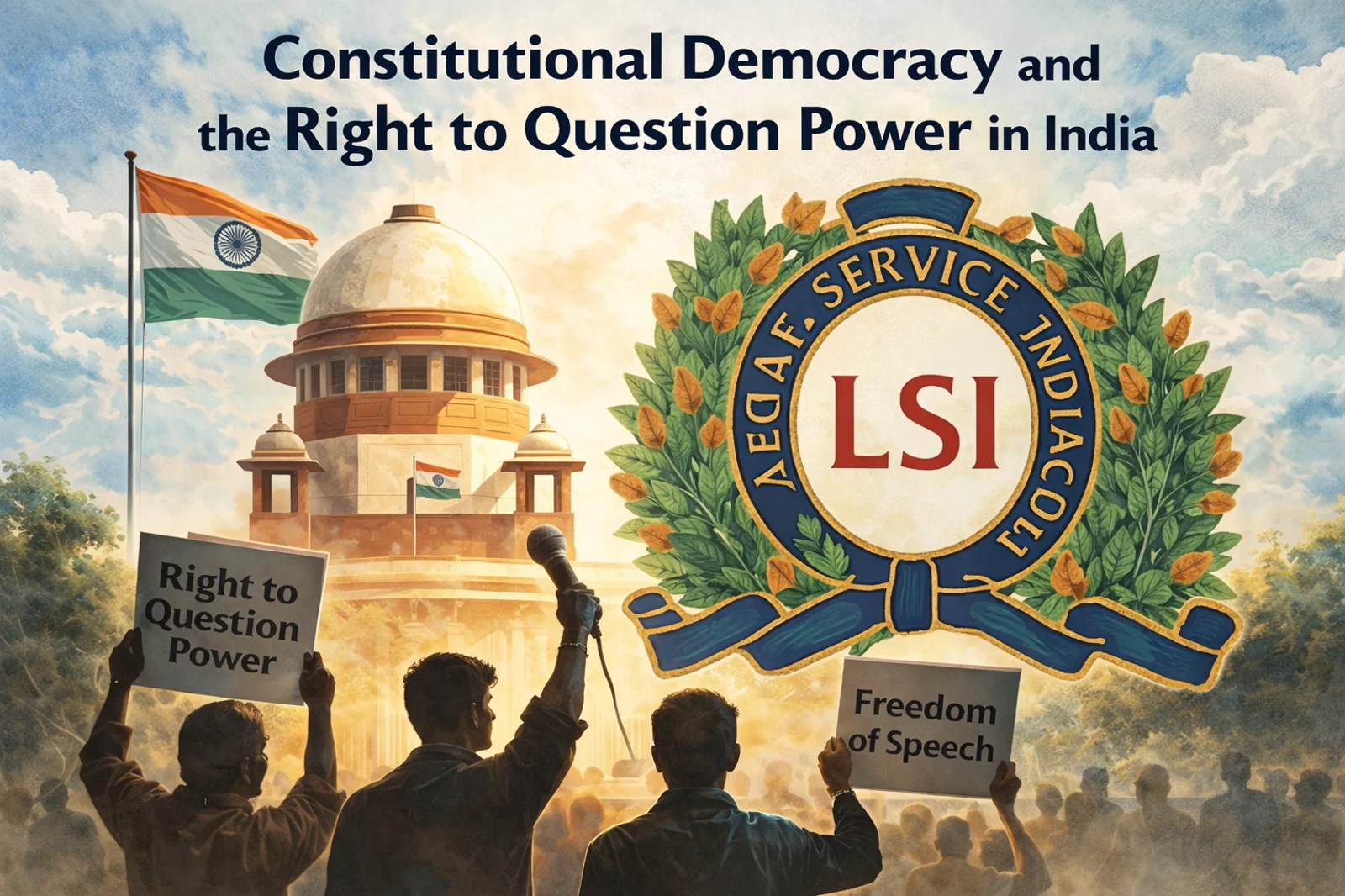
Constitutional Democracy And The Right To Question Power
In a constitutional democracy, the right to question those in power is not a concession—it is a right. Recent Supreme Court observations and rulings have once again brought this principle to the forefront, reaffirming that criticism of government policy, including criticism expressed in online spaces, cannot be criminalised unless it amounts to incitement of violence or has a direct tendency to cause public disorder.
While there may not yet be a single, formally reported 2025 judgment with a standalone citation capturing this proposition in one sentence, the position of law is firmly settled through a consistent line of authoritative decisions of the Supreme Court of India, now being reaffirmed and applied to the digital age.
Constitutional Foundation: Article 19 And Its Limits
Article 19(1)(a) of the Constitution guarantees freedom of speech and expression. Article 19(2) permits reasonable restrictions only on specific grounds such as public order, sovereignty, security of the State, and incitement to an offence.
Scope Of Judicial Interpretation
The Supreme Court has repeatedly clarified that mere criticism, dissent, satire, or disapproval of government policy does not fall within these exceptions. The State must demonstrate a clear, proximate, and direct link between the speech and incitement to violence or public disorder.
Summary Of Article 19 Framework
| Provision | Core Principle |
|---|---|
| Article 19(1)(a) | Guarantees freedom of speech and expression |
| Article 19(2) | Allows reasonable restrictions only on limited grounds such as public order, sovereignty, security of the State, and incitement to an offence |
Key Judicial Requirement
- Mere criticism or dissent is constitutionally protected
- Restrictions must fall strictly within Article 19(2)
- A clear, proximate, and direct nexus with violence or public disorder is mandatory
The Leading Authorities That Shape the Law
1. Vinod Dua v. Union of India (2021)
This decision stands as one of the most emphatic reaffirmations of free speech in recent times. The Supreme Court quashed an FIR alleging sedition against senior journalist Vinod Dua for criticising the Union Government’s handling of the COVID-19 pandemic.
Key Holding
The Court held that every journalist and citizen has the right to criticise government actions, and such criticism does not constitute sedition or any criminal offence unless it incites violence or tends to create public disorder.
The judgment expressly relied on earlier constitutional principles and clarified that:
- Disagreement with State policy is not anti-national.
- Harsh or unpopular criticism is constitutionally protected.
- Criminal law cannot be used to silence dissent.
2. Shreya Singhal v. Union of India, AIR 2015 SC 1523
This landmark Constitution Bench judgment struck down Section 66A of the Information Technology Act, 2000, which criminalised online speech for being “offensive” or “menacing”.
Key Holding
The Court ruled that online speech enjoys the same constitutional protection as offline speech, and vague or subjective standards cannot justify criminal sanctions.
The Bench introduced a crucial constitutional test:
- Only speech that amounts to incitement or has a tendency to create imminent public disorder can be restricted.
- Mere annoyance, inconvenience, or criticism—even if strongly worded—cannot be penalised.
This judgment remains the cornerstone for all cases involving online expression and social media speech.
The Contemporary Trend: 2024–2025 Developments
In recent hearings and interim orders during 2024–2025, the Supreme Court has continued to apply and reinforce these principles in cases involving online speech, political commentary, and allegations of hate or offensive expression. Matters such as:
- Wazahat Khan v. Union of India
- SMA Cure Foundation v. Union of India
- Ranveer Allahabadia v. Union of India
- Hemant Malviya v. State of Madhya Pradesh
- Ali Khan Mahmudabad v. State of Haryana
have all seen the Court emphasise constitutional proportionality, the chilling effect of criminal law, and the necessity of a high threshold before speech can be prosecuted.
Although some of these matters are pending final adjudication or detailed reported judgments, the judicial tone is unmistakable: criminal law cannot be deployed as a shortcut to suppress inconvenient speech, particularly in digital spaces.
Online Platforms Are Not Constitution-Free Zones
A crucial aspect of the Supreme Court’s evolving jurisprudence is the recognition that:
- Social media platforms are today’s public square.
- Democratic dialogue increasingly occurs online.
- The reach of digital speech does not dilute constitutional protection.
The Court has consistently warned against the “chilling effect” caused when citizens fear arrest or prosecution for expressing political opinions online.
Constitutional Recognition of Digital Speech
| Key Aspect | Judicial Emphasis |
|---|---|
| Nature of Social Media | Recognised as the modern public square |
| Democratic Participation | Increasingly conducted in online spaces |
| Scope of Free Speech | Unaffected by the digital reach of expression |
| Chilling Effect | Fear of arrest undermines democratic discourse |
Incitement Remains the Constitutional Red Line
Importantly, the Supreme Court has not created absolute immunity for speech. The protection ends where:
- Speech explicitly calls for violence, or
- There is a clear and immediate nexus between the expression and public disorder.
The emphasis is on real, proximate danger, not speculative or subjective offence.
Conclusion: Dissent Is the Lifeblood of Democracy
Taken together, Vinod Dua, Shreya Singhal, and the Court’s recent observations form a coherent constitutional message:
- The answer to criticism is debate, not detention; rebuttal, not registration of FIRs.
By reaffirming that criticism of government policy—online or offline—cannot be criminalised without incitement to violence, the Supreme Court continues to act as the guardian of India’s democratic ethos in the digital age.
This jurisprudence is not merely about free speech; it is about preserving the constitutional balance between State power and individual liberty—a balance without which democracy itself would be reduced to silence.