





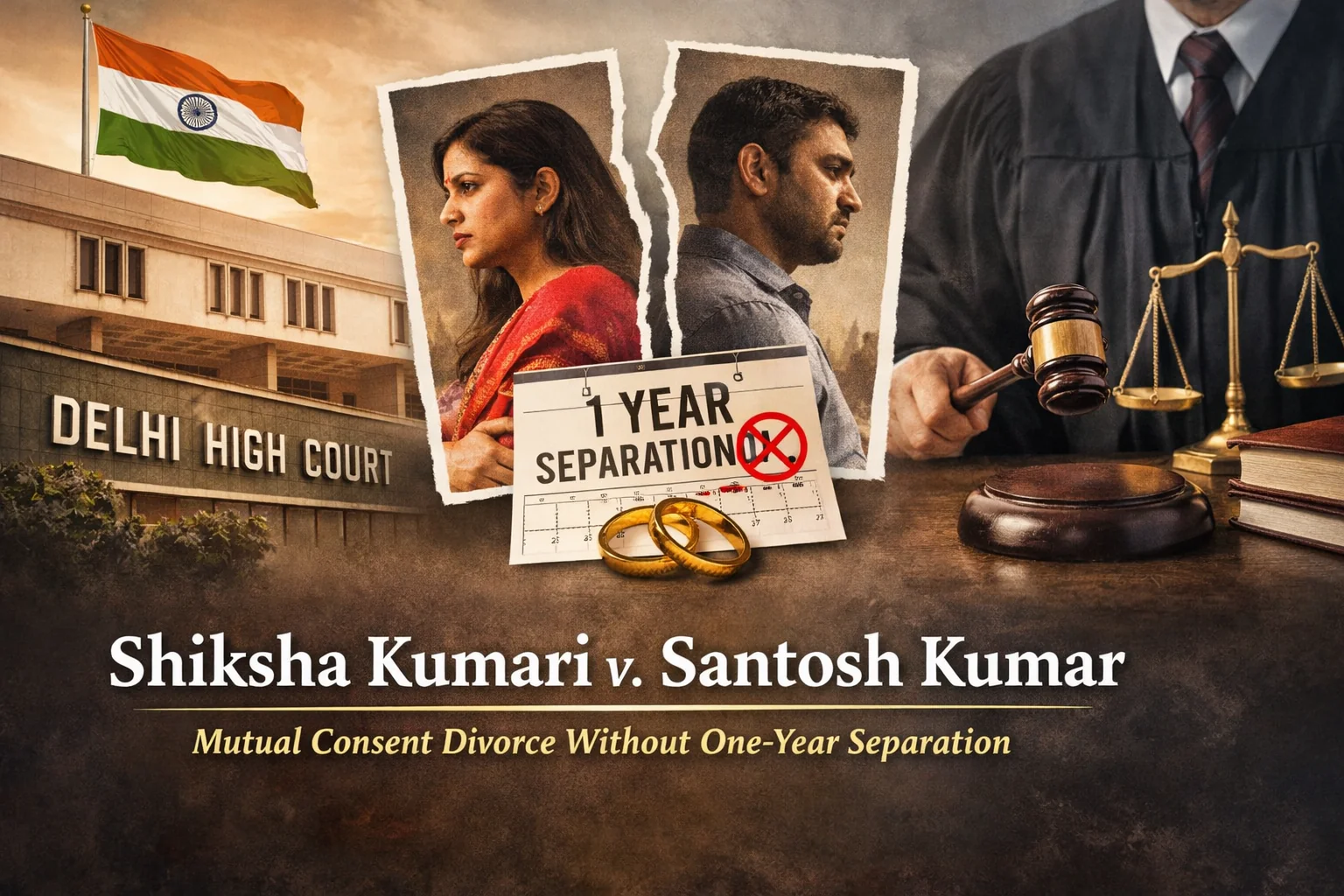
In a landmark judgment reshaping Indian matrimonial jurisprudence, the Delhi High Court has held that the statutory requirement of one-year separation for divorce by mutual consent under Section 13B(1) of the Hindu Marriage Act, 1955 is directory and not mandatory. The ruling reflects a decisive shift from procedural rigidity toward a more humane, realistic, and justice-oriented interpretation of family law.
Case Details
- Case Name: Shiksha Kumari v. Santosh Kumar
- Case Number: MAT.APP.(F.C.) 111/2025
- Court: Delhi High Court
- Bench: Justices Navin Chawla, Anup Jairam Bhambhani, and Renu Bhatnagar
- Date of Judgment: 17 December 2025
Background and Context
The appeal before the Delhi High Court arose from a matrimonial dispute where both spouses sought dissolution of marriage by mutual consent. The central obstacle was the statutory requirement under Section 13B(1) HMA that the parties must have lived separately for at least one year before presenting the first motion for divorce.
Given divergent judicial views on whether this requirement is absolute or flexible, the matter was placed before a Full Bench to authoritatively settle the law.
The Core Legal Issue
The precise legal question before the Court was:
- Whether the requirement of “living separately for one year” under Section 13B(1) of the Hindu Marriage Act is mandatory, or whether courts may waive it in appropriate cases.
Statutory Interpretation: Section 13B Read with Section 14
The Court undertook a purposive reading of Section 13B(1), placing special emphasis on the opening words “subject to the provisions of this Act”. These words, the Bench held, cannot be read in isolation.
When harmoniously interpreted with the proviso to Section 14(1) of the Act—which allows courts to relax statutory time restrictions in cases of exceptional hardship or exceptional depravity— it becomes evident that the legislature never intended rigid timelines to perpetuate human suffering.
Reasoning of the Delhi High Court
The Full Bench held that insisting on a mechanical one-year separation period, even when a marriage has irretrievably broken down, would defeat the very purpose of matrimonial law. In a powerful observation, the Court cautioned that the judiciary must not “thrust unwilling parties into a matrimonial abyss” merely to satisfy a procedural formality.
The Court clarified that:
- The one-year separation requirement is directory, not mandatory
- Courts have discretion to waive it in deserving cases
- The focus must remain on genuine consent and substantive justice
Supporting Supreme Court Precedents
The judgment draws strength from a consistent line of Supreme Court authority that discourages procedural rigidity in matrimonial disputes.
Amardeep Singh v. Harveen Kaur (2017)
The Supreme Court held that the six-month cooling-off period under Section 13B(2) HMA is directory and can be waived where waiting would serve no purpose. The Delhi High Court extended this reasoning logically to the one-year separation requirement under Section 13B(1).
Sureshta Devi v. Om Prakash (1991)
While laying down the foundational elements of mutual consent divorce, the Supreme Court never intended statutory timelines to become instruments of coercion where consent is genuine and continuous.
Shilpa Sailesh v. Varun Sreenivasan (2023)
A Constitution Bench of the Supreme Court recognised irretrievable breakdown of marriage as a valid ground for dissolution, reinforcing judicial discretion even beyond explicit statutory text.
Safeguards and Judicial Discipline
The Delhi High Court was careful to underline that waiver of the one-year requirement is not automatic. Courts must rigorously examine:
- Whether consent is voluntary and informed
- Whether there is any coercion, fraud, or undue influence
- Whether issues of maintenance, alimony, and child custody are fairly settled
This ensures that flexibility does not degenerate into misuse.
Implications for Indian Family Law
The judgment has wide-ranging implications:
- For couples: Relief from prolonged legal limbo in dead marriages
- For courts: Affirmation of discretionary power rooted in equity
- For jurisprudence: Continued movement toward recognising irretrievable breakdown as a guiding principle
Critical Evaluation
This ruling strikes a careful balance between preserving the institution of marriage and respecting individual dignity and autonomy. While concerns of inconsistency across jurisdictions remain, the judgment sets a persuasive benchmark until uniform clarity emerges from the Supreme Court.
Conclusion
The Delhi High Court’s decision in Shiksha Kumari v. Santosh Kumar represents a mature and compassionate evolution of Indian matrimonial law. By declaring the one-year separation requirement under Section 13B(1) as directory, the Court reaffirmed a foundational principle: law must serve human reality, not imprison it.
Read alongside Amardeep Singh and Shilpa Sailesh, this judgment signals a clear judicial trajectory—away from rigid timelines and toward meaningful justice in family law disputes.
Adv. Tapan Choudhury – Mutual Consent Divorce Lawyer (Delhi & NCR)
Planning a Mutual Consent Divorce? Get professional, discreet, and result-oriented legal support for a smooth and dignified separation.
- ✔ Complete Mutual Consent Divorce assistance
- ✔ Documentation, drafting & court representation
- ✔ Fast, lawful & stress-free process
- ✔ Serving Delhi & NCR
25 years experience in Family Law Practice
📞 Call Now: 9650499965
✉️ Email: [email protected]

