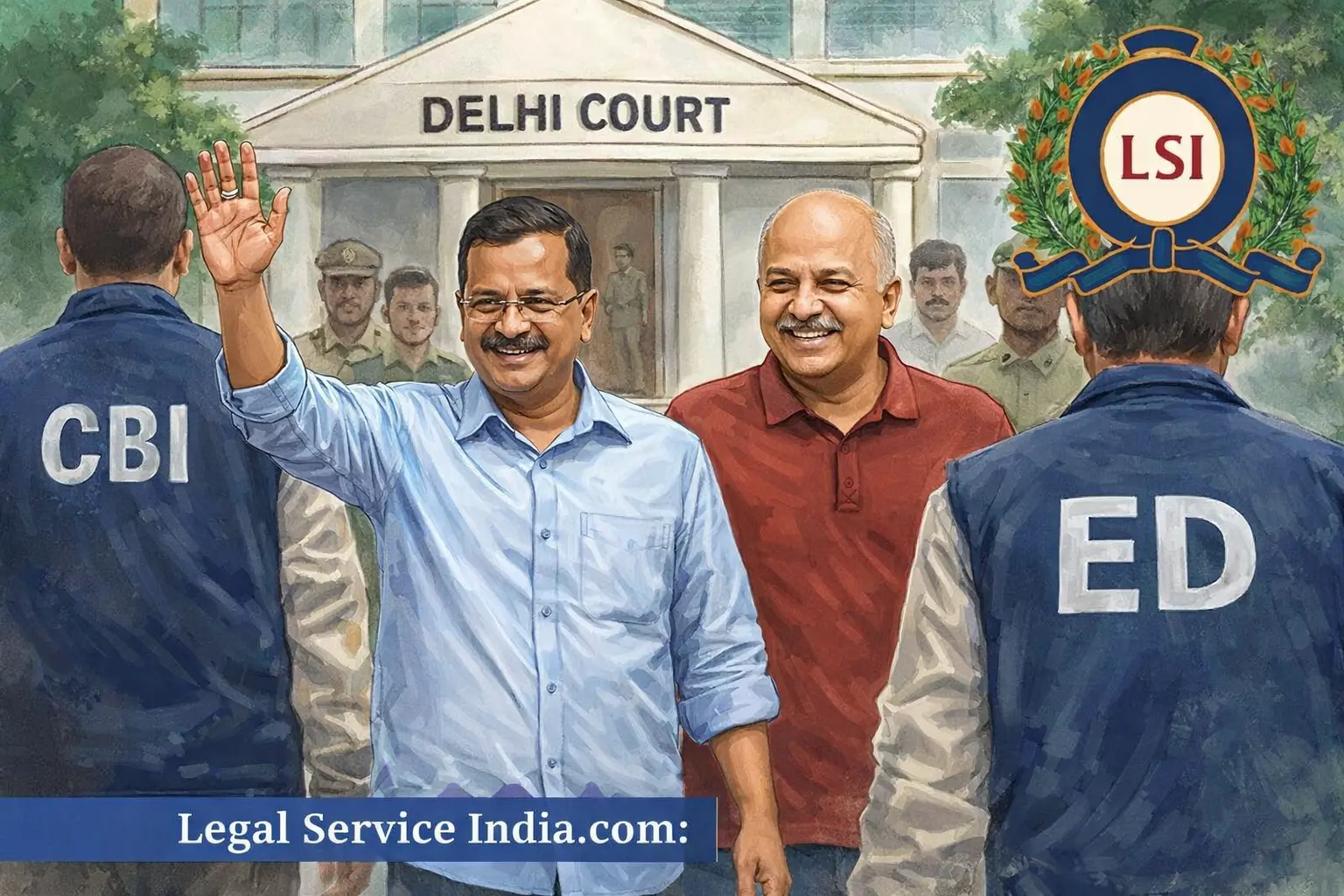
Delhi Liquor Policy Case: Court Discharges All Accused
In a major development in one of the most closely watched criminal investigations in recent years, a Delhi court has discharged all accused persons, including Delhi Chief Minister Arvind Kejriwal and former Deputy Chief Minister Manish Sisodia, in the controversial Delhi liquor policy case.
While granting discharge, the court also made strong observations regarding the investigation conducted by the Central Bureau of Investigation (CBI), pointing out serious lapses in the manner in which the case was built and prosecuted.
The ruling is legally significant because it reinforces fundamental criminal law principles relating to evidence, conspiracy, and the threshold required for framing charges in corruption cases.
Background of the Delhi Excise Policy Controversy
The case originated from allegations surrounding the Delhi Excise Policy 2021–22, introduced by the government led by Arvind Kejriwal. The policy aimed to restructure the liquor trade in the National Capital Territory by encouraging private sector participation and improving revenue generation.
However, political controversy soon followed, with allegations that certain provisions of the policy allegedly favoured select private liquor distributors and licensees. These allegations eventually led to a criminal investigation by the Central Bureau of Investigation.
The agency registered an FIR alleging criminal conspiracy, corruption, and abuse of official position. Among the individuals investigated were senior political leaders, government officials, and private entities allegedly involved in the formulation and implementation of the policy.
Charges and Legal Provisions Invoked
The prosecution sought to proceed against the accused under various provisions of the Prevention of Corruption Act, 1988 and the Indian Penal Code, 1860.
According to the prosecution, irregularities in the formulation of the excise policy were allegedly designed to provide undue advantage to certain private stakeholders, which in turn resulted in financial losses to the public exchequer.
However, the accused argued that the allegations were based on speculation and that policy decisions taken by elected governments cannot automatically be treated as criminal acts.
Major Legal Provisions Referred
| Law | Purpose |
|---|---|
| Prevention of Corruption Act, 1988 | Addresses corruption by public servants and abuse of official position. |
| Indian Penal Code, 1860 | Includes provisions relating to criminal conspiracy, cheating, and abuse of authority. |
Court’s Examination at the Stage of Charge
At the stage of consideration of charge, the trial court is required to examine whether the material placed on record discloses sufficient grounds to proceed with the trial.
After reviewing the evidence submitted by the Central Bureau of Investigation, the court concluded that the prosecution had failed to establish even a prima facie case linking the accused persons to any criminal conspiracy or corrupt activity.
The court emphasised that suspicion, however strong, cannot replace proof when the liberty and reputation of individuals are at stake.
It further noted that policy decisions, even if controversial or later withdrawn, cannot be criminalised unless there is clear evidence of illegal gratification or dishonest intent.
Court Criticises Investigative Lapses
A notable aspect of the judgment was the court’s criticism of the investigation conducted by the Central Bureau of Investigation.
The court reportedly observed several shortcomings in the investigation, including:
- Failure to establish a clear chain of conspiracy
- Absence of direct evidence linking policy changes to illegal financial gain
- Overreliance on assumptions rather than documentary proof
- Insufficient corroboration of witness statements
Such findings highlight the judiciary’s expectation that investigative agencies must meet strict evidentiary standards, especially in high-profile corruption cases.
Legal Principles Reinforced by the Judgment
The decision reiterates several fundamental principles of criminal law:
1. Prima Facie Evidence is Essential
Before framing charges, courts must determine whether credible material exists creating a strong suspicion of guilt.
2. Policy Decisions Cannot Be Criminalised Without Proof
Administrative or policy decisions cannot attract criminal liability unless there is clear evidence of corruption, bribery, or unlawful benefit.
3. Investigative Agencies Must Maintain High Standards
Investigations must be evidence-driven and not based on conjecture or political controversy.
4. Discharge as a Safeguard Against Unnecessary Trial
The discharge stage acts as an important judicial filter preventing individuals from undergoing prolonged criminal trials where evidence is insufficient.
Broader Implications for Criminal Jurisprudence
This decision may have wider implications for future corruption prosecutions involving public policy decisions.
- First, it highlights the judiciary’s role in ensuring that criminal law is not used as a tool to pursue politically sensitive matters without adequate evidence.
- Second, it reinforces the principle that investigative agencies must conduct thorough and legally sustainable investigations before seeking prosecution.
- Third, the judgment serves as a reminder that criminal proceedings must be based on concrete proof rather than speculation or public controversy.
For legal practitioners, the case offers valuable insights into how courts scrutinise evidence at the stage of framing charges in corruption and conspiracy cases.
Legal Assistance in Criminal, Corruption & Investigation Matters
High-profile investigations and criminal prosecutions require careful legal strategy, deep understanding of criminal procedure, and strong courtroom advocacy.
If you or your organisation are facing:
- CBI or police investigations
- Corruption allegations under the Prevention of Corruption Act
- Criminal conspiracy charges
- Economic offences or regulatory investigations
- Anticipatory bail, discharge, or quashing proceedings
professional legal guidance at the earliest stage is crucial to protect your rights and reputation.
Contact for Legal Consultation
Top Lawyers in India – Search by City
Top Lawyers in Northern India
Top Lawyers in Western India
Top Lawyers in Eastern India
Top Lawyers in Southern India
Lawyers from Other Cities
With over two decades of contribution to legal awareness through LegalServiceIndia.com, professional assistance is available for individuals, professionals, and businesses seeking guidance in complex legal disputes and criminal proceedings.
Early legal intervention can often make the decisive difference in protecting liberty, reputation, and legal rights.