- Introduction
In criminal administration, the police perform several functions ranging from maintaining law and order to detecting and investigating crimes. Two terms often used in this context are police investigation and police enquiry. Although they may appear similar in everyday language, in criminal procedure they represent two different stages and levels of scrutiny.
A police investigation is a formal legal process usually conducted after the registration of a First Information Report (FIR), though in certain categories of cases the police may conduct a brief preliminary enquiry to determine whether an FIR should be registered.
Understanding the distinction between these two concepts is important for students of criminal law, police officers, and the general public because it clarifies when legal powers such as arrest, search, and seizure may be exercised and how a criminal case progresses through the justice system.
- Legal Meaning of Investigation
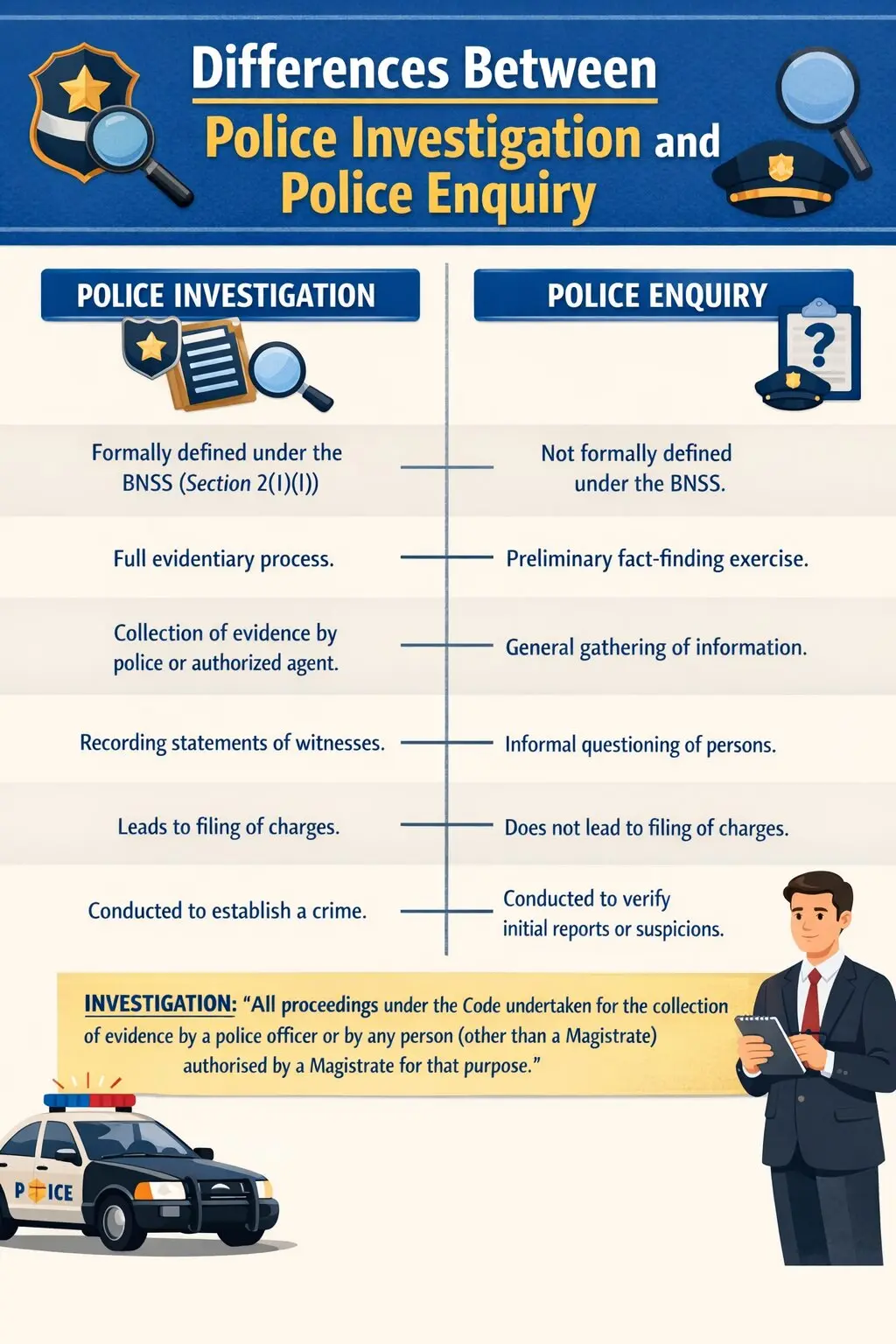
Under the Bharatiya Nagarik Suraksha Sanhita, 2023 (BNSS), investigation is legally defined.
Section 2(1)(l) BNSS defines investigation as:
“Investigation” includes all the proceedings under this Sanhita for the collection of evidence conducted by a police officer or by any person (other than a Magistrate) who is authorised by a Magistrate in this behalf.
Thus, investigation is a formal process of collecting evidence relating to a criminal offence.
The investigation generally includes:
- Visiting the scene of crime
- Collecting physical and documentary evidence
- Recording witness statements
- Arresting suspects
- Conducting searches and seizures
- Interrogating accused persons
- Preparing case diaries
- Filing a charge sheet or final report
Investigation therefore forms the foundation of criminal prosecution and the subsequent trial process.
3. Meaning of Police Enquiry
Unlike investigation, police enquiry is not expressly defined in the BNSS as a formal evidentiary process. In practice, it refers to a preliminary verification of facts conducted by the police to determine whether the information received discloses the commission of a cognizable offence.
Police enquiry may occur when:
- A complaint appears doubtful
- Information is vague or incomplete
- Authorities need to verify basic facts
- Administrative authorities request fact verification
- Police want to determine whether an FIR should be registered
Thus, police enquiry functions as a screening mechanism before the criminal law machinery is formally set in motion.
- Comparative Table
|
No. |
Basis of Difference |
Police Investigation |
Police Enquiry |
||
|
1 |
Meaning |
Formal process of collecting evidence regarding an offence. |
Preliminary fact-finding to verify whether an offence exists. |
||
|
2 |
Legal Definition |
Defined under Section 2(1)(l) BNSS. |
Not formally defined as a full evidentiary process in BNSS; generally understood as a preliminary fact-finding exercise. |
||
|
3 |
Purpose |
To gather legally admissible evidence for prosecution. |
To verify facts and decide whether investigation should begin. |
||
|
4 |
Stage |
Conducted after registration of FIR. |
Usually conducted before FIR registration or at initial stage. |
||
|
5 |
Authority |
Conducted by police officers or authorized investigators. |
Conducted by police officers or sometimes administrative authorities. |
||
|
6 |
Nature |
Formal and structured legal process. |
Informal and preliminary in nature. |
||
|
7 |
Objective |
To establish whether a crime occurred and identify offenders. |
To assess whether information or complaint is genuine. |
||
|
8 |
Evidence Collection |
Systematic and detailed collection of evidence. |
Limited gathering of basic information. |
||
|
9 |
Police Powers |
Police may search, seize, arrest, and interrogate. |
Coercive powers generally not exercised. |
||
|
10 |
Registration of Case |
Normally follows registration of a criminal case (FIR). |
May occur before formal registration of a case. |
||
|
11 |
Legal Procedures |
Governed by detailed procedural provisions of criminal law. |
Not strictly governed by detailed procedural rules. |
||
|
12 |
Documentation |
Case diaries and detailed records maintained. |
Documentation usually minimal. |
||
|
13 |
Outcome |
Leads to charge sheet or final report before court. |
Leads to decision whether to start investigation. |
||
|
14 |
Judicial Relevance |
|
Findings generally serve only administrative or preliminary purposes. |
||
|
15 |
Time Frame |
May continue until sufficient evidence is gathered. |
Usually short and limited. |
||
|
16 |
Witness Participation |
Witnesses may be formally examined. |
Participation generally voluntary and informal. |
||
|
17 |
Legal Consequences |
May lead to arrest, prosecution, and trial. |
Usually results only in administrative decision-making. |
||
|
18 |
Scope |
Broad and comprehensive examination of the offence. |
Narrow and limited verification of facts. |
||
|
19 |
Recording of Statements |
Statements formally recorded under legal provisions. |
Statements are generally informal and not recorded under formal evidentiary provisions. |
||
|
20 |
Final Objective |
To assist the court in determining guilt or innocence. |
To determine whether legal action is required. |
- Practical Illustration
Consider a situation where a person reports that money has gone missing from an office locker.
- Initially, the police may conduct a preliminary enquiry by speaking to employees, checking basic facts, and verifying whether the complaint is genuine.
- If the police enquiry indicates that theft has actually occurred, the police will register an FIR and start a formal investigation by collecting evidence, examining witnesses, and identifying suspects.
Thus, police enquiry acts as a filter, while investigation is the formal legal process of crime detection.
- Importance of the Distinction
The distinction between police enquiry and investigation is important for several reasons:
- Protection of citizens’ rights – coercive powers like arrest should not be used casually.
- Efficient use of police resources – trivial or false complaints can be screened through police enquiry.
- Proper legal procedure – investigation must follow statutory rules to ensure evidence is admissible.
- Judicial scrutiny – courts often examine whether police followed the correct stage before exercising powers.
Understanding this difference therefore helps maintain a balance between effective law enforcement and protection of individual liberties.
- Judicial Recognition of Preliminary Enquiry
The scope of preliminary enquiry before registration of an FIR has been clarified by the Supreme Court in Lalita Kumari v. Government of Uttar Pradesh (2014). The Court held that registration of an FIR is mandatory when information discloses the commission of a cognizable offence. However, in certain categories of cases—such as matrimonial disputes, commercial offences, medical negligence, corruption cases, and situations where the information is doubtful—a brief preliminary enquiry may be conducted to verify whether a cognizable offence is made out. Section 173(3) of the Bharatiya Nagarik Suraksha Sanhita, 2023 now provides statutory backing for the conduct of a preliminary enquiry in cases involving offences punishable with imprisonment between three and seven years.
- Conclusion
Police enquiry and police investigation are distinct but complementary stages in criminal administration. A police enquiry serves as a preliminary verification process, helping the police determine whether a complaint warrants formal action. Investigation, on the other hand, is a legally structured process of evidence collection conducted after the registration of a criminal case.
While enquiry focuses on initial fact-checking, investigation aims at building a legally sustainable case for prosecution. Recognizing this distinction is essential for ensuring that criminal procedure operates lawfully, efficiently, and fairly.