I. Introduction
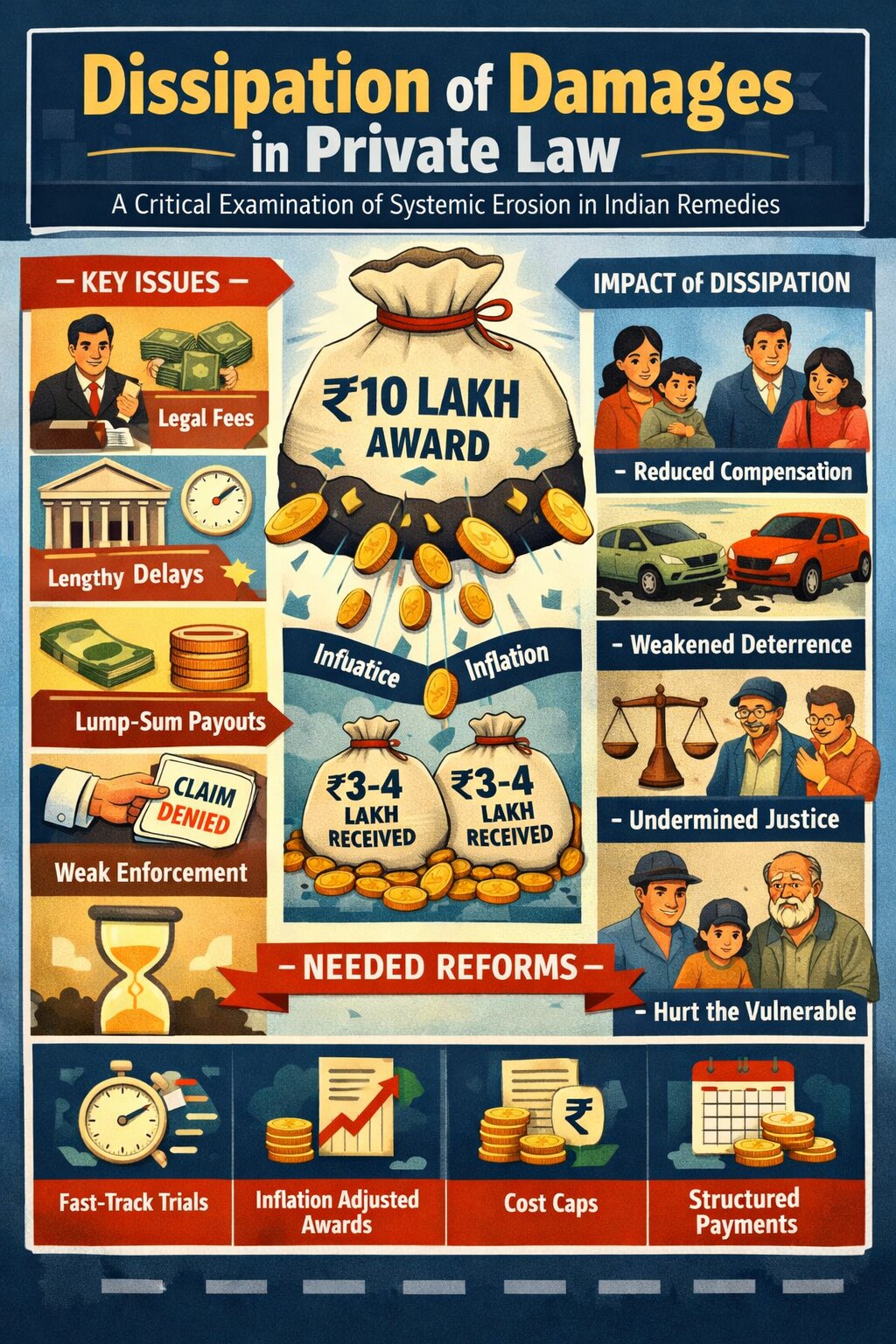
Damages are the central tool of remedial justice in private law, meant to place the injured party as far as possible in the position they would have occupied had the wrong not occurred (restitutio in integrum). In practice, however, this aim is often defeated. A claimant awarded ₹10 lakh in a medical negligence or motor accident case may receive only a fraction after deducting lawyer’s fees, expert costs, and court expenses, with further loss caused by years of delay and inflation. This erosion of real value is known as the dissipation of damages—the gap between what courts award on paper and what victims actually receive.
In India, where litigation is slow and costly, dissipation has deeper systemic consequences. When compensation is delayed or diluted, it weakens deterrence by allowing wrongdoers and insurers to treat liability as manageable. It also undermines corrective justice, as victims remain under-compensated despite formal success in court, and skews loss distribution against poorer claimants who cannot absorb prolonged costs. Thus, dissipation is not merely an individual hardship but a structural failure that limits the ability of private law to deliver real and equitable justice.
II. Conceptual Meaning
Dissipation of damages occurs when factors within the legal system, rather than the defendant’s wrongdoing, reduce the real value of compensation. Although an award may appear adequate on paper, it often proves insufficient in practice. Legal fees, expert costs, procedural delays, and inflation capture a large share of the award before it reaches the claimant. This loss is caused by intermediaries and systemic inefficiencies, not by the defendant. For example, a ₹10 lakh award in a medical negligence case may finally yield only ₹3–4 lakh after paying lawyers and experts and after years of delay erode its value.
III. Impact on the Purposes of Damages
Dissipation reduces the compensatory value of damages by diverting a large portion of the award to lawyers, insurers, and procedural costs instead of the victim. It also weakens deterrence, as wrongdoers may expect that victims will recover little in real terms even after winning a case. The moral link between wrongdoing and repair is broken, undermining corrective justice. Most seriously, dissipation affects vulnerable groups the hardest—such as the poor, daily wage earners, and marginalised communities—thereby deepening inequality and unfairness in access to justice.
IV. Causes of Dissipation
One major cause is high legal costs and adversarial procedures, where formalism and lawyer fees consume a large part of compensation, as noted in Salem Advocate Bar Association v. Union of India (2005). Delay is another key factor: long trials allow inflation to erode the real value of awards while victims continue to suffer, highlighted in Rudul Sah v. State of Bihar (1983).
Courts also often grant lump-sum awards without regular inflation adjustment, leading to under-compensation (U.P. SRTC v. Trilok Chandra, 1996). Insurance companies further contribute by delaying or aggressively contesting claims (Jai Prakash v. National Insurance, 2010). Finally, even after a decree, weak execution mechanisms prolong recovery, as criticised in Satyawati v. Rajinder Singh (2013).
V. Sector-Specific Insights
In tort cases, especially personal injury and medical negligence, high expert fees and long trials significantly increase dissipation, as noted in V. Kishan Rao v. Nikhil Super Speciality Hospital (2010). In motor accident claims, standardised methods of calculation have reduced uncertainty (Sarla Verma v. DTC, 2009), but delays remain common. Courts therefore direct safeguards like structured deposits or investments to protect vulnerable claimants. In contract disputes, many small claims are never pursued because litigation costs outweigh likely recovery. Consumer forums were designed to limit dissipation through simple procedures, yet repeated appeals often dilute the final benefit.
VI. Comparative Insights
In the United States, contingency fees reduce upfront costs but typically absorb 30–40% of awards. In the UK, cost-shifting rules and cuts to legal aid discourage claims. No-fault compensation systems, such as in New Zealand, largely avoid litigation-related dissipation, though India follows this model only in limited statutory contexts.
VII. Judicial Recognition
Indian courts have recognised that justice is meaningless if relief is only formal and not effective. They have repeatedly stressed the need for speedy trials, realistic compensation, and avoidance of unnecessary technical objections that delay or dilute relief. In motor accident cases, courts have also introduced specific safeguards—such as structured payments and protections for dependants—to ensure that compensation is not prematurely lost, especially by vulnerable claimants.
VIII. Public Dimensions
Dissipation of damages weakens public trust in the justice system when court awards fail to deliver real relief. It encourages parties to seek extra-legal or informal settlements, knowing that formal litigation may be slow and ineffective. Reduced and delayed compensation also weakens deterrence, allowing harmful conduct to continue. Ultimately, when victims remain under-compensated, the financial burden shifts to state welfare systems, turning a private law failure into a public concern.
IX. Reforms
Compensation cases should be decided within fixed timelines so that delay does not reduce the real value of damages. Courts should award amounts that reflect actual costs and adjust for inflation, especially in long-pending cases. Placing reasonable caps on legal costs in personal injury claims can ensure that compensation reaches victims rather than being absorbed by litigation expenses.
Further, courts should prefer structured or periodic payments instead of one-time lump sums, particularly in long-term injury cases. Simplifying rules of evidence and negligence can reduce procedural complexity and delay. Finally, stronger and faster execution mechanisms are essential so that winning a decree leads to timely and effective payment.
X. Conclusion
Dissipation of damages highlights a serious remedial failure in private law. Although courts may award compensation, a large part of it often disappears due to legal costs, long delays, inflation, and enforcement difficulties. As a result, victims do not receive meaningful relief, and monetary awards fail to achieve their basic purpose of restoring the injured party or correcting the wrong.
Indian courts have addressed this problem in a limited way through safeguards for vulnerable claimants and by standardising compensation in some areas. However, these measures are not enough. Genuine reform requires shifting the focus from formal awards on paper to effective, timely outcomes. Only then can private law regain legitimacy in ensuring compensation, deterrence, and equity.
Ultimately, dissipation of damages undermines access to justice by ensuring that remedies exist in law but fail in practice, particularly for economically and socially vulnerable claimants.
References
- Jai Prakash v. National Insurance Co. Ltd., (2010) 2 Supreme Court Cases 607 (India).
- Rudul Sah v. State of Bihar, (1983) 4 Supreme Court Cases 141 (India).
- Salem Advocate Bar Association v. Union of India, (2005) 6 Supreme Court Cases 344 (India).
- Sarla Verma v. Delhi Transport Corporation, (2009) 6 Supreme Court Cases 121 (India).
- Satyawati v. Rajinder Singh, (2013) 9 Supreme Court Cases 491 (India).
- P. State Road Transport Corporation v. Trilok Chandra, (1996) 4 Supreme Court Cases 362 (India).
- Kishan Rao v. Nikhil Super Speciality Hospital, (2010) 5 Supreme Court Cases 513 (India).