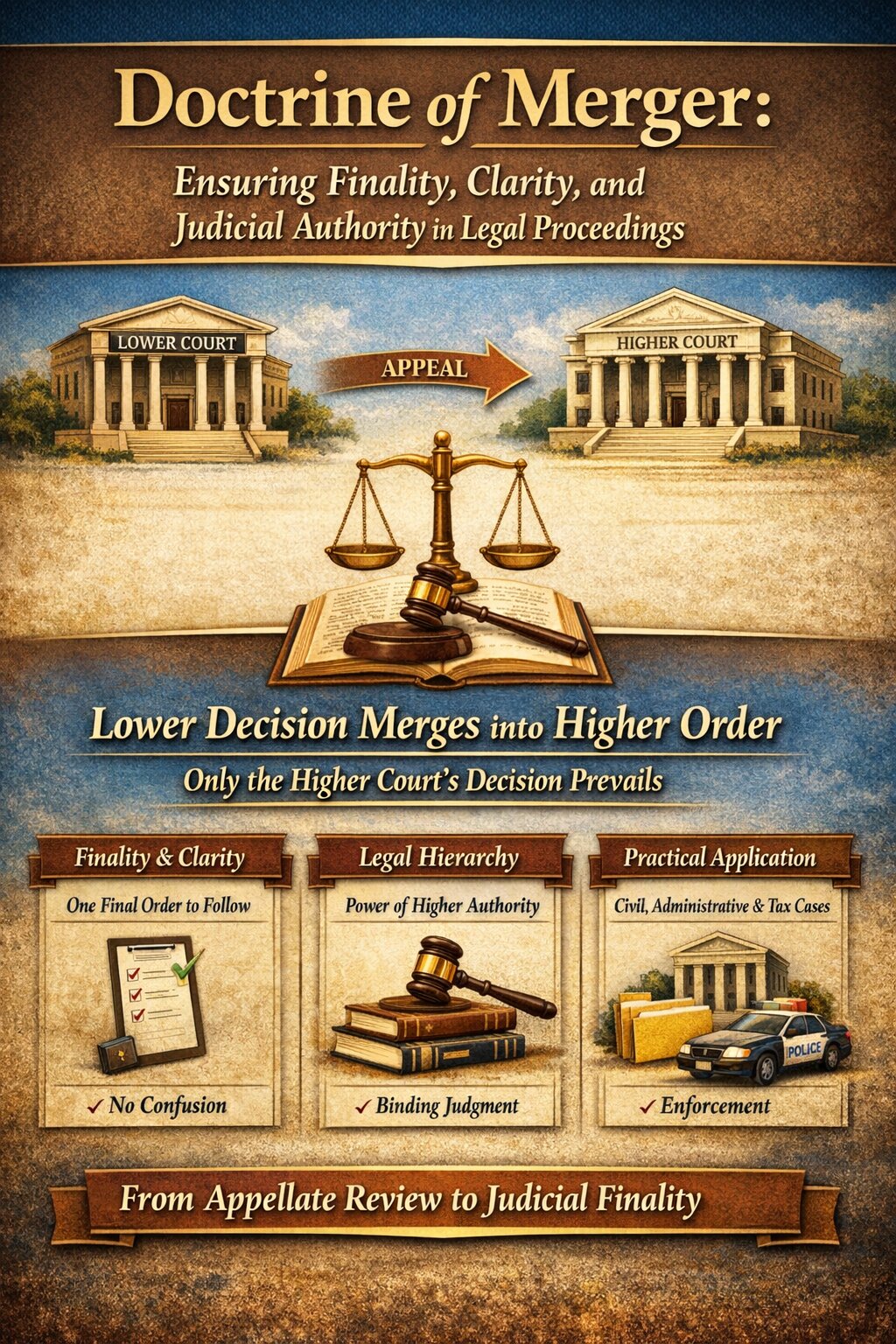
The Doctrine of Merger is an important legal principle. It means that when a decision of a lower authority is challenged before a higher authority, and the higher authority gives its decision, the lower decision no longer exists separately. It becomes part of the higher authority’s order.
In simple words: once the higher court decides the matter, only that decision matters.
This rule is mainly used in civil cases, administrative law, and tax matters. It helps avoid confusion by making sure that only one final order is followed.
Basic Idea Behind the Doctrine
The doctrine is based on common sense. In every legal system, higher courts have the power to check the decisions of lower courts. Once the higher court uses that power and gives its judgment, that judgment becomes final.
For example, suppose a trial court orders someone to pay ₹10,000. The person files an appeal, and the higher court increases the amount to ₹15,000. Now the earlier order of ₹10,000 does not exist separately. It merges into the new order of ₹15,000.
When Does the Doctrine Apply?
The doctrine usually applies when:
- The lower authority had the legal power to pass the order.
- The higher authority also had the legal power to hear the case.
- The higher court actually examined the case and gave a proper decision.
- The issue decided by both authorities is the same.
Important Point: Decision Must Be on Merits
The doctrine does not apply in every situation.
If an appeal is dismissed only because:
- it was filed late, or
- it had a technical mistake, or
- the court did not examine the facts of the case,
then the lower court’s order will continue to exist. This is because the higher court did not really decide the matter.
Where Is This Doctrine Used?
- Civil Cases: If a higher court changes the order of a lower court, then only the higher court’s order can be enforced. This avoids confusion.
- Administrative and Tax Matters: In tax cases, if a matter goes to a higher authority like a tribunal, then the final order is treated as the tribunal’s order, not the original one.
- Review Petitions: Once the lower court’s order merges into the higher court’s order, the lower court usually cannot review its own decision anymore.
Limitations and Exceptions
The doctrine is not absolute. It does not apply in every case.
It may not apply when:
- Only a small part of the order was challenged in appeal
- The higher court dismissed the case without hearing it properly
- A law specifically says that the original order will continue to exist
Difference Between Merger and Res Judicata
These two ideas are often confused, but they are different.
- Doctrine of Merger: tells us which order is valid now.
- Res Judicata: prevents the same issue from being decided again.
Why Is This Doctrine Important?
This doctrine keeps the legal system clear and organized. Without it:
- There could be two different orders for the same case
- People would not know which order to follow
- Courts would face unnecessary confusion
Case Laws
The Doctrine of Merger provides that when a higher court or authority decides an appeal or revision on merits, the original order or judgment merges into the appellate or revisional order, and thereafter only the decision of the higher forum remains operative and enforceable. In India, the Supreme Court has clearly explained this principle in several landmark cases.
In Kunhayammed v. State of Kerala, the Court held that the doctrine of merger applies only when the higher court actually examines and decides the matter on merits. In Commissioner of Income Tax v. Amritlal Bhogilal & Co, it was observed that once an appeal is decided, the original order merges into the appellate order.
Similarly, in S.S. Rathore v. State of Madhya Pradesh, the Court emphasized that after the appeal is disposed of, only the decision of the higher authority survives and remains effective. Internationally, the doctrine finds recognition in common law jurisdictions; for instance, in Hoystead v. Commissioner of Taxation, the Privy Council affirmed that once a matter is finally adjudicated by a higher forum, the earlier decisions lose their independent existence, thereby reinforcing the principles of judicial finality and consistency.
Filing Contempt Petition in Cases Involving Doctrine of Merger
In cases governed by the Doctrine of Merger, the appropriate forum for filing a contempt petition depends on whose order is alleged to have been disobeyed and the nature of the appellate decision. Generally, when a higher court (such as the Supreme Court) has examined the matter on merits and the original order has merged into the appellate order, the contempt petition for non-compliance should be filed before the higher court, as only its order remains operative and enforceable.
However, recent Supreme Court rulings have clarified that the doctrine of merger does not automatically extinguish the High Court’s contempt jurisdiction under Article 215 of the Constitution and the Contempt of Courts Act, 1971.
Where the Supreme Court has merely affirmed the High Court’s directions without issuing fresh or independent directions of its own, the High Court retains the power to entertain and decide the contempt petition for disobedience of its original order.
The petitioner must therefore carefully assess whether the higher court has substantively modified, reversed, or merely affirmed the lower order before choosing the forum.
Conclusion
The Doctrine of Merger means that when a higher court or authority examines a case and gives its decision, the earlier decision of the lower court loses its separate identity and becomes part of the higher court’s order. In other words, the lower court’s order does not stand on its own anymore—the final and binding decision is only that of the higher court.
This principle is important because it brings clarity and certainty. It ensures that there is only one final order to follow, so parties, lawyers, and authorities are not confused about which decision is applicable. It also promotes finality in litigation, meaning that once a higher court has decided the matter, the dispute should come to an end and should not continue endlessly.
Further, it helps maintain the hierarchy of courts, giving proper authority to higher courts over lower ones. It also prevents conflicting or overlapping decisions and ensures smooth enforcement of judgments. Overall, the doctrine plays a key role in making the legal system more organized, efficient, and reliable.