





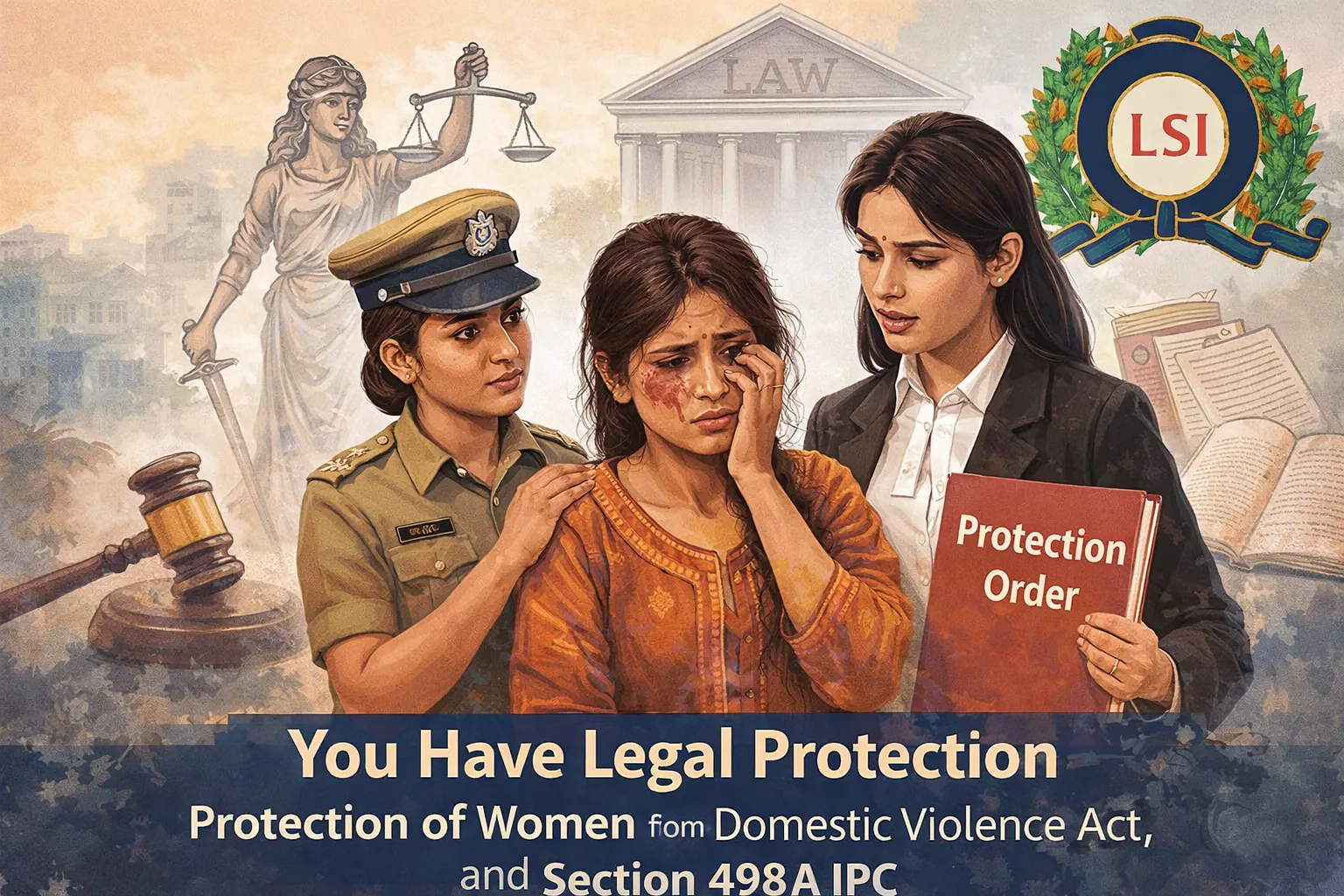
You’re Not Alone — And You Have Legal Protection
You’re being beaten. Or controlled. Or starved. Or emotionally tortured. Maybe your in-laws are demanding more dowry. Perhaps your husband threatens you constantly, destroys your belongings, or keeps you locked in the house. Or maybe the abuse is more subtle – financial control, isolation from family, constant humiliation, or being denied food.
You’re scared. You feel trapped. You don’t know where to turn or what rights you have. You might think this is just your fate, that you have to endure it, that no one will help you, or that leaving means losing everything – your home, your children, your financial security.
Key Legal Message
But here’s what you need to know: You have extensive legal rights under Indian law. Domestic violence is not just morally wrong – it’s illegal. The Protection of Women from Domestic Violence Act, 2005 (DV Act) and Section 498A of the Indian Penal Code give you powerful tools to stop the abuse, protect yourself and your children, stay in your home, get financial support, and hold your abusers accountable.
- You don’t have to be married to seek protection.
- You don’t have to show visible injuries.
- Economic abuse, emotional abuse, and verbal abuse all count.
- You can get immediate protection orders.
- You can force your abuser to leave the house.
- You can get maintenance money.
- You can keep custody of your children – often within days or weeks of filing your complaint.
Purpose Of This Guide
This comprehensive guide will walk you through everything you need to know about domestic violence laws in India in 2026. From understanding what constitutes domestic violence to filing complaints, getting protection orders, claiming maintenance and residence rights, pursuing criminal cases, and rebuilding your life – we’ll cover it all in clear, practical language.
Whether you’re currently experiencing abuse, trying to help someone who is, or want to understand your rights for the future, this guide will help you understand the legal protections available and how to access them.
Understanding Domestic Violence Under Indian Law
Before you can protect yourself, you need to understand what legally qualifies as domestic violence and who is protected.
What Is Domestic Violence?
Domestic violence is not just physical beatings. Under the DV Act, domestic violence includes:
1. Physical Abuse
- Hitting, slapping, kicking, punching
- Pushing, shoving, or throwing things
- Burning or scalding
- Pulling hair
- Forceful confinement
- Any act that harms the body
2. Sexual Abuse
- Forced sexual intercourse
- Forced sexual acts you don’t consent to
- Forced viewing of pornography
- Sexual harassment
- Any conduct of a sexual nature that abuses, humiliates, degrades, or violates dignity
3. Verbal And Emotional Abuse
- Insults, ridicule, humiliation
- Threats of harm to you, children, or family
- Accusations of infidelity or bad character
- Constant criticism
- Preventing you from working or studying
- Isolating you from friends and family
- Controlling where you go and what you do
- Monitoring phone calls, messages, movements
- Comparing you unfavorably with others
- Threats of divorce, remarriage, or taking children
- Forcing you to not have children
- Threatening to commit suicide
4. Economic Abuse
- Not providing money for household expenses
- Not allowing you to work
- Taking your salary or money
- Denying you access to bank accounts
- Selling or destroying your belongings
- Preventing you from using household items
- Not maintaining you or children
- Disposing of household property or assets
- Forcing you to quit your job
Dowry Harassment
Dowry-related harassment is domestic violence and also a criminal offense under Section 498A IPC.
Important
You don’t need visible injuries or medical proof to file a case. Emotional, verbal, and economic abuse are equally valid grounds.
Who Can File Under The DV Act?
Any woman in a domestic relationship can file:
Wives (Most Common)
- Legally married wives
- Wives in customary marriages (recognized by community)
- Wives in live-in relationships (if relationship is like marriage)
- Divorced or separated women (for violence during marriage)
Other Women Who Can File
- Sisters
- Widows
- Mothers
- Daughters (adult or minor)
- Live-in partners (in a relationship in the nature of marriage)
- Any female relative living in a shared household
Children (male or female) can also claim protection if they live in the household where the woman is being abused.
Who Can Be Accused (Respondents)
- Husband
- Male relatives (father-in-law, brother-in-law, etc.)
- Female relatives (mother-in-law, sister-in-law, etc.)
- Anyone in a domestic relationship with you
Important Clarifications
Live-In Relationships
- If you’ve been in a live-in relationship “in the nature of marriage,” you can file
- Doesn’t require years of cohabitation
- Courts have held that even relationships of reasonable duration qualify
Sisters, Mothers, And Other Female Relatives
- Can file against their relatives who abuse them
- Not just wife vs. husband
Shared Household
- The house where you live with the abuser
- Or used to live
- Or have a right to live
What Is NOT Covered
The DV Act does NOT cover:
- Abuse by boyfriend who is not in a live-in relationship
- Abuse by casual acquaintances
- Abuse outside a domestic relationship
For Non-Domestic Abuse
- Can still file FIR under IPC sections (assault, criminal intimidation, etc.)
- Can file complaints with police
- Can seek criminal prosecution
Protection Of Women From Domestic Violence Act, 2005 (DV Act)
This is the primary civil law protecting women from domestic violence.
Key Features
- Provides immediate relief
- Protection orders, residence orders, monetary relief
- Fast procedure (compared to regular court cases)
- Don’t need a lawyer (though recommended)
- Free legal aid available
- Cases heard by Magistrate Courts
Purpose: Protect women’s right to live in a violence-free home, maintain them financially, and provide immediate relief.
Section 498A IPC: Criminal Law
This is the criminal law against cruelty to a married woman.
Section 498A IPC: Punishment for subjecting a married woman to cruelty.
What It Covers
- Cruelty by husband or relatives
Cruelty means:
- Conduct likely to drive woman to suicide
- Conduct causing grave injury or danger to life, limb, or health
- Harassment for dowry
Punishment
- Imprisonment up to 3 years
- Fine
- Cognizable offense (police can arrest without warrant)
- Non-bailable (must apply for bail)
Difference From DV Act
| DV Act | Section 498A IPC |
|---|---|
| Civil (protection and support) | Criminal (leads to jail) |
| Relief and safety | Punishment |
| Can file simultaneously | Can file simultaneously |
Recent Debates
- 498A has been called misused in some cases
- Supreme Court has issued guidelines to prevent misuse
- But it remains an important protection for abused women
Immediate Steps If You’re Facing Domestic Violence
If you’re in immediate danger or just realizing you need help, here’s what to do right now.
If You’re In Immediate Danger
Call For Help
- Women’s helpline: 181 or 1091 (toll-free)
- Police: 100 or 112 (emergency)
- National Commission for Women: 011-26942369, 26944754
Get To Safety
- Leave the house if you can safely do so
- Go to a neighbor, friend, or relative
- Go to the nearest police station
- Go to a women’s shelter/protection home
Don’t Worry About “Abandoning” The Home
- You have the right to leave if you’re in danger
- This won’t affect your right to return or claim the residence
- Safety first
Medical Treatment
- If injured, go to hospital immediately
- Get a medico-legal certificate (MLC)
- This is crucial evidence
- Doctors are required to provide it free if you say it’s for legal purposes
Document Everything
- If safe to do so, photograph injuries
- Take photos of damaged property
- Save threatening messages, emails, call logs
- Note dates, times, witnesses to incidents
If You’re Not In Immediate Danger But Need Help
Reach Out For Support
- Contact local women’s organizations (list in next section)
- Speak with a Protection Officer (in every district)
- Consult a lawyer (many provide free consultations)
- Call women’s helpline for guidance
Start Documenting Abuse
- Write down incidents (date, time, what happened, who was present)
- Keep a journal in a safe place
- Save all evidence (messages, emails, recordings if legal in your state)
- Tell trusted friends/family (they can be witnesses)
Assess Your Safety
- Does the abuse seem to be escalating?
- Do you have children to protect?
- Can you stay temporarily with family?
- Do you need immediate legal intervention?
Plan Your Next Steps
- Decide whether to file DV complaint, criminal FIR, or both
- Gather necessary documents (marriage certificate, proof of residence, etc.)
- Arrange safe place to stay if needed
- Consider financial needs
Key Organizations And Resources
National-Level
- National Commission for Women (NCW): ncw.nic.in, 011-26942369
- Central Social Welfare Board
- Women’s helpline: 181
State-Level
- State Women’s Commissions (every state has one)
- State Legal Services Authority (free legal aid)
- District Legal Services Authority (in every district)
NGOs And Organizations
- Women’s rights organizations
- Legal aid clinics
- Counseling centers
- Protection homes
Police Stations
- Women’s police stations (Mahila Thana) in many cities
- Regular police stations must also accept complaints
Protection Officers
- Every district has designated Protection Officers
- Their job is to assist DV victims
- List available from District Magistrate’s office or online
Lawyers
- Contact local bar association for lawyer referrals
- Legal aid lawyers available free if you can’t afford private lawyer
- Some lawyers work pro bono on DV cases
Online Resources
- Many states have online complaint systems
- NCW online complaint portal
- State-specific helplines
Shelters
- Short Stay Homes for Women
- Protection Homes
- Swadhar Greh (shelter for women in distress)
- Local NGO shelters
Don’t suffer in silence. Help is available, and you deserve it.
How To File A Domestic Violence Complaint
Ready to take legal action? Here’s the step-by-step process.
Preparing To File
Gather Documents
- Your identity proof (Aadhaar, passport, voter ID, driving license)
- Marriage certificate (if married)
- Proof of residence (any document showing you lived in the shared household)
- Medical records if injured
- Photos of injuries or damaged property
- Copies of threatening messages, emails
- Any previous complaints filed
- Names and addresses of witnesses
Not all documents are required, but the more evidence you have, the stronger your case.
Write Down Incidents
- Chronological list of abuse incidents
- Dates (as best as you remember)
- What happened each time
- Who was present
- What was said/done
This helps you:
- Present your case clearly
- Remember details when filing complaint
- Show pattern of abuse
Where To File
1. Magistrate Court
File directly with the Magistrate (Judicial Magistrate First Class or Metropolitan Magistrate)
Court in the jurisdiction where:
- You live (or used to live)
- Respondent lives
- The abuse occurred
2. Through Protection Officer
- Every district has Protection Officers
- Their duty is to help you file complaint
- Can prepare Domestic Incident Report
- Often easiest route
3. Through Service Provider
- NGOs registered as service providers
- Can help you file complaint
- Provide counseling and support
You can also:
- Contact women’s helpline (they’ll guide you)
- Approach women’s police station
- Approach any police station (they should refer you to Protection Officer)
Filing is free. There is no court fee for DV cases.
The Complaint / Application
What To Include In Your Complaint
| Section | Required Information |
|---|---|
| Your details | Name, age, address, relationship to respondent (wife, daughter, sister, etc.) |
| Respondent’s details | Name, age, address of abuser(s), relationship to you |
| Shared household | Address of the home, ownership, duration of stay |
| Domestic violence | Type of abuse, incidents, injuries, impact on you and children, ongoing threats |
| Relief sought | Protection order, residence order, monetary relief, custody, other relief |
Format
- Can be in the form of an application
- In English or regional language
- Can be handwritten or typed
- Must be signed by you
If You Can’t Write
- You can give oral statement
- Protection Officer or court staff will write it down
- You put your thumb impression
Legal Aid Lawyer
- Court will provide free lawyer if you request
- Highly recommended even though not mandatory
- Lawyer helps draft better application and represent you
Domestic Incident Report (DIR)
The Protection Officer prepares this report.
What It Contains
- Details of domestic violence
- Medical examination report if any
- Your statement
- Details of shared household
- Children involved
- Relief sought
Process
- You approach Protection Officer
- Give details of abuse
- PO investigates (may visit house, interview respondent, talk to witnesses)
- Prepares DIR
- Submits to Magistrate
Timeline: Protection Officer should submit DIR within 3 days of receiving information.
This is not mandatory – you can file directly with Magistrate. But DIR from Protection Officer strengthens your case and provides official documentation.
After Filing: What Happens Next
- Case registered – Magistrate registers application and fixes first hearing (usually within a week or two)
- Notice to respondent – Court sends notice to appear
- Interim protection order – Immediate protection possible at first hearing
- Hearings – Evidence and witnesses presented
- Counseling (if ordered) – Optional reconciliation attempt
- Final order – Relief granted or denied (often takes 6–12 months)
You can request interim relief immediately – don’t wait for final order.
Protection Orders: Your Shield Against Abuse
What Is A Protection Order?
A court order that prohibits the respondent from:
- Committing any act of domestic violence
- Aiding others to commit violence
- Entering your workplace
- Contacting you
- Alienating assets
- Harassing anyone in domestic relationship with you
Purpose: Stop the violence immediately and prevent further abuse.
What Protection Orders Can Include
- Not to commit violence
- Move out of shared household
- No contact with you or children
- Stay away from workplace
- Not dispose property
- Not threaten family
- Surrender weapons
Breach of protection order:
- Criminal offense
- Punishment: imprisonment up to 1 year or fine up to ₹20,000 or both
Interim Vs. Final Protection Orders
| Type | When Granted | Purpose |
|---|---|---|
| Interim Order | Early stage | Immediate relief while case pending |
| Final Order | After trial | Long term protection |
How To Get Protection Order
- Request it in application
- Specify protections needed
- Explain urgency
Evidence:
- Medical records
- Photos
- Threatening messages
- Witness statements
- Your testimony
Court can grant protection order on prima facie case.
Enforcement Of Protection Order
- Keep copies always
- Give copy to local police station
- Report violation immediately
Violation Consequences
- Arrest
- Prosecution
- Imprisonment
Steps If Violated
- File police complaint
- Inform Magistrate
- Request arrest warrant
- Request penalty
Police must enforce protection orders. If they refuse, approach senior officers or file contempt application in court.
Residence Rights: Your Right to Stay in Your Home
One of the most powerful provisions of the DV Act is the right to secure housing.
What are Residence Rights?
Under the DV Act, you have the right to:
- Live in the shared household
- Not be evicted without court order
- Claim residence order from court
Shared household means:
- House where you live or lived with respondent
- Can be owned by respondent, in-laws, joint family, or even rented
Important: You don’t need to own the house. Even if house is owned by husband or in-laws, you have right to live there.
Types of Residence Orders
Court can pass various types of residence orders:
- Residence order (allowing you to live there):
- Respondent cannot evict you
- You can stay in shared household
- Even if house is in respondent’s name
- Restraining order (stopping respondent from evicting you):
- Prevents respondent from removing you from house
- Prevents changing locks
- Prevents disposing of household effects
- Order directing respondent to provide alternate accommodation:
- If staying in same house is not feasible
- Respondent must arrange and pay for alternative accommodation
- Order directing respondent to pay rent:
- For accommodation you’ve had to take
- Due to domestic violence
- Order directing respondent to return:
- Property or assets taken from you
- Stridhan (your personal belongings, jewelry, gifts)
- Order directing not to sell/transfer shared household:
- Prevents respondent from selling house
- Protects your residence right
Who Can Get Residence Orders
Any woman in a domestic relationship:
- Wife (even if house is in husband’s name alone)
- Daughter (in parents’ house)
- Sister (in brothers’ house)
- Mother (in son’s house)
- Widow (in deceased husband’s house)
- Any woman living in shared household
Even if:
- You don’t have ownership rights
- You don’t pay rent
- House is ancestral or joint family property
- House is owned by in-laws
The right to residence is independent of ownership.
Special Protections
- You cannot be evicted from shared household:
- Without court order
- Even if divorce is granted
- Unless court specifically orders otherwise
If respondent tries to evict you forcefully:
- This is violation of DV Act
- Can file complaint
- Can get protection and residence order
If you’ve left the house due to violence:
- You don’t lose your residence right
- You can claim right to return
- Or claim alternate accommodation
Practical Considerations
If you want to stay in the house:
- File for residence order immediately
- Get interim order restraining eviction
- Police can enforce order
If you don’t want to live with abuser:
- Request alternate accommodation
- Court can order respondent to arrange
- Or order rent payment for your separate accommodation
If there are other family members:
- Residence order affects only respondent’s right to evict you
- Other family members may still live there
- Court considers practical situation
If house is rented:
- Landlord cannot evict you just because respondent left
- Your residence right continues
- Respondent must continue paying rent
If house is sold:
- Sale without informing court (after case filed) can be set aside
- Get court order restraining sale
- Protects your rights
Monetary Relief: Financial Support Under DV Act
Domestic violence often leaves women financially dependent or destitute. The DV Act provides monetary relief.
Types of Monetary Relief
Court can order the respondent to pay:
- Maintenance for yourself:
- Monthly payment for your living expenses
- Food, clothing, shelter, other basic needs
- Maintenance for your children:
- Monthly payment for children’s expenses
- Education, food, clothing, healthcare
- Compensation for injuries:
- Lump sum amount for physical injuries
- Mental agony and emotional distress
- Loss of earnings
- Loss of earnings:
- If you lost job due to violence
- Or couldn’t work due to abuse
- Compensation for income loss
- Medical expenses:
- Reimbursement of medical bills
- Ongoing treatment costs
- Loss or destruction of property:
- If respondent destroyed your belongings
- If stridhan was taken or destroyed
- Fair value of property
Monetary relief can be interim (temporary) or final (in final order).
Maintenance Under DV Act
What is maintenance?
- Regular monthly payments
- For you and/or children
- To meet living expenses
Factors court considers:
- Your income and financial resources
- Respondent’s income and assets
- Standard of living during relationship
- Your needs (food, rent, medical, education, etc.)
- Children’s needs
- Number of dependents
How much maintenance?
- No fixed formula
- Varies based on respondent’s income
- Typically 25-40% of respondent’s income for wife + children
- Can be less if you have your own income
- Can be more if children have special needs
Example:
- Husband earning ₹50,000/month
- Wife not working, two children
- Court might order ₹15,000-20,000/month total maintenance
When does it start?
- Interim maintenance from date of first hearing or application
- Arrears (past months) may also be ordered
Duration:
- Until final order
- Or until specific period ordered
- Or until you remarry
- Or until children become adults (for child maintenance)
Can be modified:
- If circumstances change (increase or decrease in income, remarriage, etc.)
- File application for modification
Compensation and Damages
- Compensation for injuries:
- Physical injuries
- Emotional and mental trauma
- Pain and suffering
- Humiliation
Amount varies:
- ₹25,000-₹5 lakh depending on severity
- Serious injuries: Higher amounts
- Economic abuse: Compensation for financial loss
- Medical expenses:
- Hospital bills
- Doctor’s fees
- Medicines
- Therapy/counseling costs
- Future medical needs
- Loss of earnings:
- If you had to quit job
- If violence affected your work
- If you lost business opportunities
- Loss of property:
- Stridhan (jewelry, clothes, gifts) value
- Other personal belongings
- Household items destroyed
How to Claim Monetary Relief
In your application:
- Clearly state you want monetary relief
- Specify what kind (maintenance, compensation, medical expenses)
Provide details:
- Your income (if any)
- Respondent’s income (as best as you know)
- Your monthly expenses
- Children’s expenses
- Medical bills
- Property loss
Request interim maintenance
Evidence:
- Your income proof (salary slips, income tax returns)
- Respondent’s income proof (if you have access)
- Rent receipts or mortgage documents
- Children’s school fees, medical bills
- Household expense records
- Medical bills for treatment
- Receipts for damaged property
If respondent’s income is unknown:
- Court can estimate based on lifestyle
- Based on profession/business
- Respondent must disclose income in court
Court can award interim maintenance at first hearing itself if you’re in urgent need.
Enforcement of Monetary Relief Orders
If respondent doesn’t pay:
- File execution application
Court can:
- Attach salary (employer pays directly)
- Attach bank accounts
- Auction property
- Imprisonment (under certain circumstances)
Arrears accumulate:
- Non-payment doesn’t erase the obligation
- Total arrears can be recovered later
Criminal proceedings for non-payment:
- Willful non-compliance can lead to imprisonment
- Under Section 20 of DV Act (breach of protection order)
Keep records:
- Note all payments received
- Bank statements
- Helps in enforcement if payments stop
Custody of Children Under the DV Act
If you have children, their safety and welfare are paramount. The DV Act provides protection.
Custody Rights
Under the DV Act:
- You can request temporary or permanent custody of children
- Court grants custody based on child’s best interest
- Usually mother gets custody of young children (especially girls)
Court considers:
- Age and sex of child
- Child’s preference (if old enough to express)
- Child’s welfare and best interest
- Each parent’s ability to care for child
- History of abuse (abusive parent less likely to get custody)
- Which parent child is more attached to
- Education, health, and emotional needs of child
Interim custody:
- Can be granted at first hearing
- Immediate custody to protect child
- While final decision pending
Final custody:
- After full trial
- More permanent arrangement
Visitation Rights
- Even if respondent doesn’t get custody:
- They usually get visitation rights
- Unless they’re a danger to child
- Supervised visitation if necessary
You can request:
- No visitation if respondent is violent
- Supervised visitation only
- Visitation at specific times/places
- Conditions on visitation (no alcohol, specific location, etc.)
Child’s safety comes first.
Child Maintenance
- Separate from spousal maintenance:
- Respondent must pay for children’s expenses
- Education, food, clothing, medical, extracurricular
- Even if they don’t have custody
Amount:
- Based on child’s needs
- Respondent’s income
- Standard of living
- Usually substantial portion of income
Cannot be denied:
- Even if custody is with mother
- Even if mother is working
- Father (or mother if she’s the abuser) must contribute
Protecting Children from Abuse
If children are also being abused:
- Clearly state this in your application
- Children can be included as “aggrieved persons”
- Protection orders cover children too
- Court takes child abuse very seriously
Child Welfare Committees:
- In cases of severe child abuse
- Can involve child welfare authorities
- Children’s homes or foster care if needed
Best interest of child is paramount in all decisions.
Related Laws
- Guardianship laws:
- Guardians and Wards Act
- Hindu Minority and Guardianship Act
- For more permanent custody arrangements
- Child protection laws:
- Protection of Children from Sexual Offences (POCSO) Act if child is sexually abused
- Juvenile Justice Act for child welfare
You can file multiple cases (DV Act, guardianship, criminal) simultaneously.
Criminal Action: Section 498A IPC And Other Charges
Alongside civil protection, you can pursue criminal prosecution of your abuser.
Section 498A IPC: Cruelty To Married Women
What it says: “Whoever, being the husband or the relative of the husband of a woman, subjects such woman to cruelty shall be punished with imprisonment for a term which may extend to three years and shall also be liable to fine.”
Who can be charged:
- Husband
- Relatives of husband (in-laws, etc.)
What is “cruelty”:
- Conduct likely to drive woman to suicide
- Conduct causing grave injury or danger to life, limb, or health (physical or mental)
- Harassment for the purpose of coercing the woman or her relatives to meet unlawful demand for property/valuable security (dowry)
Punishment:
- Imprisonment up to 3 years
- Fine
- Both
Nature of offense:
- Cognizable (police can arrest without warrant)
- Non-bailable (must apply for bail to court)
- Triable by Magistrate
How to File FIR Under 498A
- Step 1: Go to police station
- Any police station can register FIR
- Women’s police station is often more sensitive
- You can also file online in some states
- Step 2: Give details of abuse
- Tell your story
- Incidents of cruelty
- Dowry demands if any
- Threats or violence
- Names of all accused (husband, in-laws, etc.)
- Step 3: FIR is registered
- Police write down your statement (FIR)
- You sign it
- You get copy of FIR
- This is free – you don’t pay anything
- Step 4: Medical examination
- Police may send you for medical exam
- Get medico-legal certificate
- Important evidence
- Step 5: Investigation
- Police investigate
- Visit your home/accused’s home
- Interview witnesses
- Collect evidence
- Step 6: Chargesheet filed
- If police find evidence, they file chargesheet in court
- Accused are summoned to court
- Trial begins
- Step 7: Trial
- Prosecution presents evidence
- You testify as witness
- Accused present their defense
- Can take 2-5 years or more
- Step 8: Judgment
- Guilty: Imprisonment and/or fine
- Not guilty: Acquitted
Important Supreme Court Guidelines On 498A
To prevent misuse, Supreme Court has issued guidelines:
- Arrest not automatic:
- Police should not arrest immediately
- Should verify allegations first
- Arrest only if necessary
- Bail possible:
- Despite being non-bailable, courts can grant bail
- Especially if allegations seem exaggerated
- Family Welfare Committee:
- District-level committee
- Can be approached before arrest
- Attempts reconciliation
These guidelines protect against false cases, but genuine victims should not hesitate to file FIR.
Other Criminal Charges
Beyond 498A, you can file FIR for:
| Section | Offense | Punishment |
|---|---|---|
| Section 323 IPC | Voluntarily causing hurt | Imprisonment up to 1 year or fine |
| Section 324 IPC | Voluntarily causing hurt by dangerous weapons | Imprisonment up to 3 years or fine |
| Section 325 IPC | Voluntarily causing grievous hurt | Imprisonment up to 7 years + fine |
| Section 354 IPC | Assault or criminal force with intent to outrage modesty | Imprisonment up to 2 years or fine or both |
| Section 376 IPC | Rape | Rigorous imprisonment 7 years to life |
| Section 304B IPC | Dowry death | Imprisonment minimum 7 years, can extend to life |
| Section 406 IPC | Criminal breach of trust | Imprisonment up to 3 years or fine or both |
| Section 506 IPC | Criminal intimidation | Imprisonment up to 2-7 years depending on severity |
Your lawyer or police will help decide which sections apply.
Dowry Prohibition Act
If dowry harassment is involved:
- Dowry Prohibition Act, 1961
- Taking or giving dowry is criminal offense
- Punishment: Imprisonment up to 5 years + fine of ₹15,000 or the dowry amount, whichever is more
- Section 3: Taking or giving dowry is offense.
- Section 4: Demanding dowry is offense.
Court Procedure: What Happens in DV Cases
Understanding court procedure reduces anxiety and helps you participate effectively.
First Hearing
Usually within 7-15 days of filing:
- Magistrate reads your application
- You may be asked to briefly explain
- Respondent may or may not be present (notice takes time to reach)
You can immediately request:
- Ex-parte interim protection order (without hearing respondent)
- Interim residence order
- Interim maintenance
- Interim custody
If you’re in danger:
- Explain urgency
- Court can pass interim orders same day or within a few days
Adjournments (next date):
- Case adjourned for respondent to file reply
- Usually 2-4 weeks
Lawyer recommended:
- Even though you can represent yourself
- Lawyer ensures all reliefs are properly requested
Subsequent Hearings
- Respondent files written statement:
- Their version of events
- Denying or admitting allegations
- Their defenses
- Evidence stage:
- Your testimony (you’ll testify in court)
- Witness testimony
- Documents (medical records, photos, messages, etc.)
- Protection Officer’s DIR
- Respondent presents evidence:
- Their testimony
- Their witnesses
- Their documents
- Cross-examination:
- Respondent’s lawyer can cross-examine you and your witnesses
- Your lawyer can cross-examine respondent and their witnesses
This is the longest stage – can take multiple hearings over months.
Role of Protection Officer
- Assists you in filing application
- Prepares Domestic Incident Report
- Helps you get shelter if needed
- Facilitates medical examination
- Provides information about your rights
- May provide updates to court
Their support is valuable – don’t hesitate to use it.
Counseling
- To attempt reconciliation
- Not mandatory to agree
- If you want to reconcile, counseling can help
- If you don’t, you can refuse
Counseling sessions:
- Usually 1-3 sessions
- With professional counselor
- Both parties attend
If counseling succeeds: Case can be withdrawn or settled
If counseling fails: Case continues as before
Counseling doesn’t delay interim relief – you should already have interim orders.
Final Order
- Findings on each allegation
- Whether domestic violence is proved
- Relief granted or denied
Relief can include:
- Protection order (permanent until further orders)
- Residence order
- Monetary relief (maintenance amount, compensation)
- Custody of children
- Any other relief deemed necessary
If dissatisfied: Can file appeal in Sessions Court within 30 days of order
Timeline
- Filing to first hearing: 1-2 weeks
- Interim orders: Within 1-4 weeks
- Final order: 6 months to 2 years
Varies widely by:
- Court’s workload
- Availability of judge
- Complexity of case
- Number of witnesses
- Respondent’s cooperation (or obstruction)
Interim orders protect you while waiting for final order.
Enforcement
- Protection order violated: Police complaint and court action
- Maintenance not paid: Execution application, salary or property attachment
- Residence order violated: Police complaint and enforcement through court
Costs
- No court fees
- Free legal aid available
- Private lawyer: ₹10,000-₹50,000+ depending on case complexity and location
- You can request court order respondent to pay your legal costs
Life After Filing: Practical Considerations
Filing a case is just the beginning. Here’s what to expect.
Living Arrangements
If you stay in shared household:
- You have court protection
- Respondent cannot legally evict you
- Keep police informed of court orders
If you leave:
- Stay with family, friends, or shelter
- You don’t lose residence rights
- Can still claim right to return or alternate accommodation
If you need shelter:
- Protection homes available
- Women’s shelters run by government and NGOs
- Protection Officer can help arrange
For your children:
- Continuity in school important
- Inform school of situation
- Court orders regarding custody should be shared with school
Financial Management
Maintenance from respondent:
- Track all payments
- If not paid, enforce immediately
- Don’t wait months – arrears accumulate
Your own finances:
- Open separate bank account if you don’t have one
- Keep your money separate
- Document all expenses (for maintenance calculations)
Employment:
- If you weren’t working, consider finding work
- Not required, but financial independence helps
- Maintenance continues even if you work
Government schemes:
- Check for widow pensions (if applicable)
- Women’s welfare schemes
- Child welfare schemes
Emotional and Psychological Support
Counseling:
- Individual therapy highly recommended
- Many organizations offer free counseling
- Helps process trauma
- Rebuilds self-esteem
Support groups:
- Groups for DV survivors
- Sharing experiences helps
- Realize you’re not alone
Family and friends:
- Lean on support system
- Explain what you’re going through
- Accept help
Self-care:
- Prioritize your health
- Exercise, sleep, nutrition
- Engage in activities you enjoy
Children’s counseling:
- If children witnessed violence
- Child psychologists can help
- Important for their healing
Safety Planning
If you’re still at risk:
- Keep protection order copies always
- Save emergency numbers in phone
- Have a go-bag ready (documents, clothes, money)
- Plan escape route if needed
- Tell trusted people about your situation
- Consider changing locks (if you have residence order)
- Restraining order should prevent contact
Stalking or harassment:
- Document everything
- File police complaints
- Request modification of protection order if needed
Online harassment:
- Block on all platforms
- Report threats to police
- Consider changing phone number
Divorce Considerations
DV case is separate from divorce:
- You can file both simultaneously
- Or file divorce later
- Or never file divorce (your choice)
DV case doesn’t automatically divorce you.
If you want divorce:
- File under Hindu Marriage Act / Special Marriage Act / Muslim/Christian/Parsi personal laws
- Can cite cruelty as ground
- DV case evidence helps in divorce case
- Can claim permanent alimony in divorce (in addition to DV maintenance)
You don’t have to divorce:
- Some women prefer to remain legally married
- For social reasons
- Religious reasons
- Financial security (maintenance)
It’s your choice.
Reconciliation
Some couples reconcile:
- After counseling
- After respondent changes
- After family intervention
If you choose to reconcile:
- Proceed carefully
- Ensure genuine change in behavior
- Can withdraw case if you wish
- Don’t feel pressured
Withdrawal of case:
- File application in court
- Court may ask if withdrawal is voluntary
- Once withdrawn, case closes
Important: Statistics show most DV victims who return to abusers face renewed violence. Consider carefully.
If reconciliation fails:
- You can file a new case
- Previous case withdrawal doesn’t prevent future cases
Common Challenges and How to Overcome Them
“My family says I should adjust”
Cultural pressure to stay is enormous.
- Abuse is never acceptable
- Your safety matters
- Children shouldn’t witness violence
- Adjusting to abuse isn’t strength – leaving is
How to handle:
- Seek support from those who understand
- Contact women’s organizations
- Remember the law is on your side
- Your life has value
“I have nowhere to go”
Practical concern, but not insurmountable.
Options:
- Residence order lets you stay in shared household (even if husband owns it)
- Alternate accommodation can be ordered
- Protection homes and shelters available
- Family support (if available)
- Friends or community members
- NGO-run shelters provide temporary accommodation
- Government schemes for women in distress
Financial support:
- Maintenance from court
- Employment opportunities
- Government welfare schemes
- Skill development programs
You’re not trapped – legal and practical options exist.
“I don’t have proof of abuse”
Many women worry about this.
| Reality | What Helps |
|---|---|
| Your testimony IS evidence | Your detailed testimony |
| Courts understand the nature of domestic violence | Witness testimony (neighbors, family, friends who observed) |
| Verbal and emotional abuse rarely leaves physical evidence | Medical records if you were injured |
| Economic abuse may not have “proof” | Messages, emails, call records |
| Protection Officer’s investigation and report |
Even without documents, cases succeed based on credible testimony.
“He’s threatening to take my children”
- Courts prioritize child’s welfare
- Mother usually gets custody of young children
- Abusive fathers rarely get custody
- Courts recognize using children as control is itself abuse
Protection:
- Immediately request custody in your DV application
- Interim custody granted quickly
- Inform school/daycare not to release children to him without your permission
- Court orders are enforceable
“He says he’ll deny everything and I’ll lose”
- In civil cases (DV Act), burden of proof is “balance of probabilities” – not “beyond reasonable doubt”
- Your credible testimony carries weight
- Most respondents can’t maintain lies under cross-examination
- Protection Officer’s report supports your case
- Pattern of behavior can be shown
Many cases are decided on testimony alone when judges find one party more credible than the other.
“Police won’t help me”
Your rights:
- Police MUST register FIR if you report cognizable offense (like 498A)
- Refusing to register FIR is itself an offense
- You can file zero FIR (at any police station, transferred to correct jurisdiction)
Escalate:
- Complaint to senior police officers (SP, DCP, Commissioner)
- Complaint to Superintendent of Police (women’s cell)
- Written complaint with acknowledgment
- Approach women’s police station
- Contact National/State Women’s Commission
- File private complaint directly in Magistrate Court
Media and activism:
- Contact local media (often pressures police)
- Women’s rights organizations can intervene
- Social media can create pressure (use carefully)
Don’t give up if first police station refuses – you have multiple avenues.
Special Situations And Vulnerable Groups
Pregnant Women
Additional protections:
- Courts extremely protective of pregnant women
- Immediate interim relief usually granted
- Medical expenses can be claimed
- Mental stress during pregnancy recognized as serious harm
Medical evidence:
- Important to document stress, anxiety
- Any physical abuse during pregnancy is aggravating factor
Child’s rights after birth:
- Father’s maintenance obligation
- Child included in relief immediately
Elderly Women
Mother-in-law or mother abused by son/daughter-in-law:
- Can file under DV Act
- Sister can file against brother
- Any woman in domestic relationship
Common issues:
- Financial exploitation
- Denial of food and medical care
- Verbal abuse
- Eviction from home
Specific reliefs:
- Residence rights (cannot be thrown out of son’s house)
- Maintenance (son’s duty to maintain parents)
- Protection from abuse
Senior Citizens Act also applies:
- Maintenance and Welfare of Parents and Senior Citizens Act, 2007
- Additional remedy
Women With Disabilities
Face unique vulnerabilities:
- Physical abuse harder to escape
- Greater dependency
- Difficulty accessing legal system
Special provisions:
- Priority in court hearings
- Accessibility accommodations
- Additional care provisions in maintenance calculations
Resources:
- National/State Commissions for Persons with Disabilities
- Disability rights organizations
- Special legal aid provisions
Transgender Persons
Legal status evolving:
- Transgender Persons (Protection of Rights) Act, 2019
- Protection from abuse in family and institutional settings
DV Act application:
- Courts increasingly recognizing transgender persons under DV Act
- If in domestic relationship, can seek protection
Challenges:
- Fewer precedents
- May face discrimination
- Important to have supportive lawyer and organization
Women From Marginalized Communities
Dalit/Adivasi/Minority women face compounded discrimination:
Additional barriers:
- Caste-based discrimination
- Limited access to legal system
- Economic vulnerability
- Language barriers
Targeted support:
- Legal aid clinics in rural areas
- Community-based organizations
- Activists and NGOs working specifically with these communities
- National Commission for Scheduled Castes/Scheduled Tribes
Intersection of laws:
- SC/ST Prevention of Atrocities Act (if caste-based abuse)
- Can file multiple cases
Migrant Women
Women who moved from other states for marriage:
Challenges:
- Language barriers
- Unfamiliar with local system
- Isolated from family
- May be sent back to home state
Rights:
- Can file case where you live now or where you lived with husband
- Translation services available in courts
- Can request transfer to home state court (sometimes)
Support:
- Migrant worker helplines
- Inter-state coordination of women’s commissions
- NGOs working with migrant communities
Muslim/Christian/Parsi Women
Personal laws differ, but DV Act applies to all:
DV Act is secular:
- Applies regardless of religion
- All women protected
Additional laws:
- Muslim Women (Protection of Rights on Divorce) Act, 1986
- Christian marriage and divorce laws
- Parsi Marriage and Divorce Act
Can file under:
- DV Act (civil relief)
- 498A IPC (if married)
- Personal law for divorce/maintenance
Some personal laws have specific provisions for maintenance and divorce.
Myths Vs. Reality About Domestic Violence Laws
| Myth | Reality |
|---|---|
| “DV laws are anti-men and easily misused” | While there are provisions to prevent misuse, these laws exist because domestic violence against women is widespread and serious. NFHS-5 (2019-21) found 30% of married women in India have faced physical, sexual, or emotional violence Most domestic violence goes unreported Laws provide much-needed protection Safeguards against misuse: Complainant must provide evidence Court examines claims carefully False complaints can lead to perjury charges Respondent has full opportunity to defend Balance: Laws should protect genuine victims False cases should be punished System aims for both |
| “Only physical violence is domestic violence” | DV Act explicitly includes emotional, verbal, sexual, and economic abuse. Denial of food as domestic violence Verbal insults as emotional abuse Controlling money as economic abuse Sexual coercion in marriage as sexual abuse You don’t need bruises to have a valid case. |
| “If I file a case, my husband will go to jail immediately” | Depends on the type of case. DV Act (civil): No arrest or jail Only court orders (protection, residence, maintenance) 498A IPC (criminal): Arrest possible But Supreme Court guidelines require verification before arrest Bail is often granted Imprisonment only after conviction (which takes years) Purpose of laws: Protection and relief (DV Act) Punishment for serious cruelty (498A) |
| “I can’t file a case if I don’t have a marriage certificate” | Marriage certificate is helpful but not mandatory. Proof of marriage: Customary marriage (recognized by community) Wedding photos Joint documents (ration card, etc.) Witness testimony Living together as husband and wife Live-in relationships: Don’t need marriage certificate at all “Relationship in nature of marriage” is enough Courts recognize ground realities and don’t dismiss cases due to lack of formal documentation. |
| “If I file a case, I can never withdraw it” | You can withdraw DV cases at any stage. Process: File application for withdrawal Court may ask if it’s voluntary If satisfied, court allows withdrawal Criminal cases (498A): More complex to withdraw Need court permission (under Section 320 CrPC) Court considers if compounding is appropriate No pressure: You shouldn’t be forced to continue But also shouldn’t be pressured to withdraw |
| “Court will always separate us – reconciliation is impossible” | Courts encourage reconciliation when appropriate. If both parties willing, counseling arranged If reconciliation seems possible, given opportunity No pressure if woman doesn’t want to reconcile Many couples do reconcile through court-ordered counseling. But: If violence is serious or repeated, court prioritizes safety Your wishes are primary |
| “The house is in his name so I have no rights” | Ownership doesn’t determine residence rights under DV Act. Even if house is solely in husband’s name Even if it’s in-laws’ house Even if it’s ancestral property You have right to live there Court can order: You can stay Husband cannot evict you Or alternate accommodation must be provided This is one of the most powerful provisions of the DV Act. |
| “I need a lawyer – I can’t afford justice” | Free legal aid is available. Legal Services Authority: Every district has Legal Services Authority Provides free lawyers For women, SC/ST, poor, disabled, etc. Quality: Legal aid lawyers are qualified advocates Often experienced in DV cases Additionally: No court fees for DV cases Many NGOs provide free legal help Pro bono lawyers available Justice shouldn’t depend on ability to pay. |
Moving Forward: Life After Domestic Violence
Short-Term: Immediate Safety and Stability
First 3-6 months:
Safety:
- Secure housing (with protection/residence orders)
- Protection orders enforced
- Distance from abuser if needed
Legal matters:
- DV case proceeding
- Interim orders in place
- Criminal case if filed
- Compliance with court dates
Financial:
- Maintenance payments
- Employment if possible
- Government schemes accessed
Emotional:
- Counseling begun
- Support system activated
- Processing trauma
Children:
- Custody secured
- School continuity maintained
- Their counseling if needed
Medium-Term: Rebuilding (6 months to 2 years)
Legal resolution:
- DV case final orders
- Criminal case progressing
- Divorce if sought
Financial independence:
- Employment secured
- Skills developed
- Financial planning
Emotional healing:
- Therapy continued
- Self-esteem rebuilt
- New relationships (friendships, family reconnection)
Children’s wellbeing:
- Adjusted to new situation
- Doing well in school
- Healing from trauma
New normal:
- Stable housing
- Routine established
- Moving forward
Long-Term: Thriving (2+ years)
Full independence:
- Financial stability
- Own home (if possible)
- Career development
Emotional health:
- Trauma processed
- Healthy relationships
- Self-worth restored
Children grown:
- Well-adjusted
- Educated
- Understanding of past
Closure:
- Legal matters concluded
- Able to move forward
- Not defined by past abuse
Many survivors not only survive but thrive – building successful lives, careers, and relationships.
Success Stories
Across India, countless women have used these laws to transform their lives:
- Women who left abusive marriages and built successful careers
- Mothers who raised children alone with maintenance support
- Women who reclaimed their homes through residence rights
- Survivors who became advocates helping others
You can be one of them.
Becoming an Advocate
Many survivors help others:
- Volunteer with women’s organizations
- Become peer counselors
- Share experiences (when comfortable)
- Help other women navigate the system
Your experience has value – when you’re healed, you can help others heal.
Resources and Helplines
National Helplines
| Service | Contact |
|---|---|
| Women’s Helpline | 181 (24/7, toll-free) |
| Police Emergency | 100 or 112 |
| Women in Distress | 1091 |
| NCW Helpline | 011-26942369, 26944754 |
Online Resources
- National Commission for Women: ncw.nic.in
- Online complaint portal
- Information about rights
- Referrals to services
- State Women’s Commissions: Each state has own commission with websites and helplines
- Legal Services Authority: nalsa.gov.in
- Information on free legal aid
- List of legal aid lawyers
- Forms and procedures
Important Organizations
National-level:
- National Commission for Women
- Central Social Welfare Board
- National Human Rights Commission
State-level:
- State Women’s Commissions
- State Legal Services Authorities
- State Social Welfare Departments
NGOs (examples – many more exist):
- Women’s rights organizations in every state
- Lawyers’ collectives
- Counseling centers
- Shelter homes
Government Schemes
- Ujjwala Scheme: Prevention of trafficking, rescue, rehabilitation
- Swadhar Greh: Shelters for women in difficult circumstances
- One Stop Centre (OSC): Integrated support for violence-affected women (in many districts)
- Women Helpline: 181 in every state
Check your state government websites for additional schemes.
Finding Help in Your Area
District Legal Services Authority:
- Visit district court or call
- Free legal aid available
Protection Officer:
- Contact District Magistrate office
- Every district has designated Protection Officers
Women’s police station:
- Many cities have women-only police stations
- More sensitive to DV issues
Local NGOs:
- Search online for “[your city] women’s rights NGO”
- Ask at legal aid office
- Women’s Commission can refer
Conclusion: You Have Rights – Use Them
Domestic violence is not your fault. It’s not something you deserve or caused. It’s not your fate to endure it.
You have legal rights:
- Right to live free from violence
- Right to stay in your home
- Right to financial support
- Right to custody of your children
- Right to legal protection
Indian law provides powerful tools:
| Legal Provision | Purpose |
|---|---|
| DV Act | Immediate civil relief |
| 498A IPC | Criminal prosecution |
| Protection orders | Stop the violence |
| Residence rights | Secure housing |
| Monetary relief | Financial support |
| Custody rights | Protect your children |
The legal system works – when you use it:
- Thousands of women get protection orders every year
- Maintenance is granted regularly
- Residence rights are enforced
- Criminal cases result in convictions
You are not alone:
- 30% of married women face domestic violence
- Millions have walked this path before you
- Help is available – organizations, helplines, legal aid, counselors
- Other survivors can guide you
Taking the first step is hardest:
- Fear is normal
- Uncertainty is expected
- But once you file, the system supports you
What happens next:
- File complaint (DV Act and/or 498A)
- Get interim protection within days/weeks
- Secure your residence
- Get maintenance
- Protect your children
- Final orders within months
- Rebuild your life
You don’t have to have everything figured out:
- Start with one step: call a helpline
- Or visit a Protection Officer
- Or file a complaint
- The system will guide you from there
Your safety matters:
- Your children’s safety matters
- Your dignity matters
- Your life matters
Domestic violence is a crime – not a private family matter, not something to tolerate, not your cross to bear.
The law is on your side. Use it. Fight back. Reclaim your life.
If you’re experiencing domestic violence right now:
- Call women’s helpline: 181
- Contact Protection Officer in your district
- File DV complaint in Magistrate Court
- File FIR if violence is serious
- Get medical treatment and medico-legal certificate
- Request interim protection immediately
- Secure your safety first, everything else follows
You deserve to live without fear. You deserve a life of dignity and peace. The law can help you get there. Take that first step today.

