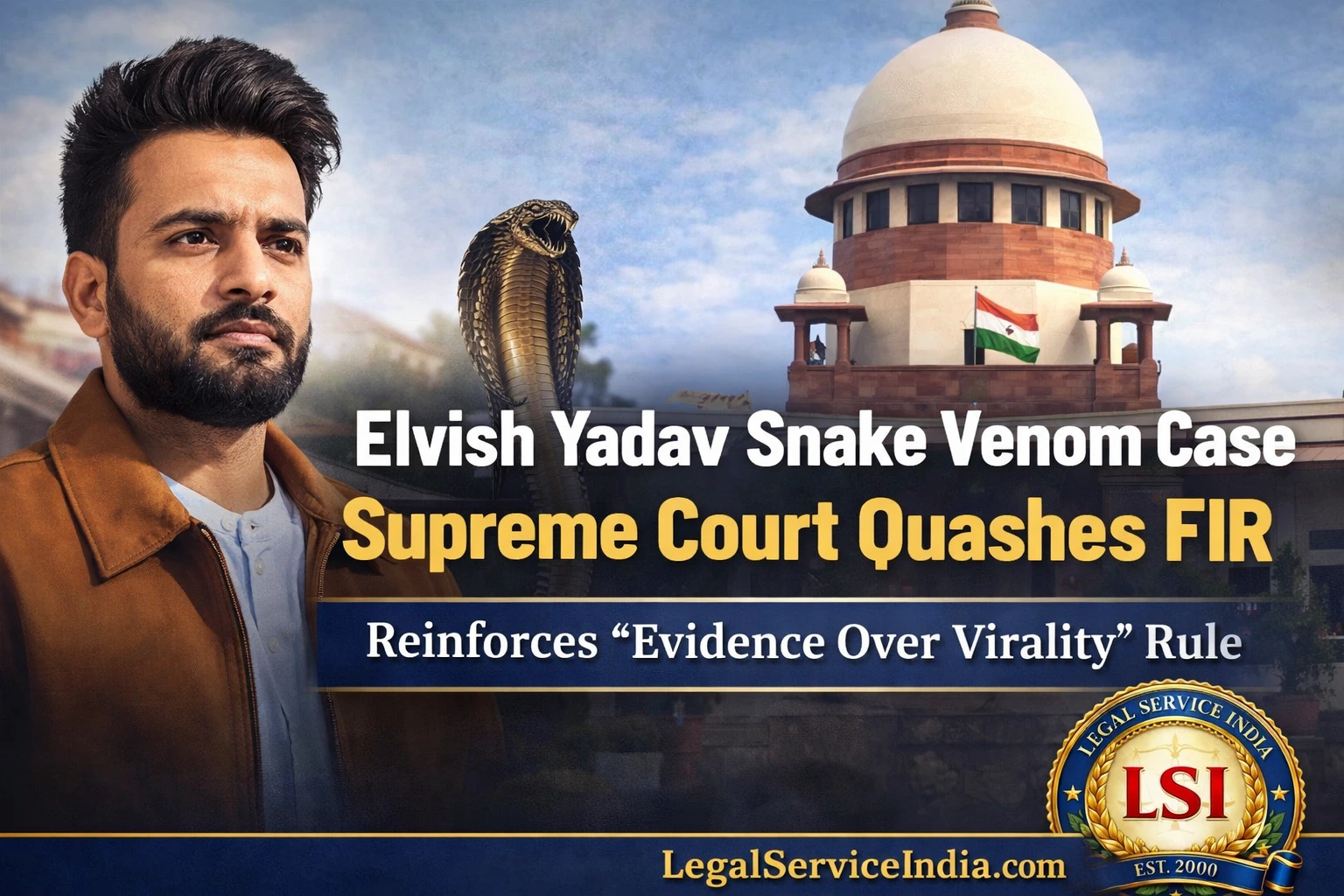
When Virality Meets The Rule Of Law
In a significant ruling that sits at the intersection of celebrity culture and criminal jurisprudence, the Supreme Court’s decision to quash the FIR against Elvish Yadav in the so-called snake venom case has drawn widespread attention.
The case, which gained rapid traction across social media platforms, alleged the use of snake venom in recreational events — a claim that triggered outrage and swift police action. However, as the Court emphasized, public sentiment cannot replace proof.
Statutory Provisions Involved
| Statute | Sections |
|---|---|
| Penal Code, 1860 | Ss. 284, 289, 120-B |
| Wildlife (Protection) Act, 1972 | Ss. 9, 39, 49, 51 |
| Criminal Procedure Code, 1973 | S. 482 |
Case Summary And Holding
Quashing of FIR — Celebrity accused — Allegations relating to use of snake venom in social media event — No direct recovery or scientific evidence linking accused — FIR based primarily on statements and media reports — Maintainability — Held, criminal law cannot be set in motion on speculative or sensational allegations without foundational evidence — Continuation of proceedings would amount to abuse of process — FIR quashed — However, liberty granted to authorities to initiate fresh proceedings in accordance with law upon availability of cogent material.
Principles Reiterated
- Courts must guard against misuse of criminal law in high-profile cases driven by public sentiment
- Evidentiary threshold cannot be diluted merely due to social media outrage
- Quashing justified where allegations fail to disclose prima facie offence
Legal Classification
Criminal Law — Quashing of FIR — Sensational Allegations — Absence of Evidence — Scope of Judicial Intervention
Court Observations
The Supreme Court quashed an FIR registered against social media personality Elvish Yadav in connection with alleged use and procurement of snake venom for recreational purposes.
It was observed that:
- The FIR lacked direct recovery, forensic confirmation, or credible linkage between the accused and alleged contraband.
- The prosecution case was largely built on secondary statements, viral content, and public perception.
- Essential ingredients under the Wildlife (Protection) Act, 1972 were not prima facie satisfied.
The Court held that continuation of such proceedings would amount to an abuse of process of law, especially in cases where:
- Allegations are amplified by media without evidentiary backing
- Investigative agencies act prematurely under public pressure
However, the Court clarified that:
- Authorities are not precluded from initiating fresh proceedings if supported by legally admissible evidence.
Ratio Decidendi
Criminal proceedings cannot be sustained on speculative allegations lacking foundational evidence, even in cases attracting intense public attention.
The Core Legal Question
At the heart of the matter was a familiar but crucial question:
Can Criminal Proceedings Continue Solely on the Basis of Suspicion, Viral Narratives, or Unverified Allegations?
The Court answered in the negative.
Despite the seriousness of allegations under the Wildlife (Protection) Act, 1972, the prosecution failed to establish:
- Any direct possession or recovery of prohibited substances
- Forensic confirmation of snake venom
- A clear nexus between the accused and alleged offences
Reaffirming the Power of Section 482 CrPC
Invoking its inherent powers under Section 482 of the CrPC, the Court stepped in to prevent what it termed a misuse of criminal process.
This judgment reinforces a consistent judicial stance:
Criminal law is not a tool for spectacle — it is a system grounded in evidence, fairness, and restraint.
The Court cautioned against:
- Investigations driven by media trials
- Premature conclusions in high-visibility cases
- The dilution of prima facie standards
Balancing Public Outrage with Legal Discipline
One of the most striking aspects of the ruling is its subtle acknowledgment of the “outrage economy” — where allegations gain legitimacy simply by going viral.
The Court effectively drew a line:
| Public Perception | Legal Position |
|---|---|
| Public interest | Cannot override due process |
| Popularity | Cannot determine culpability |
This is particularly relevant in an era where influencers command massive audiences, and allegations can escalate within hours.
Fresh Complaint: A Strategic Legal Window
Importantly, the Court did not close the door entirely.
Instead, it allowed:
- ➡️ Filing of a fresh complaint
- ➡️ Subject to proper legal provisions and credible evidence
This ensures that:
- Genuine violations, if any, are still prosecutable
- Investigative agencies are encouraged to build legally sustainable cases
Why This Judgment Matters
| Key Point | Explanation |
|---|---|
| 🔹 1. A Warning Against “Trial by Social Media” | The ruling sends a strong message that virality is not evidence. |
| 🔹 2. Reinforces Evidentiary Discipline | Even in sensational cases, minimum legal thresholds cannot be compromised. |
| 🔹 3. Protects Integrity of Wildlife Law Enforcement | Misuse of statutes like the Wildlife Act can weaken genuine conservation efforts. |
| 🔹 4. Sets a Precedent for Celebrity Prosecutions | Courts will scrutinize whether cases are legally grounded or publicity-driven. |
Conclusion
The Supreme Court’s decision in the Elvish Yadav case is not merely about one individual — it is about the resilience of legal principles in the face of digital frenzy.
In reaffirming that evidence, not emotion, must guide criminal law, the Court has delivered a judgment that is both timely and necessary.
For legal practitioners, investigators, and the public alike, the message is clear:
In the courtroom, truth is not what trends — it is what can be proved.