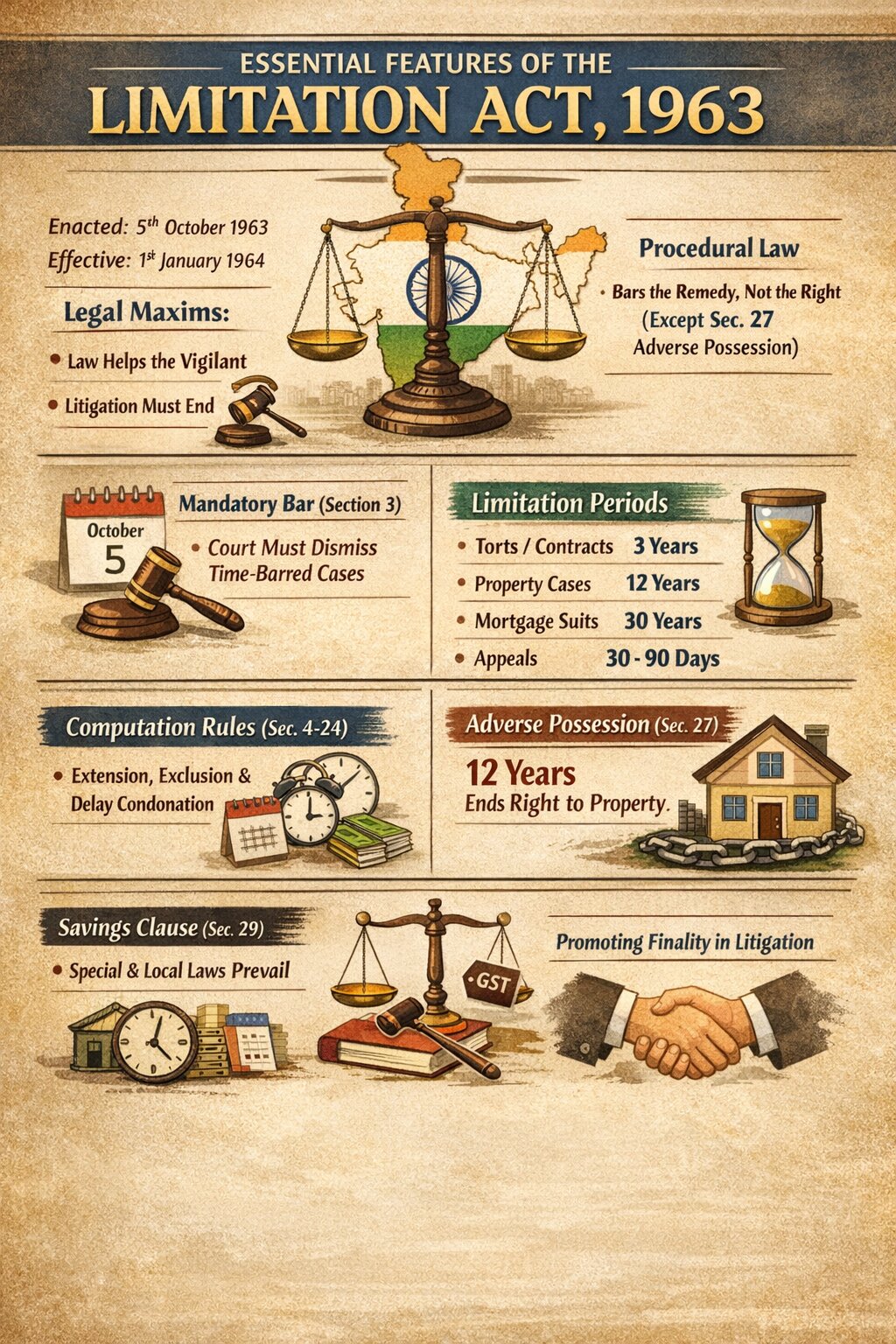
The Limitation Act, 1963 occupies a central place in Indian procedural law by prescribing the time limits within which legal proceedings must be initiated. By fixing definitive periods for suits, appeals, and applications, the Act ensures discipline in litigation, prevents the revival of stale claims, and promotes certainty and finality in legal relations. It reflects a careful balance between individual rights and the broader public interest in avoiding endless litigation.
Introduction
Enacted on 5 October 1963 and brought into force on 1 January 1964, the Limitation Act consolidates and amends the law relating to limitation for civil proceedings in India. Following the Jammu and Kashmir Reorganisation Act, 2019, the Act now extends uniformly across the entire territory of India.
The philosophy of the Act is rooted in two enduring legal maxims:
- Vigilantibus non dormientibus jura subveniunt — the law assists those who are vigilant, not those who sleep over their rights.
- Interest reipublicae ut sit finis litium — it is in the public interest that litigation must come to an end.
Structurally, the Act consists of 32 sections and a Schedule containing 137 Articles, which are broadly classified into:
- Suits (Articles 1–113)
- Appeals (Articles 114–117)
- Applications (Articles 118–137)
Nature and Scope of the Act
A defining feature of the Limitation Act, 1963 is its procedural (adjective) character. It does not create or extinguish rights in general; rather, it regulates the time within which existing rights may be enforced through legal proceedings.
Ordinarily, the expiry of the limitation period bars the remedy but not the right. However, this principle is subject to a crucial exception under Section 27, where the failure to bring a suit for possession within the prescribed period results in the extinguishment of the right itself, particularly in cases of adverse possession.
Mandatory Bar of Limitation (Section 3)
One of the most stringent provisions of the Act is Section 3, which imposes a mandatory duty on courts to dismiss any suit, appeal, or application filed beyond the prescribed limitation period.
This obligation applies:
- Even if limitation is not pleaded as a defence, and
- Irrespective of the merits of the case.
Thus, limitation operates as a threshold bar, reinforcing the principle that courts cannot entertain time-barred claims.
Schedule of Limitation Periods
The Schedule to the Act provides a comprehensive catalogue of limitation periods applicable to various legal proceedings. Some important illustrations are as follows:
|
Type of Case |
Limitation Period |
Commencement of Period (Cause of Action) |
|
Damages for tort |
3 years |
When the injury or tort occurs |
|
Breach of contract |
3 years |
When the breach occurs |
|
Money payable (on demand) |
3 years |
When the money becomes payable |
|
Possession of immovable property |
12 years |
When possession becomes adverse |
|
Redemption of mortgage |
30 years |
When the right to redeem accrues |
|
Execution of decree |
12 years |
When the decree becomes enforceable |
|
Appeal to High Court |
90 days |
From the date of decree or order |
|
Appeal to other courts |
30 days |
From the date of decree or order |
Residual provisions, such as Articles 113 and 137, generally prescribe a three-year limitation period for cases not specifically covered elsewhere.
Computation of Limitation Period (Sections 4–24)
The Act lays down detailed rules governing the computation, extension, and exclusion of limitation periods to ensure fairness in their application.
- Extension and Condonation
- Section 4 (Court Holidays): If the limitation period expires on a day when the court is closed, the proceeding may be instituted on the next working day.
- Section 5 (Condonation of Delay): Courts have discretionary power to admit appeals and applications filed after the limitation period if the applicant demonstrates “sufficient cause.” Notably, this provision does not apply to suits.
- Section 6 (Legal Disability): In cases involving minors, persons of unsound mind, or those under legal disability, the limitation period begins only after the disability ceases.
- Exclusion of Time
- Section 12: Time taken to obtain certified copies of judgments or decrees is excluded.
- Section 14: Time spent prosecuting a case in good faith before a court lacking jurisdiction is excluded.
- Section 15: Time during which proceedings are stayed by injunction or when the defendant is absent from India is excluded.
- Effect of Conduct of Parties
- Section 17 (Fraud or Mistake): The limitation period commences from the date of discovery of fraud or mistake.
- Section 18 (Acknowledgement): A written and signed acknowledgement of liability before expiry of the limitation period resets the limitation clock.
- Section 19 (Part-Payment): Part-payment of a debt or interest similarly gives rise to a fresh limitation period from the date of payment.
Acquisition of Title by Adverse Possession
Acquisition of title by adverse possession is a significant exception under the Limitation Act, 1963, where a person in continuous, open, hostile, and uninterrupted possession of immovable property for the prescribed period acquires ownership rights, while the original owner’s title stands extinguished.
Under Section 27 read with Article 65 of the Schedule, if the true owner fails to file a suit for possession within 12 years from the date the possession becomes adverse (or 30 years in the case of government property), his right to the property is extinguished, and the adverse possessor acquires a perfect title equivalent to that of the outgoing owner.
For this doctrine to apply, the possession must be nec vi, nec clam, nec precario — without force, without secrecy, and without permission of the owner — coupled with the animus possidendi (intention to hold the property as owner in exclusion of all others).
This provision underscores the Act’s emphasis on vigilance and serves as a powerful illustration of how limitation not only bars the remedy but, in cases of property possession, extinguishes the substantive right itself.
Savings Clause (Section 29)
The Limitation Act accommodates the operation of special or local laws through Section 29, which provides that:
- Where a special or local law prescribes a different limitation period, that period will prevail.
- The provisions of the Limitation Act apply only to the extent they are not expressly excluded by such laws.
This ensures harmony between general procedural law and specialised statutory frameworks such as taxation, rent control, and family law statutes.
Continuous Running of Time
Section 9 of the Limitation Act, 1963 embodies the principle of continuous running of time by providing that once the period of limitation has begun to run, no subsequent disability or inability to institute a suit or make an application shall stop or suspend it, thereby ensuring that the limitation period proceeds uninterrupted even if the plaintiff or applicant later becomes subject to any legal disability such as minority, unsoundness of mind, or other incapacity.
This rule operates as a counterbalance to the provisions relating to legal disability under Sections 6 to 8, which apply only when the disability exists at the time the cause of action arises; however, once time has started running, fresh disabilities arising afterwards do not extend or pause the period.
The section contains a limited proviso that where letters of administration to the estate of a deceased creditor have been granted to his debtor, the running of limitation for a suit to recover the debt is suspended during the continuance of such administration, as the same person cannot simultaneously be both plaintiff and defendant.
This provision reinforces the Act’s emphasis on diligence and finality by preventing litigants from seeking indefinite extensions due to supervening events after the limitation clock has commenced.
Landmark Cases on the Limitation Act, 1963
Several landmark Supreme Court judgments have significantly shaped the interpretation and application of the Limitation Act, 1963. In Balwant Singh (Dead) v. Jagdish Singh & Ors. (2010), the Court adopted a strict approach towards condonation of delay under Section 5, holding that “sufficient cause” must be adequately explained and cannot be liberally construed to condone inordinate delays arising from negligence, thereby reinforcing the mandatory nature of limitation periods in appeals.
The case of Bharat Barrel & Drum Manufacturing Company Pvt. Ltd. v. Amin Chand Pyarelal (1999) clarified principles relating to acknowledgement of liability and presumptions under negotiable instruments in the context of limitation for recovery suits, emphasizing how written acknowledgements under Section 18 can extend the period of limitation.
In various judgments involving K. Subba Rao (including related rulings on adverse possession and title), the Supreme Court has reiterated that a plea of adverse possession requires strict proof of open, continuous, hostile, and uninterrupted possession with animus possidendi for the full statutory period under Article 65 read with Section 27, and that mere long possession without hostile intent does not extinguish the true owner’s title.
These cases, along with others like State of Punjab v. Gurdev Singh (1991) and Hemaji Waghaji Jat v. Bhikhabhai Khengarbhai Harijan (2009), underscore the Act’s philosophy of balancing vigilance with equity while treating limitation as a threshold bar that promotes finality in litigation.
Conclusion
The Limitation Act, 1963 functions as a “statute of repose”, ensuring that legal claims are brought within a reasonable time and that disputes do not linger indefinitely. By mandating strict timelines, it protects defendants from perpetual uncertainty while encouraging plaintiffs to act with diligence and promptness.
At the same time, the Act incorporates equitable principles—such as condonation of delay, exclusion of time, and recognition of disabilities—to mitigate hardship in deserving cases. With its balanced approach, the Act continues to play a vital role in maintaining efficiency, certainty, and finality in the administration of justice in India.