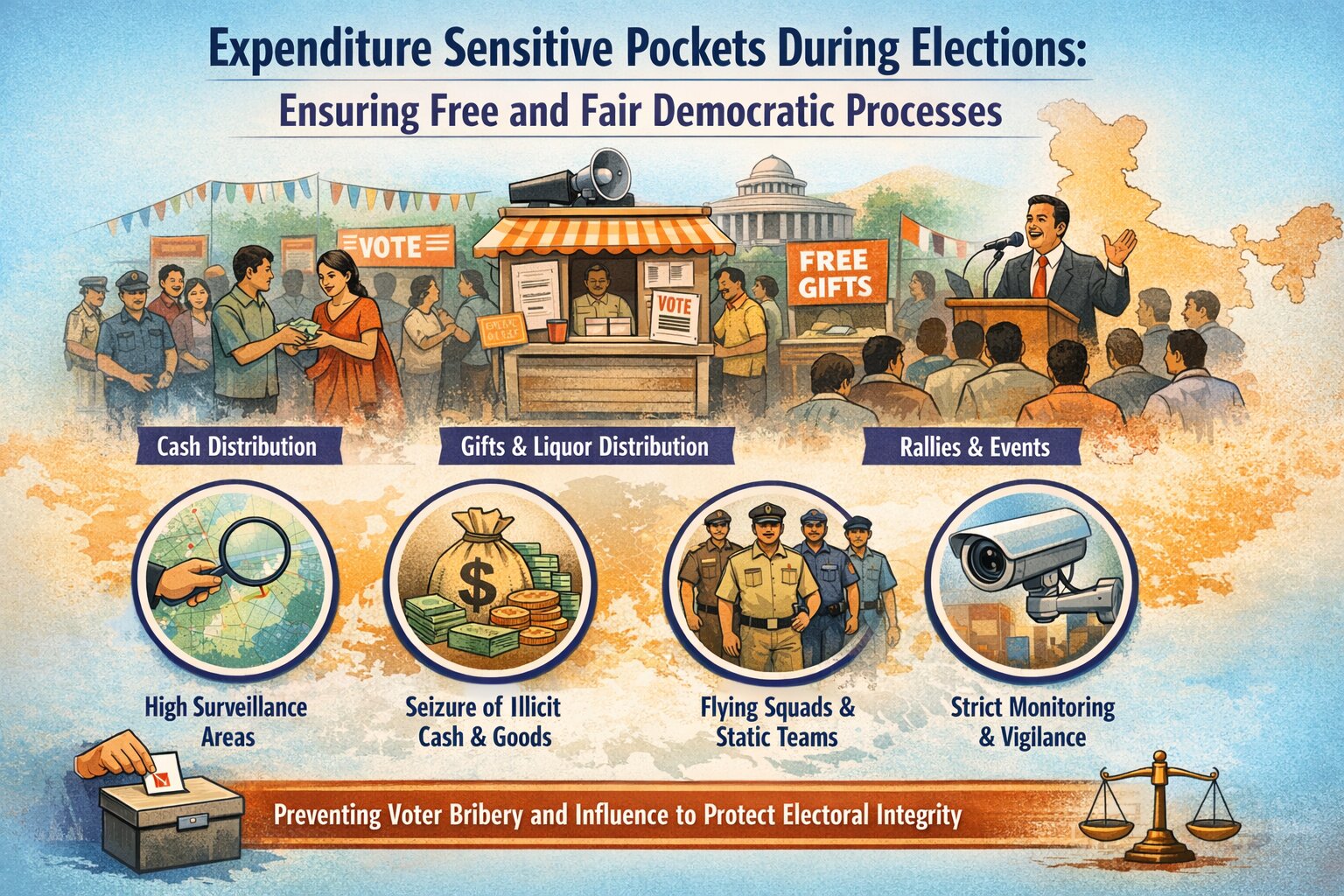
Free and fair elections form the cornerstone of any vibrant democracy. In India, the constitutional responsibility of conducting impartial elections rests with the Election Commission of India (ECI). To curb the misuse of money power and ensure a level playing field among candidates, the Commission has developed various monitoring mechanisms. One such important mechanism is the identification of Expenditure Sensitive Pockets (ESPs) during elections.
Meaning and Concept
An Expenditure Sensitive Pocket (ESP) refers to a specific locality within a constituency that is identified as vulnerable to excessive or illegal election expenditure. These pockets may include certain villages, urban wards, slum clusters, border areas, or polling booth regions where there is credible information or past history of distribution of cash, liquor, gifts, or other inducements to influence voters.
Unlike an entire Expenditure Sensitive Assembly Constituency, which covers the whole constituency, an ESP is a micro-level identification aimed at targeted surveillance and intervention.
An Expenditure Sensitive Pocket (ESP) may exist either within a constituency formally classified as expenditure-sensitive or within one that is not so classified. In practice, the number of Expenditure Sensitive Pockets is typically greater than the number of expenditure-sensitive constituencies, as vulnerability to inducement can arise in specific localized areas even where the constituency as a whole is not considered high-risk.
Basis for Identification
Expenditure Sensitive Pockets are identified based on:
- Past instances of bribery or inducement in previous elections
- Intelligence inputs from enforcement agencies
- Complaints from political parties or observers
- Seizure data of cash, liquor, drugs, or freebies
- Socio-economic vulnerabilities that may make voters susceptible to inducements
The identification process is evidence-based, intelligence-led and coordinated among district election officials, police authorities, and expenditure observers appointed by the ECI.
Monitoring and Enforcement Measures
Once a pocket is declared expenditure sensitive, intensified monitoring measures are implemented, such as:
- Deployment of Flying Squads and Static Surveillance Teams
- Installation of CCTV cameras or video surveillance
- Increased patrolling and Naka (check-post) operations and interception drives
- Monitoring of suspicious financial transactions
- Quick response mechanisms for complaints
Expenditure Observers maintain strict oversight of candidate accounts and monitor campaign activities to ensure compliance with expenditure limits prescribed by the ECI.
Importance in Strengthening Democracy
The misuse of money power can distort electoral outcomes, undermine voter autonomy, and weaken democratic values. By identifying and closely monitoring Expenditure Sensitive Pockets, the Election Commission ensures:
- Greater transparency in campaign financing
- Protection of vulnerable voters from undue influence
- Fair competition among candidates
- Deterrence against electoral malpractices
These targeted interventions help maintain public confidence in the electoral system and reinforce the credibility of the democratic process.
Who Identifies Expenditure Sensitive Pockets
Expenditure Sensitive Pockets (ESPs) are primarily identified by Sector Officers within a constituency, often in coordination with local police authorities. The identification is based on objective indicators such as literacy levels, socio-economic conditions, demographic patterns, past complaints, seizure records from earlier elections, and specific intelligence inputs suggesting vulnerability to inducements such as cash, liquor, or freebies.
The Returning Officer (RO) plays a crucial role in consolidating and reviewing these inputs prior to the announcement of elections and forwards the compiled assessment to higher authorities. The District Election Officer (DEO) supervises the overall process, ensuring coordination among enforcement agencies.
The final approval and implementation of focused monitoring measures—such as deployment of Static Surveillance Teams—are undertaken under the district election machinery in accordance with the guidelines and Standard Operating Procedures (SOPs) issued by the Election Commission of India.
Expenditure Sensitive Pockets may also be identified on the basis of inputs received from the Election Observer, whose field assessments, independent verification, and on-ground intelligence play a significant role in flagging areas vulnerable to inducement or excessive election expenditure.
This structured, micro-level, evidence-based and intelligence-led mechanism enables targeted surveillance of high-risk localities instead of indiscriminate, blanket monitoring across the constituency.
Difference between Expenditure Sensitive Constituency and Expenditure Sensitive Pocket
The terms Expenditure Sensitive Assembly Constituency (ESAC) and Expenditure Sensitive Pocket (ESP) are used by the Election Commission of India to curb the misuse of money power during elections. An ESAC refers to an entire Assembly constituency that is identified as vulnerable to excessive or illegal election expenditure based on past violations, high seizure records, or credible intelligence inputs.
In such cases, the whole constituency is subjected to intensified surveillance, including additional flying squads, expenditure observers, video monitoring, and strict scrutiny of candidates’ accounts. For example, if a particular Assembly constituency has a history of large-scale cash and liquor distribution across multiple areas in previous elections, the Commission may declare the entire constituency as expenditure sensitive.
In contrast, an Expenditure Sensitive Pocket (ESP) refers to specific localized areas within a constituency—such as certain villages, urban wards, slum clusters, or polling booth zones—where there are indications of targeted inducement practices.
Monitoring in an ESP is focused and area-specific rather than constituency-wide. For instance, if intelligence inputs suggest that cash distribution is likely to occur in two or three identified villages within an otherwise normal constituency, only those villages may be marked as expenditure sensitive pockets and placed under special watch through static surveillance teams and increased patrolling.
In simple terms, an ESAC covers the entire constituency, while an ESP targets specific high-risk pockets within a constituency, ensuring more precise and effective monitoring of election expenditure.
Conclusion
In conclusion, the identification and monitoring of Expenditure Sensitive Pockets reflect the proactive commitment of the Election Commission of India to uphold electoral integrity at the grassroots level. By moving beyond a purely constituency-wide approach and adopting a precise, intelligence-based micro-monitoring strategy, the Commission enhances its capacity to curb the misuse of money power where it is most likely to occur.
Such targeted vigilance not only deters electoral malpractices but also safeguards vulnerable voters from inducement and coercion. In a vast and diverse democracy like India, these focused, evidence-based and intelligence-led mechanisms are indispensable to ensuring transparency, fairness, and equality in the electoral process, thereby reinforcing public trust and preserving the constitutional mandate of free and fair elections.