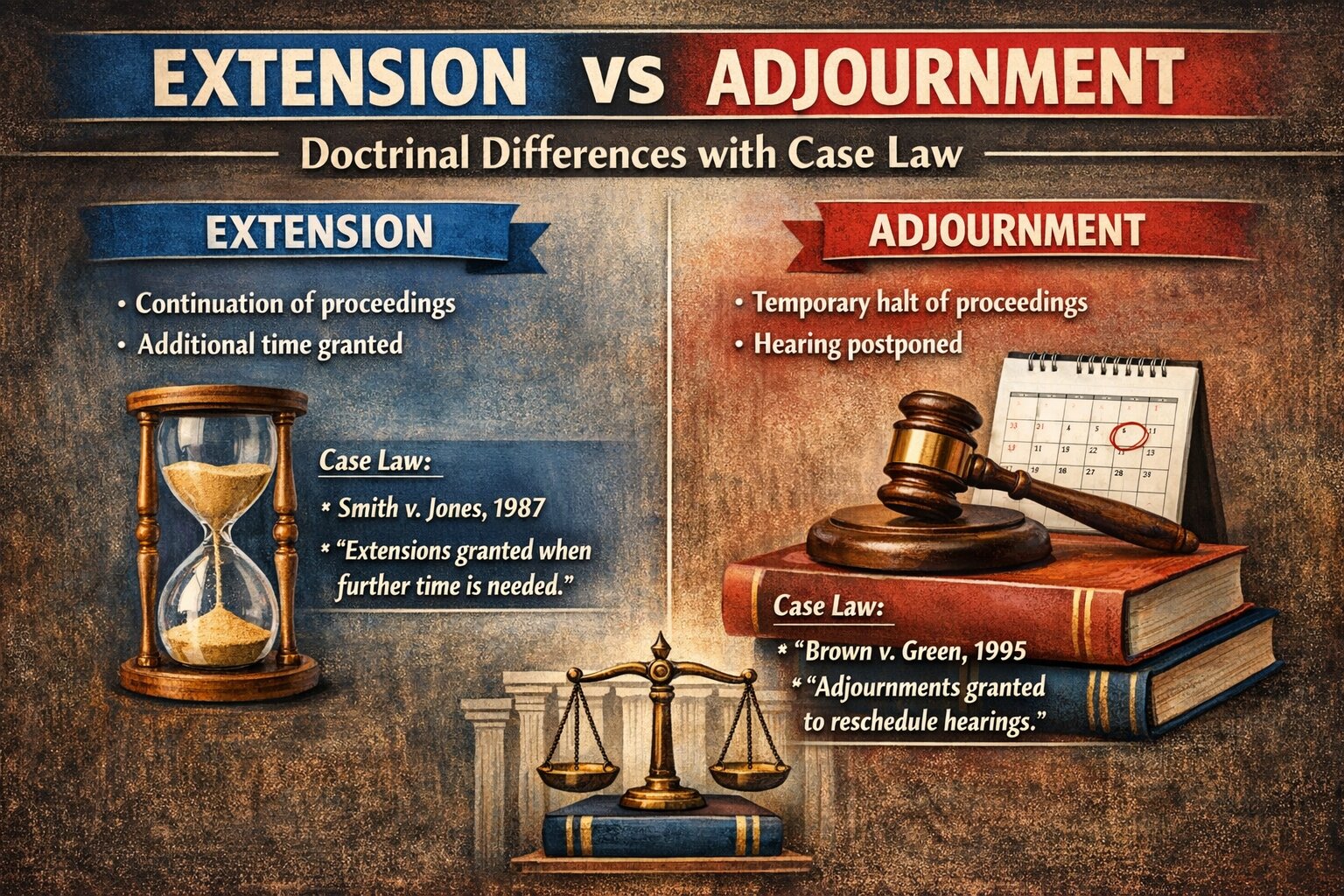
Meaning of Extension
An Extension is the legal enlargement of a mandatory deadline (statutory or court-fixed) for a specific procedural task, such as filing a defense or a charge sheet. Doctrinally, it is stricter than an adjournment because it concerns “limitation periods.” Missing these deadlines can extinguish substantive rights or lead to a default judgment; therefore, courts require “sufficient cause” and recorded reasons to grant one.
Doctrinal Focus
The primary focus is the “Interests of Justice.” Courts generally prefer cases to be decided on their merits rather than technical defaults.
Key Case Law (Global & UK Context)
- Woodhouse v Consignia [2002]: Emphasized that while rules are strict, the court must look at the “overriding objective” to deal with cases justly.
- Denton v TH White Ltd [2014]: Established a three-stage test for relief from sanctions, focusing on the seriousness of the delay and the reason it occurred.
Criminal Law Context
Under Section 167 CrPC (now Section 187 BNSS), extensions for investigation or remand are strictly limited to 60 or 90 days. Failure to file a charge sheet within this window entitles the accused to “Default Bail.”
- Ritu Chhabaria v. Union of India (2023): The Supreme Court held that filing an incomplete charge sheet just to block default bail is invalid. This right is a fundamental right under Article 21, not merely a statutory one.
- Limitation: The Court clarified that general extensions of limitation (like those during COVID-19) do not apply to Section 167(2)/187 timelines, prioritizing personal liberty.
Civil Law Context
Extensions under Order VIII Rule 1 CPC (for filing written statements) are permissible if “sufficient cause” is shown.
- Salem Advocate Bar Association v. Union of India (2005): The Supreme Court ruled that the 30-day limit for written statements is directory, not mandatory. This allows judges to grant extensions for valid, recorded reasons.
Core Principle: Extensions must be justified in writing and are construed strictly to prevent procedural abuse and ensure the protection of substantive rights.
Meaning of Adjournment
An adjournment defers a hearing date under Order XVII Rule 1 CPC (civil) or Section 309 CrPC (criminal), now Section 346 BNSS. It is granted only for “sufficient cause” and sparingly to prevent delays.
Adjournment (of a Hearing)
An adjournment is the suspension or postponement of a specific proceeding or trial to a future date. The “clock” on the case stops and is moved to a different day.
- Doctrinal Focus: “Fair Trial Rights” (Article 6). Adjournments are often requested because a party cannot properly present their case due to illness, new evidence, or missing witnesses.
- Key Case Law: * Maxwell v Keun [1928]: Established that while a judge has discretion, refusing an adjournment that prevents a party from presenting their case can be a “denial of justice” and is appealable.
- Solanki v Intercity Telecom Ltd [2018]: Reaffirmed that if a party is genuinely ill and cannot attend, refusing an adjournment is usually a breach of the right to a fair trial.
Civil Context:
- Amendments to CPC (1999/2002) limit adjournments to three per party, unless exceptional, with costs often imposed.
- In Raj Deo Sharma v State of Bihar (1998) 7 SCC 507, the Supreme Court stressed that routine adjournments erode the right to a speedy trial under Article 21.
Criminal Context:
- In Akil @ Javed v State of NCT of Delhi (2013) 7 SCC 155, the Court held that when witnesses are present, adjournments should not be granted except for special reasons recorded in writing.
- Section 309 CrPC/ Section 346 BNSS mandates daily proceedings unless adjourned for reasonable cause; frequent adjournments undermine justice.
Principle: Adjournments are discretionary but must be sparingly granted, with reasons recorded, to protect the right to speedy justice.
Key Differences Between Extension and Adjournment
|
Aspect |
Extension |
Adjournment |
|
Nature |
Increase of a statutory or procedural time limit |
Postponement of a scheduled hearing or proceeding |
|
Primary Target |
Statutory/Procedural Deadlines |
Scheduled Court Dates |
|
Strictness |
High (often affects substantive rights) |
Moderate (discretionary but regulated) |
|
Subject Matter |
Time-bound acts (e.g., investigation, filing of charge sheet, appeal) |
Court hearings and trial dates |
|
Purpose |
To allow completion of a required legal act |
To defer court proceedings to a later date |
|
Impact on Proceedings |
Does not stop court hearings; extends compliance deadline |
Temporarily pauses court proceedings |
|
Legal Consequences |
May affect substantive rights (e.g., default bail) |
Mainly procedural; excessive use may violate the right to speedy trial |
|
Requirement of Reasons |
Mandatory and strictly interpreted |
Required; granted on “sufficient cause” at court’s discretion |
|
Frequency |
Strictly limited by statute (e.g., 90 days under BNSS) |
Regulated (e.g., maximum 3 adjournments under CPC; limited under BNSS) |
|
Judicial Scrutiny |
Narrow and strict, especially where personal liberty is involved |
Broader discretion, but discouraged to curb delays |
|
Key Philosophy |
Interests of Justice (Merits) |
Fair Trial Rights (Opportunity) |
|
Failure Result |
Default Bail/Relief from Sanctions |
Ex-parte proceedings / Costs |
Judicial Approach
Indian courts balance efficiency and fairness:
- Extensions affecting liberty are strictly construed; default bail is indefeasible if timelines lapse without valid extension.
- Adjournments are sparingly granted for sufficient cause only, with recorded reasons. Excessive adjournments erode public confidence and deny speedy justice under Article 21.
The Supreme Court repeatedly directs courts to avoid dilatory tactics, impose costs for unjustified requests, and prioritize timely disposal.
Why this matters under the BNSS
Under newer legal frameworks like the Bharatiya Nagarik Suraksha Sanhita (BNSS), the leash has been tightened on both. For example:
- Extensions for police investigations are monitored heavily to prevent indefinite detention.
- Adjournments are discouraged to prevent the “date-after-date” culture that bogs down the judiciary.
The “Golden Rule”: If you need more time to work, you ask for an extension. If you need more time to show up, you ask for an adjournment.
Conclusion
An extension enlarges a statutory or court‑fixed deadline, usually requiring sufficient cause and recorded reasons. It applies to time‑bound acts like filing charge sheets or written statements, and improper extension can trigger substantive rights such as default bail. By contrast, an adjournment postpones a scheduled hearing or trial date, granted sparingly for sufficient cause to prevent delays. Extensions are strictly limited by statute and protect liberty, while adjournments are discretionary but regulated to safeguard speedy justice. Misuse of either—routine extensions defeating bail or endless adjournments—undermines constitutional safeguards. Proper use ensures fairness, procedural integrity, and timely justice.
SCOLA Footnotes
- Code of Criminal Procedure 1973, s 167.
- Ritu Chhabaria v Union of India (2023) SCC OnLine SC 310.
- Salem Advocate Bar Association v Union of India (2005) 6 SCC 344.
- Code of Civil Procedure 1908, Or VIII r 1.
- Code of Civil Procedure 1908, Or XVII r 1.
- Akil @ Javed v State of NCT of Delhi (2013) 7 SCC 155.
- Raj Deo Sharma v State of Bihar (1998) 7 SCC 507.
- Code of Criminal Procedure 1973, s 309.