Introduction
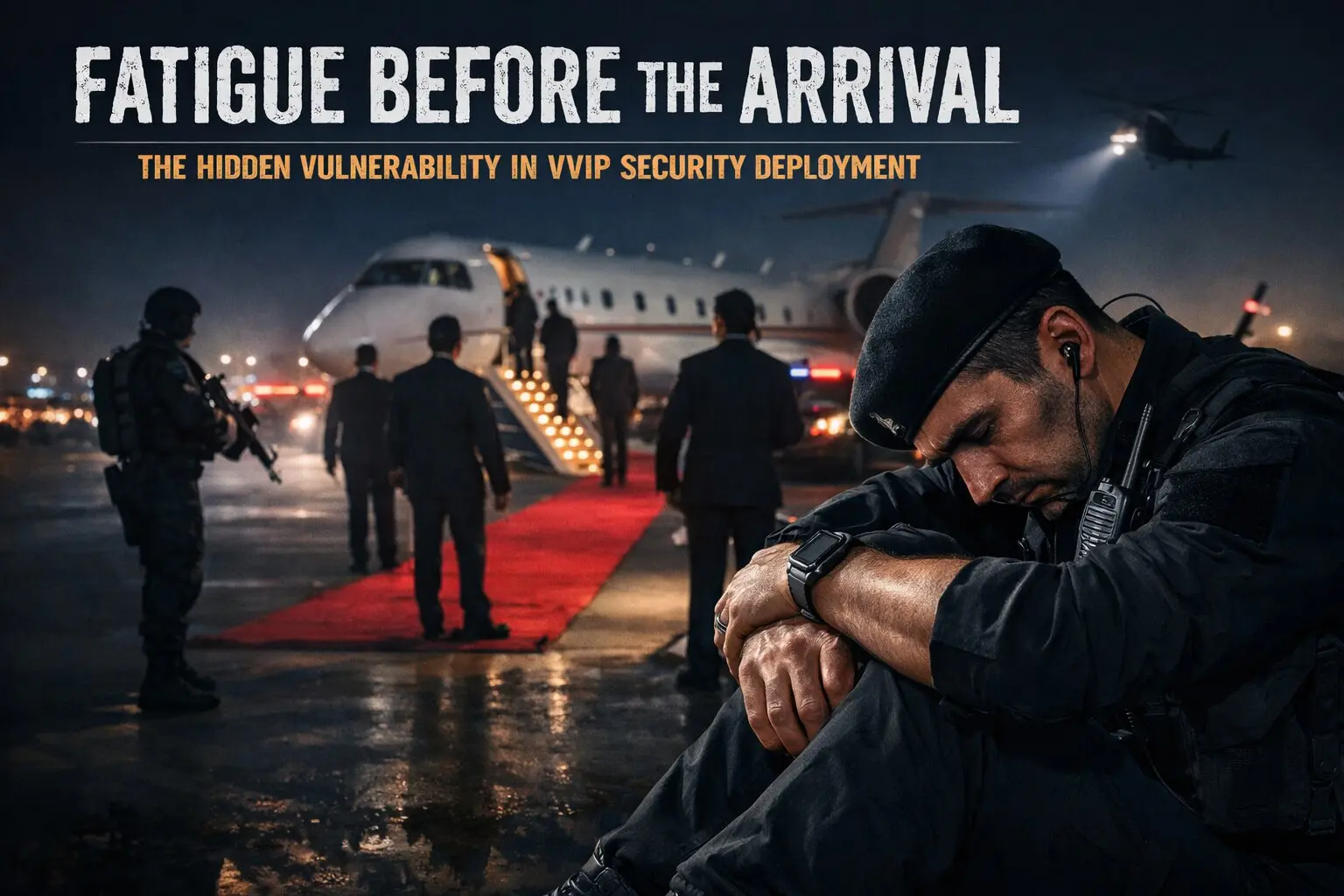
In VVIP security operations, discipline, preparedness, and precision are treated as non-negotiable imperatives. Yet, embedded within standard operating procedures lies a paradox that quietly undermines the very objective of security: the systematic fatigue of police personnel before the VVIP even arrives. Across India, it is common practice for police personnel assigned to VVIP duty to be directed to report at their duty location four hours—or often more—before the arrival of the protectee. At helipads, road corridors, and static venues, personnel frequently remain standing in direct sunlight, without shade, hydration breaks, or rotation, for prolonged periods.
By the time the VVIP arrives, the security apparatus may look visually immaculate—uniforms pressed, formations intact—but physically and cognitively, the system is already degraded. Fatigue, dehydration, heat stress, attentional lapses, and irritability replace alertness and responsiveness.
The Rationale Behind Early Reporting: A Well-Intentioned Legacy
The directive for early reporting is rooted in legitimate operational logic:
- Area domination and sanitization
- Anti-sabotage checks
- Access control establishment
- Dry runs and rehearsals
- Buffer for intelligence updates or last-minute changes
Historically, early reporting evolved in response to real threats—IEDs, insider attacks, last-minute route changes, and crowd volatility. However, what began as a margin of safety has, over time, hardened into a ritualistic overkill, often disconnected from ground realities and human endurance.
The failure lies not in the intent but in the absence of fatigue management as an operational variable.
The Helipad Problem: A Microcosm of Systemic Neglect
The helipad represents the most acute manifestation of this issue. Personnel posted at helipads often face:
- Open, treeless terrain
- Concrete or blacktop surfaces amplifying heat
- No seating (due to alert posture requirements)
- No shade structures (for aesthetic or protocol reasons)
- Limited access to drinking water
- Strict instructions against movement
Standing motionless for four to six hours in peak summer temperatures is physiologically punishing. Studies in occupational health establish that prolonged static standing leads to:
- Reduced venous return and pooling of blood in the legs
- Dizziness and fainting
- Muscular fatigue
- Reduced reaction time
- Cognitive slowing
In a security context, this translates to delayed threat recognition, slower weapon handling, and impaired judgment—exactly when peak vigilance is required.
Heat Stress and Dehydration: The Silent Threat Multipliers
India’s climatic conditions exacerbate the problem. During summer months, ground temperatures at helipads can exceed 50°C, even when ambient temperatures are lower. Personnel in dark uniforms, wearing protective gear, belts, and boots, face a compounded thermal load.
Heat stress leads to:
- Reduced concentration
- Tunnel vision
- Short temper and irritability
- Poor communication
- Increased error rates
Dehydration of even 2% of body weight has been shown to impair cognitive performance. Yet, many personnel deliberately avoid drinking water due to fear of breaking formation or lack of toilet access.
The irony is stark: a security system designed to eliminate unpredictability creates predictable physiological failure.
Psychological Fatigue and the Illusion of Readiness
Fatigue is not merely physical. Long hours of inactivity under stress induce psychological disengagement. Personnel may appear alert but are mentally “switched off,” conserving energy subconsciously.
This results in:
- Reduced scanning behavior
- Fixation on limited visual fields
- Over-reliance on routine
- Failure to question anomalies
Security history repeatedly demonstrates that attacks succeed not because of absence of forces, but because of momentary lapses. Fatigue is a known precursor to such lapses.
Command Culture and the Fear of Deviation
A critical factor sustaining this practice is command rigidity. Supervisors often prefer early deployment because:
- It minimizes personal accountability
- It aligns with “safe” bureaucratic practice
- Any deviation risks post-incident scrutiny
Field commanders rarely factor fatigue into deployment decisions because fatigue has no formal reporting metric, whereas late reporting or relaxed posture does.
Thus, officers choose procedural safety over operational effectiveness.
The Myth of “Visibility Equals Security”
There is a deeply entrenched belief that continuous visible presence equals robust security. This leads to:
- Static posturing over dynamic readiness
- Aesthetic discipline over functional alertness
- Reluctance to provide shade, seating, or rotation
However, modern security doctrine emphasizes layered, intelligence-led, and dynamically responsive protection, not endurance displays. A fatigued guard standing rigidly in the sun may look impressive—but is operationally inferior to a rotated, hydrated, alert counterpart.
Legal, Ethical, and Human Resource Implications
From a governance perspective, prolonged exposure without safeguards raises concerns under:
- Occupational safety norms
- Human rights principles
- Police welfare policies
While police duty inherently involves hardship, avoidable hardship that degrades performance is indefensible. Moreover, repeated exposure leads to long-term consequences such as:
- Heat-related illnesses
- Varicose veins and musculoskeletal disorders
- Burnout and morale erosion
An exhausted force is not only less effective—it is less loyal, less motivated, and more error-prone.
Operational Consequences: When Fatigue Becomes a Threat Vector
Fatigue before arrival can result in:
- Missed suspicious behavior during final approach
- Delayed response to drone incursions
- Poor crowd control during sudden movement
- Slower evacuation in case of emergency
Ironically, the most critical phase—the arrival and departure window—coincides with the lowest alertness levels.
This creates a temporal vulnerability that adversaries could exploit.
International Best Practices: Fatigue as a Security Variable
Advanced protection agencies globally treat fatigue as a managed risk, not an inconvenience.
Key practices include:
- Staggered reporting times
- Rotational static duties
- Climate-adaptive uniforms
- Shade and hydration protocols
- Mandatory rest cycles before “H-Hour”
Security effectiveness is measured not by how early personnel arrive, but by how alert they are at the moment of exposure.
The Way Forward: Reform Without Compromising Security
- Phased Deployment
Not all personnel need to report simultaneously. Anti-sabotage teams, access control, and inner cordon can be deployed in phases aligned with task relevance.
- Pre-Arrival Rest Windows
Personnel assigned to critical posts during arrival should be rested 60–90 minutes prior, even if present on-site.
- Rotational Standing
At helipads, two-tier teams should rotate between active posture and shaded standby.
- Environmental Adaptation
Temporary shade structures, cooling mats, and hydration points must be normalized—not seen as laxity.
- Command Sensitization
Senior officers must internalize that fatigue is a security threat, not a personnel weakness.
- SOP Revisions
Fatigue management must be explicitly included in VVIP security SOPs, with accountability mechanisms.
Conclusion
VVIP security is not a test of endurance; it is a test of alertness at the decisive moment. Forcing police personnel to remain standing in extreme conditions for hours before the VVIP arrives undermines the very purpose of protection. It converts discipline into dogma and preparedness into pre-emptive exhaustion.
A fatigued guard is not a badge of commitment—it is a liability.
True professionalism lies in designing systems that respect human limits while maximizing operational readiness. Until fatigue is recognized as a frontline security risk, VVIP protection will continue to suffer from a paradox where the protectors are spent before protection truly begins.