





Introduction
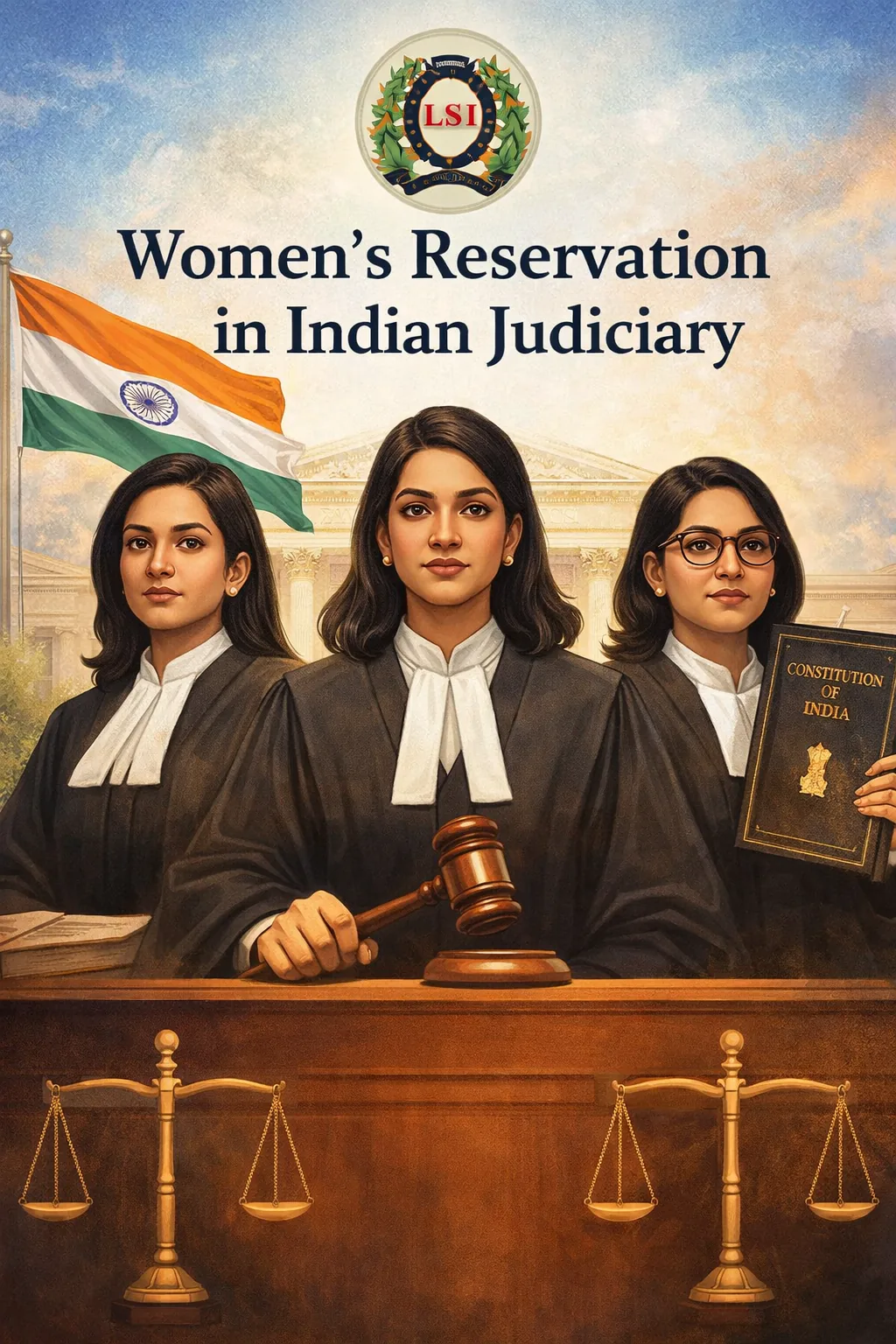
The judiciary is the most important and prominent branch of democracy, assigned with the duty of safeguarding the principles of the constitution, the basic liberties, and the rule of law. The judiciary is required to be independent and representative in order to build public trust in the judicial delivery system. But the sad fact is that despite the availability of the provision of equality in the constitution of India, the representation of gender in the judiciary is very low. Nearly half of the population of India is composed of women.
Although India has had women holding superior constitutional positions, such as that of Chief Justice of High Courts and judges within the Supreme Courts, their presence as a whole within the judicial system is marginal. This has significant implications concerning inclusivity and substantive equality, and even access to justice. It is within this backdrop that the call for women’s reservations within the judicial system has acquired increased attention.
This paper seeks to discuss and explore women’s reservations within the judicial system of India, its justification within the Indian Constitution, and considerations and means to achieve this end.
Present Status of Women in Indian Judiciary
The position of women judges has always been very low in the Indian judiciary, especially when it comes to the upper echelons of the judicial system. Even as the number of women judges has been mounting over the years, the figure still remains lower when compared to the number of male judges.
Women judges are more visible at the level of the lower judiciary, especially at the entry point, but once it comes to the level of High Courts or the Supreme Court, the position changes significantly.
Glass Ceiling in Judicial Appointments
This discrepancy symbolizes the existence of the “glass ceiling” in the appointments in the judiciary. This could be attributed to the lack of transparency in the appointment process, professional networks, and societal pressures that impede the representation of women in the said issue.
This problem proves the need for structural change in order to properly incorporate women in the decision-making roles in the judiciary.
Constitutional And Legal Framework
The Indian Constitution offers a solid basis in the concepts of equality and affirmative action. This is due to the law ensuring “equality before the law” through Article 14 and the prohibition of “discrimination on the grounds of sex” through Article 15(1).
More specifically, the Indian Constitution equips the state with the legislative framework to implement “special provisions” in favor of women through Article 15(3). Moreover, equality in public employment in accordance with Article 16 ensures equality in opportunities in employment.
Additionally, the Indian Constitution enables the state to implement affirmative action “for the purpose of giving Special Facilities.
Moreover, Article 39A of the “Directive Principles of State Policy” promotes equal justice and free legal aid, thereby underlining that “justice shall not be denied to anyone by reason of economic or other disabilities.”
Taking everything into account, one could say that women reservation in the judiciary would in no way be contrary to the constitutional provisions but would in fact be in line with making everyone equality in every aspect. “Reservation, in this case, is not an exception to “merit” but is in fact meant to make up for imbalances in the system.”
Key Constitutional Provisions
| Article | Provision |
|---|---|
| Article 14 | Equality before the law |
| Article 15(1) | Prohibition of discrimination on grounds of sex |
| Article 15(3) | Special provisions in favor of women |
| Article 16 | Equality of opportunity in public employment |
| Article 39A | Equal justice and free legal aid |
Arguments In Favour Of Women’s Reservations
- One of the most persuasive arguments in support of women’s reservation is the attainment of substantive equality. Assumed equality hypothesizes that all have equal opportunities in the competition arena, regardless of the disadvantages faced by women. Clearly, the playing field will be levelled through the reservations.
- Gender diversity improves justice delivery. Women bring a different perspective, especially when it comes to gender violence, family law, harassment, and reproduction. It also helps bring a more balanced perspective due to empathy.
- Furthermore, the impact of greater female representation in the judiciary is that it instills public confidence in the judiciary. The judiciary will be seen as more representative of society through its diverse representation. Female plaintiffs may feel more at ease seeing female judges presiding over cases in which they are involved.
- The reservation system can also prove to be an impetus for change at an institutional level. It goes against the patriarchal setting that pervades the legal system and hence can help to ensure that more women join this profession to hold leadership positions in the future.
Arguments Against Women’s Reservation
- Notwithstanding its advantages, there are objections against the proposal of reservation in the judiciary. It has been argued that reservation could potentially affect merit and excellence in the judiciary. It has been argued that appointments in the judiciary need to be purely based on merit and experience without any quota system.
- Judicial autonomy is another issue. The judiciary must maintain a certain autonomy from political interference. Reservation, which may be linked to legislative and executive decisions, appears as a challenge that may undermine autonomy.
- Another problem is that reservations may merely be symbolic forms rather than tools for empowerment.
- There are also people who believe the issue is not the lack of representation in reservation but in other structural and cultural issues such as a lack of mentoring, imbalance in work, or opaque selection processes. These individuals believe changes should allow for better working conditions.
Comparative Perspective
A comparative analysis shows that a number of countries have done better in gender representation in the judiciary. Countries such as Canada, the UK, and a few European countries have been very transparent in the appointments of judges, and as such, women judges form a higher percentage.
Though not all countries practice reservation on a formal basis, they encourage gender diversity in their institutions through reforms. India can learn lessons from these countries to suit its own needs based on its constitution and realities.
Illustrative International Practices
| Country / Region | Key Approach | Impact on Gender Representation |
|---|---|---|
| Canada | Transparent judicial appointments and diversity considerations | Higher percentage of women judges |
| United Kingdom | Judicial appointments commission and openness in selection | Improved gender balance |
| European Countries | Institutional reforms promoting diversity | Enhanced female participation in judiciary |
Challenges in Implementing Reservation
Women’s reservation in the judiciary faces many challenges. First, the Collegium System that regulates appointments in the judiciary functions in a manner that is not transparent or accountable. Moreover, opposition in the legal fraternity, societal stereotype, and concerns about the integration of professional and other responsibilities have impacted the progress of women.
Key Structural and Social Barriers
- Lack of transparency and accountability in the Collegium System
- Opposition within the legal fraternity
- Societal stereotypes affecting women professionals
- Challenges in integrating professional and other responsibilities
The other challenge would be to ensure that this reservation does not become merely symbolic. Without enabling infrastructure such as flexible working terms, mentorship initiatives, and gender-friendly policies, reservation policy, per se, may not lead to substantive representation.
Way Forward
To counter the imbalance, a balanced approach needs to be adopted. The implementation of the reservation policy may begin at the bottom level entry points in the judicial system, helping more women to enter at the grass roots level. At the same time, efforts also need to be made through reforms to make this procedure more transparent.
Supportive Institutional Measures
- Mentorship programs
- Leadership development activities
- Institutional support structures
- Sensitization exercises within the legal community
Mentorship programs, leadership development activities, and institutional support structures can aid women in realizing their potential in higher judicial positions. Sensitization exercises within the legal community can also be necessary in combating any form of gender prejudice.
After all, reservation can only be seen as an intermediate step that is required in the quest for equality. It can only work in conjunction with other measures that would increase the independence and excellence of the judiciary.
Conclusion
The matter of gender representation in the judiciary is not merely an issue of representation but rather an issue of justice, equity, and representation. The issue of women’s reservation in the Indian judiciary is a valid remedy in rectifying the imbalance in representation for women in the judiciary due to past inequalities. Although the issues of merit and independence are not negligible, they pale in comparison to the issue of equity.
It is easier for an inclusive judiciary to work towards maintaining the purity of constitutionality in the nation and for providing equal judicial delivery to everyone in society. Women’s reservation has an important role to play in establishing a more representative judicial delivery system in the Indian judiciary.

