





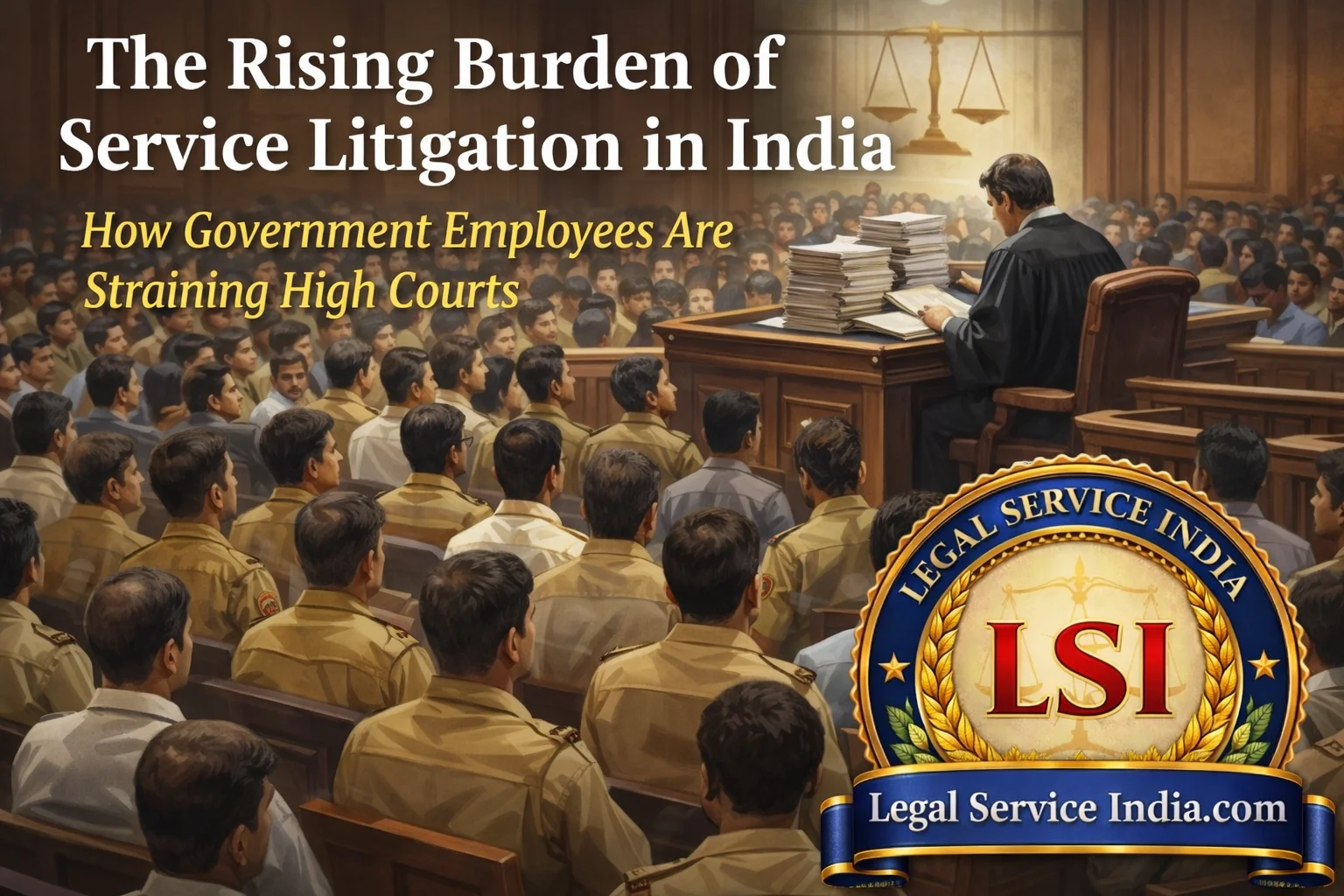
The Culture of Perpetual Litigation in Government Service Matters: A Systemic Strain on Constitutional Courts
In the contemporary functioning of constitutional courts, particularly the High Courts across India, a discernible and concerning trend has emerged—an overwhelming docket burden arising from service-related litigations instituted by government employees.
While the right to judicial review remains a sacrosanct constitutional guarantee, its indiscriminate invocation in matters of minor administrative inconvenience reflects a growing culture of litigiousness that warrants critical introspection.
Government Employment: Benefits and Expectations
Government employment in India has historically been perceived as a bastion of stability, security, and social prestige.
Employees of the State enjoy a wide array of benefits, including assured pay scales, pensionary entitlements, medical facilities, housing allowances, leave encashments, and, most importantly, a high degree of job security insulated from arbitrary termination.
These privileges, funded by public exchequer, are intended to ensure that public servants discharge their duties efficiently and without undue external pressures.
- Assured pay scales
- Pensionary entitlements
- Medical facilities
- Housing allowances
- Leave encashments
- High degree of job security
Rise of Litigation Culture Among Government Employees
However, paradoxically, it is observed that a substantial segment of government employees, notwithstanding the extensive benefits conferred upon them, frequently resort to litigation even in the face of trivial administrative grievances.
Transfer orders, minor adverse entries, delay in promotions, posting preferences, or disciplinary proceedings at nascent stages often become subject matter of writ petitions under Article 226 of the Constitution.
This phenomenon has led to an exponential increase in service jurisprudence cases, significantly encumbering the judicial system.
- Transfer orders
- Minor adverse entries
- Delay in promotions
- Posting preferences
- Early-stage disciplinary proceedings
Right to Judicial Review and Its Misuse
At the outset, it must be unequivocally acknowledged that access to justice is a fundamental right, and no individual— whether a government employee or otherwise—can be precluded from seeking redressal against arbitrary or illegal State action.
The power of judicial review serves as a vital check against executive excesses and ensures adherence to the rule of law.
Nevertheless, the misuse or overuse of this remedy for inconsequential issues dilutes its sanctity and undermines judicial efficiency.
Impact on Judicial Time and Efficiency
One of the primary concerns arising from this trend is the disproportionate consumption of judicial time.
High Courts, being constitutional courts, are entrusted with adjudicating matters of significant public importance, including protection of fundamental rights, constitutional interpretation, and resolution of complex civil and criminal disputes.
When a considerable portion of their docket is occupied by service matters—many of which pertain to routine administrative decisions—it inevitably results in delays in adjudication of more pressing and substantive issues.
| Judicial Function | Impact of Service Litigation Burden |
|---|---|
| Fundamental Rights Protection | Delayed hearings and relief |
| Constitutional Interpretation | Reduced judicial focus |
| Complex Civil & Criminal Cases | Backlog and prolonged adjudication |
Bypassing Alternative Remedies
The doctrine of alternative remedy, though well-established, is often bypassed by litigants.
Statutory forums such as service tribunals and departmental appellate authorities are specifically constituted to address grievances of government employees.
Despite the availability of these efficacious remedies, there is a growing tendency to directly invoke the writ jurisdiction of High Courts.
Impact On Judicial Discipline
This not only contravenes settled principles of judicial discipline but also burdens the courts with matters that could be effectively resolved at lower or specialized forums. :contentReference[oaicite:0]{index=0}
Transfer Orders And Litigation
Furthermore, there exists a perceptible lack of restraint in challenging transfer orders—a quintessential incidence of service. The settled legal position is that transfer is an administrative prerogative, and judicial interference is warranted only in cases of mala fides or violation of statutory provisions. Yet, High Courts are inundated with petitions seeking quashing of transfer orders on grounds that are, more often than not, personal inconveniences rather than legal infirmities. Such petitions, while individually appearing innocuous, collectively contribute to judicial backlog.
Key Issues In Transfer Litigation
- Administrative prerogative frequently challenged
- Personal inconvenience cited over legal grounds
- High volume of petitions increasing backlog
Psychological And Institutional Implications
Another dimension of this issue pertains to the psychological and institutional implications. The ease with which service matters are litigated has fostered a mindset wherein administrative decisions are routinely viewed through the prism of potential litigation. This not only erodes the authority of administrative superiors but also hampers effective governance. Decision-making becomes cautious to the point of paralysis, with officers apprehensive of legal challenges at every step.
Financial Burden On The State
From a fiscal perspective, the cost implications are equally significant. Government litigation entails expenditure on legal representation, administrative processing, and compliance with court orders. When such litigation is multiplied across thousands of cases, it results in a substantial financial burden on the State—funds that could otherwise be utilized for developmental purposes.
Cost Components
| Category | Description |
|---|---|
| Legal Representation | Fees for lawyers and legal teams |
| Administrative Processing | Internal handling of cases and documentation |
| Compliance Costs | Execution of court orders |
Ethical Dimension
It is also pertinent to consider the ethical dimension of this phenomenon. Government employees, as public servants, are expected to exhibit a higher degree of responsibility and restraint. The frequent recourse to litigation for personal service matters, particularly when internal mechanisms are available, raises questions about the commitment to institutional discipline and public duty.
Solutions And Institutional Reforms
In addressing this systemic issue, a multifaceted approach is imperative.
Strengthening Grievance Redressal Mechanisms
Firstly, there is a need to strengthen and streamline departmental grievance redressal mechanisms. If employees are assured of fair and timely resolution of their grievances at the departmental level, the inclination to approach courts may significantly diminish. Transparency in administrative processes and reasoned decision-making can further enhance trust in internal systems.
Empowering Service Tribunals
Secondly, service tribunals must be empowered and made more accessible. Ensuring their functional autonomy, adequate staffing, and expeditious disposal of cases can restore confidence in these specialized forums. High Courts, in turn, must adopt a more stringent approach in enforcing the rule of alternative remedy, entertaining writ petitions in service matters only in exceptional circumstances.
Deterrence Through Costs
Thirdly, imposition of realistic costs in frivolous or premature litigation can act as a deterrent. While courts have traditionally been cautious in imposing costs, particularly in service matters, a calibrated approach may be necessary to discourage misuse of judicial processes.
Need For Awareness And Legal Education
Judicial pronouncements have, on multiple occasions, emphasized the need for restraint in service-related litigation. However, the persistence of this trend indicates that mere reiteration of legal principles is insufficient. There must be a conscious effort—both at the institutional and individual levels—to recalibrate the approach towards litigation. Legal education and awareness also play a crucial role. Government employees must be sensitized to the legal thresholds for judicial intervention and the importance of exhausting alternative remedies. Workshops, training programs, and advisory circulars can contribute to fostering a more responsible litigation culture.
Balanced Perspective
It is equally important to acknowledge that not all service litigations are frivolous. Instances of genuine injustice, discrimination, or arbitrariness do arise and necessitate judicial intervention. The objective, therefore, is not to curtail the right to seek justice but to ensure that it is exercised judiciously and responsibly.
Role Of High Courts
The High Courts, as guardians of constitutional rights, must not be transformed into forums for routine administrative grievances. Their role in the constitutional framework is far too significant to be overshadowed by an avalanche of service-related disputes. Preserving the sanctity and efficacy of these institutions requires a collective commitment to minimizing avoidable litigation.
Conclusion
In conclusion, the burgeoning trend of government employees invoking writ jurisdiction for minor service matters represents a systemic challenge with far-reaching implications. It strains judicial resources, delays justice in critical matters, and imposes financial and administrative burdens on the State.
Addressing this issue necessitates a balanced approach that upholds the right to judicial review while discouraging its misuse. A cultural shift towards responsible litigation, reinforced by institutional reforms and judicial prudence, is essential. Only then can the High Courts effectively discharge their constitutional mandate, ensuring justice not only for government employees but for society at large.
Written By:
- Advocate Manoj Sharma
- Advocate Abhishek Sharma

